
Scottish Marine Recovery Fund: consultation analysis report
Key findings from the public consultation 2025 on the Scottish Marine Recovery Fund policy for offshore wind.
Consultation
5 Applying to the Scottish Marine Fund Consultation Analysis Results
5.1 Introduction
5.1.1 The consultation posed 4 questions on applying to the Scottish MRF which are discussed below. These questions are multiple choice with free text responses.
5.2 Question 1 - Do you agree with our proposal that developers may choose which MRF to apply to in the circumstances outlined?
5.2.1 Within the consultation document it is proposed that developers wishing to use an MRF to discharge their compensation requirements, the location of anticipated adverse effects on protected sites will determine whether an offshore wind developer would apply to use the Scottish MRF or UK Government MRF.
5.2.2 If the project is to be located in Scotland and expected to have adverse effects on protected sites within Scottish waters[12], the developer would be able to apply to the Scottish MRF for the required environmental compensation. If the project is to be located in Scotland but is likely to have adverse effects on protected sites beyond Scottish waters (i.e., in English, Welsh or Northern Irish waters), Scottish Government propose that the offshore wind developer would be able to choose whether their application to the Scottish MRF also addresses the adverse effects on these sites.
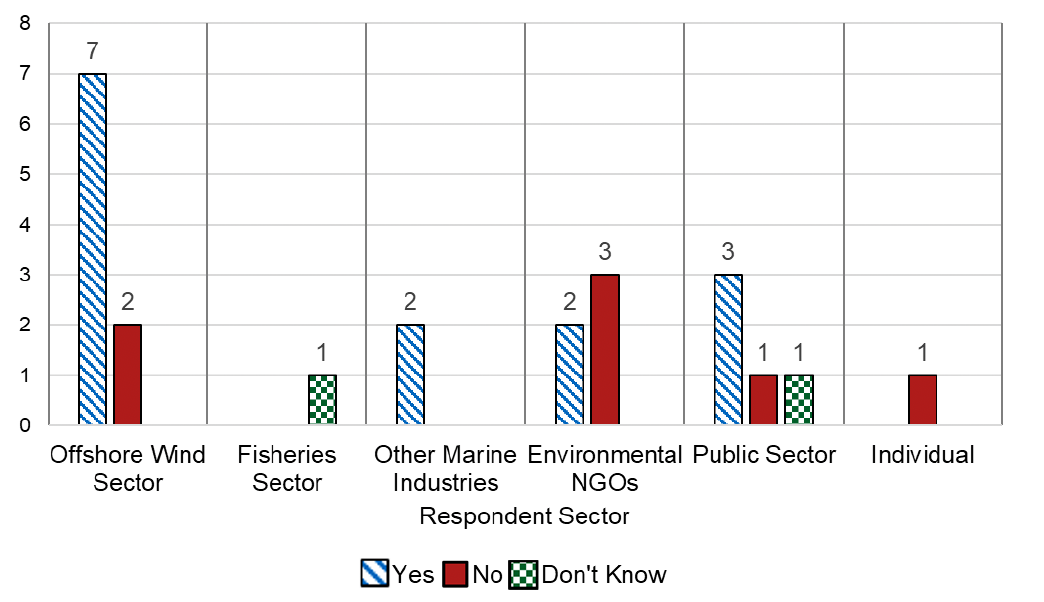
5.2.3 The total number of responses in relation to the multiple choice component of question 1 was 23. 3 respondents did not answer this question. The breakdown by respondent type was 1 individual and 23 organisations. The breakdown of responses by respondent sector is provided in Figure 1.
5.2.4 14 organisational respondents answered ‘Yes’, 7 organisational respondents and 1 individual answered ‘No’, and 2 organisational respondents answered ‘Don’t Know’.
5.2.5 A breakdown by sector shows that the Offshore Wind Sector and Other Marine Industries generally supported the proposals for a choice of MRF. 3 Environmental NGOs disagreed, and the Fisheries Sector respondent answered ‘Don’t Know’.
5.2.6 For the free text component of question 1, there were 23 responses, all of which were considered substantive responses. 3 respondents did not answer this question. The breakdown by respondent type was 1 individual and 22 organisations.
5.2.7 Reasons for agreement included the need for flexibility to appropriately mitigate any cross-border adverse effects beyond the jurisdiction of the wind farm itself. One Environmental NGO agreed with the proposal but with a qualification that whatever fund is chosen, compensation provides ecological benefits for Scotland and upholds the ‘Island-Proofed’ requirement under the Islands (Scotland) Act 2018[13].
5.2.8 Affirmative responses from the Offshore Wind Sector indicated that criteria for cross-border impacts should be clear, transparent and consistently applied and support flexibility to align compensation delivery with project timelines. They also noted that ecological impacts flow across jurisdictional boundaries and that managing this across boundaries will be difficult. It was also noted that administrative friction would be present and requested clarity on binding protocols on apportionment of liability, monitoring delivery of compensation and dispute resolution. Respondents also requested further clarity on a range of issues including how projects which have already submitted a compensation plan can access the MRF and what the timelines and integration procedures will be for those projects.
5.2.9 Suggestions were also provided calling for the establishment of a centralised mechanism to track and quantify project impacts and compensation across jurisdictions. Potential risks raised included oversubscription of the Scottish MRF, difficulty of assessing combined ecological benefit if subscription to both Scottish and UK MRFs is required, increased burden on consenting authorities such as Scottish Ministers if other jurisdictions are allowed to apply to the Scottish MRF, and uncertainty around whether responsibility for discharge of consent conditions lies with Scottish Ministers or the local consenting authority.
5.2.10 Other Marine Industries also supported the proposal but indicated that the principle should be extended to other technologies besides offshore wind, indicating that allowing other marine renewables such as tidal power to access the MRF would support net zero and energy security goals as well as Just Transition Commitments to support rural and island communities.
5.2.11 Public Sector respondents who responded affirmatively indicated that if Scottish projects could apply to the UK MRF, then the reverse should also apply. However, this was conditioned by the request for a UK-wide register of predicted impacts, delivery mechanisms and agreed compensation measures, which could avoid risks of double funding.
5.2.12 Reasons for disagreement provided by respondents that answered ‘No’ to question 1 included 3 responses from Environmental NGOs that indicated that there is a risk to the ecological coherence of Scottish species and habitats if developers opt in to the UK MRF. They indicated that this could result in developers opting for the less stringent MRF and a missed policy goal of the principle of no net loss to deliver compensation at the source of impacts, which could undermine the Good Environmental Status conservation objectives of the UK Marine Strategy[14]. A range of opinions were presented on what developers should be required to do, including a requirement to apply to the Scottish MRF, that statutory authorities should decide which MRF developers apply to, or the creation of a unified UK-wide MRF to avoid complications.
5.2.13 Offshore Wind Sector respondents who answered ‘No’ commented that it may be more appropriate to apply to the UK MRF before the Scottish MRF if it is providing mitigation for a specific impact. The ‘No’ responses further noted the need to ensure the integrity of the network of sites and maximise biodiversity across the UK, pointing to recent examples of English offshore wind projects which secured compensation measures for impacts in Scotland. Respondents also noted that there could be significant inefficiencies in the delivery of compensation across different jurisdictions, indicating that if the proposed approach is taken forward, then it should be consistent across all jurisdictions.
5.2.14 A ‘Don’t Know’ response from the Fisheries Sector indicated that if the proposed approach is taken forward, that the MRF only be used for projects in Scottish waters. They also indicated that the current consultation lacked appropriate detail and engagement while negotiations between the four UK administrations on MRFs are still ongoing. A response from the Public Sector also indicated that if impacts are identified outside of Scottish waters but the project is located in Scottish waters, compensation measures should still be delivered locally. The response also indicated that clear definitions of compensation types and cross-jurisdictional coordination is necessary to support genuine biodiversity gain. The response also asked for further details on how the MRF could support coexistence options with other marine users including aquaculture, recreation, fishing, shipping and other renewables.
5.2.15 One response from the Public Sector specifically called for a UK-wide approach to compensation delivery in order to maintain the full network of MPAs and to meet UK Government commitments on biodiversity, indicating that developers should apply to the fund which delivers the most ecologically meaningful compensation.
5.3 Question 2 - Do you agree with the proposal for the way in which the two MRFs will interact to address cross-border impacts?
5.3.1 As set out in the consultation document, the Scottish Government is in dialogue with the UK Government and other devolved governments to agree suitable intergovernmental working arrangements for the two MRFs. This will allow ongoing engagement on shared interests and operational considerations which arise across the two funds, to support broad, general alignment, and to aid collaboration on future policy development.
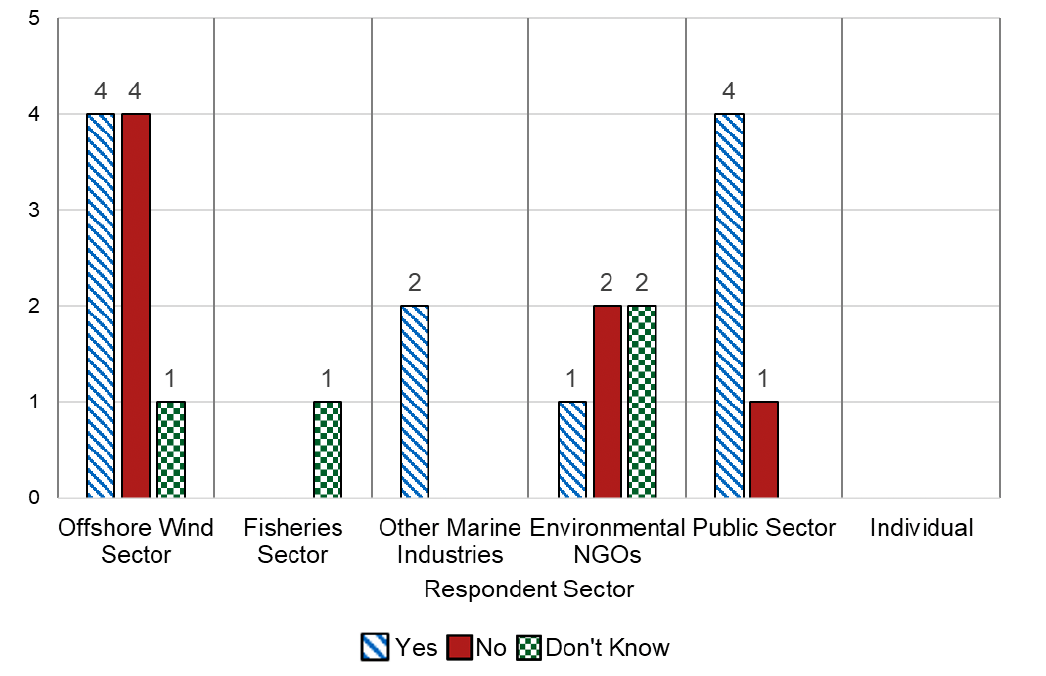
5.3.2 The total number of responses in relation to the multiple choice component of question 2 was 22. 4 respondents did not answer this question. The breakdown by respondent type was 0 individuals and 21 organisations. The breakdown of responses by respondent sector is provided in Figure 2.
5.3.3 11 organisational respondents answered ‘Yes’, 7 organisational respondents answered ‘No’, and 4 organisational respondents answered ‘Don’t Know’.
5.3.4 A breakdown by sector shows that the Public Sector generally supported the proposals for the way in which the two MRFs will interact. The Offshore Wind Sector was split between agreement and disagreement. None of the sectors generally disagreed, the Fisheries Sector answered, ‘Don’t Know’.
5.3.5 For the free text component of question 2, there were 21 responses. 5 respondents did not answer this question. The breakdown by respondent type was 0 individuals and 21 organisations.
5.3.6 3 out of 21 responses did not address the question and referred to a response for another question.
5.3.7 Some respondents from the Offshore Wind Sector broadly agreed with the approach but indicated that it would be crucial to coordinate to minimise risk double-counting or gaps in compensation and conflicting outcomes. They also requested further information on how Statutory Nature Conservation Bodies (SNCBs) would address cross-border impacts. Furthermore, they indicated that bodies like Natural England should not be a decision-maker for projects applying to the Scottish MRF (such as the ability to object or request compensation) as this could introduce further delays and complications. The Offshore Wind Sector also indicated that avoiding duplication is necessary to not undermine the consenting system as well as impact on investment opportunities in offshore wind projects.
5.3.8 Affirmative answers from the Public Sector indicated that measures identified through the Sectoral Marine Plan process should be prioritised for Scottish projects, also indicating that only requiring developers to apply to one MRF would reduce bottlenecks. The Public Sector also requested clarity on the role of SNCBs and clear cross-jurisdiction governance protocols. They also noted that Scottish interests should be safeguarded and not diluted by wider UK policies and that community interests and concerns should be taken on board.
5.3.9 Reasons for disagreement provided by respondents that answered ‘No’ to question 2 included 2 responses from Environmental NGOs that the proposal does not indicate how cross-border impacts will be addressed proportionally, recommending a proportional payment model to ensure contributions to both Scottish and UK MRFs. This sector also called for a cross-jurisdiction governance structure to ensure long-term oversight of impacts, robust monitoring and adaptive management. Some called for a single UK-wide MRF. One Environmental NGO also called for data transparency and shared monitoring between the MRFs and noted that they should integrate citizen science data.
5.3.10 A few ‘No’ responses from the Offshore Wind Sector indicated that developers should be able to choose which MRF to apply to, even if there is not a cross-border effect in a separate jurisdiction, claiming that this would support the integrity of the ecological network of sites on a UK-wide basis. They also noted that the UK Department for Environment, Food and Rural Affairs (DEFRA) would likely have similar compensation measures and that further work should be carried out on how the devolved governments would work together and share the results with the Offshore Wind Sector.
5.3.11 ‘No’ responses from the Public Sector indicated that the various devolved governments should agree to deliver ecologically meaningful compensation which maintains the UK-wide network of MPAs. They also noted inconsistencies across supporting assessments, specifically that the twin crises of climate change and biodiversity loss is mentioned in the BRIA but not in the consultation papers for the Scottish and UK MRFs. They also noted that the proposed joint Public Compensation Register[15] is the best measure to provide an overview of UK-wide compensation measures.
5.3.12 A ‘Don’t Know’ response from an Environmental NGO indicated that the vague nature of the current proposals risked establishing a two-tiered process between the Scottish and UK MRFs, particularly if one was established before the other, potentially leading to subscription to the first available MRF to speed up delivery of projects.
5.3.13 The Fisheries Sector also indicated that the consultation paper lacked clarity to properly consider cross-border impacts, providing recommendations that a rule should be implemented to direct developers to specific MRFs where most impacts occur.
5.3.14 A further ‘Don’t Know’ response from the Offshore Wind Sector requested further information on how similar compensation measures across the both the Scottish and UK MRFs would be managed.
5.4 Question 3 - Do you agree with the proposed approach for making an application to the Scottish MRF and how it will interact with existing offshore wind application and determination processes?
5.4.1 The consultation document proposes the process for offshore wind developers to apply to a Scottish MRF will be separate from, but parallel to, the existing Scottish offshore wind consenting process. Primarily, the application process to the Scottish MRF will chronologically align with the established process for applying for a consent under Section 36 of the Electricity Act 1989 [16].
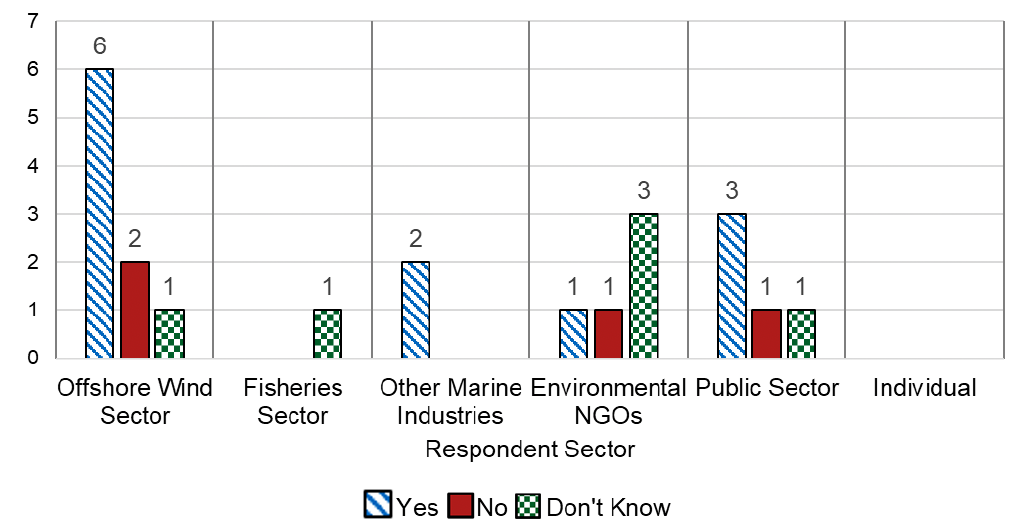
5.4.2 The total number of responses in relation to the multiple choice component of question 3 was 22. 4 respondents did not answer this question. The breakdown by respondent type was 0 individuals and 22 organisations. The breakdown of responses by sector is provided in Figure 3.
5.4.3 12 organisational respondents answered ‘Yes’, 4 organisational respondents answered ‘No’, and 6 organisational respondents answered ‘Don’t Know’.
5.4.4 A breakdown by sector shows that the Offshore Wind Sector and Public Sector generally supported the proposed approach for applying to the Scottish MRF. None of the responding sectors generally disagreed, Environmental NGOs generally answered, ‘Don’t Know’.
5.4.5 For the free text component of question 3, there were 21 responses. 5 respondents did not answer this question. The breakdown by respondent type was 0 individuals and 21 organisations.
5.4.6 Reasons for agreement provided by respondents that answered ‘Yes’ to question 3 included supportive responses from the Offshore Wind sector, but with conditions that indicated that the Scottish MRF application process should align with the Section 36, Marine Licences and HRA timelines so as not create bottlenecks in project timelines. They noted a lack of clarity around steps for projects to apply to the Scottish MRF which are near or have already achieved Section 36 consent. They also noted the importance of developers being able to apply to the Scottish MRF early on and recommended staged entry points to the Scottish MRF at scoping, post-assessment and final sign off as a condition of consent.
5.4.7 Overall while most Offshore Wind Sector respondents supported the proposals, they noted that the MRF should integrate better with project timelines and that the MRF should be clearer on how responsibilities will be allocated, how MRF decision time limits will be enforced and how developers can engage early on to support strategic environmental objectives. They also recommended that fee payment be more closely tied to the receipt of consent and that options for moderating fees based on consent decisions or the implementation of measures be considered.
5.4.8 Similar reasons as mentioned above were raised by Offshore Wind Sector respondents who answer ‘No’ to the proposal.
5.4.9 One environmental NGO supported the proposal as long as island communities were given priority. Specific mention was made of how the process could support Strategic Compensatory Measures such as marine litter removal at scale as an example of island-specific measures which would be supported by island community representatives and data.
5.4.10 There were also concerns about the availability of compensation opportunities within the MRF and the risk of developers "locking in" compensation for projects far in the future. Clear rules on fund release, project milestones, and the prevention of compensation "banking" were recommended to ensure that environmental benefits are delivered when required.
5.4.11 Environmental NGO respondents that answered ‘Don’t Know’ indicated that the MRF should embed the mitigation hierarchy and that there should be robust safeguards so as not to legitimise damage to the marine environment, including independent verification by SNCBs. They also indicated that consenting authorities including Scottish Government and Local Authorities should withhold consent until developers have applied for an appropriate compensation proposal within the Scottish MRF. They further noted that the Scottish MRF should not be used as tool to presume consent for projects with high levels of impacts on biodiversity.
5.4.12 The Fisheries Sector indicated that there was insufficient detail and that it was unclear how plan-level compensation under the updated Sectoral Marine Plan – Offshore Wind Energy (SMP-OWE)[17] would integrate with the Scottish MRF application process.
5.4.13 One ‘Don’t Know’ response from the Offshore Wind Sector indicated that there was insufficient detail regarding fee levels and alignment at different stages of the consenting process, noting that this could affect the risk of a project. They indicated that a non-refundable application to the MRF at the time of Appropriate Assessment would increase risk and that instead the fee should be tied to the development consent to more accurately reflect risk levels at early stages of project development. They further noted that derogation cases occur very late in project timelines and that fees should be collected once consent is received and that fee structure and levels be moderated based on the outcomes of consent or when compensation measures begin implementation.
5.5 Question 4 - Do you agree that the Scottish MRF should be a voluntary mechanism, including in relation to strategic compensation?
5.5.1 The consultation document set out that the use of a Scottish MRF would be voluntary and offshore wind developers would be able to pursue delivery of their own compensatory measures as they currently do.
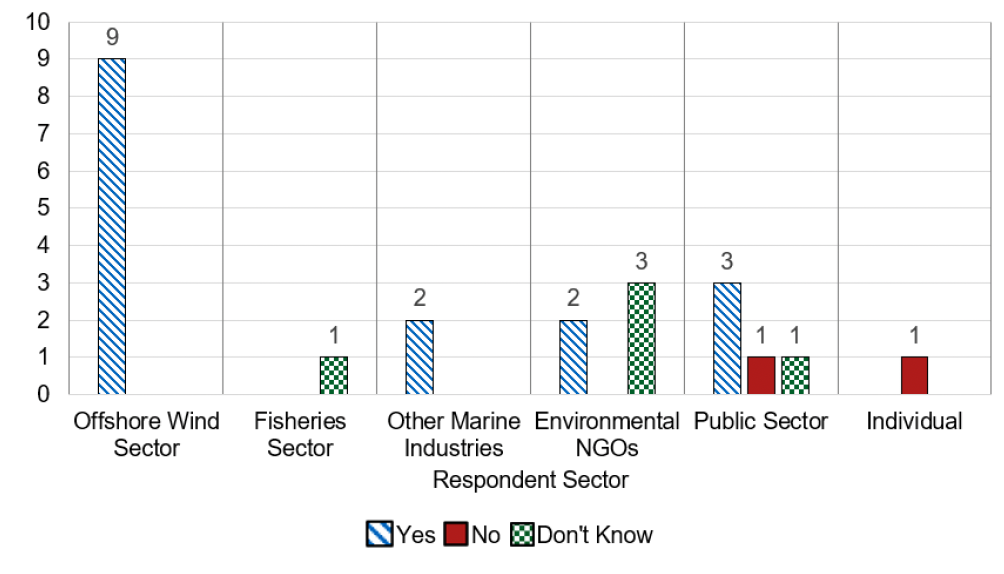
5.5.2 The total number of responses in relation to the multiple choice component of question 4 was 23. 3 respondents did not answer this question. The breakdown by respondent type was 1 individual and 23 organisations. The breakdown of responses is provided in Figure 4.
5.5.3 16 respondents answered ‘Yes’, 1 organisational respondent and 1 individual answered ‘No’, and 5 organisational respondents answered ‘Don’t Know’.
5.5.4 A breakdown by sector shows that the Offshore Wind Sector generally agreed that the Scottish MRF should be a voluntary mechanism. Including in relation to strategic compensation. None of the responding sectors generally disagreed, while Fisheries and Environmental NGOs generally answered, ‘Don’t Know’.
5.5.5 For the free text component of question 4, there were 23 responses, all of which provided substantive responses. 3 respondents did not answer this question. The breakdown by respondent type was 1 individual and 22 organisations.
5.5.6 Reasons for agreement provided by respondents that answered ‘Yes’ to question 4 included responses from the Offshore Wind Sector which emphasised the importance of allowing developers to combine fund-based and bespoke compensatory measures. This was seen as particularly relevant for projects already in advanced stages of development, where existing mitigation plans might be difficult to revise. Flexibility was also valued for enabling tailored responses to specific project contexts, avoiding duplication, and supporting innovative or locally appropriate solutions.
5.5.7 Reasons for disagreement provided by respondents that answered ‘No’ to question 3 included comments from the Environmental NGOs that further clarity is required. They further noted that compensation is the last resort in the mitigation hierarchy and that SNCBs should be able to verify applications and proposed mitigation measures before a developer submits an application to the Scottish MRF.
5.5.8 The Offshore Wind Sector also noted that the Scottish MRF must provide tangible advantages over bespoke compensation, such as time savings in the consenting process, transparent and pre-approved measures, and competitive costs. They suggested that publishing case studies demonstrating the fund’s benefits could incentivise uptake and give developers greater confidence in choosing the Scottish MRF route. At the same time, there was caution that the fund should not become a competitor to project-specific measures or introduce unnecessary legal and regulatory complexity.
5.5.9 The tension between strategic, plan-led compensation and project-specific interventions was also a recurring topic. Many respondents advocated for a coordinated, large-scale approach to compensation, especially for impacts on mobile species and broader ecological systems. However, they also acknowledged that smaller projects or unique circumstances might require bespoke measures.
5.5.10 Respondents requested more detailed guidance on application procedures, timelines, cost estimation, and accountability. Specific concerns included how Expressions of Interest (EOI) would be managed, what happens if projects are delayed, and how to ensure the fund complements rather than competes with existing mitigation efforts.
5.5.11 Reasons for disagreement provided by respondents that answered ‘No’ to question 4 included concerns that a purely voluntary system might lead to underfunding or allow developers to benefit from environmental improvements without contributing. Respondents from the Public Sector suggested that while the fund could begin as voluntary, mandatory elements might be needed over time to ensure fairness and effectiveness.
5.5.12 Respondents stressed that only proven, effective interventions should be supported by the fund. Suggestions included creating a library of pre-approved measures, requiring independent verification, and ensuring that developer-led actions outside the fund meet the same standards. There were also worries about poorly monitored outcomes and the risk of undermining the principle of additionality if bespoke measures were absorbed into the strategic portfolio without proper safeguards.
5.5.13 Environmental NGOs also stressed that the Scottish MRF must not undermine mandatory regulatory requirements in other marine sectors. There were also concerns about the inclusion of untested or speculative compensation measures, particularly in fisheries management. Respondents recommended that the Scottish Government provide clear guidance on the scope, reliability, and legal standing of the Scottish MRF.
Contact
Email: MarineRecoveryFund@gov.scot