
Scottish Marine Recovery Fund: consultation analysis report
Key findings from the public consultation 2025 on the Scottish Marine Recovery Fund policy for offshore wind.
Consultation
6 Funding and Fee Structure Consultation Analysis Results
6.1 Introduction
6.1.1 The consultation posed 9 questions on the funding and fee structure which are discussed below. Questions 5, 6, 7, 8, 10, 11, and 12 are multiple choice only questions. Question 9 is a multiple choice question with free text response, and question 13 is a free-text only question.
6.2 Question 5 - Do you agree with the proposal of an initial payment to reserve access to appropriate compensation?
6.2.1 As described in the consultation paper, it is intended that the developer will pay an initial fee to provisionally reserve access to appropriate compensation through the Scottish MRF.
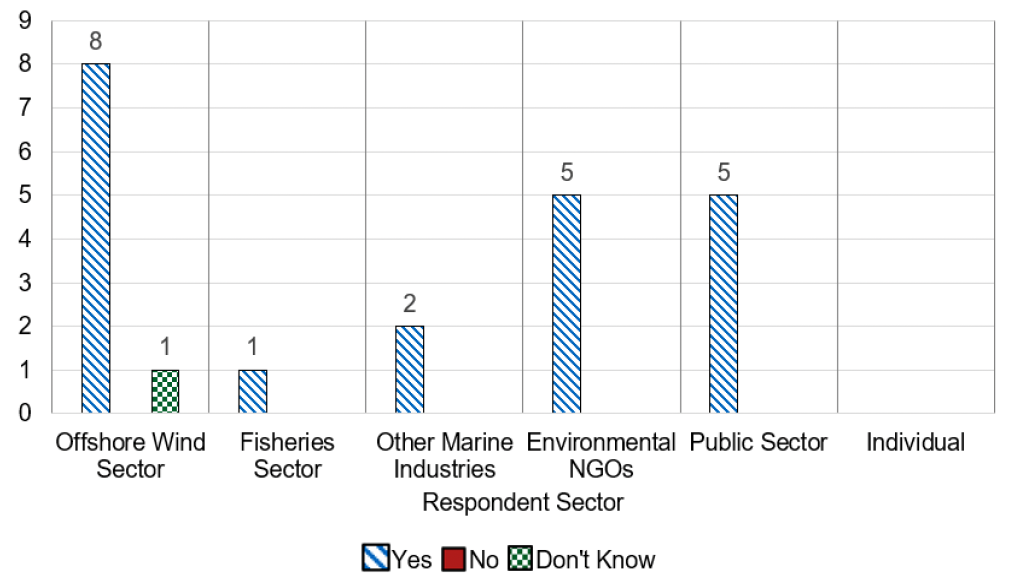
6.2.2 The total number of responses to question 5 was 22. 4 respondents did not answer this question. The breakdown by respondent type was 0 individuals and 22 organisations. The breakdown of responses is provided in Figure 5.
6.2.3 21 organisational respondents answered ‘Yes’, and 1 organisational respondent answered ‘Don’t Know’.
6.2.4 A breakdown by sector shows that there was agreement across all sectors, with only 1 Offshore Wind Sector respondent that answered, ‘Don’t Know’.
6.3 Question 6 - Do you support the proposal that the Scottish MRF Operator will be responsible for assigning appropriate compensation to projects?
6.3.1 The consultation paper outlines that it is expected that the Scottish MRF Operator will assign appropriate compensation to a project based on the adverse effects identified and the measures available.
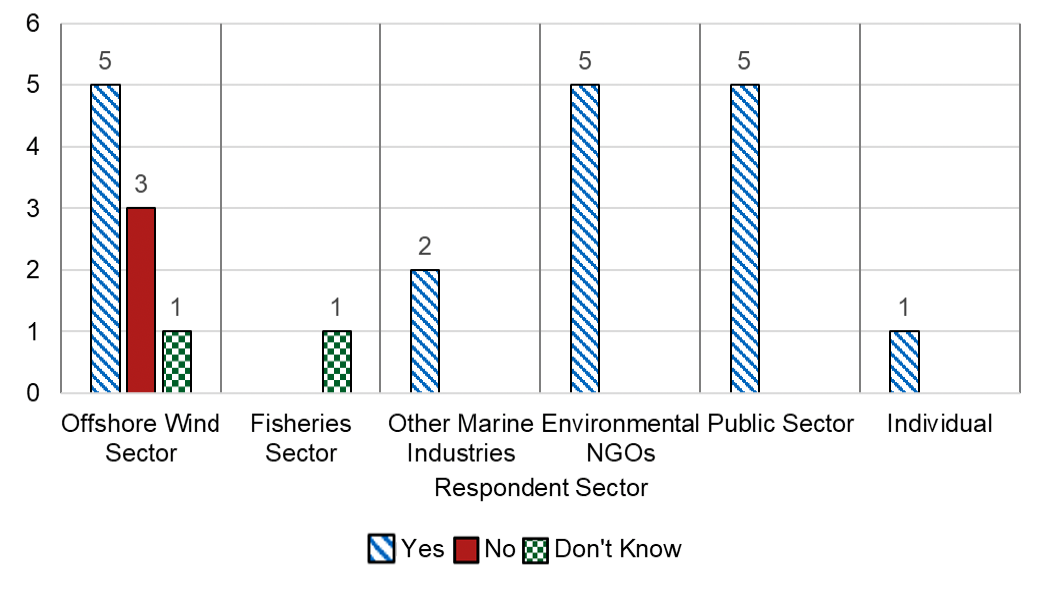
6.3.2 The total number of responses to question 6 was 23. 3 respondents did not answer this question. The breakdown by respondent type was 1 individual and 22 organisations. The breakdown of responses by sector is provided in Figure 6.
6.3.3 17 organisational respondents and 1 individual answered ‘Yes’, 3 organisational respondents answered ‘No’, 2 organisational respondents answered ‘Don’t Know’.
6.3.4 A breakdown by sector shows that the Public Sector, Environmental NGOs and Other Marine Industries agreed with the proposal that the Scottish MRF Operator will be responsible for assigning appropriate compensation to projects. The Offshore Wind Sector was split on the issue with 5 respondents agreeing, 3 answering ‘No’ and 1 answering ‘Don’t Know’.
6.4 Question 7 - Do you support any payments made into the Scottish MRF being non-refundable?
6.4.1 As described in the consultation paper, following an EOI, if compensation is available, an initial fee to reserve access to appropriate compensation will be required. The initial reservation fee would be non-refundable but would count towards the total cost of discharging a compensation condition through the Scottish MRF.
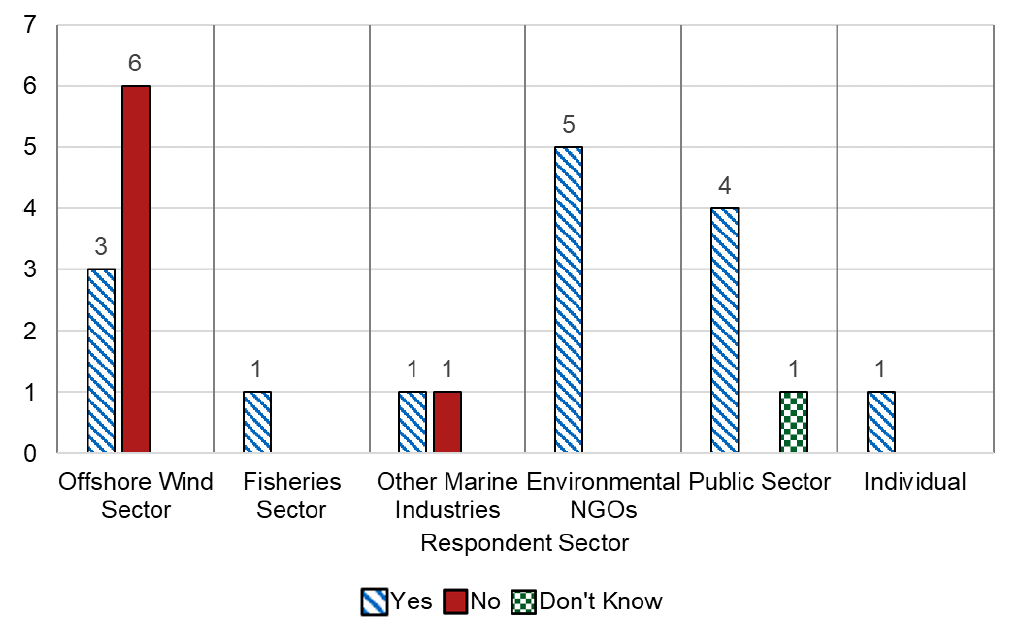
6.4.2 The total number of responses to question 7 was 23. 3 respondents did not answer this question. The breakdown by respondent type was 1 individual and 22 organisations. The breakdown of responses by sector is provided in Figure 7.
6.4.3 14 organisational respondents and 1 individual answered ‘Yes’. 7 organisational respondents answered ‘No’, and 1 organisational respondent answered ‘Don’t Know’.
6.4.4 A breakdown by sector shows that Environmental NGOs and the Public Sector generally agreed that any payments made into the Scottish MRF are to be non-refundable. The Offshore Wind Sector generally disagreed, with 6 respondents answering ‘No’, although 3 respondents answered ‘Yes’.
6.5 Question 8 - Do you support a full cost recovery model for the Scottish MRF?
6.5.1 As stated in the consultation paper, it is expected that the Scottish MRF will operate on a not-for-profit basis. To ensure public money and resources are used properly and efficiently, it will aim to achieve a full cost recovery model at the earliest practicable opportunity.
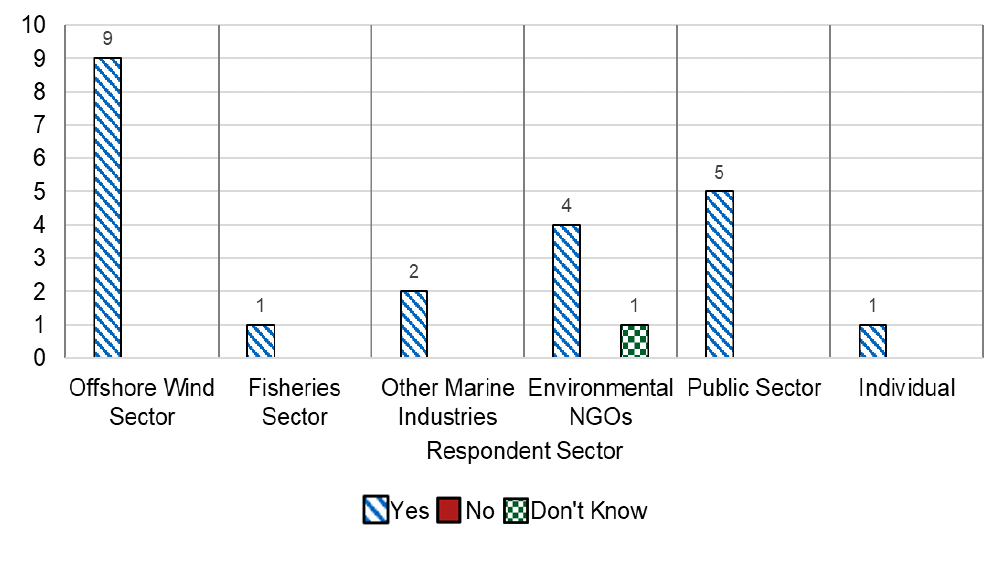
6.5.2 The total number of responses to question 8 was 23. 3 respondents did not answer this question. The breakdown by respondent type was 1 individual and 22 organisations. The breakdown of responses by sector is provided in Figure 8.
6.5.3 21 organisational respondents and 1 individual answered ‘Yes’, 1 organisational respondent answered ‘Don’t Know’.
6.5.4 A breakdown by sector shows there was agreement across all sectors, with only 1 Environmental NGO respondent that answered, ‘Don’t Know’.
6.6 Question 9 - If options are available, do you have a preference for whether the total payable to secure compensatory measures should be paid in a single lump sum or through a payment plan?
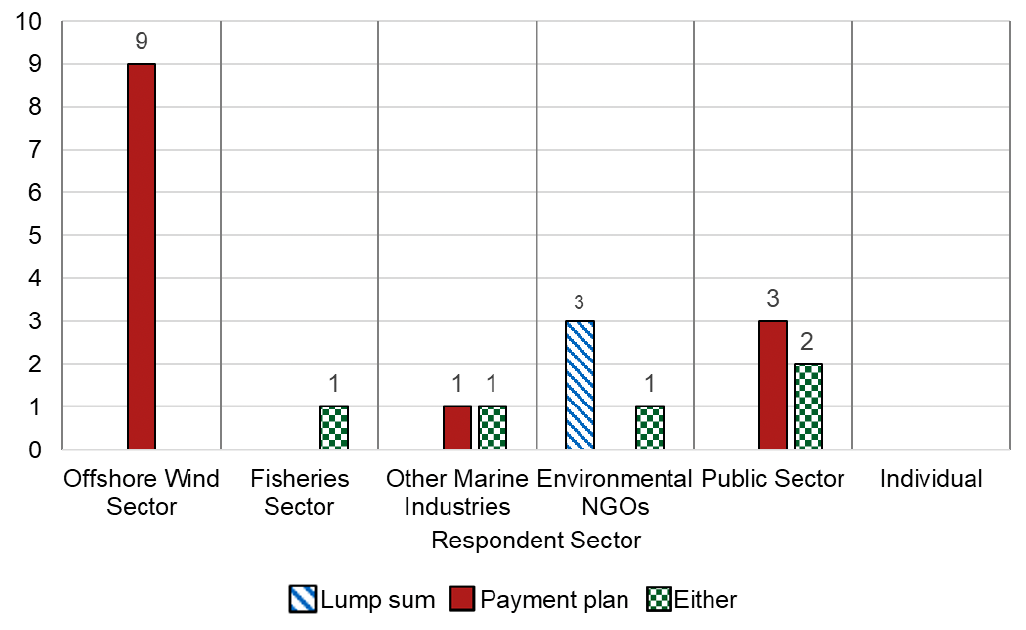
6.6.1 The total number of responses to the multiple choice component of question 9 was 21. 5 respondents did not answer this question. The breakdown by respondent type was 0 individuals and 21 organisations. The breakdown of responses by sector is provided in Figure 9.
6.6.2 3 organisational respondents answered ‘Lump sum’, 13 organisational respondents answered ‘Payment plan’, and 5 organisational respondents answered ‘Either’.
6.6.3 A breakdown of responses by sector shows that the Offshore Wind Sector generally expressed preference for the total payable to secure compensatory measures to be paid by a payment plan. Only Environmental NGO respondents expressed preference for a lump sum option, whilst other sectors responded with ‘Either’ or with support for a payment plan.
6.6.4 For the free text component of question 9, there were 21 responses. 5 respondents did not answer this question. The breakdown by respondent type was 1 individual and 20 organisations.
6.6.5 Reasons for preference for compensatory measures to be paid in a ‘Lump sum’ included views of Environmental NGOs who argued that it ensures compensation is secured and deliverable before any environmental harm occurs. This method was seen as providing upfront capital for immediate investment in critical infrastructure and long-term compensatory measures, thereby maximising the reliability and real value of the contribution.
6.6.6 Reasons for preference for compensatory measure to be paid via a ‘Payment Plan’ included the importance of flexibility in payment arrangements. The Offshore Wind Sector and Public Sector advocated for payment plans that can be tailored to the size and nature of the project and the compensatory work required. Flexible payment options, such as annualised or milestone-based instalments, were seen as more manageable for developers, especially during the early, high-risk phases of a project. This flexibility is also considered beneficial for cash flow management and allows for adjustments if the actual costs of compensatory measures differ from initial estimates. They cautioned against the use of one-off payments, arguing that it is difficult to accurately forecast costs over decades and that regular payments allow for more responsive and effective management.
6.6.7 The Offshore Wind Sector also expressed concerns about the future viability of developers, noting that mergers, acquisitions, or company failures could complicate ongoing payment obligations. To mitigate these risks, some suggested mechanisms such as bonds or letters of credit to ensure that funds remain available for compensatory measures, even if the original developer ceases to exist. This approach is intended to protect public funds and ensure the continuity of environmental compensation.
6.6.8 The Offshore Wind Sector also indicated the need for alignment of payment schedules with project milestones and the timing of environmental impacts, arguing that payment plans should reflect the actual delivery and operation timelines of projects, with payments made as impacts occur or as milestones are reached. This approach is seen as more practical and equitable, particularly for large or phased projects, and helps to ensure that compensation measures are funded in line with their implementation and monitoring needs.
6.6.9 Respondents across sectors emphasised the need for ongoing review and adjustment of compensation payments. Given the lengthy timeframes and uncertainties associated with strategic compensation measures, respondents in the Offshore Wind Sector and Public Sector believed that costs should be regularly reviewed and payment plans adjusted accordingly. This adaptive management approach is seen as essential for ensuring that compensation remains appropriately funded over time and that any changes in project scope or environmental impact are adequately addressed.
6.7 Question 10 - Do you agree with the proposal that a 30% adaptive management charge will be charged to all applicants to the Scottish MRF?
6.7.1 Within the consultation paper it is proposed that the Scottish MRF will mirror the approach taken by the UK Government MRF, whereby the adaptive management charge for the Scottish MRF will be set at 30% of the total estimated cost of delivery, maintenance, monitoring and any decommissioning of the measure and will be applicable to all measures.
6.7.2 The charge has been set at 30% to reflect inherent uncertainty in calculation costs and delivering measures over the long term, to ensure sufficient fund liquidity to meet all relevant fund obligations, and to comply with subsidy control regulations.
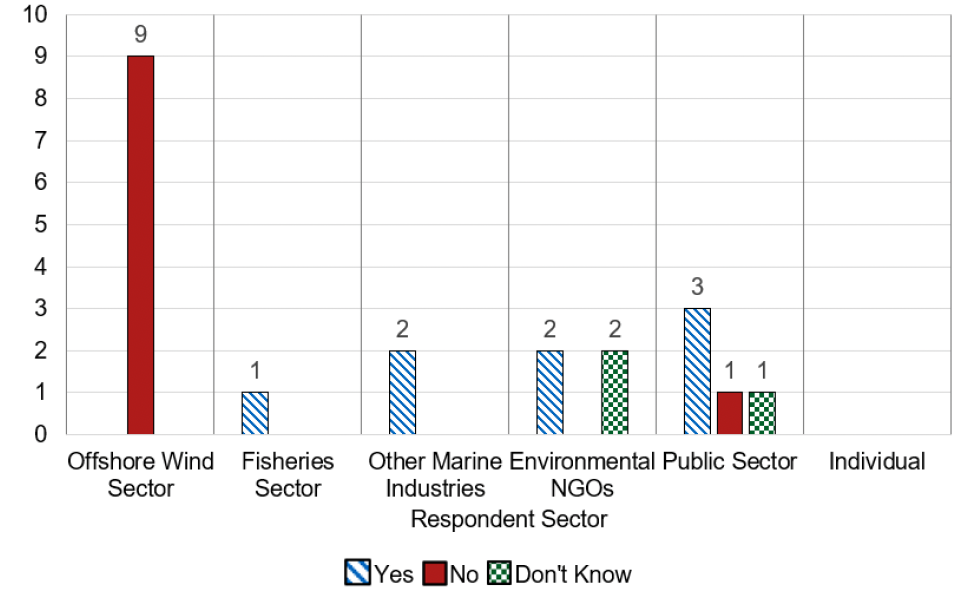
6.7.3 The total number of responses in relation to the multiple choice component of question 10 was 21. 5 respondents did not answer this question. The breakdown by respondent type was 0 individuals and 21 organisations. The breakdown of responses by sector is provided in Figure 10.
6.7.4 8 organisational respondents answered ‘Yes’. 10 organisational respondents answered ‘No’, and 3 organisational respondents answered ‘Don’t Know’.
6.7.5 A breakdown by sector shows that all Offshore Wind Sector respondents disagreed with the proposal, answering ‘No’, whilst the other sectors generally agreed, answering ‘Yes’. Some Environmental NGOs and Public Sector respondents answered ‘Don’t Know’.
6.8 Question 11 - Do you agree with the proposal that the 30% adaptive management charge will be non-refundable?
6.8.1 The consultation paper proposes that the adaptive management charge will be non-refundable, and any unused funds from this charge will be redistributed across the Scottish MRF to meet other relevant costs.
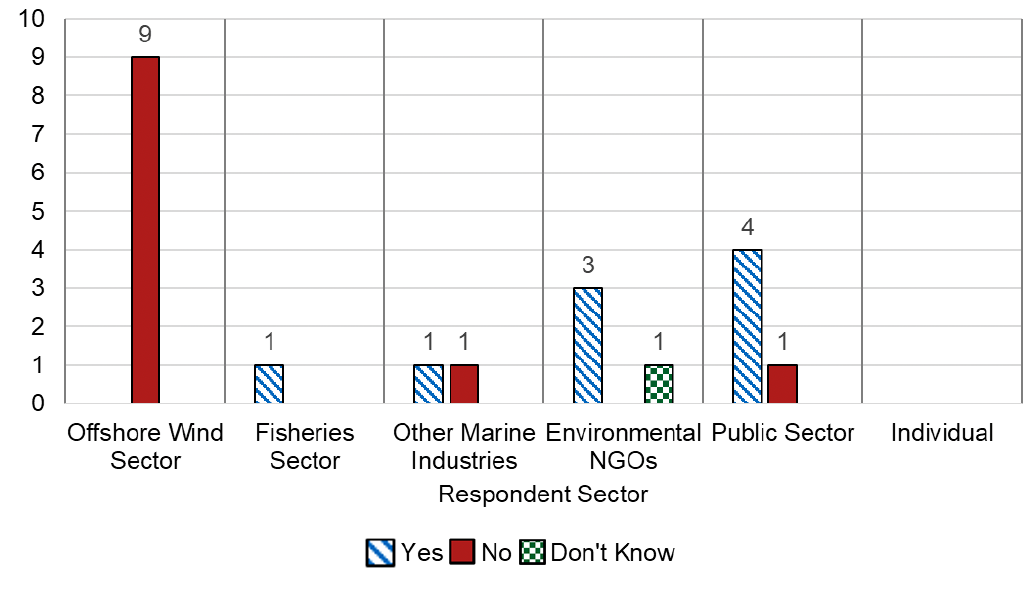
6.8.2 The total number of responses in relation to the multiple choice component of question 11 was 21. 5 respondents did not answer this question. The breakdown by respondent type was 0 individuals and 21 organisations. The breakdown of responses by sector is provided in Figure 11.
6.8.3 9 organisational respondents answered ‘Yes’, 11 organisational respondents answered ‘No’, and 1 organisational respondent answered ‘Don’t Know’.
6.8.4 A breakdown by sector shows that Environmental NGOs and the Public Sector generally supported the proposal that the 30% adaptive management charge will be non-refundable, answering ‘Yes’. All Offshore Wind Sector respondents disagreed, answering ‘No’. One respondent representing an Environmental NGO answered. ‘Don’t Know’.
6.9 Question 12 - Do you agree with the proposal that surplus funds may be used for further development of measures?
6.9.1 The consultation paper outlines that while the Scottish MRF is intended to be not-for-profit and operate on a full cost recovery model, it is possible the Scottish MRF may accrue surplus funds. This surplus funding may be utilised for the identification and further development of new and additional compensatory measures.
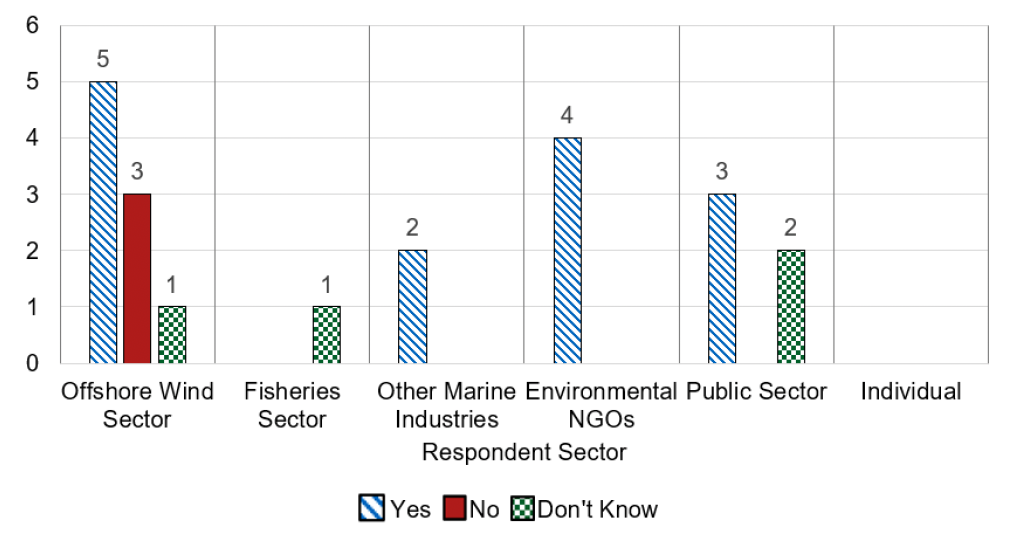
6.9.2 The total number of responses in relation to the multiple choice component of question 12 was 21. 5 respondents did not answer this question. The breakdown by respondent type was 0 individuals and 21 organisations. The breakdown of responses is provided in Figure 12.
6.9.3 14 organisational respondents answered ‘Yes’, 3 organisational respondents answered ‘No’, and 4 organisational respondents answered ‘Don’t Know’.
6.9.4 A breakdown by sector shows that the Offshore Wind Sector, Other Marine Industries, and Environmental NGOs generally agreed with the proposal that surplus funds may be used for further development of measures, although 3 Offshore Wind Sector respondents disagreed. None of the responding sectors generally disagreed. 2 respondents from the Public Sector and 1 respondent from the Offshore Wind Sector and Fisheries Sector, answered ‘Don’t Know’.
6.10 Question 13 - Do you have any other comments on the proposed costs and charges as described above (questions 5-12)?
6.10.1 21 respondents answered question 13. 5 respondents did not answer the question. The breakdown by respondent type was 1 individual and 20 organisations.
6.10.2 Responses by organisational sector primarily came from the Offshore Wind Sector, Environmental NGOs, and the Public Sector, with 8, 5, and 5 responses respectively.
6.10.3 A central topic raised by respondents is the structure and timing of payments into the Scottish MRF. Many respondents in the Offshore Wind Sector support the idea of an initial payment to secure access to compensation measures, noting that this approach helps deter speculative applications and provides early certainty for both developers and ecologically coherent compensation measures over time. However, there was significant debate about whether these payments should be non-refundable. Some respondents such as Environmental NGOs argued that non-refundable payments provide certainty and prevent delays, while the Offshore Wind Sector caution that a lack of refund options could discourage legitimate projects, especially if consent is not granted or project circumstances change unexpectedly. The need for a proportionate, transparent, and flexible fee structure was a recurring theme.
6.10.4 Management and allocation of adaptive management charges were generally supported by respondents, but many in the Offshore Wind Sector expressed concerns about the proposed flat 30% charge, with many indicating that a one-size-fits-all approach may not be appropriate across different types of compensatory measures. These respondents instead called for a risk-based or tiered system. There was also a call for clearer justification of the 30% figure and for mechanisms that allow for refunds or adjustments if adaptive management funds are not ultimately required.
6.10.5 Respondents from Environmental NGOs, Other Marine Industries and the Public Sector emphasised that transparency in how these funds are used, and regular independent evaluation, is essential for maintaining trust and maintaining buy-in to the fund.
6.10.6 The role and capacity of the Scottish MRF Operator was another key area of discussion. Respondents across all sectors emphasised the importance of the operator working closely with SNCBs and relevant local expertise within a robust and transparent framework. There was a consensus that the criteria and process for assigning compensation measures must be clearly defined and publicly available, with all measures tracked, evaluated, and adaptively managed over time. Concerns were also raised about the need for the operator to be adequately resourced and skilled, and for the process to avoid diverting capacity from other marine priorities. Environmental NGOs noted that baseline and updated data on protected areas is often required to support development planning. However, the respondents also highlighted that funding constraints have frequently prevented this data from being kept up to date in advance of new proposals, which can hinder effective assessment and decision-making.
6.10.7 Cost recovery and the use of surplus funds were also frequently mentioned. Environmental NGOs supported a full cost recovery model that explicitly includes provision for independent monitoring, evaluation, and enforcement, as well as additional capacity for SNCBs. There was broad agreement from the Offshore Wind Sector, Environmental NGOs and the Public Sector that surplus funds should be reinvested to scale up restoration efforts and to enhance the strategic pool of compensatory measures, with a strong preference for these funds to be ringfenced for nature and not subject to wider government reallocation. Transparent and regular public reporting on the use of funds was considered essential.
6.10.8 Finally, respondents highlighted the importance of ensuring that the overall scheme is cost-neutral and delivers long-term positive ecological outcomes. There was a shared view across the Offshore Wind Sector and Public Sector that charges should be structured to ensure timely delivery of compensation without creating financial barriers that might deter developer participation. The need for effective stakeholder engagement, clear guidance on the allocation and refundability of fees, and mechanisms for regular review and adjustment of the scheme were mentioned as issues needing further consideration in the creation of the Scottish MRF.
Contact
Email: MarineRecoveryFund@gov.scot