
Scottish Marine Recovery Fund: consultation analysis report
Key findings from the public consultation 2025 on the Scottish Marine Recovery Fund policy for offshore wind.
Consultation
7 Interaction between the Scottish MRF and the UK Government MRF Consultation Analysis Results
7.1 Introduction
7.1.1 The consultation posed 2 questions relating to the interaction between the Scottish MRF and the UK Government MRF which are discussed below. Both questions included a multiple choice and free text component.
7.2 Question 14 - Do you support the establishment of a Scottish MRF that operates separately from a UK Government MRF, providing Scottish offshore wind developers and plan authorities with a mechanism to compensate for adverse effects in Scottish waters?
7.2.1 As described in the consultation paper, the Scottish Government believes that a separate Scottish MRF would be more effective for meeting the unique needs of the Scottish offshore wind consenting process but supports the two MRFs working together as closely as possible.
7.2.2 The total number of responses in relation to the multiple choice component of question 14 was 23. 3 respondents did not answer this question. The breakdown by respondent type was 1 individual and 22 organisations. The breakdown of responses by sector is provided in Figure 13.
7.2.3 18 organisational respondents answered ‘Yes’, 3 organisational respondents and 1 individual answered ‘No’, and 1 organisational respondent answered ‘Don’t Know’.
7.2.4 A breakdown by sector shows that the Offshore Wind Sector, Environmental NGOs, Public Sector and Other Marine Industries, generally agreed with the establishment of a Scottish MRF that operates separately to the UK Government MRF. These represent 8,4,4, and 2 responses respectively. None of the responding sectors generally disagreed. One respondent from the Fisheries Sector answered, ‘Don’t Know’.
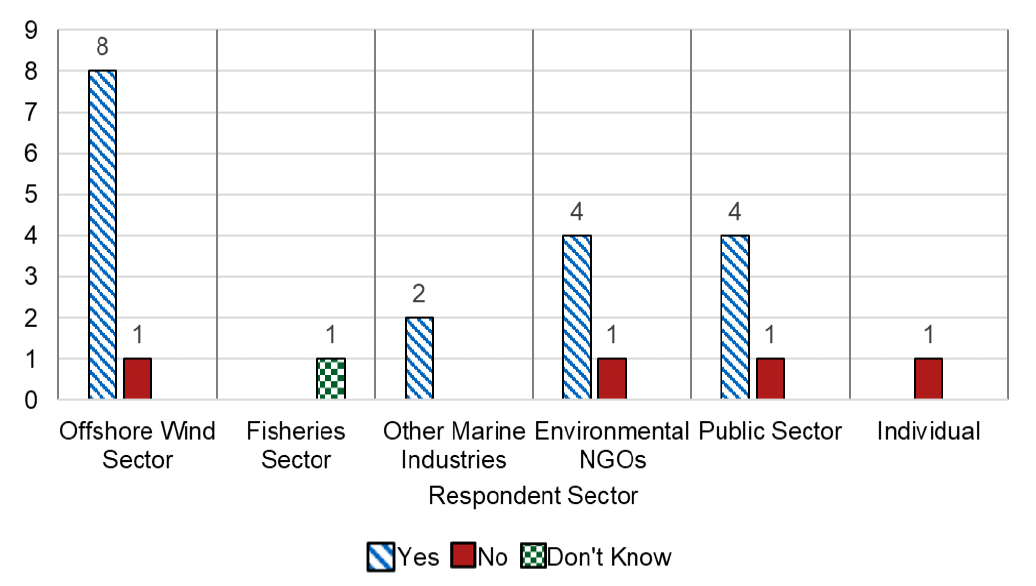
7.2.5 For the free text component of question 14, there were 23 responses. 3 respondents did not answer this question. The breakdown by respondent type was 1 individual and 22 organisations.
7.2.6 Respondents from the Offshore Wind Sector, Other Marine Industries, Environmental NGOs and Public Sector expressed aligned agreement for the establishment of a Scottish MRF as it would be better tailored to Scotland’s unique legal, ecological, and policy context, including Scottish planning frameworks such as the National Marine Plan[18] and Sectoral Marine Plans (SMPs)[19], noting that the current Library of Strategic Compensation Measures (LoSCM)[20] associated with the UK MRF is not aligned with the requirements of Scotland’s consenting framework. An Environmental NGO respondent noted the Scottish MRF would improve administrative efficiency and responsiveness to local projects and reduce confusion for developers in navigating the planning system.
7.2.7 Respondents also emphasised the importance of the Scottish MRF and UK MRF working in tandem to address cross-border impacts and ensure complementary operation. However, respondents also called for aligned policy and guidance particularly regarding MPAs and Measures of Equivalent Benefit (MEEB).
7.2.8 One respondent from the Offshore Wind Sector recommended that the Scottish MRF have a broad remit, extending beyond ornithological impacts to include benthic and wider ecological considerations. Respondents also suggested the establishment of joint-governance mechanisms to oversee cross-border compensation decisions and to ensure ecological coherence.
7.2.9 Two respondents from Environmental NGOs and Offshore Wind Sector expressed disagreement due to concerns about the complexity and potential inconsistency of managing compensation measures for highly mobile cross-border species such as cetaceans under separate MRFs. Both respondents indicated preference for a UK-wide MRF to avoid conflicting approaches and ensure more effective delivery of measures across jurisdictions. One respondent from the Offshore Wind Sector also noted that two separate MRFs could introduce unnecessary complexity and competition over available measures.
7.2.10 The respondent from the Public Sector expressed disagreement due to the importance of maintaining a coherent UK network of MPAs and meeting biodiversity commitments. The respondent also suggested that strategic compensation measures are delivered in locations where they offer the greatest ecological benefit.
7.3 Question 15 - In addition to how cross border impacts are proposed to be addressed between a Scottish MRF and the UK Government MRF (see question 2), do you have any other views on how both MRFs should interact with one another?
7.3.1 The total number of responses in relation to the multiple choice component of question 15 was 19. 7 respondents did not answer this question. The breakdown by respondent type was 0 individuals and 19 organisations. The breakdown of responses is provided in Figure 14.
7.3.2 16 organisational respondents answered ‘Yes’, and 3 organisational respondents answered ‘No’.
7.3.3 A breakdown by sector shows that the Offshore Wind Sector, Environmental NGOs, and the Public Sector had other views on how both MRFs should interact with each other, with 8, 5 and 4 respondents from each sector respectively.
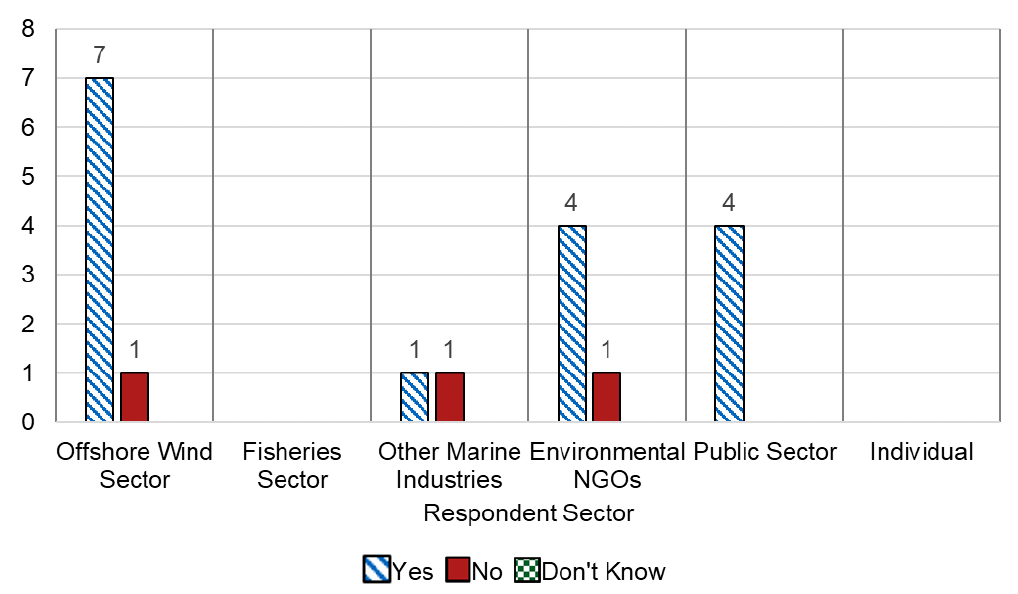
7.3.4 For the free text component of question 15, there were 19 responses. 7 respondents did not answer this question. The breakdown by respondent type was 0 individuals and 19 organisations.
7.3.5 A primary topic raised by respondents was the necessity for formal coordination and alignment between the Scottish and UK MRFs. Respondents across sectors emphasised that both funds must co-exist and complement each other, with mechanisms in place to share data, apply consistent standards, and prevent duplication or gaps in delivery. Many respondents advocated for a joint oversight body to review cross-border cases and cumulative effects, ensuring that both MRFs are aligned on monitoring standards, adaptive management frameworks, and success criteria. This alignment is seen as essential for delivering effective environmental outcomes across jurisdictions.
7.3.6 Environmental NGOs and some respondents from the Offshore Wind Sector also called for clear guidance and transparency regarding intergovernmental working arrangements. Respondents called for all governments to collectively publish information on how they will collaborate, particularly in cross-jurisdictional scenarios. Respondents stressed that greater transparency would help projects and developers understand processes and work more efficiently when interacting with multiple devolved jurisdictions. The establishment of intergovernmental agreements was viewed as crucial to avoid competition between the funds and to ensure that compensation requirements can be delivered efficiently and without duplication.
7.3.7 Respondents from the Offshore Wind Sector also highlighted the importance of strategic planning and the integration of compensation measures with broader sectoral marine plans. They noted that strategic planning should streamline efforts, avoid the need to renegotiate compensation measures already identified at the plan level, and provide opportunities for holistic ecological enhancement. There was support for a shared library of compensatory measures accessible across jurisdictions, which would help minimise competition, avoid duplication, and ensure that compensation is delivered where it is most ecologically beneficial.
7.3.8 The equitable allocation of compensation and the prevention of competitive disadvantages were further concerns specifically raised by Environmental NGOs and the Public Sector. Respondents argued that there should be no situation where developments in one jurisdiction discharge obligations in another without clear justification, and that measures should be created as close as possible to the most adversely impacted area. Respondents also stressed the importance of including island community representatives in intergovernmental arrangements and ensuring that the system does not create market imbalances or incentivise developers to choose one fund over another for financial reasons.
7.3.9 Finally, respondents underscored the need for ongoing collaboration, joint governance, and regular sharing of lessons learned between the MRFs. They recommended joint reporting protocols, alignment of methodology and monitoring, and the establishment of a UK-wide public register of compensation measures. This collaborative approach was seen as vital for maintaining the integrity of the network of MPAs, supporting commitments to address the biodiversity crisis, and ensuring that the most ecologically meaningful compensation is delivered across the UK.
Contact
Email: MarineRecoveryFund@gov.scot