
Scottish Climate Survey 2025 to 2025: technical report
Technical report supporting the publication 'Scottish Climate Survey: main findings'

Fieldwork
Letters and reminders
The push-to-web mailing approach selected was as follows:
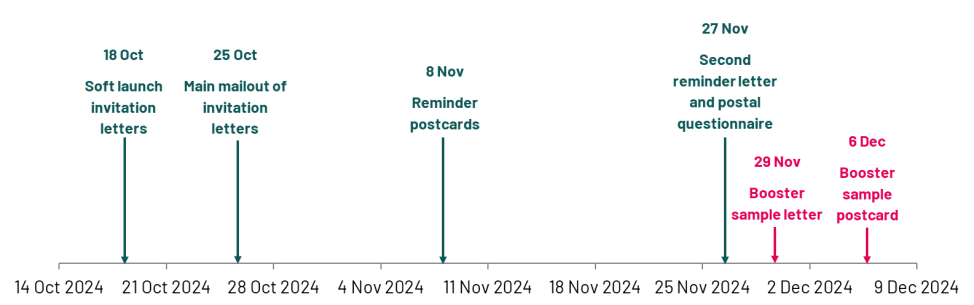
- An initial invitation letter (see Appendix B) was issued to all addresses on the original sample, inviting up to two adults to complete the online questionnaire. This letter was mailed on the 25th October 2024.
- The first reminder postcard (see Appendix C) was issued on the 8th November 2024. Reminder invitations were only sent to non-responding addresses.
- The second reminder letter (see Appendix D) was issued on the 27th of November 2024. This was sent to non-responding addresses; all of these letters were accompanied by one copy of the postal questionnaire, to allow those who could not access the internet, and those who are less comfortable completing online questionnaires, to take part. The survey remained open until 12th January 2025.
In advance of the full mailout of the initial invitation letter, a ‘soft launch’ was carried out. This comprised a mailout of the letter to 3,000 addresses on the sample. The purpose of the soft launch was to check if any amendments were required to different aspects of the survey administration, such as the letters, mailout process and the survey script, before the full mailout of the remaining addresses. The soft launch letters were mailed on the 18th October 2025.
Addresses on the booster sample received two mailings – an initial invitation, mailed on the 29th of November 2024, and a reminder postcard issued on the 6th of December 2024.
Figure 5.1: Mailout schedule
 Letter design
The principles for designing the invitation and reminder letters were based on the Tailored Design Method[1], along with a host of literature and best practice based on previous studies. The main aim of the letters was to provide all the relevant information a respondent requires to complete the survey, and to answer immediate questions which they may have.
The principles for designing the letter were to ensure it was engaging and helped to encourage participation, using simple and easy to understand language, with no unnecessarily complicated text. Both invitation and reminder letters covered the key messages that needed to be conveyed, including:
- the importance of the survey
- motivators for taking part
- how to take part
- assurances of confidentiality
In addition to this the letters also provided key information about Ipsos and Scottish Government and contact details for both organisations should the respondent have any queries about the survey.
Survey URL
The URL www.scottishclimatesurvey.co.uk was used for the online survey. When deciding on the URL we selected an address that was straighforward and short enough for respondents to remember.
Vouchers for respondents
Incentives were used to encourage participation in the survey and boost response rates. £5 conditional vouchers were offered upon completion of the survey.
For online completions, respondents wishing to receive a £5 voucher entered their email address at the end of the survey and were sent a unique link to a dedicated survey website where they could select a voucher from a list of suppliers. Respondents were then emailed a link/code for their voucher which allowed them to redeem it. Respondents who returned a postal questionnaire received their choice of a £5 supermarket gift card within two weeks of Ipsos receiving the questionnaire. They could also request an online voucher if they preferred. Respondents were asked to give their name in order to address the incentive to the correct person, but even without a name an incentive would be sent to that address.
Handling queries
The survey letters provided information about the survey and included a list of FAQs which had been developed based on similar studies, such as the Scottish Household Survey.
Additionally, a dedicated telephone helpline and email address were set up allowing respondents to contact Ipsos if they had any queries about the survey. Telephone queries were recorded and dealt with by the Ipsos helpline team and a member of the research team returned the call when they had identified an appropriate solution. All emails sent to the survey inbox were followed up individually within five working days.
The most common queries included respondents requesting a copy of the postal questionnaire, questions about accessing the online survey, requests to opt out of the survey and questions regarding the voucher incentive.
[1] Dillman, DA. Smyth, JD. Christian, LM. Internet, Phone, Mail and Mixed-Mode Surveys: The Tailored Design Method (2014). Wiley.
Contact
Email: emily.creamer@gov.scot