
Scotland's Fourth Land Use Strategy: 2026-2031
Scotland’s Fourth Land Use Strategy sets out a new vision and objectives to support the development of integrated land use. The strategy covers the next five years and includes a commitment to publish a delivery plan and a refreshed set of land use principles.
Annex B: Using landscapes to understand integration and actions
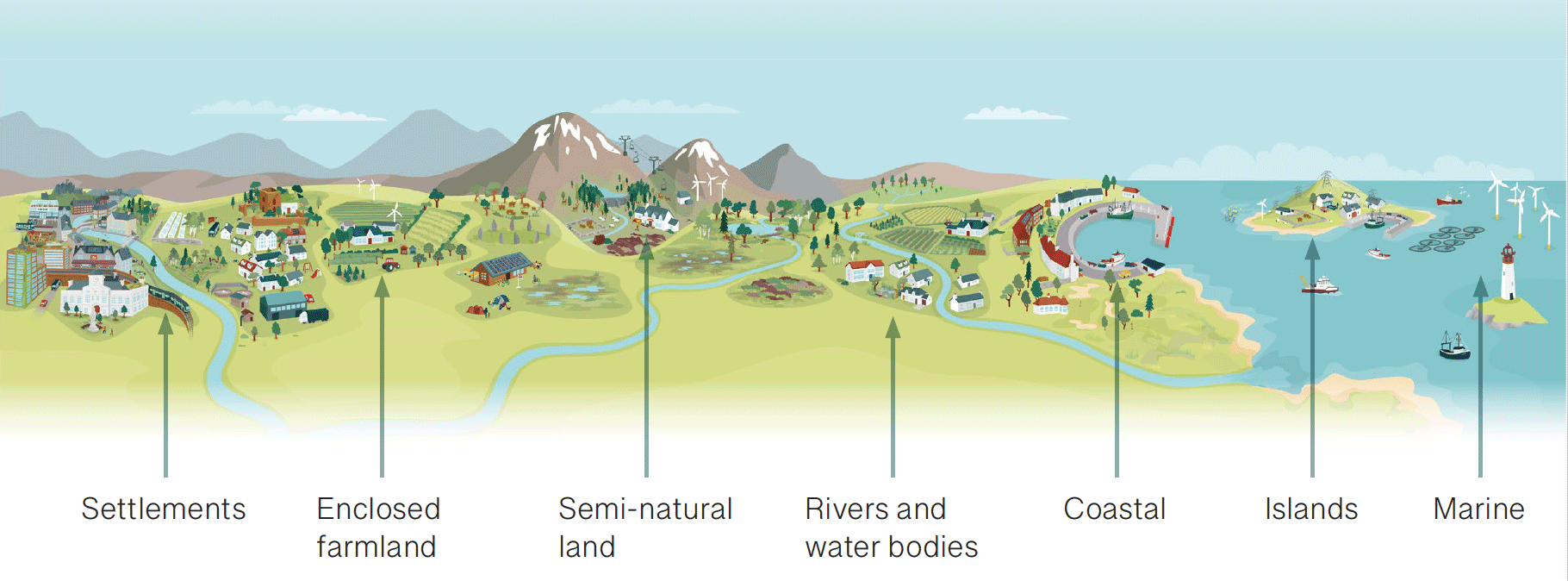
Graphic text below:
Settlements
Enclosed farmland
Semi-natural land
Rivers and water bodies
Coastal
Islands
Marine
Through the third Strategy we introduced a series of illustrative landscapes to represent different types of land in Scotland. This approach was, and continues to be, well received. We continue to use illustrative landscapes as a means of demonstrating how different uses of land interact with each other and how integrated actions can support our ecosystems, our society, our economy, and our wellbeing.
The seven illustrative landscapes below have been chosen to represent broadly different aspects of our land in Scotland. Within each illustrative landscape we have highlighted high-level examples of SG actions aimed at supporting sustainable land use in those landscapes.
These landscapes and the images of what sustainable land use could look like in the future, are illustrative only. They are not map-based or intended to be geographically specific. They are deliberately not mutually exclusive: real landscapes do not fall strictly into categories. Many areas in Scotland will identify with more than one of these illustrative landscapes, for example, many of our big urban centres are located in coastal areas.
Please note: these are illustrative landscape examples intended to support broader understanding of how land uses can interact and the benefits they can provide or enhance. The Scottish Government (SG) recognises that the inclusion of any practices depends on a complex set of environmental, economic and social factors, which must be carefully considered by landowners and managers. These examples are not prescriptive and do not override individual landowners’ rights or decision-making processes.
Settlements
While most of Scotland’s land mass is rural in nature, the majority of people live within our cities, towns, villages, and hamlets. Using and managing land within our settlements well brings many benefits, to health and wellbeing, equality, environmental quality, cultural identity, flood reduction, jobs and housing, as well as climate resilience and biodiversity.
Ecosystem services provided through this landscape
Provisioning
- Renewable and non-renewable energy
Regulating
- Clean air
- Carbon storage
- Flood management
Supporting
- Photosynthesis
- Space for wildlife
Cultural
- Physical health and mental wellbeing
- Recreation
- Sense of place
- Inspiration
- Spiritual and religious connection
High-level examples of SG actions aimed at supporting sustainable land use in this landscape
Local Place Plans
Local Place Plans are part of the Government’s wider work on planning reform and implementation of the Planning (Scotland) Act 2019. It is vital that local people have the opportunity to engage meaningfully and have a positive influence in the future planning of development in their areas. The aim is to significantly enhance engagement in development planning, effectively empowering communities to play a proactive role in defining the future of their places through a community-led, collaborative approach. Local Place Plans can support community aspirations on the big challenges for a future Scotland, such as responding to the global climate emergency and tackling inequalities.
Make Space for Nature
Make Space For Nature is a public facing campaign run by NatureScot, aimed at driving behaviour change. The campaign highlights the strong link between nature loss and climate change, and why we need to care for nature. It provides seasonally relevant ways people can ‘make space for nature’ physically and mentally, encouraging them to care for nature and adopt these habits as part of everyday life such as:
- encourage nature into our lives
- provide water and homes for wildlife
- plant hedgerows and create gaps in fences
- avoid using artificial grass, paving, or decking
- give our time for nature
- undertake regular citizen science activity
Climate Action Hubs
Communities are uniquely placed to play a key role in sharing and driving forward Scotland’s transition to low carbon and climate-resilient living. It is vital that we continue empowering people to take action in their neighbourhoods in a way which is right for them. 24 hubs have been set up across Scotland to help empower people to act in their neighbourhoods and have supported a range of projects including those linked to local energy generation, flood mitigation and food-growing. Through the hubs the Scottish Government will continue to support people and communities to take action, helping Scotland decarbonise by 2045 and prepare for the impacts of climate change.
Climate Ready Regions
Funded through the Scottish Government’s Adaptation Scotland programme and delivered by Verture, Climate Ready Regions are partnerships that bring together local authorities, public bodies, businesses, communities and the third sector from across a region. These partnerships allow people to collaborate on shared climate risks and build climate resilient places, communities, and economies.
Enclosed Farmland
This landscape is primarily made up of arable fields producing the high-quality produce that Scotland is renowned for, such as cereals, fruits and vegetables. It is also home to improved grassland, livestock, and a range of environmentally beneficial habitats.
Ecosystem services provided through this landscape
Provisioning
- Food and drink
- Materials
- Renewable and non-renewable energy
Regulating
- Clean air
- Carbon storage
- Flood management
- Erosion control
- Disease and natural pest control
- Pollination
Supporting
- Healthy soils
- Photosynthesis
- Nutrient cycling
- Space for wildlife
Cultural
- Physical health and mental wellbeing
- Tourism
- Recreation
- Sense of place
- Inspiration
- Spiritual and religious connection
High-level examples of SG actions aimed at supporting sustainable land use in this landscape
Agricultural Reform Programme
We have a public ambition to help make Scotland a global leader in sustainable and regenerative agriculture. To achieve that, we need to transform how we deliver agricultural support. The Agricultural Reform Programme has been established to deliver this work.
Vision for Agriculture
Our Vision for Agriculture sets an ambition to make Scotland a global leader in sustainable and regenerative agriculture. To do that, we are transforming the support we give to our farmers and crofters.
In 2025, the first changes to agricultural support were introduced. These include:
- The start of the Whole Farm Plan. This will help farmers and crofters to create a baseline of current agricultural practices, allowing them to measure progress over time.
- A calving interval for the Scottish Suckler Beef Support Scheme (SSBSS). This will help reduce emissions and encourage efficient beef production.
- New protections for peatlands and wetlands. This will help to make sure these important natural assets are protected.
Changes to be delivered in 2026 have also been announced. These are:
- The introduction of Enhanced Greening. In 2026, more farmers and crofters will need to manage Ecological Focus Areas (EFA). This will mean more land is farmed in a way that enhances nature and is good for the climate.
- A derogation for some small herd producers for SSBSS. This will mean that those claiming support for 10 calves or fewer in 2026 will not need to meet the calving interval requirement.
Agri-Environment Climate Scheme (AECS)
The Scottish Government’s Agri-environment climate scheme promotes land management practices which protect and enhance Scotland’s magnificent natural heritage, improve water quality, manage flood risk, and help to mitigate and adapt to climate change. The scheme is delivered jointly by the Rural Payments and Inspections Division (RPID) of the Scottish Government and NatureScot.
Following engagement with the agricultural sector, 20 AECS options and items have been amended for the 2026 round to encourage uptake and simplify access for applicants. This has included widening the eligibility of several options through removing geographical targeting.
Agritourism Investment Scheme (AIS)
The Agritourism Investment Scheme is a competitive capital grant scheme designed to help agritourism businesses in Scotland to be financially sustainable, profitable, and resilient businesses that will play a key role in sustaining the future of Scottish agriculture. It offers capital support to agritourism businesses to enable investment that will deliver on these ambitions.
Sustainable and regenerative agriculture: code of practice
Published in June 2025, the purpose of the code is to provide clear guidance on how farming or crofting businesses can undertake different actions or measures which will help contribute to sustainable and regenerative farming. It aims to establish common standards for good practice and to encourage continuous improvement and development. The key purpose of this is to enable the production of high-quality food in an economically and environmentally sustainable way.
Semi-natural Land
This wide-ranging landscape category includes mixed farmland, forests, hills, mountains, and moors. It is the predominant landscape in Scotland and encompasses much of our most quintessential scenery as well as our National Parks and the world-renowned Flow Country. This landscape is central to delivering many of our national priorities.
Ecosystem services provided through this landscape
Provisioning
- Food and drink
- Natural medicines
- Water supply
- Materials
- Renewable and non-renewable energy
- Timber and wood products
Regulating
- Clean air
- Carbon storage
- Flood management
- Erosion control
- Water purification
- Disease and natural pest control
- Pollination
Supporting
- Healthy soils
- Photosynthesis
- Nutrient cycling
- Space for wildlife
Cultural
- Physical health and mental wellbeing
- Tourism
- Knowledge and learning
- Recreation
- Sense of place
- Inspiration
- Spiritual and religious connection
High-level examples of SG actions aimed at supporting sustainable land use in this landscape
Whole Farm Plans
The Whole Farm Plan was a recommendation from the Farmer Led Groups and will support farmers and crofters to take a holistic view of their farm or croft. By establishing their current performance and activities, businesses will be able to better identify opportunities for improvement and work towards being more productive and profitable, better positioning them to contribute to meeting Scotland’s climate and nature targets.
Forestry Grants Scheme
Scotland’s woodlands and forests are a vital national resource and play an important role in rural development and sustainable land use. As well as helping to reduce the impacts of climate change and providing timber for industry, our forests enhance and protect the environment and provide opportunities for public enjoyment.
The Forestry Grant Scheme has been a cornerstone of forestry support in Scotland for the past decade and has helped deliver a wide range of environmental, economic, and social benefits across the country. Through this support scheme the Scottish government continues to support:
- the creation of new woodlands
- the sustainable management of existing woodlands
Peatland ACTION
The true worth of our peatlands is becoming increasingly recognised. As stores of carbon, they are important in tackling climate change and as the basis of rural farming, sporting activities, tourism, and crofting they are vital to the economy. They also play a role in flood regulation, water quality, and support nationally and internationally important biodiversity.
Peatland ACTION is a strategic partnership established by the Scottish Government with five public sector delivery partners: NatureScot, Loch Lomond and Trossachs National Park Authority , Scottish Water, Cairngorms National Park Authority and Forestry and Land Scotland.
The Scottish Government continues to support Peatland ACTION, which primarily supports on-the-ground peatland restoration activities and is open for applications from eligible land managers who have peatlands that would benefit from restoration.
Scotland’s Natural Capital Market Framework
The true worth of our peatlands is becoming increasingly recognised. As stores of carbon, they are important in tackling climate change and as the basis of rural farming, sporting activities, tourism, and crofting they are vital to the economy. They also play a role in flood regulation, water quality, and support nationally and internationally important biodiversity.
The Integrating Trees Network
The award-winning Integrating Trees Network is a farmer-led initiative that aims to encourage more farmers and crofters to plant trees. It helps raise awareness of the multiple benefits that planting trees can have on land and business, which include:
- providing shelter and shade for livestock
- improving productivity
- diversifying income streams
- creating habitat for wildlife
- reducing carbon footprint
The Network farmers and crofters host events across Scotland, providing an informative and supportive network for other farmers and crofters who are considering planting trees.
Crofting legislation
Through the National Development Plan for Crofting and the Crofting and Scottish Land Court Bill, we will support the sustainability of crofting, make crofting regulation less onerous for active crofters and the Crofting Commission, and allow crofters a greater say in how croft land is used to help innovate, diversify, and adapt to help meet future climate and environmental challenges.
Livestock Health and Welfare Strategy 2025 to 2030
The relationship between greenhouse gas emissions and food production, combined with the unique geography, the nature of Scotland’s land capabilities and the loss of biodiversity, have brought livestock production into sharper focus than ever before. Working on improving efficiency is key to addressing these challenges while continuing to produce high quality food. In November 2025, the Scottish Government published the Livestock Health and Welfare Strategy aimed at protecting and improving the health and welfare of livestock in Scotland. Building on the work carried out under the 2016 strategy, it sets out six overarching commitments, each supported by targeted actions.
Rivers and Water Bodies
Scotland is renowned worldwide for the quality of its rivers, wetlands and lochs. They are some of our greatest natural assets, contributing to the health and well-being of our people, supporting a rich diversity of wildlife and providing the basis for sustainable economic activity such as tourism.
Ecosystem services provided through this landscape
Provisioning
- Food and drink
- Natural medicines
- Water supply
- Materials
- Renewable and non-renewable energy
- Sand and gravel
- Timber and wood products
Regulating
- Clean air
- Carbon storage
- Flood management
- Erosion control
- Water purification
- Disease and natural pest control
- Pollination
- Storm protection
- Stabilise sediment and transport
Supporting
- Healthy soils
- Photosynthesis
- Nutrient cycling
- Space for wildlife
- Water cycling
- Water currents and sediment transport
Cultural
- Physical health and mental wellbeing
- Tourism
- Knowledge and learning
- Recreation
- Sense of place
- Inspiration
- Spiritual and religious connection
High-level examples of SG actions aimed at supporting sustainable land use in this landscape
Flood Resilience Strategy
Published in December 2024, our Flood Resilience Strategy sets out a vision for a flood resilient Scotland through to 2045. Focusing on building community flood resilience and resilient placemaking, it puts people at the heart of the process and supports an increase in the range and rate of delivery of actions both to manage our flood exposure, and to reduce the impacts of flooding when it does occur.
The strategy supports a flood resilient places approach, recognising that reducing the impacts of flooding is as much about the design of our places as it is about the design of specific flood actions. It sets out the four guiding principles to help us make the most of all the resources available to us. They will help embed flood resilience into climate adaptation and placemaking and engage as many contributors as possible to deliver as broad a range of actions as possible.
River Basin Management Planning
River Basin Management Planning (RBMP) protects and improves Scotland’s water environment for the benefit of people, wildlife, and the economy. Much of the water environment in Scotland is in good condition. However, there are still significant problems affecting water quality, physical condition, water resources, and the migration of wild fish. RBMPs set out a range of actions to address these impacts. They are produced by SEPA on behalf of the Scottish Government and cover actions for public bodies, industry, and land managers in Scotland. They summarise:
- the state of the water environment
- pressures affecting the quality of the water environment where it is in less than good condition
- actions to protect and improve the water environment
- a summary of outcomes following implementation
Scotland River Temperature Monitoring Network
In Scotland many native freshwater species, including iconic fish species such as brown trout and Atlantic salmon, are adapted to live in cool water habitats. This means that river temperature is a critical control on the health of freshwater ecosytems, controlling species distribution and abundance. In July 2025, the Scottish Government published research aimed at further improving our understanding of river temperature.
Coastal
Scotland’s coasts, from rugged cliffs to pearly sand beaches, are among our most coveted landscapes. Nowhere is more than 40-50 miles away from the sea in Scotland, and our coastal communities are woven deep into the cultural fabric of our nation.
Ecosystem services provided through this landscape
Provisioning
- Food and drink
- Natural medicines
- Water supply
- Materials
- Renewable and non-renewable energy
- Timber and wood products
- Harvestable seaweed
- Sand and gravel
Regulating
- Clean air
- Carbon storage
- Flood management
- Erosion control
- Water purification
- Disease and natural pest control
- Pollination
- Storm protection
- Stabilise sediment and transport
Supporting
- Healthy soils
- Photosynthesis
- Nutrient cycling
- Space for wildlife
- Water cycling
- Water currents and sediment transport
Cultural
- Physical health and mental wellbeing
- Tourism
- Knowledge and learning
- Recreation
- Sense of place
- Inspiration
- Spiritual and religious connection
- Seascapes
High-level examples of SG actions aimed at supporting sustainable land use in this landscape
Marine and coastal restoration plan
Thriving marine and coastal ecosystems provide many benefits, both to the people who interact with them and to the wider natural world, yet they are under increasing pressure from climate change, pollution and historic degradation. In December 2025, the Scottish Government published this first plan of its kind in Scotland with a dedicated focus on restoration in the marine and coastal environment. The plan sets out actions to accelerate active restoration of habitats and species across Scotland, and support communities interested in undertaking restoration whilst reflecting the pioneering nature of the work that restoration groups are doing.
A Blue Economy Vision for Scotland
The Vision sets out our long-term ambition for Scotland’s blue economy to 2045, demonstrating how much we value our marine environment and its significance. The blue economy approach recognises that our economies, livelihoods and well-being all depend on our most precious asset: nature, where nature provides a flow of benefits to people and the economy, called natural capital. It helps demonstrate the interconnections between economic, social, and environmental challenges in a more holistic way.
Dynamic Coast
There is growing international recognition that some of the early obvious effects of climate change will be through increased erosion and flood impacts on the coastline. Governments and organisations around the world are undertaking risk assessments to inform new, flexible and adaptive approaches to better manage these growing risks. The Dynamic Coast project aims to provide the strategic evidence base on the extent of coastal erosion in Scotland.
Coastal Change Adaptation Plan Guidance
Coastal erosion and flooding (including erosion enhanced flooding) will affect society in many ways, impacting transport, power and water infrastructure, recreation, and businesses. Working together through the Adaptation Scotland programme, the Scottish Government, SEPA, local authorities, Dynamic Coast Project Team, NatureScot and Verture have produced guidance for local authorities and their partners in planning for our future climate at the coast, and to support the long-term adaptation and resilience of coastal communities.
Islands
Our islands have a range of outstanding natural resources, from unique ecosystems such as machair, one of the rarest habitats in Europe, to powerful winds and tides.
Ecosystem services provided through this landscape
Provisioning
- Food and drink
- Natural medicines
- Water supply
- Materials
- Renewable and non-renewable energy
- Timber and wood products
- Harvestable seaweed
- Sand and gravel
Regulating
- Clean air
- Carbon storage
- Flood management
- Erosion control
- Water purification
- Disease and natural pest control
- Pollination
- Storm protection
- Stabilise sediment and transport
Supporting
- Healthy soils
- Photosynthesis
- Nutrient cycling
- Space for wildlife
- Water cycling
- Water currents and sediment transport
Cultural
- Physical health and mental wellbeing
- Tourism
- Knowledge and learning
- Sense of place
- Inspiration
- Spiritual and religious connection
- Wildlife watching
- Seascapes
High-level examples of SG actions aimed at supporting sustainable land use in this landscape
National Islands Plan
Published in February 2026, the new National Islands Plan will replace the first National Islands Plan which was published in 2019. Developed in close partnership with local authorities and public agencies, the actions in this plan inject further impetus into the delivery of policies, services and investment that equip island communities to pursue their own priorities.
Scotland’s Islands are central to our identity as a nation and a core part of Scotland’s international image. With their diverse economies, deep-rooted heritage and inspiring natural beauty, islands play a vital role in realising our vision of Scotland as a successful country in which to live, work and study.
The plan recognises that challenges remain, while also embracing the transformational opportunities for economic and social development on our islands.
Carbon Neutral Islands
Working with six core islands; Barra, Great Cumbrae, Hoy, Islay ,Raasay and Yell the Carbon Neutral Islands programme was established in 2021 aiming to support six islands to become carbon neutral by 2040. The programme demonstrates the low-carbon energy potential of islands as hubs of innovation in relation to renewable energy and climate change resilience and seeks to ensure that all Scottish islands will benefit through the good practices developed by the core project islands. In order to do so, the Scottish Government is working closely with Community Energy Scotland to support a wider network of Scotland’s islands to undertake work to decarbonise. This will include developing climate change action plans, producing carbon audits, and developing projects for capital funding. In November 2024, the Scottish Government published a progress report for the project.
To build on these successes, we followed this up with a Financing Roadmap, published in May 2025, setting out how future initiatives under the project are to be taken forward over the coming years.
Marine
The offshore marine environment is by definition beyond the extent of our land but the terrestrial and marine environments form part of a wider ecosystem. The ways that we manage and use our land and our terrestrial water bodies affects our marine environment and offshore development and use also has onshore components and impacts. This Land Use Strategy includes a marine section because effective management of our natural capital needs to be integrated across our land and seas.
Ecosystem services provided through this landscape
Provisioning
- Sand and gravel
- Genetic resources
- Harvestable seaweed
- Energy
- Fish and shellfish stocks
Maintaining
- Storm protection
- Waste breakdown and detoxification
- Carbon storage and climate regulation
- Stabilise sediment and sediment transport
Supporting
- Food web
- Nutrient cycling
- Water cycling
- Larval/gamete supply
- Habitats for species
- Water currents and sediment transport
Cultural
- Tourism
- Recreation
- Wildlife watching
- Science and education
- Seascapes
- Health and well-being
- Creativity and art
High-level examples of SG actions aimed at supporting sustainable land use in this landscape
Scotland’s National Marine Plan
The National Marine Plan sets out strategic policies for the sustainable development of Scotland’s marine resources out to 200 nautical miles and puts forward our vision of clean, healthy, safe, productive, and diverse seas, managed to meet the long-term needs of nature and people. It promotes an ecosystem approach, putting the marine environment at the heart of the planning process to promote ecosystem health, resilience to human-induced change and the ability to support sustainable development and use.
To achieve this, the National Marine Plan continues to provide a comprehensive overarching framework for all marine activity in our waters. It facilitates sustainable development and use of our marine area in a way that will protect and enhance the marine environment whilst promoting both existing and emerging industries.
Scotland’s National Marine Plan 2 is currently under development with a consultation having run in 2025 on the early-stage work. The Scottish Government is now considering the feedback received and how best it should inform the approach to the National Marine Plan 2.
Scottish Blue Carbon Action Plan
Our seas have a crucial role to play in regulating the climate and tackling climate change. Blue carbon habitats are an important part of this, offering a marine nature-based solution for climate change mitigation, adaptation, and biodiversity. That is why in September 2025 the Scottish Government published the Scottish Blue Carbon Action Plan. This action plan sets out how the Scottish Government will work to integrate the latest evidence on blue carbon into nature conservation and climate change policies and actions that will be taken to address key evidence gaps. Addressing these evidence gaps means that blue carbon habitats can be supported effectively and with the right tools, so that they can form part of the broader Government strategy to tackle the climate crisis.
Contact
Email: lus4@gov.scot