
Climate change duties: statutory guidance for public bodies
Statutory guidance to support public bodies in implementing their climate change duties under the Climate Change (Scotland) Act 2009.
Annex K: Sectoral guidance: health and social care
This annex provides information and guidance for public bodies working in the health and social care sector:
- NHS Scotland: a sectoral approach
- Integration Joint Boards.
NHS Scotland: a sectoral approach
Introduction to NHS Scotland
NHS Scotland is made up of 22 Health Boards operating under the strategic direction of the Scottish Ministers. They are responsible for the delivery of healthcare services and for promoting the improvement of the physical and mental health of the people of Scotland.
Collectively, Health Boards employ 181,000 people (as of June 2023)[50] operating from over 1,000 locations across Scotland and purchase £3.8 billion of goods per year.
The threats to human health from the climate emergency are so serious that climate change has been described by the Lancet Commission on Managing the Health Effects of Climate Change as "the biggest global health threat of the 21st century".[51]
At the same time, many of the actions needed in response to the climate emergency and the environmental crisis have positive health impacts if delivered with that intent. The direct and indirect health benefits are so great that tackling climate change has also been described by the Lancet Commission as "the greatest global health opportunity of the 21st century".[52]
At COP 26 in Glasgow, the Cabinet Secretary for Health and Social Care committed NHS Scotland to aims of the COP26 Health Programme – building sustainable, low carbon, climate resilient health services. The COP26 Health Programme is now being taken forward by the World Health Organisation as the Alliance for Transformative Action on Climate and Health (ATACH) and 76 UN member states have signed up to it (at time of writing).[53]
There are significant opportunities for NHS Scotland to reduce its own environmental impact and to contribute to the decarbonisation of wider society and to improvements in public health.
Key documents
A policy for NHS Scotland on the climate emergency and sustainable development (DL (2021) 38 was issued by Scottish Government to Health Boards on 10 November 2021. It sets out the aims and associated targets relating to sustainable development and climate change for Health Boards to work towards. It takes account of relevant wider Scottish Government policies and existing statutory duties.
The NHS Scotland Climate Emergency Strategy 2022-2026 sets out actions directed at achieving the aims and targets in DL (2021) 38. It sets out actions which will either begin between 2022 and 2026, be completed during that period, or are already underway and will continue during that time.
NHS Scotland climate and sustainable development aims
NHS Scotland aims to collectively:
- ensure that it, as an integral part of our communities, contributes to the achievement of the UN SDGs and national outcomes for health
- become a net-zero greenhouse gas emissions health service by 2040 or earlier
- make its assets and activities more resilient to the impacts of a changing climate, particularly extreme weather events
- establish a culture of stewardship, where resources are safeguarded and responsibly used to provide environmentally sustainable healthcare
- establish NHS Scotland as part of the circular economy through designing out waste and pollution, keeping products and materials in use and contributing to the regeneration of natural systems
- increase its contribution to tackling the ecological emergency and restoring biodiversity
Net zero targets
NHS Scotland aims to become a net zero organisation by 2040 for the following emission sources:
- building fossil fuel energy use
- owned and leased fleet fuel use
- fluorinated gases and anaesthetic gases
- purchased energy use (electricity, heat, steam, cooling)
- energy transmission and distribution
- waste
- water consumption
- waste water treatment
- business travel, including the use of grey fleet.
NHS Scotland also aims to maximise its contribution to Scotland and its supply chain achieving net zero emissions by 2045. This covers the following sources which the NHS does not control but which it can influence:
- supply chain
- staff commuting
- patient and visitor travel
Case study: Nitrous oxide
Anaesthetists working in NHS Scotland have reduced their emissions from volatile anaesthetic gases from over 11,000 tCO2e in 2017-18 to just over 1,000 tCO2e in 2024-25 by identifying high Global Warming Potential gases and switching over to clinically equivalent alternatives with a lower Global Warming Potential. Anaesthetists have also been adopting low-flow techniques to achieve the same results while reducing gas usage.
Governance structure
National level
The NHS Scotland Climate Emergency and Sustainability Board has been established with the responsibility for:
- the development and oversight of the implementation of the Scottish Government’s Health and Social Care Directorate’s (SGHSC) policies for NHS Scotland’s climate emergency response and sustainable development
- the development and implementation of NHS Scotland’s Climate Emergency Response and Sustainability Strategy
- the oversight of NHS Scotland’s climate emergency response, its compliance with relevant statutory targets and its implementation of the wider Scottish Government’s climate emergency and environmental policies.
Health Board governance
Each NHS Scotland body must either establish a Climate Emergency and Sustainability Group or designate an existing committee as the lead group for climate emergency and sustainability (DL (2021) 38, para. 1).
In either case, the group must be chaired by a member of its senior or executive management team and its membership must be of sufficient authority to ensure that the aims of this policy are fully integrated into all planning, management decisions and operational practices across the NHS Scotland body.
Each NHS Scotland body must appoint an executive lead for its climate emergency response and sustainability (DL (2021) 38, para. 3).
Each NHS Scotland body must appoint a member of its board to act as champion for its climate emergency response and sustainability at a strategic level to assist in articulating and promoting its sustainability priorities (DL (2021) 38, para. 4).
Each NHS Scotland body Chief Executive is accountable to the SGHSC for their organisation’s implementation of this policy (DL (2021) 38, para. 5).
Forums have been established at a national level for Health Board Executive Leads and Sustainability Champions.
Health Board Reporting
Annual Climate Emergency and Sustainability Report
DL (2021) 38 (para. 65 to 67) requires each NHS Scotland body to publish a report on its public website each year summarising its progress against the aims of the policy using a template approved by the SGHSC for that purpose.
The progress report must be provided to:
- the NHS Scotland body’s staff
- the NHS Scotland body’s board members
- SGHSC.
Each NHS Scotland body must have a communications plan to publicise its annual progress report.
These reports also cover the action taken by the NHS Scotland body to further the conservation of nature as required by section 2A of the Nature Conservation (Scotland) Act 2004.
NHS Scotland Sustainability Action Programme
The national NHS Scotland Sustainability Action Programme was established in 2022-23 to introduce a defined, structured and timebound approach to the delivery of Once for Scotland actions with the intention of supporting NHS Boards to implement the strategy locally.
The programme is delivered by NHS Scotland bodies and the Scottish Government in collaboration with other organisations including NatureScot, Zero Waste Scotland and Scottish Water. It consists of eight priority workstreams supported by enabling work.
Priority Workstreams
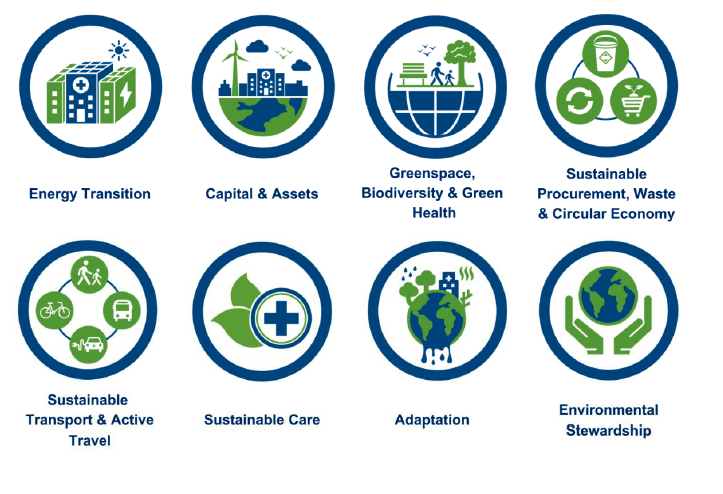
The eight priority workstreams
- Energy Transition
- Capital & Assets
- Greenspace, Biodiversity & Green Health
- Sustainable Procurement, Waste & Circular Economy
- Sustainable Transport & Active Travel
- Sustainable Care
- Adaption
- Environmental Stewardship
Programme governance
NHS Scotland Sustainability Action Delivery Group is responsible for governing the implementation of the NHS Scotland Sustainability Action Programme. It reports to the NHS Scotland Climate Emergency and Sustainability Board.
NHS Scotland Energy Transition Board
In recognition of the level of planning and investment which will be required to carry out NHS’s Scotland energy transition and achieve the target of publicly owned NHS buildings using renewable heat by 2038, an NHS Scotland Energy Transition Board has been established to:
a) manage the Energy Transition Workstream of the Sustainability Action Programme
b) coordinate national support, including to Health Boards for building energy decarbonisation;
c) coordinate and oversee, at a strategic level, a programme of major energy
decarbonisation projects for the NHS.
National Green Healthcare Scotland
The Centre for Sustainable Delivery, which is part of NHS Golden Jubilee, has been commissioned to deliver the National Green Theatres Programme (NGTP) and, more recently, Green Endoscopy and Green Renal Medicine.
Focusing on reducing the environmental impact of theatres provides a great opportunity to make a positive difference in moving towards net zero targets.
The NGTP is founded on the learning from NHS Highland’s Green Theatre Project. This project was a series of local initiatives which reduced greenhouse gas emissions, resource use and waste associated with surgery.
The key areas for actions are:
- low flow anaesthesia
- surgical fluid suction and disposal
- waste segregation at source
- patient warming
- efficient fluid warming
- anaesthetic gases scavenging systems switching
- theatre ventilation
- metal recycling
- plastics recycling
- disposal cup and cutlery ban
- non-sterile glove review.
Integration Joint Boards (IJBs)
Introduction to Integration Joint Boards
Integration Joint Boards (IJBs) were formed following the introduction of the Public Bodies (Joint Working) (Scotland) Act 2014 (‘the 2014 Act’), which came into force on 1 April 2016. The 2014 Act introduced arrangements for integrating health and social care, to improve outcomes for patients, service users and carers. It requires local authorities and NHS health boards to work together to deliver high quality, sustainable care services, through Integration Joint Boards. IJBs are responsible for planning integrated health and social care arrangements and onward service delivery for the communities within their areas.
There are 30 IJBs in Scotland. They are a unique type of public body, as they do not own any assets or directly employ staff. Members of the IJB include staff employed by the local authority and NHS Board, plus others representing key stakeholder groups.
IJBs have an important role to play in the shared national endeavour in responding to the climate crisis and biodiversity loss. As well as being subject to the climate change duties, IJBs are considered - due to their influence on the health and social care sector, and the scale of their annual budgets – to be ‘major players’ and are also subject to the statutory reporting duty.
Collectively, Integration Authorities across Scotland manage almost £9 billion of resources for Health Boards and local authorities, and have the power and authority to drive real change.
Approaching the climate change duties
Reducing emissions
As IJBs do not own or operate any assets, they do not generate scope 1 or scope 2 emissions. These emissions are instead generated by the body responsible for delivering the health or social care service, e.g. the local authority or NHS Board. IJBs’ climate impacts therefore lie in scope 3 indirect emissions and in their wider influence.
While developing a climate change strategy, or equivalent, is likely to be appropriate for IJBs, developing a typical carbon management plan may not. A more suitable approach would be to embed climate and sustainability action within their Strategic Plan. They should consider the work undertaken throughout the year with their partners on relevant climate change policies, and how reducing emissions is taken into account in decision making and planning service delivery. They should ensure that emissions are considered through the impact assessment process, where relevant.
IJBs should consider:
- the indirect emissions generated through purchased goods and services that they are responsible for, or can influence
- how the design and delivery of health and social care services can help deliver emissions reductions
- how they can best use their influence on the health and social sector, and on the communities they serve, to support wider mitigation efforts.
Adaptation
IJBs, through their strategic planning function, have the potential to play a key role in supporting the climate resilience of many of those most vulnerable to the impacts of climate change in Scotland. Similar to the approach taken to mitigation, IJBs should embed adaptation in their strategic plans, account for this in their work with partners, and ensure adaptation is considered through the impact assessment process.
As they have a key strategic planning function, IJBs should ensure that assessment of strategic risks and opportunities includes those posed by the changing climate, both physical and transitional.
It is vital that the needs and vulnerabilities of both those receiving and delivering social care are taken into account in relation to climate change. A significant majority of people working in the social care sector are women; and in 2020, the median age of a public sector adult care worker was over 50[54]. This illustrates the importance of considering the protected characteristics in relation to the changing climate and the risks that this may pose to service delivery, as impacts will be felt disproportionately across the working population.
IJBs should consider:
- critical impacts the changing climate may have on key services or the goods they need to deliver health and social care services; this should include consideration of stacked or cascading risks
- climate impacts on staff and care users, including in relation to the protected characteristics
- how the design and delivery of health and social care services can be made more resilient to the changing climate
- how they can best use their influence on the health and social sector, and on the communities they serve, to support wider adaptation efforts.
Tables 5 to 7 below illustrate how key strategic health and social care priorities and objectives may link to adaptation, and what this might look like for IJBs, NHS Boards and local authorities. The tables are illustrative only and are not exhaustive.
Table 5: Adaptation for IJBs (illustrative example)
Key strategic priorities, objectives or service delivery areas
- Strategic planning and commissioning of adult health and social care services.
- Tackling Health Inequalities in Partnership.
- Home First.
- Prevention and early intervention.
- Equalities and human rights based service.
- Engagement with people who use our services.
- Sustainable service delivery which improves outcomes for people.
- Links to Community Planning Partnership.
Possible climate change adaptation links
Examples of why climate change adaptation may be relevant to different strategic priorities and how climate change may impact the priority or service area.
- Increasing elderly population is likely to be impacted by adverse weather events - need to develop appropriate community and local responses to support this.
- Ability to deliver care at home and DN services in poor weather - impact of staff and ability to travel in region.
- Cost impacts for delivery of services, impacts on staff and people supported.
- Workforce impacts - migration - recruitment impact - skill base etc.
- Impact on externally commissioned services by migration - risks and opportunities.
- Migration issues, population changes and differing needs of that population.
- How people work – remotely, use of technology etc.
Action within your organisation
Describe existing actions, plans or policies that support adaptation in this area.
- Market Facilitation Plan is being developed which will reflect impact of migration on the wider workforce.
- Delivery Boards in place to inform strategic commissioning.
- Workforce Plan is in place and is kept under review - it will be updated to reflect these points within the Annual Action Plan.
- Development of locality-based working.
- IJB links in place with Community Planning Partnership.
- Improvement of relationship with third sector - community based support - support self management.
- Work on early intervention, prevention and support for self management.
Actions that could be completed within your organisation
Describe potential actions or next steps that could form part of an adaptation plan.
- Link with colleagues in NHS and local authority bodies.
- Review workforce annual work plan.
- Climate change is already a priority within the Enabling High Quality Care Plan but actions will be more refined.
- Opportunity to review standardised contract terms and conditions.
- Engage further with providers to highlight environmental impacts of service delivery.
- Opportunity to work more closely with partners to ensure understanding of role IJB (could) have within plans.
- Opportunity to engage with staff on this issue.
- Opportunity to reference impacts of climate change and need for adaptation plans within our broader plans, which could change conversations and way we think about what we are doing and planning.
Relevant collaborators
List any departments, groups or organisations that may be necessary or useful to collaborate with in this area.
- The workforce.
- IJB Board members - their role in decision making.
- An opportunity to review Community Planning Partnership engagement ensuring the right people are involved.
- Localities.
- Commissioned Services.
- Third Sector.
- Voluntary sector.
- Key teams with estates and fleet in both council and NHS.
Table 6: Adaptation for NHS Board (illustrative example)
Key strategic priorities, objectives or service delivery areas
- Mental health, illness and wellbeing:
- monitor changing health of populations.
- Reduce costs.
- Net zero.
- Health inequalities.
- Primary care services.
- Anchor Institution.
- Sustainable models of care.
- Biodiversity and greenspace.
- Management of our impacts to reduce environmental harms.
Possible climate change adaptation links
Examples of why climate change adaptation may be relevant to different strategic priorities and how climate change may impact the priority/service area.
- Impact on service resilience through loss of premises.
- Increased (financial and carbon) costs of cooling and heating.
- Impact on fuel poverty.
- Impact on transport and distribution: people, supplies, staff.
- Changing clinical service needs and specialisms.
- Impact on morbidity - symptoms and recovery.
- Increased costs.
- Increased demand on services.
- Loss of greenspace and biodiversity.
- Further shift away from prevention to crisis management.
- Inability of estate to operate during high-temperature events.
- Viability of home as care setting.
Action within your organisation
Describe existing actions, plans or policies that support adaptation in this area.
- Have a net zero strategy.
- Greenspace and Biodiversity Plan.
- Sustainable Development Framework and Action Plan.
- Climate Change Risk Assessment.
- Seeking to establish process for reporting environmental incidents.
- Surface Water Attenuation.
- Engagement with Edinburgh Net Zero Leadership Board and Climate Compact.
- Building designs use future climate scenarios.
- Winter resilience plans.
- Sustainable Design and Construction guide.
- Heat network development.
Actions that could be completed within your organisation
Describe potential actions or next steps that could form part of an adaptation plan.
- Map of spread across existing plans and functions.
- Stronger engagement across the organisation.
- Corporate focus on adaptation planning.
- Complete a full Climate Risk Assessment.
- Resilience exercise focused on prolonged periods of high temperature.
- Understand other stakeholder risks that could affect us e.g. Scottish Water, Ambulance Service.
- Review historic environmental impact events (flooding, drought, heat waves, landslides).
Relevant collaborators
List any departments, groups or organisations that may be necessary or useful to collaborate with in this area.
- Health and Social Care Services.
- Local authorities.
- Facilities and Estates departments.
- SEPA.
- Community groups.
- Scottish Water.
- Public health and resilience.
- Key supply chain partners.
- Transport Scotland.
- Ambulance Service.
- Sustainability Team.
Table 7: Adaptation for local authority (illustrative example)
Key strategic priorities, objectives or service delivery areas
- Net zero by 2045 at the latest with a series of milestones leading up to 2045.
- Implementing the actions in our Climate Change Strategy.
- Service areas: Education, Housing, Planning and Economic Development, Health and Social Care, Waste, Roads, the Environment (Biodiversity and Climate Change), Parks and Woodlands.
- The council has priorities for the coming five-year period. These reflect the areas that are the most important for the community and improving the quality of life for all those living in, working and visiting the area.
- Priorities include:
- raising educational attainment;
- strengthening care and support for children, adults and older people;
- investing in skills and jobs;
- helping to create strong and sustainable communities;
- tackling homelessness, poverty and inequality.
Possible climate change adaptation links
Examples of why climate change adaptation may be relevant to different strategic priorities and how climate change may impact the priority/service area.
- Concerns as a major landowner, especially of woodland: increased wildfire devaluing our woodlands; increasing public risk and increasing costs for clean up.
- Duty of care to our domestic tenants - concerns of overheating, buildings not being designed to shade, increased river and surface flooding.
- Increased financial pressure: additional climate change-related maintenance and repair costs as either a direct or indirect result of extreme weather events. Not accounting for loss of staff time and costs due to impairment of service delivery.
Action within your organisation
Describe existing actions, plans or policies that support adaptation in this area.
- Adaptation Action Plan
- Assessing risks, embedding climate knowledge, improving tenant awareness, using green infrastructure e.g. SUDS.
- Example action: ensure sufficient transport for care providers in adverse weather conditions to maintain continuity of care. Objective: identify issues that may arise with different types of severe weather e.g. flooding, heatwave or prolonged winter events.
Actions that could be completed within your organisation
Describe potential actions or next steps that could form part of an adaptation plan.
- Flood risk assessments.
- Biodiversity actions taking place on our own landholdings.
- Staff and elected member training.
- Monitor costs associated with weather-related maintenance.
Relevant collaborators
List any departments, groups or organisations that may be necessary or useful to collaborate with in this area.
- Community Planning Partnership.
- Property Services.
- Energy and Climate Change Team.
- Fleet.
- Emergency Planning.
- Flood Risk Management Team.
- NHS.
- Local Climate Action Network .
- Scottish Water and Scottish Water Horizons.
Acting in the most sustainable way
As with adaptation and mitigation, IJBs should embed the duty to act in the most sustainable way into their strategic plans, account for this in their partnership work, and ensure sustainability is considered through the impact assessment process. In particular, IJBs are likely to find that procurement and commissioning offer them significant opportunities to meet this duty.
Refer to section 7.3.6 for information on sustainable commissioning of social care.
Further information and resources
- Health and Social Care: Strategic Plans statutory guidance (Scottish Government)
- Adaptation Scotland provide guidance and tools, and are developing dedicated resources for the social care sector
- Case studies on the Sustainable Procurement Tools site
- Climate hazards and resilience in the workplace, guidance and tools developed by Adaptation Scotland and the Scottish Trade Union movement
- Coalition of Care and Support Providers in Scotland (CCPS)
- IRISS Ethical Commissioning Programme
- Resources on ethical commissioning, Scottish Care
- Procuring for Adaptation: incorporating climate adaptation into investment decisions.
The reporting duty
As ‘major players’ IJBs are subject to the statutory reporting duty. At the time of writing, relevant public bodies are required to report using a standard template. It is noted that this does not reflect the less typical nature of IJBs, for example that they do not generate direct emissions. IJBs should discuss the statutory reporting with their partner local authority and NHS Board, to ensure that:
- collectively, the reports are aligned
- emissions, where relevant, are reported by the most appropriate body, e.g. the scope 3 emissions from purchased goods and services or from business travel
- emissions are not duplicated on bodies’ reports, e.g. a procured service should be reported by one body only, to prevent double counting.
If certain scope 3 emissions are reported by another body, the IJB should note this clearly on their own report.
IJBs do not have delivery functions and will therefore have little to include in the annual report relating to direct operations. However, IJBs should include information on how they have met the climate change duties through their strategic planning and budgetary functions; and through their approach to procurement.
IJBs are also encouraged to use the ‘supporting information’ fields in the reporting template to demonstrate how they have supported wider climate change and sustainability action, and how they have used their influence.
Further guidance:
- Sustainable Scotland Network provide practical guidance to support the statutory reporting duty.
Contact
Email: climate.change@gov.scot