
Climate change duties: statutory guidance for public bodies
Statutory guidance to support public bodies in implementing their climate change duties under the Climate Change (Scotland) Act 2009.
Annex E: Area wide emissions and influence
This annex provides information on area wide emissions and the influence that local authorities and other public bodies may have on these:
- local area wide emissions and place based climate action
- what makes up area wide emissions
- public bodies duties and action on area wide emissions
- public bodies’ influence and collaboration
- developing plans, projects and policies to reduce area wide emissions
- focusing on resource allocation and implementation
- monitoring, reporting and decision making
- what does this mean for public bodies?
- what action public bodies should be taking
- developing partnerships for area wide emissions reduction
- what support is available?
Section 44 of the 2009 Act provides that public bodies have duties, in exercising their functions, to act in the way best calculated to contribute to mitigation and adaptation, and to act in a way that they consider is most sustainable. Many public body functions are key to supporting wider society’s transition to net zero, building climate resilience and achieving sustainable development outcomes. This annex addresses the area wide emissions that public bodies have a critical role in tackling as part of Scotland’s just transition net zero.
Public bodies, especially local authorities, can have significant influence on area wide emissions. This is recognised in a range of policy documents and reports emphasising the importance of local area action on climate change, notably:
- The Scottish Parliament’s Net Zero, Energy and Transport Committee Report on the Role of Local Government and its Cross-Sector Partners in Financing and Delivering a Net Zero Scotland (January 2023)
- Environmental Standards Scotland’s Climate Change Delivery Investigation Improvement Report (December 2023)
- The Climate Change Committee’s Local Government and the Sixth Carbon Budget Report (2020)
- The Carbon Scenario Tool report by Edinburgh Climate Change Institute (May 2022)
Local area wide emissions and place based climate action
‘Area wide’ and ‘place based’ are terms often used interchangeably. Broadly speaking, for the purposes of this guidance, they are used as follows:
- Area wide refers to the totality of activities either planned or currently occurring within a defined geographic area. This aggregates and then breaks down measures, activities, and actions at an area wide scale, in this context those specifically related to sources of emissions and actions for emissions mitigation.
- Place based refers to the design of future solutions and approaches by considering the specific needs and attributes of a place (however that place is defined). This recognises the complex and interconnected nature of a place, and in this case the impact that has on both emissions from a place and the effectiveness of measures to target them. The Place Standard with a Climate Lens is a useful resource for addressing climate change at a place based level.
Places, and place based solutions, should be designed and optimised at different scales for different challenges and solutions. In this guidance, area wide is used primarily to describe plans for emissions reduction which target emissions sources at a local authority level.
What makes up area wide emissions
‘Area wide emissions’ refers to all emissions allocated to local authority areas. There are various methodologies that can be used for this, but protocols and data sets are being established that are improving consistency and clarity. Key for work in Scotland are:
- The Global Protocol on Community-Scale Emission Inventories, produced by the GHG Protocol initiative of the World Resources Institute (WRI) and the World Business Council for Sustainable Development (WBCSD).
- The Local Authority GHG Emissions datasets produced annually as Official Statistics by the UK Government, under the National Atmospheric Emissions Inventory (NAEI).
- The PAS 2080 Standard (and associated Guidance from the Institute of Civil Engineers) on the carbon assessment of infrastructure, buildings, and wider public sector investment decisions.
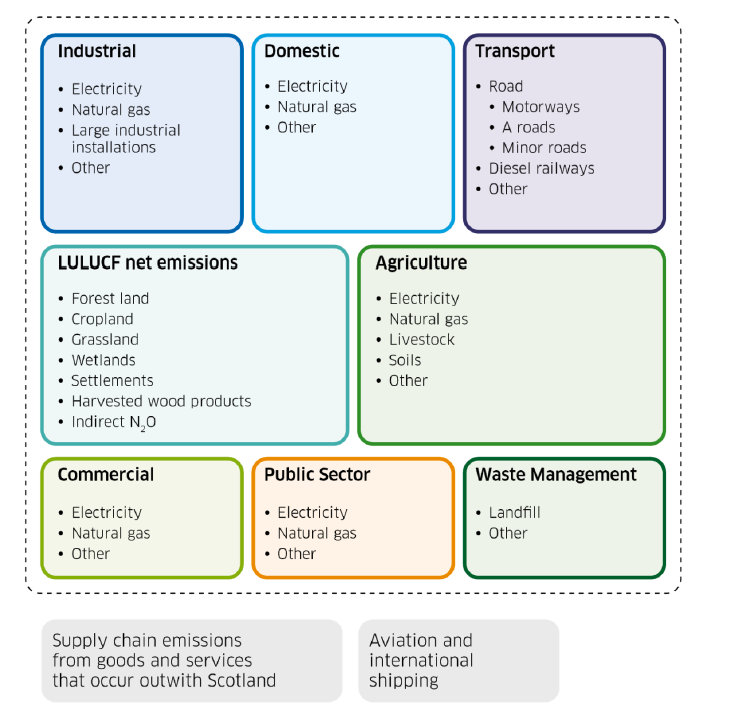
Estimates of greenhouse gas emissions are produced for each local authority and National Park area in the UK from the following broad source categories:
- industry (including electricity-related emissions)
- commercial (including electricity-related emissions)
- public sector (including electricity-related emissions)
- domestic (including electricity-related emissions)
- transport
- land use, land use change and forestry (LULUCF) (including removals of carbon dioxide from the atmosphere, so that net emissions from this sector can sometimes be negative)
- agriculture (including electricity-related emissions)
- waste management (distributed based on the waste arising in each local authority.
Industrial
- Electricity
- Natural gas
- Large industrial installations
- Other
Domestic
- Electricity
- Natural gas
- Other
Transport
- Road
- Motorways
- A roads
- Minor roads
- Diesel railways
- Other
LULUCF net emissions
- Forest land
- Cropland
- Grassland
- Wetlands
- Settlements
- Harvested wood products
- Indirect N2O
Agriculture
- Electricity
- Natural gas
- Livestock
- Soils
- Other
Commercial
- Electricity
- Natural gas
- Other
Public Sector
- Electricity
- Natural gas
- Other
Waste Management
- Landfill
- Other
Supply chain emissions from goods and services that occur outwith Scotland
Aviation and international shipping
Breaking down emissions by source enables the alignment of local area plans, actions and measures for emissions reduction and can be used to develop cost estimates for area-wide emissions reduction pathways.
Local area wide emissions reduction plans should also be designed to secure co-benefits relevant to the National Performance Framework and policy commitments on adaptation, wellbeing, health, economic development, justice and inclusion and biodiversity improvement.
The Scottish Climate Intelligence Service, established in 2023, supports a consistent approach to area wide emissions accounting and local area wide emission reduction planning and action across all local authority areas.
Public bodies duties and action on area wide emissions
Public bodies’ influence and collaboration
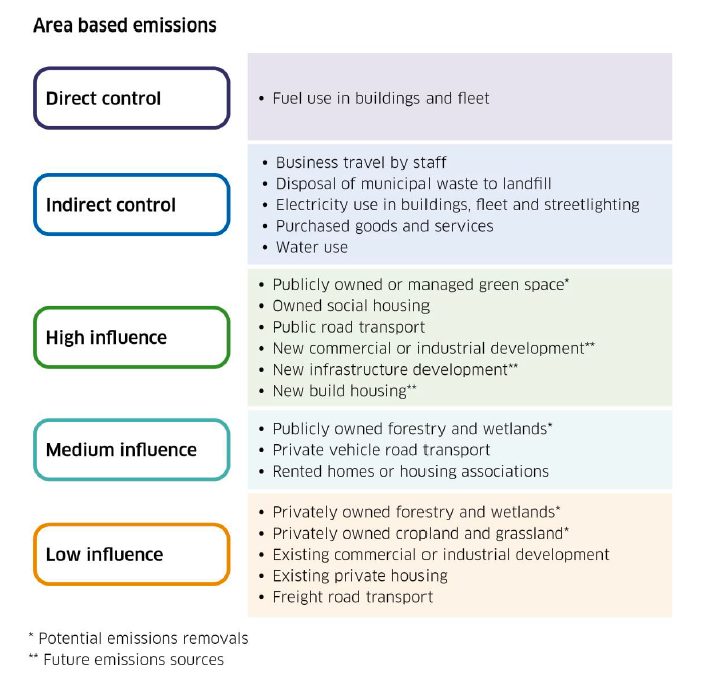
Public bodies need to use their various functions to influence the reduction of area wide emissions. Central to this is the role of local authorities and their Community Planning Partners. Other public bodies can support plans, projects and policies at local authority level to support efforts to reduce emissions locally.
Key to working on area wide emissions is recognising that public bodies have significant influence on these emissions, while they mostly do not have direct control. Much like local economic development and public health improvement, for example, public bodies should work to use their various functions and to collaborate across the public sector and with communities, businesses and third sector organisations, to influence local area emissions from various sources.
Area based emissions
Direct control
- Fuel use in buildings and fleet
Indirect control
- Business travel by staff
- Disposal of municipal waste to landfill
- Electricity use in buildings, fleet and streetlighting
- Purchased goods and services
- Water use
High influence
- Publicly owned or managed green space*
- Owned social housing
- Public road transport
- New commercial or industrial development**
- New infrastructure development**
- New building housing*
Medium influence
- Publicly owned forestry and wetlands*
- Private vehicle road transport
- Rented homes or housing associations
Low influence
- Privately owned forestry and wetlands*
- Privately owned cropland and grassland*
- Existing commercial or industrial development
- Existing private housing
- Freight road transport
* Potential emissions removals
** Future emissions sources
Developing plans, projects and policies to reduce area wide emissions
Having clarified the area wide emissions inventory, public bodies (especially local authorities) should develop a plan for area wide emissions reduction. These plans need clarity on targets, emission reduction pathways, projects and policies. Local authorities and public bodies can draw on Scotland’s Climate Change Plan for relevant policies and projects, and also supplement these with local initiatives.
Of critical importance is a clear policies and projects register, with associated carbon impact assessment that allows calculation of reduction pathways and projections.
Good practice area wide emissions reduction plans should:
- develop plans with clear policies and projects that have a clear and auditable impact on emissions
- consider the functions of your public body and how these influence local area emissions
- identify the collaborations and partnerships needed to effect change and scale up impact
- allocate resources, financial and human, to ensure projects and policies are implemented
- maintain the area wide emissions reduction plan as a live document that remains relevant and impactful on decision making and investment, with on-going monitoring and reporting of progress (where applicable, linked to mandatory public bodies climate change duties reporting).
Influencing area wide emissions is a complex, multi stakeholder challenge. Public bodies are encouraged to use holistic, systems thinking approaches to plan and implement actions. A helpful approach is to make use of the Scottish Government’s Individual, Social, Material (ISM) framework to understand and address the multiple barriers that can affect the effectiveness of projects and policies. For example, consideration needs to be given to material change (infrastructure, technical actions), social change (community engagement, public level information, shifting social norms), and individual change (actions that individuals and families can take and how public bodies can support these).
Focusing on resource allocation and implementation
Plans, policies and projects to reduce area wide emissions need to be resourced and implemented to be effective. The policies and projects register should provide a register of commitments and opportunities that require resourcing.
Public bodies need to take steps to align their own financial, staff and other resources to support implementation of the policies and projects. However, area wide emissions plans require investment, support and resources from other local actors, within the public sector and within business, the voluntary sector and communities. Projects will be of varying scales and will require different levels of investment over varying timescales.
Area wide emissions reduction plans need to be treated as investment plans, with pipelines of investable opportunities. These plans should form the basis of investment portfolios that local authorities and their partners can use to attract both public and private sector investment.
Monitoring, reporting and decision making
It is vital that area wide plans are actively managed, monitored and reported on, and used to attract and scale up investment towards net zero targets on an ongoing basis. Effective monitoring and reporting of area wide plans are needed to ensure they are used for active and committed decision making. The data and reporting of area wide plans should provide leaders and decision makers with information that can be used in spatial and investment planning and decision making.
Local authorities and their partners should use the voluntary Wider Influence section of the mandatory public bodies climate change duties report to report on their area wide emissions plans, policies and projects, and to report progress towards targets. Guidance can be found on the SSN website.
What does this mean for public bodies?
All public bodies across Scotland should be contributing to area wide emissions reduction in designing and delivering their services. Different bodies have distinct roles in designing, supporting, and delivering area wide emissions reduction programmes:
- local authorities are currently leading area wide emissions reduction strategies and action planning across Scotland
- national and regional public bodies should support delivery of local area wide strategies by using their functions to contribute to delivery of projects and policies; and by prioritising their investments, regulatory functions, and activities to enable effective implementation of local projects and policies
- all public bodies should contribute to area wide emissions reductions by minimising their operational impact in the areas in which they are based and operate
- all public bodies should improve their contribution to area wide emissions reductions by recognising and using their wider influence on place.
For all public bodies, this means embedding climate impact into organisational decision making, service delivery and future investment.
What action public bodies should be taking
All public bodies should fully understand their role in area wide emissions reduction and deliver it to the best of their ability. This means building internal capability and capacity to ensure climate impact is embedded into decision making at all levels, and actively supporting other public bodies to develop and deliver area wide emissions reduction strategies.
Given the different roles of public bodies, what this means in practice is that:
- Local authorities should have a plan in place for area wide emissions reduction, which sets out actions for climate mitigation against their place based emissions profile on a pathway to net zero by 2045 at the latest. Plans should have estimated costs based on recognised methodologies against sets of actions for climate mitigation. Local authorities should also be actively convening local partnerships of critical partners who can support and enable development and delivery of area wide programmes.
- National and regional public bodies should prioritise area based emissions reduction as part of their climate change duties, coordinating effectively with local authorities and between public bodies to target measures where national investment is needed to enable effective delivery of local area wide emissions reduction strategies, and where national investments and policies can deliver the most impact into local area wide emissions reduction plans.
- All public bodies should fully contribute to area wide emissions reduction using both their operations and their wider influence. This means that as well as delivering their own commitments to reduce operational emissions, they should actively use their influence on partners, suppliers and service users to reduce area wide emissions, contribute to local partnerships for planning and delivery of emissions reduction, and look for opportunities to share the costs and risks of investment in mitigation actions.
Developing partnerships for area wide emissions reduction
Many of the solutions required for net zero delivery cannot be optimised within one organisation and often other organisations may be better placed to facilitate change. Recognising this, it is important to identify and engage critical local partners as early as possible and to share resources and build collaborations for net zero delivery. Critical partners will come from both the public and private sectors, in particular organisations within an area who may be:
- responsible for a significant share of local emissions
- able to share assets and investment to make better use of resources
- able to reduce the emissions impact of delivering local services
- able to engage local stakeholders in changes to behaviours or business practices.
To realise the benefits of partnerships in delivering net zero, it is important to find mechanisms and resources to ensure partners are aligned, work is coordinated, opportunities are realised, investment is shared, and effort is not duplicated.
Several mechanisms exist or are emerging which either build on or establish new mechanisms focussed on net zero delivery. These include partnerships for strategic infrastructure investment, independent local bodies such as climate commissions and community-led initiatives for local action. All of these can contribute to accelerating place based approaches to climate action making the need for coordination even more vital for effectiveness and impact.
Formal public sector partnerships at local or regional levels can also be important in fostering a partnership approach to local area emissions planning and delivery. These include:
- Community Planning Partnerships
- Regional Land Use Partnerships
- Regional Growth Deal Partnerships
- Regional Economic Partnerships
- Regional Transport Partnerships
- Community Climate Action Hubs
- Local public health partnerships
- Local biodiversity and environmental partnerships
What support is available?
Support is available to local authorities and public bodies for the development and delivery of area wide emissions reduction plans through the recently established Scottish Climate Intelligence Service (SCIS) This has been established by joint funding from Scottish Government and the 32 local authorities to build capacity in local authorities to deliver area wide programmes of emissions reduction as part of the national Climate Change Plan. The SCIS manages a national data platform and supporting service to help local authorities to design, manage, monitor and deliver area-wide programmes for emissions reduction. It is delivered in partnership by the Edinburgh Climate Change Institute, the Improvement Service, and the Sustainable Scotland Network.
The Sustainable Scotland Network (SSN) is an established network of sustainability practitioners across all of Scotland’s public bodies. SSN runs an active programme of events, forums and challenge-specific networks to support collaboration and knowledge sharing across the public sector in responding to climate change and delivering climate impact. It welcomes approaches from public bodies where SSN can support collaboration and progress on key issues.
Contact
Email: climate.change@gov.scot