
Climate change duties: statutory guidance for public bodies
Statutory guidance to support public bodies in implementing their climate change duties under the Climate Change (Scotland) Act 2009.
Annex G: Adaptation: further guidance
This annex provides further guidance to support chapter 6. It contains more technical and complex guidance aimed at organisations with greater adaptation needs, either owing to the size and nature of their estate and assets, or due to their function, i.e. those bodies responsible for delivering essential services. It will also be useful for bodies at a more mature stage in relation to adaptation.
Public bodies should take responsibility to ensure understanding of the challenges of climate change, their role in providing solutions, and in leading the way with action to support an adapting and resilient Scotland. Public bodies should be engaging, collaborating and leading beyond their boundaries to reduce risks, protect the natural and built environments, communities and organisational staff.
The Adaptation Capability Framework for the Scottish public sector, developed by Adaptation Scotland, sets out 42 key adaptation tasks across four capabilities and a series of maturity stages, from ‘Starting’ to ‘Mature’ (table 4). Section 6.3 of the guidance details the tasks associated with the Starting maturity level. As your organisation advances beyond the basics, refer to the Intermediate through to Mature stages for further guidance and support. It is important to note that public bodies may be starting their adaptation journey in some capabilities, but might be more mature in others. Therefore, this guidance is likely be useful wherever public bodies are on their journey.
The Leader’s Climate Adaptation Checklist, produced by SSN, SOLACE, COSLA and the Improvement Service may also be useful.
Table 4: Adaptation Scotland capability framework[44]
Stage: Starting
Understanding the challenge
- UC1A Learn about Scotland’s changing climate and impacts
- UC1B Develop understanding of climate risk and vulnerability
- UC1C Record and consider the impact of recent weather events on your organisation
Organisational culture and resources
- OC1A Consider how adaptation fits with your organisation's objectives
- OC1B Identify resources already available for adaptation
- OC1C Identify key internal stakeholders for adaptation
Strategy, implementation and monitoring
- SIM1A Consider how you contribute to Scotland's adaptation outcomes
- SIM1B Identify existing adaptation work within your organisation
- SIM1C Define strategic adaptation outcomes and or vision
Working together
- WT1A Define your objectives and opportunities for joined working
- WT1B Identify relevant groups, partnerships and forums
- WT1C Join or participate in relevant professional and adaptation networks
Stage: Intermediate
Understanding the challenge
- UC2A Map out how your organisation's functions might be affected by climate change
- UC2B Consider scenarios for future climate change impacts
- UC2C Engage with stakeholders using participatory approaches
Organisational culture and resources
- OC2A Engage with colleagues to optimise adaptation opportunities
- OC2B Define resource requirements to plan and deliver adaptation
- OC2C Establish governance arrangements for adaptation
Strategy, implementation and monitoring
- SIM2A Identify a range of potential adaptation actions
- SIM2B Identify plans, policies and procedures that can include climate adaptation
- SIM2C Deliver initial adaptation actions
Working together
- WT2A Engage with relevant groups, partners and forums
- WT2B Co-ordinate with partners to deliver initial actions
Stage: Advanced
Understanding the challenge
- UC3A Carry out climate change risk assessment
- UC3B Integrate climate adaptation knowledge into internal training and procedures
- UC3C Improve understanding of stakeholder needs
Organisational culture and resources
- OC3A Ensure key people are responsible for adaptation actions
- OC3B Develop an investment plan to mobilise resources for adaptation
Strategy, implementation and monitoring
- SIM3A Appraise adaptation options
- SIM3B Develop an adaptation strategy and action plan
- SIM3C Develop a monitoring approach for achieving your adaptation outcomes
Working together
- WT3A Formalise partnership working
- WT3B Develop communication activities with partners
Stage: Mature
Understanding the challenge
- UC4A Undertake project-level risk assessment
- UC4B Mainstream climate change risk assessment
- UC4C Identify knowledge gaps, seek expertise and foster links with research and innovation
Organisational culture and resources
- OC4A Review and update governance arrangements for adaptation
- OC4B Secure resources to plan and deliver adaptation
Strategy, implementation and monitoring
- SIM4A Implement a programme of adaptation actions
- SIM4B Adopt an adaptive management cycle for adaptation planning
Working together
- WT4A Enhance long-term partnership working
- WT4B Lead in networks and peer organisations
Understanding climate risk
Understanding climate risk is an essential step in planning for the delivery of a public body’s functions and services in Scotland’s changing climate.
The Adaptation Capability Framework includes guidance and tools to support organisations in undertaking climate change risk assessments.
Public bodies should understand their climate risks and review this in line with relevant organisational and business planning cycles, SNAP cycles or where new climate risk data becomes available, where proportionate. It is considered best practice for public bodies to make organisational climate risks publicly available, and where applicable for relevant public bodies, provide a link to where they can be found in their annual report under the mandatory reporting duty.
The rest of this section covers:
- the components of risk: hazard, exposure and vulnerability
- why assessing vulnerability is important
- guidance on climate scenario analysis
- interdependencies and cascading impacts.
Risk components: hazard, exposure and vulnerability
Risk is considered as the interaction between a hazard, exposure and vulnerability. It can be defined as the potential for adverse effects on human health, ecosystems, economies and societies resulting from the interactions between climate related hazards (such as extreme weather events, sea level rise and temperature changes) and the vulnerability and exposure of a specific community, region or system.
Hazard refers to a climate related event or phenomenon with the potential to cause harm or adverse impacts on the environment, human health, economies or societies. Hazards associated with climate change include extreme weather events (floods, droughts and heatwaves) sea level rise, changes in precipitation patterns and shifts in seasonal temperature.
Exposure refers to the degree to which a system (such as a human population or ecosystem) or asset is subjected to climate related hazards. Exposure is highly context specific and is influenced by various factors including geographic location, land use or land management practices. It is the presence of people, infrastructure or assets being in the location in which a hazard may occur. For example, living or working in a flood zone.
Vulnerability is the extent to which an individual, community, society, economy or ecosystem is susceptible to being adversely affected by a hazard. Different communities or systems exposed to a hazard, will be affected differently. Personal or social vulnerabilities (like poverty, inequality and access to resources) can impact a person’s ability to cope with, adapt and recover from hazards.
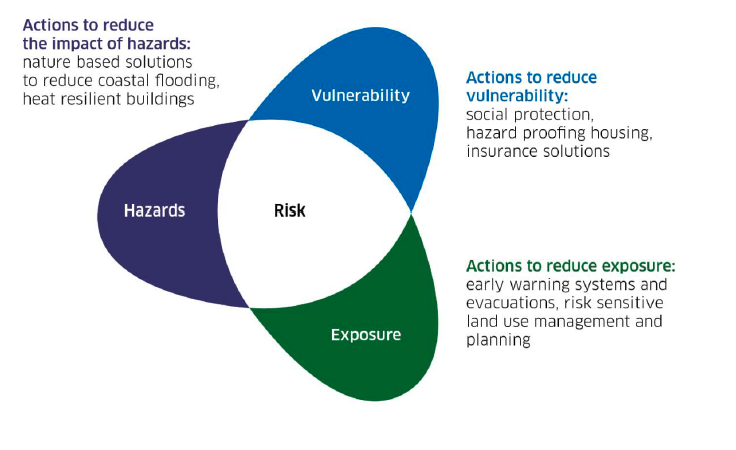
Hazards
Actions to reduce the impacts of hazards: nature based solutions to reduce coastal flooding, heat resilient buildings
Vulnerability
Actions to vulnerability: social protection, hazard proofing housing, insurance solotions
Exposure
Actions to reduce exposure: early warning systems and evacuations, risk sensitive land use management and planning
Why assessing vulnerability is important
Due to existing societal inequalities, certain communities or groups experience climate change impacts disproportionately. Vulnerability can be the result of marginality and lack of access to resources that can be exacerbated by a hazard.
The concept of intersectionality – multiple and compounding inequalities – is highly relevant to the assessment of vulnerability to climate change. Climate change and social, economic and personal factors (such as gender, race, income, age and health status) can act together as risk multipliers, increasing the impacts on health, and health and other inequalities[46]. Taking an intersectional approach can identify and highlight the lived experiences of people with intersecting identities, and help to develop policies, plans and services that address structural inequalities[47].
Some interventions that that could help reduce inequalities (a root cause of climate vulnerability) include:
- developing new green spaces providing shade and cool spaces in lower income urban areas
- support for property flood resilience measures in housing association accommodation
- support to manage excess heat in residential care home buildings.
Any adaptation plan or policy should address inequalities and embed fairness by acknowledging that different groups and communities will be impacted by hazards and weather extremes differently. The set of impact assessments carried out on SNAP3 may contain useful data and research. Further guidance on equalities is provided in chapter 3.
Climate scenario analysis
While further changes in the climate are inevitable over the next two to three decades, changes in the UK’s climate after the 2050s will depend on how rapidly global emissions are reduced[48]. Climate scenario analysis is a tool and process to assesses the impact of different plausible future climate change scenarios on an organisation, project or strategy to inform decisions.
Section 4.2 of this guidance covers taking future climate change into account in all policies, programmes, and projects, including a simple decision-tree (figure 2 in the guidance) to support a proportionate approach. This annex supports public bodies who choose to use ‘climate scenario analysis’ as part of a mature approach to corporate adaptation planning.
HM Treasury and the Government Actuary’s Department have produced climate scenario analysis guidance for use by the public sector (especially those undertaking TCFD-aligned disclosure). This includes the following steps:
Step 1: Survey existing climate risk assessments
Step 2: Establish present-day climate risks and their impacts
Step 3: Understand data requirements
Step 4: Set the scope of the scenario analysis
Step 5: Assess climate risks under different scenarios.
Steps 1 to 3 outlined above are largely the same as for adaptation planning under one future scenario. To guide bodies undertaking Steps 4 to 5 and to drive consistency and comparability of risks across the public sector, this guidance recommends the following when undertaking a climate scenario analysis:
- physical hazards to cover - scenario analysis should cover both chronic and acute physical climate hazards.
- scenario prescription and definition - to drive consistency, bodies should consider both 2°C and 4°C warming scenarios. (Further discussion of warming scenarios and for a table comparing global warming levels and equivalent RCPs and SSP-RCPs for prescribed scenarios please see: Using future climate scenarios to support today’s decision making | ClimateXChange)
- number of scenarios - at least two scenarios should be considered, specifically 2°C and 4°C warming scenarios.
- climate data provider – a list and description of climate hazard data sources is available from ClimatexChange’s Climate data rapid review spreadsheet.
- timeframes to be considered – to drive consistency, this guidance recommends bodies should consider risks in line with the body’s own business planning cycles, plus the climate risks that may arise at 2045-50s (medium term) and 2080s-end of century (long-term).
This guidance recommends that where appropriate public bodies should seek to understand what global warming levels of 2°C and 4°C will mean for organisational climate risk, apply these findings to adaptation plans, and where possible make publicly available what climate futures they are planning for. Where applicable, they should also utilise projections for socio-demographics of the population, as this will influence who is impacted by the changing climate, and how. Public bodies should be clear on the climate change pathways and scenarios, and the risks and implications for their services that they have considered as part of their adaptation planning.
Illustrative example
A land manager is planning the next iteration of a local land management plan, and they are looking to see how climate change will impact the landscape in addition to infrastructure in the area. They have a bridge in the area that is due for maintenance in five years, and land that is due for commercial timber replanting now that will stand for the next 60 years and is a very important asset.
They choose to assess the change in frequency and intensity of hazards associated with 2°C and 4°C of global warming. They decide to replant this area of forest in a way that is resilient under higher warming scenarios to increase the chance that the trees will still be standing in a 4°C world. This includes consideration of the changing growing conditions, water availability, the changing risks from pests and diseases and the species mix. They decide not to take immediate action on adapting the bridge as, short term, the climate scenarios suggest limited damage that can be tolerated. However, they plan to adapt the bridge at the next maintenance cycle to futureproof it and save on resources.
They plan out future decision review points in line with climate risk assessment review points and ad hoc reviews as new developments come forward from climate science and review bodies, like the Met Office, CCC and IPCC. They also agree to review should experience suggest that they may not have gone far enough in their adaptation measures, for example if they see a more rapid change in flooding frequency or severity.
Interdependencies and cascading impacts
When climate-related risks like extreme weather or flooding strike, their impacts can ripple across sectors, disrupting services and communities. Where disruption to one organisation or asset affects others, this is referred to as a cascading risk (see figure 14).
When conducting a climate change risk assessment it is important to consider possible interdependencies. This involves considering impacts that extend beyond your organisation boundaries. Specifically, it is helpful to identify the inputs or infrastructure (transport networks, energy, water) that are important to your organisation’s functions and the ‘cascading’ impact to your organisation if these services and or infrastructure are disrupted.
Likewise, it is important to consider the implications for other organisations if your services or assets are disrupted as consequence of climate change or extreme weather. This is particularly relevant for organisations managing infrastructure assets. Disruption to core infrastructure and services have a significant impact on health, wellbeing and equity, for example people being unable to access work, education, food, social support, health and social care.
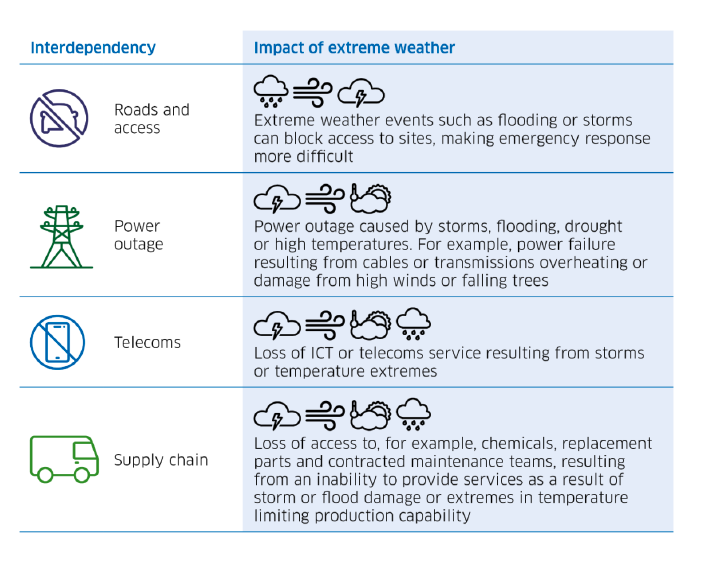
Interdependency
Roads and access
Impact of extreme weather
Extreme weather events such as flooding or storms can block access to sites, making emergency response more difficult
Power outage
Power outage caused by storms, flooding, drought or high temperatures. For example, power failure resulting from cables or transmissions overheating or damage from high winds or falling trees
Telecoms
Loss of ICT or telecoms service resulting from storms or temperature extremes
Supply chain
Loss of access to, for example, chemicals, replacement parts and contracted maintenance teams, resulting from an inability to provide services as a result of storm or flood damage or extremes in temperature limiting production capability
Public bodies should seek to work in partnership with diverse stakeholders to pool knowledge, align efforts and take co-ordinated actions to build wider system resilience to these shared challenges.
Illustrative example
A local authority may be concerned over public water supply availability for their community during periods of drought. They may reach out to Scottish Water to get a better understanding of risk in their area, who in turn may offer to work in partnership to ensure decisions the local authority makes are not causing further future ‘lock-in’, increasing vulnerabilities to this risk. They may also engage with local landowners who have a part to play to ensure our natural landscape supports public water supply. The local authority may also look to engage and work in partnership with a wide range of community groups, and education establishments to ensure education about water usage is on the agenda in an accessible format for all.
Public bodies should seek to understand the whole system in which they operate and should proactively nurture opportunities to collaborate to deliver adaptation and wider multiple benefits in partnership, in addition to reducing risk.
The Climate Ready Infrastructure Scotland Forum is a specific collaboration between those who plan, deliver, and manage infrastructure across Scotland to improve coordinatated action across infrastructure networks to manage climate risks.
Adaptation strategy, planning and implementation
Public bodies’ understanding of climate risk is the foundation to developing an adaptation strategy and plan for the delivery of their functions and services in Scotland’s changing climate.
Adaptation is a long term evolving challenge that requires planning and implementation that is strategic yet flexible. The Adaptation Capability Framework includes guidance and tools to support strategic adaptation planning and implementation.
Developing an adaptation strategy and plan is not an exercise for individual staff members to do in isolation. To ensure an adaptation strategy and plan are holistic and inclusive, there is a need for bottom-up approaches. Public bodies should assess which parts of the organisation might be impacted by climate hazards, who might feed into strategies and plans, and who might be key to delivering adaptation.
Public bodies should consider how their adaptation strategy fits with SNAP3; and specific SNAP3 policies and deliverables should be included in a public body’s adaptation plan where relevant. Alignment with other national strategies, such as the National Performance Framework, National Flood Resilience Strategy and Scottish Biodiversity Strategy, should also be considered.
It is important to remember that there is no final state to adaptation. Once strategies and plans are complete and action has been taken, this does not signify the end of the journey. Public bodies will need to periodically review strategies, plans, actions, and capabilities to ensure climate adaptation and resilience is maintained.
The rest of this section covers guidance on:
- financial planning for adaptation
- monitoring and evaluation
- collaboration for adaptation.
Financial planning for adaptation
This section covers the need to consider climate risks as part of long-term financial planning, and guidance on developing an investment plan to mobilise resources for delivery of an adaptation action plan.
As outlined by the Scottish Fiscal Commission, climate change poses a significant risk to public finances with cost of damages resulting from climate events already in the billions per year [49]. In order to deliver value for money spending and reduce future losses resulting from climate change it is important that public bodies consider climate risks as part of long-term financial planning.
This involves considering investment in primary adaptation interventions (such as flood resilience) but also ‘climate-proofing’ of wider investment (such as maintenance costs for existing infrastructure).
For example, the cost to maintain current service levels in some sectors are increasing. Public bodies delivering essential services should develop an understanding of their baseline service levels, the impacts climate change will have on these and the investment required to maintain acceptable service levels in the changing climate.
Scottish Water - Sustaining services in a changing climate
Adapting infrastructure to cope with the challenges of climate change is a complex issue. Scottish Water is considering the implications of climate change in terms of the level of services provided by its infrastructure today, and the way in which this will be impacted by climate change over the next 25 years. This covers issues such as the hydraulic capacity of its networks, the balance between water resources and customer demand, and the increased risk to the integrity of its assets.
This enables Scottish Water to get a perspective on the adaptation requirements and costs to sustain today’s level of service in a climate change future. This is important to enable the financial impact of climate change to be reflected in strategic investment planning. A simple model of this approach is shown below in figure 15.
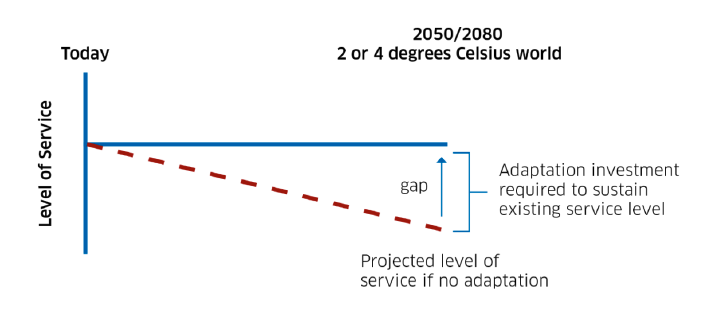
An example of this in practice is the service implications of more water pipe bursts. Scottish Water has identified a risk that there will be more bursts in the network in the future as soil moisture levels change, the ground moves and more bursts occur. If the rate of mains repair and rehabilitation is not increased there will be a deterioration in service and more customers may be at risk of service interruptions. It is possible using this approach to estimate how much Scottish Water may need to spend in the future to sustain today’s service levels.
Increased investment will be needed to respond to climate impacts and public bodies should engage in preventative spend, where there is evidence that early, preventative spend will save money in the longer term. In a number of sectors early, preventative spend in adaptation has been shown to save money in the longer term – with benefit-cost ratios ranging from 2:1 to 10:1, i.e., every £1 invested in adaptation could result in £2 to £10 in net economic benefits
Business cases will be needed to mobilise additional resources for adaptation action. Developing your business case for adaptation plans or projects will involve compiling various sources of information:
- your organisation’s key climate risks
- your adaptation objectives
- estimation of costs – considering both capital and operational costs, including maintenance of assets where relevant.
- co-benefits – assess potential environmental, social, health, and economic co-benefits of adaptation projects to strengthen the case for investment. Highlight the value proposition of your adaptation plan, including its co-benefits and potential cost savings from avoiding climate-related damages.
- sources of finance - familiarise yourself with a range of finance possibilities, including those outside of the public sector. Consider how you can build an investment plan to mobilise a broad set of funding.
Further guidance and resources available include:
- Adaptation Scotland guidance and case studies on business case development. This identifies current barriers to adaptation finance, and aims to support development of the knowledge and skills needed to successfully finance adaptation projects in Scotland. This guide will be helpful to public bodies who are looking to assess financing options for climate adaptation related projects.
- The Green Book: Central Government Guidance on Options and Appraisal and the supplementary business case guidance for projects and programmes can support in undertaking value for money appraisals which account for climate change.
- Publications from the CCC, such as the Investment for a well-adapted UK report, may aid in conversations around adaptation investment needs and support business cases.
Monitoring and evaluation
A Monitoring and Evaluation framework was published alongside SNAP3. When assessing how best to monitor their adaptation action, bodies may find it helpful to look at the national monitoring indicators, and consider whether these could also be useful at local or organisational level, in an adapted form.
For example (these are intended to be illustrative only and are not exhaustive):
(C5) Culture and historic environment: Scotland's historic environment is preparing for a future climate, and the transformational power of culture, heritage and creativity supports Scotland's adaptation journey.
Example organisational indicators for a public body that owns historic buildings as part of its estate (e.g. a body may own traditional listed buildings in a city centre):
- Proportion of historic buildings which have been climate risk assessed
- Proportion of historic buildings for which a site-specific adaptation actions have been developed.
(PS4) Transport system: the transport system is prepared for current and future impacts of climate change and is safe for all users, reliable for everyday journeys and resilient to weather-related disruption.
Example organisational indicators for a local authority responsible for maintaining the road network (excluding trunk roads and infrastructure under the responsibility of Transport Scotland):
- Proportion of A roads which require close monitoring
- Proportion of B roads which require close monitoring
- Proportion of road bridges which have been climate risk assessed
- Proportion of road bridges which may require maintenance.
(B1) Increasing business understanding of climate risks and adaptation action: businesses understand the risks posed by climate change and are supported to embed climate risks into governance, investment, and operations, and are collaborating on effective adaptation action.
Example organisational indicators for a public body that awards grant funding to businesses:
- Proportion of businesses in receipt of grant funding monitoring climate related risks
- Proportion of businesses in receipt of grant funding reporting taking action to adapt to the effects of climate change.
The Adaptation Scotland Benchmarking Tool can be used to track progress against the tasks set out in the Adaptation Capability Framework and used to monitor an organisation’s adaptation capability.
Collaboration for adaptation
Adaptation is not possible without collaboration. No organisation can adapt in isolation; by working together public bodies can achieve positive, cooperative adaptation outcomes.
“Working together” is one of the Adaptation Capability Framework’s four capabilities.
It is imperative that public bodies establish good relationships and connections with key partners across the space, place, community and system in which they operate. Collaborating allows for knowledge sharing, resource sharing, joined-up solutions and inclusive adaptation. This way of working is in line with the Christie Commission Review of Public Services in Scotland.
Collaboration is also crucial to the success of certain adaptation actions. All key partners need to work towards the same goal: often a break in this chain can lead to unsuccessful adaptation or greater resource spent on trying to fight against the outliers.
To build the organisation’s capacity to collaborate, public bodies should seek to:
- join relevant networks for their sector or for climate adaptation
- engage with a wide range of stakeholders on an on-going basis
- take participatory and bottom-up approaches
- work in partnership to achieve adaptation outcomes
- take joint action to adapt to climate change.
Contact
Email: climate.change@gov.scot