
Preventing Harm, Promoting Recovery: Scotland's Alcohol & Drugs Strategic Plan 2026 – 2035
The Alcohol & Drugs Strategic Plan sets out the Scottish Government and COSLA's long-term approach to addressing alcohol and drug harms.
Human Rights-Based Approach
Outcome: People affected by alcohol and drugs have their human rights fulfilled.
Our overarching vision is for a Scotland where everyone can live with human dignity through the realisation of internationally recognised human rights. Therefore, we work to secure all human rights - civil, political, economic, social, cultural and environmental - for everyone in Scottish society. Significant progress has been made in respecting and protecting children’s rights through the enactment of the United Nations Convention on the Rights of the Child (Incorporation) (Scotland) Act 2024. The Scottish Government’s Equality and Human Rights Mainstreaming Strategy sets out an ambition to move towards a culture where equality and human rights are embedded in systems, structures, and outcomes. The Scottish Government is committed to further strengthening human rights laws through the introduction of a Human Rights Bill in the next parliamentary session - subject to the outcome of the 2026 Scottish Parliament election.
In line with this, our strategic approach to alcohol and drugs policy will continue to be firmly rooted in a human rights-based approach. Continuing to centre this approach will help to empower people to claim their rights and actively participate in decisions that shape their lives, ensuring that they are supported to reach their recovery goals. It will foster a culture of dignity, respect and agency which is critical to tackling the stigma that remains a significant barrier to accessing support and services.
To translate this commitment into meaningful change, we must ensure that this approach is not only articulated at the national level but actively embedded in everyday practice and across all levels.
Our key priorities for promoting a human rights-based approach include:
- Embedding the Charter of Rights for People Affected by Substance Use
- Empowering people and families with lived and living experience
- Tackling stigma
- Ensuring non-discrimination and promoting equality
Embedding the Charter of Rights for People Affected by Substance Use
The Charter of Rights for People Affected by Substance Use - recognised by the UN Office of the High Commissioner for Human Rights as the first of its kind globally - aims to ensure people affected by substance use know their human rights and the support they can expect to receive. It supports service providers to understand how to implement a human rights-based approach. It was co-designed by a Change Team of people with life experience of alcohol and drug harms, and through extensive consultation with people affected by substance use (rights-holders) and those responsible for the design, delivery and monitoring of substance use-related support services (duty-bearers). The ‘Key Rights’ described by the Charter come mostly from existing law - the Human Rights Act 1998 and international human rights law - andinclude the right to the highest attainable standard of physical and mental health. Everyone is entitled to timely and appropriate support for physical and mental health, and services need to be available, accessible, acceptable and of quality, without discrimination. This has become known as the triple AAAQ framework.
The UN Panel Principles underpin the Charter by promoting individuals’ active participation in decisions that affect them, ensuring accountability from duty-bearers, and safeguarding equality and non-discrimination. They also emphasise empowering individuals and communities to understand and claim their rights, while ensuring that approaches align with domestic and international legal standards.
The Charter is accompanied by a comprehensive Toolkit that provides guidance to both duty-bearers and rights-holders as well as examples of emerging practice. This includes how to apply the FAIR Approach - a recommended model for putting a human rights-based approach into practice. This involves understanding the facts and experiences of people affected; analysing the human rights at stake; identifying what actions are required and who is responsible for them; and reviewing and evaluating the outcomes to ensure accountability and continuous improvement.
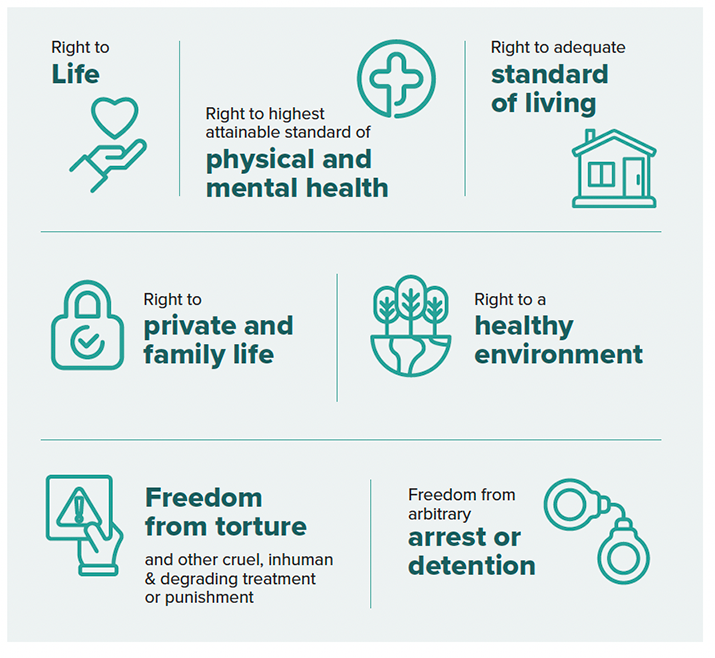
Figure 2 plain text
- Right to Life
- Right to highest attainable standard of physical and mental health
- Right to adequate standard of living
- Right to private and family life
- Right to a healthy environment
- Freedom from torture and other cruel, inhuman & degrading treatment or punishment
- Freedom from arbitrary arrest or detention
Commitment: We will continue to embed the Charter of Rights through:
- Identifying and maximising opportunities to increase visibility of the Charter and promote rights-based approaches across the public sector.
- Utilising the FAIR approach alongside the Panel Principles and the AAAQ framework to embed the Charter within key frameworks, including the National Service Specification, the revised Partnership Delivery Framework for ADPs, and future national standards and quality assurance processes for substance use services.
- Ensuring the ethos of the Charter is reflected in relevant grant processes and procurement frameworks for future funding programmes.
- Building oversight of the Charter’s implementation into governance structures for alcohol and drugs, ensuring clear accountability for progress and delivery.
Empowering people and families with lived and living experience
A fundamental priority is ensuring that people are empowered to express their needs, make informed choices and have agency and control over the support they receive. People with lived and living experience of alcohol and drug harms offer first hand insights into the complexities of substance use and the type of support required to prevent harms and promote recovery. Their participation in the design, delivery and monitoring of services is crucial.
All ADPs have formal mechanisms in place to gather feedback from people with lived and living experience[40] and there has been invaluable contributions to national initiatives including the Charter of Rights, Medication Assisted Treatment (MAT) standards and the residential rehabilitation programme.
Significant funding has supported lived and living experience-led initiatives, including an award-winning traineeship programme, peer research and peer naloxone programmes as well as family support groups and recovery communities.[41] Recovery communities are a vital part of Scotland’s response to alcohol and drug harms. These communities offer peer-led support, connection, hope and purpose - helping people sustain recovery and rebuild their lives. They also play a powerful role in tackling stigma and promoting inclusion, demonstrating that recovery is not only possible, but visible and valued.[42]
Independent advocacy plays a key role in empowering people to understand and claim their rights, and navigate systems in ways that strengthen their autonomy and control over their recovery journey. Significant progress has already been made through the continued implementation of the MAT Standard 8, which states that every person receiving MAT should have access to independent advocacy and support for housing, welfare and income needs.[43]
Commitment: We will continue to empower people and families with lived and living experience of substance use harms through:
- Supporting initiatives that enable meaningful and sustained engagement, including recovery communities and living experience empowerment work.
- Ensuring meaningful participation in the design, delivery and monitoring of services through local and national governance structures.
- Strengthening the consistent offer and integration of independent advocacy within care pathways, in line with MAT Standard 8, so that people are aware of and able to exercise their rights.
Tackling stigma
Stigma continues to be a barrier to recovery from alcohol and drug use.[44] This can take the form of internalised shame and self-stigma, judgment from loved ones, systemic inequalities within institutions, or harmful stereotypes reinforced by society. Stigma and discrimination reduce the availability and accessibility of the fundamental building blocks of health. This limits opportunities for reducing harm and increases the risk of poor health and adverse outcomes, all of which can lead to widened inequalities.
We recognise that tackling stigma requires more than isolated interventions, it demands a sustained and systemic culture change. This means shifting attitudes, language, and behaviours across society, including within public services, media, communities, and workplaces. It also means challenging the structural and institutional barriers that reinforce discrimination and exclusion.
Commitment: We will continue to take action to tackle stigma through:
- Building on interventions such as the Knowledge and Skills Framework and Pathways to Employment to challenge stigma and recognise the value of people with lived experience in the workplace.
- Continuing to support initiatives that challenge stigma in services by promoting compassionate, rights-based approaches and amplifying the voices of people with lived experience.
- Supporting service providers to identify, interrogate and amend policies and procedures that inadvertently or otherwise result in stigmatising practices.
- Exploring alignment with wider campaigns to tackle broader elements of stigma in services.
Ensuring non-discrimination and promoting equality
We recognise different groups have distinct needs and may encounter specific barriers in accessing support.[45] In developing this Plan, we have carefully assessed relevant equalities data and undertaken an Equality Impact Assessment (EqIA). The EqIA outlines potential equality impacts and key considerations to ensure the Plan promotes non-discrimination and responds effectively to diverse needs.
A Children’s Rights and Wellbeing Impact Assessment and Fairer Scotland Duty Impact Assessment have also been undertaken.
Men account for a higher number of alcohol and drug related deaths.[46] However, women affected by substance use face unique challenges, including stigma and discrimination, when accessing substance use treatment and wider services, and these challenges are often compounded by experience of gender-based violence and fears around societal expectations, pregnancy and parenthood.[47][48][49] The Women’s Health Plan sets out the Scottish Government’s ambition that women and girls in Scotland should enjoy the best possible health.
Other equality groups can encounter specific barriers when accessing support services. For example, minority ethnic communities can face challenges such as language barriers or a lack of services that adopt culturally sensitive approaches.[50][51] LGBTQI+ people may experience difficulties accessing support where services lack training on the impact of sexual and gender identity.[52][53] Distinct needs also exist across different age groups, disabled people, people with physical and mental health conditions and neurodiverse people – including people who are undiagnosed - which require a tailored approach to care and support.[54][55] It is also important to recognise that different communities can have distinct patterns of drug use, linked to a range of social, cultural or environmental motivations. Other groups that may have experienced specific challenges and trauma such as veterans, care experienced people, people involved in the justice system, people experiencing homelessness and people who sell sex can also face barriers and require tailored support.
Commitment: We will embed the human rights principle of non-discrimination and equality across service delivery through:
- Utilising and improving data and service feedback to identify inequalities, inform decision-making, and continuously improve service equity and outcomes.
- Embedding a gendered approach in the design and delivery of policies, and services to address the distinct challenges faced by women and men.
- Maximising opportunities through the design and implementation of our funding approach to meet equality needs.
Case Study: Embedding Human Rights
In collaboration with neighbouring ADPs, Moray ADP co-hosted a Grampian-wide engagement event involving people with lived and living experience, service providers, managers and Police Scotland. The event generated 46 priority statements shaped directly by lived and living experience voices, reflecting what rights mean in practice and identifying barriers to realising them.
A key outcome was a request for a portable resource to help people “carry their rights in hand.” In response, a working group of people with lived and living experience was formed to co-design and deliver two practical tools both aimed at raising awareness and empowering individuals to understand and assert their rights.
Insights from these events, alongside experiential interviews and input from the wider community, informed the development of the Moray Charter Toolkit. This toolkit, along with the national Charter of Rights, has been formally incorporated into Moray ADP’s Strategic Delivery Plan, embedding rights-based principles into local planning and accountability.
Importantly, this approach led to tangible service improvements. Through a rights-based lens, Moray ADP identified that a key service venue was not trauma-informed and lacked accessibility. As a result, the service was relocated to a more appropriate setting, leading to a measurable increase in service uptake. Training, awareness-raising, and collaborative working have been central to Moray’s success in implementing the Charter. Their experience highlights how embedding human rights can drive culture change, improve service design, and empower people affected by substance use.
Contact
Email: alcoholanddrugsplan@gov.scot