
Publication - Strategy/plan
Preventing Harm, Promoting Recovery: Scotland's Alcohol & Drugs Strategic Plan 2026 – 2035
The Alcohol & Drugs Strategic Plan sets out the Scottish Government and COSLA's long-term approach to addressing alcohol and drug harms.
The Challenge
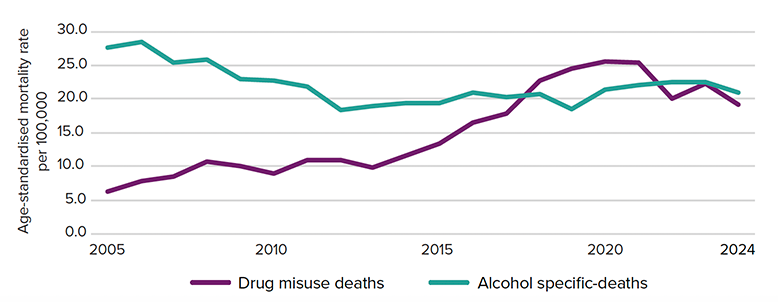
Scotland has persistently high mortality rates from alcohol and drugs
- Scotland continues to have the highest rate of drug and alcohol deaths in the UK.[7] The loss of life, particularly amongst those aged 35-55 years, means that drug-related deaths are impacting on overall life expectancy trends for Scotland and are exacerbating health inequalities.[8][9]
High-risk consumption patterns of alcohol and drugs remain
- Estimated alcohol sales per adult are higher in Scotland than in England & Wales.[11] In Scotland, almost 1 in 5 adults show signs of hazardous or harmful drinking or possible alcohol dependency.[12]
- 43,400 people in Scotland were estimated to have opioid dependence in 2022/23, with limited data on prevalence of non-opioid and polydrug use.[13] In 2023, 14% of adults selfreported that they had used drugs in the previous 12 months.[14]
There are changing patterns in drug use and supply
- There has been a rise in the use of potent synthetic drugs and cocaine, which pose new challenges and considerations for harm reduction, treatment and support.[15][16] Cocaine is now the most commonly reported main drug used by people starting specialist drug treatment in Scotland.[17]
- Drug markets continue to evolve under geopolitical influences, with online platforms and social media facilitating access.[18]
Alcohol and drug related harms affect different demographic groups in different ways
- Men account for approximately two thirds of alcohol and drug related deaths, however the gap between sexes has narrowed over time.[19]
- The age profile of alcohol and drug deaths has become older over time.[20]
- Young people (16–24) report higher levels of harmful or hazardous drinking behaviours,[21] however, adolescent drunkenness is at a 30-year low.[22] Opioid use is less common among young people, with reported increasing use of ketamine.[23]
- Alcohol and drug harms disproportionately impact deprived communities.[24]
There is an ongoing need for mental health support and holistic care
- Many people using substances do so to cope with mental health issues, which are often caused by trauma, adverse childhood experiences, and psychological distress, and there is high demand and unmet needs in relation to counselling and mental health support.[25] There is a high prevalence of psychiatric conditions amongst people suffering drug-related deaths.[26]
- Many people with alcohol and drug issues face overlapping challenges including homelessness, offending and domestic violence and abuse.[27]
Alcohol and drugs can negatively impact families
- Nearly 4 in 10 of those added to the child protection register in 2023/2024 had a concern identified relating to parental substance use (drugs/alcohol).[28]
- Hundreds of children lose a parent or parental figure to a drug death every year.[29]
There are inconsistencies in services and support available
- Whilst there is general agreement that policies are well placed, gaps remain in consistent implementation across regions and population groups.[30][31]
- Rural residents, people experiencing homelessness, and women report higher unmet needs.[32]
- Women face unique barriers, including stigma especially around pregnancy and parenting and fear of child removal when opening up about substance use issues.[33]
- Many equalities groups encounter unique barriers when accessing services, often because services lack tailored approaches that address the individual needs of specific demographic groups such as ethnic minorities,[34] LGBTQ+ individuals,[35] children and young people,[36] and disabled people.[37] People selling /exchanging sex may also experience barriers in accessing support.[38]
- Stigma can be experienced in many different ways, but continues to be a barrier in accessing help and support.[39]
Contact
Email: alcoholanddrugsplan@gov.scot