
National Centre for Remote and Rural Health and Care: evaluation
The report is an evaluation of the National Centre for Remote and Rural Health and Care.
Chapter 5: Recruitment and Retention
Recruitment and Retention remains one of the most pressing challenges for rural health systems, driven by workforce shortages, demographic trends, and structural barriers. The Centre’s work in this area aims to develop practical frameworks, pilot innovative approaches, and strengthen collaboration to support workforce stability. This chapter examines progress on recruitment and retention initiatives and reflects on the systemic factors influencing their success.
Inaugural Phase Targets
The National Centre’s targets during its Inaugural Phase for work under Recruitment and Retention, and their progress to date, are described below.
Targets achieved:
- New network established for engagement and knowledge sharing on R&R Healthcare recruitment and retention improvement models nationally and internationally
- The Rural Recruitment and Retention Stakeholder Network was established in early 2024.
- Co‑hosted SG recruitment & retention stakeholder sessions (2024–25) across health and social care, informing the SG R&R Strategy 2025, now launched as the SG R&R Direct Delivery Model with first stage underway (2025–26).
- The National Centre also established a Primary Care & Community Services R&R Stakeholder Reference Group, meeting quarterly since April 2025.
Targets progressed:
- Design, delivery, and evaluation of 5 new improvement programmes using evidence‑based R&R models
- The Making it Work (MiW) framework was applied in Skye; report published October 2025.
- As of September 2025, discussions were underway to implement the framework in two additional localities.
- As of September 2025, development continued on a toolkit and resources for community‑engaged recruitment programmes.
- Funding and support for the Community Induction Officer Pilot Programme (Highland) were ongoing as of September 2025.
- As of June 2025, partnership work with Scottish Rural Action continued to agree two new joint rural community‑led recruitment & retention programmes.
- Design and delivery of effective knowledge sharing and dissemination of outcomes from each programme
- The initial Living Library of Rural Recruitment Case Studies was completed and shared in June 2025.
- Lessons from the Community Engagement Officer role in Skye were published in October 2025.
- A full Making it Work (Skye) report and an accompanying evaluation framework were published.
- An options paper on the Scottish Government Recruitment & Retention Strategy Direct Support tool was approved in August 2025.
The Recruitment and Retention pillar has made meaningful progress but has not yet fully met its inaugural phase targets. Of the three core objectives, only one, the establishment of a Rural Recruitment and Retention Stakeholder Network, has been achieved, with the network active since early 2024 and hosting multiple multi-agency sessions. The other targets remain in progress.
The design, delivery and evaluation of five new improvement programmes are underway, with the Making it Work framework implemented and evaluated in Skye and discussions ongoing to extend this to additional localities. Development of toolkits, community-led recruitment initiatives and the Community Induction Officer Pilot are also advancing but not complete. Similarly, knowledge-sharing activities have begun, including the Living Library of case studies and publication of lessons from Skye, yet full dissemination across all programmes is still pending. These developments indicate strong foundations, but the intended outcomes, improved recruitment, retention and sustainable service capacity, will depend on completing evaluations and scaling successful models in any future phases of work.
Summary of National Centre Activities
Recruitment and retention are central to the National Centre’s mission to strengthen the sustainability of remote and rural healthcare. The inaugural phase focused on practical frameworks, collaborative networks and knowledge-sharing initiatives designed to address persistent workforce challenges. Key activities included:
- Multi-agency stakeholder engagement network: Sessions convening stakeholders representing health, social care and children’s services. These sessions explored barriers to recruitment, marketing strategies, pastoral care and community engagement, creating a platform for shared learning and problem-solving. One participant described these sessions as “a rare opportunity to hear what’s working elsewhere and adapt it locally.”
- Living Library of Recruitment Case Studies: A digital repository showcasing successful community-led recruitment models, enabling replication and adaptation across Scotland.
- Making It Work (MiW) Framework: Implementation projects launched in Skye, including mapping and analysis, creation of a community induction officer role and development of an adaptable resource pack for wider rollout.
- Knowledge sharing and tool development: Contributions to the Scottish Government Recruitment Toolkit and systematic review of recruitment strategies to update MiW, ensuring alignment with national workforce planning.
- Linked education and research initiatives: Support for the RAP MSc, fellowship accreditation, and evaluation of recruitment-focused projects, reinforcing the link between professional development and retention.
These activities have provided practical tools and collaborative spaces for tackling recruitment challenges, while laying the groundwork for more systemic change.
Reflections
Engagement and Awareness
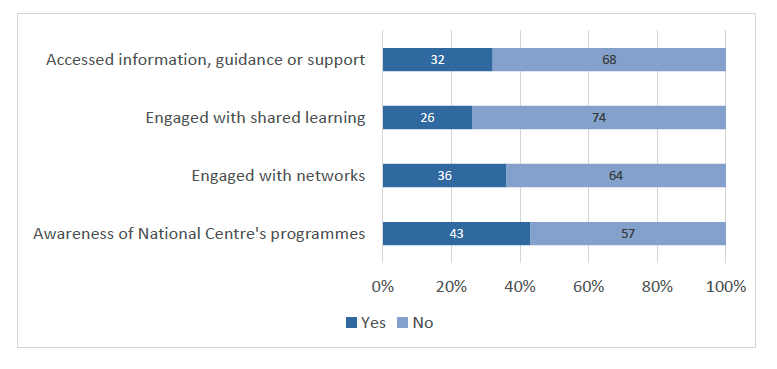
Survey findings indicated moderate engagement (Figure 5.1):
- 43% of respondents were aware of recruitment and retention programmes led by The National Centre.
- 36% had engaged with networks focused on recruitment and retention.
- 26% had participated in shared learning activities.
- 32% accessed new guidance or support since The National Centre’s establishment.
These figures suggest progress but also highlight gaps in visibility and reach. Engagement appeared concentrated among those already connected to NES or professional networks, with limited reach beyond general practice. Therefore, while The National Centre has succeeded in creating opportunities for collaboration, awareness of these initiatives remains uneven.
One interviewee noted that:
“I've seen stuff in emails about improving recruitment and retention, but it doesn't seem very innovative. I think there needs to be a more grassroots approach from both rural communities and from clinicians to resolve this.”
Benefits
Stakeholders reported tangible benefits from the National Centre’s work such as:
- Access to frameworks such as Making it Work and resources like the Living Library.
- Opportunities for knowledge exchange through multi-agency sessions.
- Practical tools to support local recruitment planning and workforce stability.
Some participants described applying insights from Centre-led initiatives to inform local strategies, including community engagement and induction processes.
These examples illustrate how shared learning is beginning to influence practice.
Challenges
Despite these successes, significant barriers to recruitment and retention of healthcare staff in rural and remote settings persist:
- Housing and infrastructure: Lack of affordable housing and poor transport links were repeatedly cited as critical obstacles.
- Workforce support: Limited mentoring and induction for new staff, particularly in isolated settings, was described as a key challenge.
- System-level constraints: Funding models and contractual arrangements often fail to reflect rural realities, leaving practices vulnerable to financial instability.
- Visibility and communication: Stakeholders called for a central hub for recruitment resources and greater use of social media to attract potential recruits. Several suggested that the National Centre needs to be louder in terms of the resources it has available.
These challenges underline the need for locally tailored strategies and stronger integration of recruitment efforts with broader workforce planning. However, many of these go beyond what the National Centre can do in terms of its role and function.
Stakeholder Perspectives
Stakeholders emphasised the importance of community-led strategies and rural career pathways. International comparisons, such as rural pathway models in Australia and Canada, were referenced as examples of best practice.
These models identify and support individuals from rural communities early in their careers, encouraging them to return to work in their home regions. Many participants expressed interest in adapting similar approaches for Scotland, alongside improving housing, transport and digital infrastructure to make rural roles more attractive.
Looking Ahead
Priorities raised by participants for the next phase of the National Centre’s work include:
- Community-led recruitment models: Embed approaches that actively involve local communities in workforce planning, recognising that solutions must reflect local realities.
- Rural career pathways: Develop structured pathways for students and early-career professionals, drawing on international models that combine education, financial support and guaranteed placements.
- Infrastructure improvements: Advocate for housing, transport and digital connectivity as enablers of workforce sustainability, working with partners beyond health.
- Mentorship and peer support: Establish formal schemes to support new and isolated staff, reducing professional isolation and improving retention.
- Visibility and communication: Create a central hub for recruitment resources and leverage social media for targeted outreach, ensuring opportunities are visible to all relevant audiences.
- Inclusive strategies: Ensure recruitment initiatives encompass all primary care professions, including pharmacy, optometry and allied health roles, not just GPs and nurses.
Assessment of progress
The Recruitment and Retention pillar has delivered important groundwork but has not yet fully met its inaugural phase targets. Of the three core objectives, only one, the establishment of a Rural Recruitment and Retention Stakeholder Network, has been achieved.
This network has been active since early 2024, convening multi-agency sessions and creating a platform for collaboration and shared learning.
The other targets remain in progress. The design, delivery, and evaluation of five new improvement programmes are underway, with the Making it Work framework implemented and evaluated in Skye and discussions ongoing to extend this approach to two additional localities. Development of toolkits and resources for community-led recruitment programmes is advancing, alongside partnership work with Scottish Rural Action and the Community Induction Officer Pilot in Highland. However, these initiatives are not yet complete, and their impact on workforce sustainability will only become clear once evaluations are finalised and successful models are scaled.
Knowledge-sharing activities have begun, including the creation of a Living Library of rural recruitment case studies and publication of lessons from Skye, but full dissemination across all programmes is still pending. While these outputs represent progress, engagement data suggests that awareness of recruitment and retention initiatives remains uneven, with participation concentrated among those already connected to NES or professional networks.
Barriers such as housing shortages, transport limitations and system-level funding constraints continue to undermine recruitment efforts, highlighting the need for broader structural solutions beyond the remit of the National Centre.
Despite these challenges, stakeholders reported tangible benefits from the Centre’s work, including access to frameworks and resources, opportunities for knowledge exchange and practical tools to support local workforce planning. Looking ahead, priorities include embedding community-led recruitment models, developing rural career pathways, improving visibility of resources and strengthening mentorship and peer support for new staff.
In summary, the inaugural phase has established strong foundations and generated early learning, but the intended outcomes. improved recruitment, retention and sustainable service capacity will depend on completing evaluations and moving from pilot initiatives to scalable strategies in any future phases.
Contact
Email: socialresearch@gov.scot