
Natural capital: regional economic reliance analysis
These infographics, based on the "Importance of Natural Capital to the Scottish Economy" analysis, highlight how natural capital supports economic activity by Regional Economic Partnerships (REP). The infographics outline output, employment, and industry reliance on ecosystem services by REPs.
9. Tay Cities REP
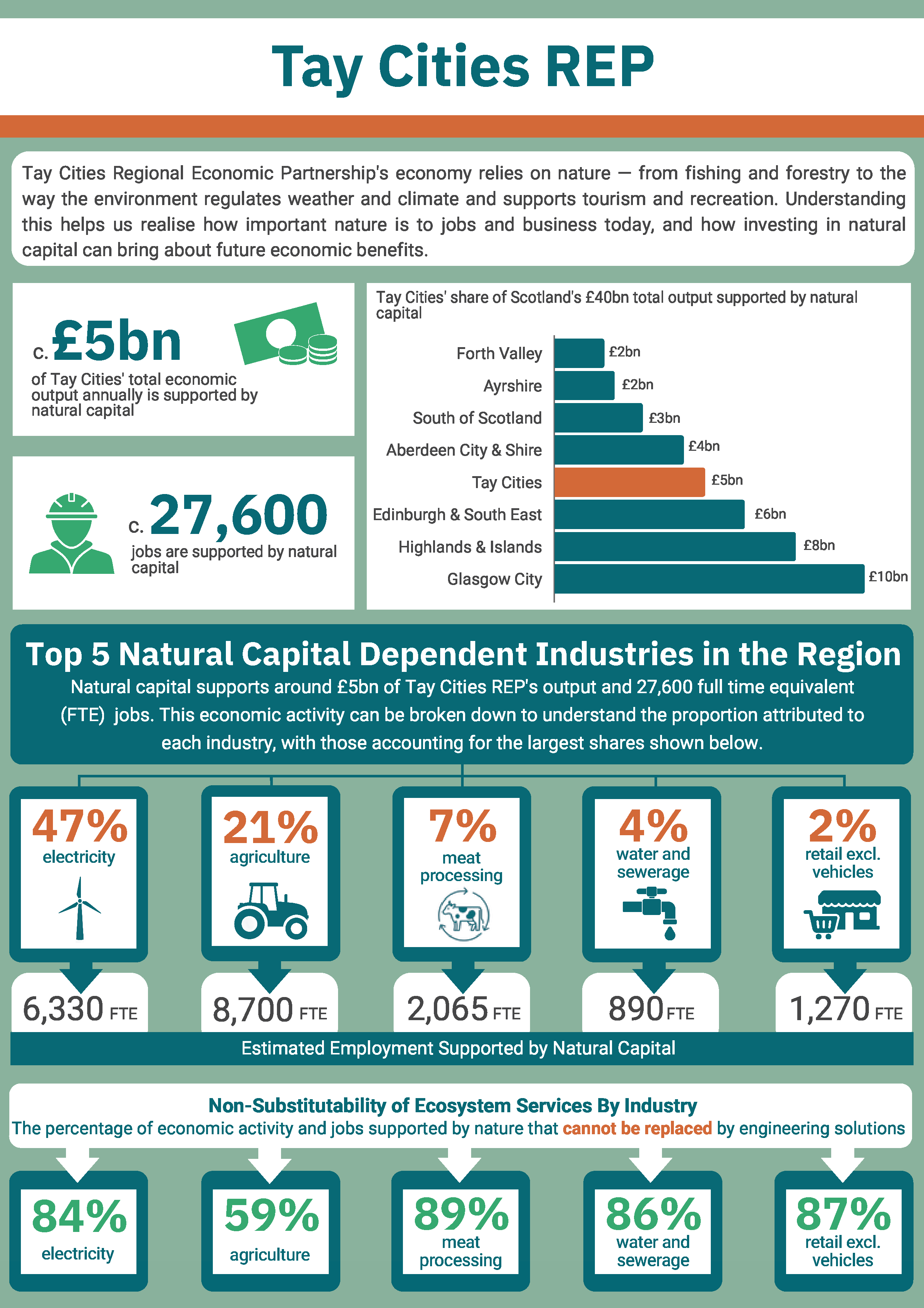
Tay Cities Regional Economic Partnership's economy relies on nature from fishing and forestry to the way the environment regulates weather and climate and supports tourism and recreation. Understanding this helps us realise how important nature is to jobs and business today, and how investing in natural capital can bring about future economic benefits. £5bn of Tay Cities’ output is annually supported by natural capital alongside an estimated 27,600 full time equivalent (FTE) jobs.
Top 5 industries accounting for the largest share of natural capital reliant economic activity are:
- Electricity: 47% reliant
- Agriculture: 21% reliant
- Meat processing: 7% reliant
- Water and sewerage: 4% reliant
- Retail excl. vehicles: 2% reliant
Estimated employment supported by natural capital in these industries:
- Electricity: 6,330 FTE
- Agriculture: 8,700 FTE
- Meat processing: 2,065 FTE
- Water and sewerage: 890 FTE
- Retail excl. vehicles: 1,270 FTE
The percentage of economic activity and jobs supported by nature that cannot be replaced by engineering solutions are:
- Electricity: 84%
- Agriculture: 59%
- Meat processing: 89%
- Water and sewerage: 86%
- Retail excl. vehicles: 87%
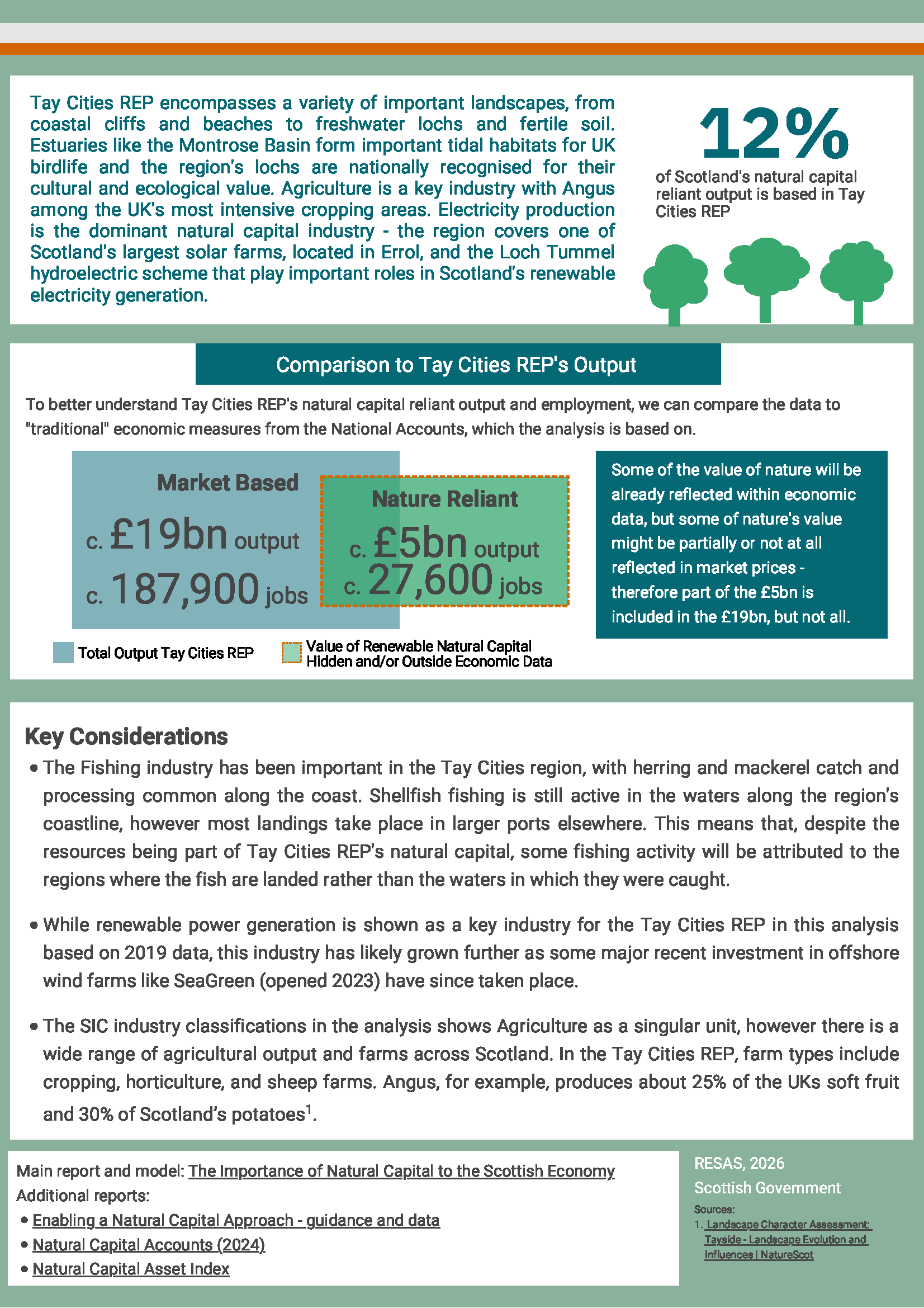
Tay Cities REP encompasses a variety of important landscapes, from coastal cliffs and beaches to freshwater lochs and fertile soil. Estuaries like the Montrose Basin form important tidal habitats for UK birdlife and the region's lochs are nationally recognised for their cultural and ecological value. Agriculture is a key industry with Angus among the UK's most intensive cropping areas. Electricity production is the dominant natural capital industry - the region covers one of Scotland's largest solar farms, located in Errol, and the Loch Tummel hydroelectric scheme that play important roles in Scotland's renewable electricity generation. 12% of Scotland’s natural capital reliant output is based in Tay Cities REP.
To better understand the Tay Cities REP’s natural capital reliant output and employment, we can compare the data to ‘traditional’ economic measures from the National Accounts, which this analysis is based on. Using the National Accounts Tay Cities’ ‘traditional’ output is £19n and 187,900 FTE jobs, while this model measures nature reliant output at £5bn and 27,600 FTE jobs. Some of this value of nature will be already reflected within the economic data, but some of nature’s value might be partially or not at all reflected in market prices, therefore part of the £5bn is included in the £19bn, but not all.
Key considerations:
- The Fishing industry has been important in the Tay Cities region, with herring and mackerel catch and processing common along the coast. Shellfish fishing is still active in the waters along the region's coastline, however most landings take place in larger ports elsewhere. This means that, despite the resources being part of Tay Cities REP's natural capital, some fishing activity will be attributed to the regions where the fish are landed rather than the waters in which they were caught.
- While renewable power generation is shown as a key industry for the Tay Cities REP in this analysis based on 2019 data, this industry has likely grown further as some major recent investment in offshore wind farms like SeaGreen (opened 2023) have since taken place.
- The SIC industry classifications in the analysis shows Agriculture as a singular unit, however there is a wide range of agricultural output and farms across Scotland. In the Tay Cities REP, farm types include cropping, horticulture, and sheep farms. Angus, for example, produces about 25% of the UKs soft fruit and 30% of Scotland’s potatoes[7].
Contact
Email: EnvironmentAnalysis@gov.scot