
Natural capital: regional economic reliance analysis
These infographics, based on the "Importance of Natural Capital to the Scottish Economy" analysis, highlight how natural capital supports economic activity by Regional Economic Partnerships (REP). The infographics outline output, employment, and industry reliance on ecosystem services by REPs.
4. Edinburgh and South East REP
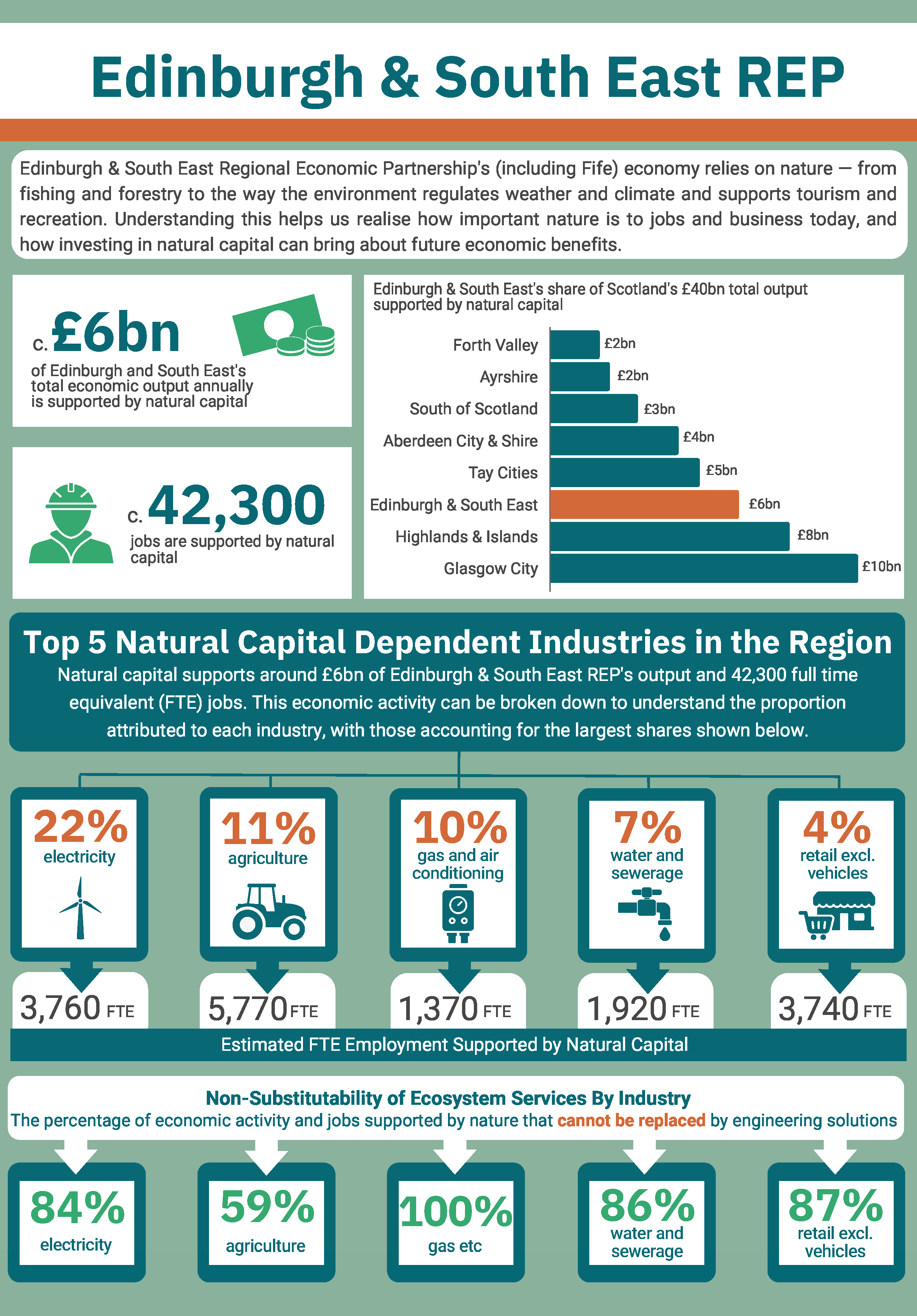
Edinburgh and South East Regional Economic Partnership's (including Fife) economy relies on nature from fishing and forestry to the way the environment regulates weather and climate and supports tourism and recreation. Understanding this helps us realise how important nature is to jobs and business today, and how investing in natural capital can bring about future economic benefits. £6bn of Edinburgh and South East REP’s output is annually supported by natural capital alongside an estimated 42,300 full time equivalent (FTE) jobs.
Top 5 industries accounting for the largest share of natural capital reliant economic activity are:
- Electricity: 22% reliant
- Agriculture: 11% reliant
- Gas and air conditioning: 10% reliant
- Water and sewerage: 7% reliant
- Retail excl. vehicles: 4% reliant
Estimated employment supported by natural capital in these industries:
- Electricity: 3,760 FTE
- Agriculture: 5,770 FTE
- Gas and air conditioning: 1,370 FTE
- Water and sewerage: 1,920 FTE
- Retail excl. vehicles: 3,740 FTE
The percentage of economic activity and jobs supported by nature that cannot be replaced by engineering solutions are:
- Electricity: 84%
- Agriculture: 59%
- Gas and air conditioning: 100%
- Water and sewerage: 86%
- Retail excl. vehicles: 87%
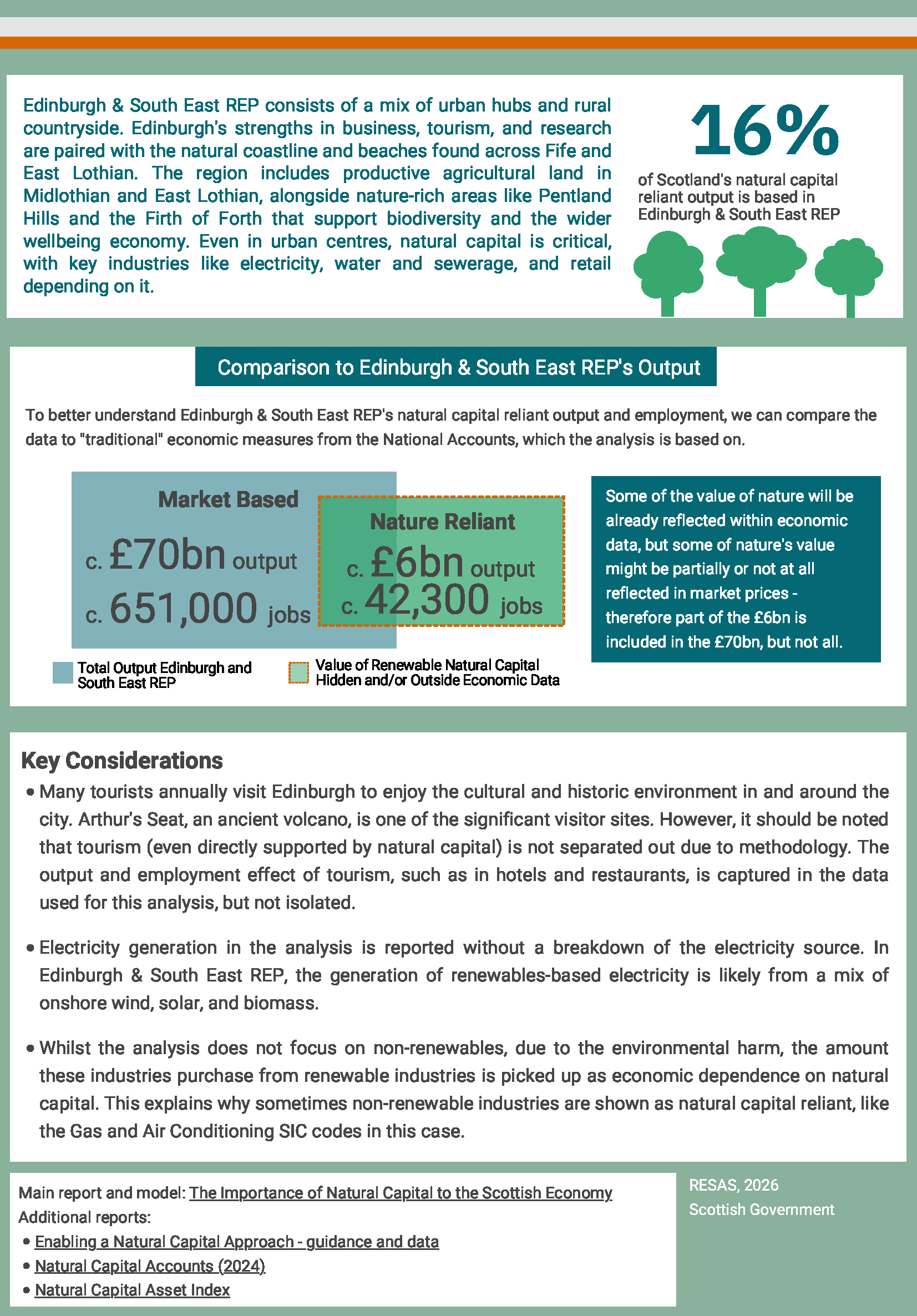
Edinburgh & South East REP consists of a mix of urban hubs and rural countryside. Edinburgh's strengths in business, tourism, and research are paired with the natural coastline and beaches found across Fife and East Lothian. The region includes productive agricultural land in Midlothian and East Lothian, alongside nature-rich areas like Pentland Hills and the Firth of Forth that support biodiversity and the wider wellbeing economy. Even in urban centres, natural capital is critical, with key industries like electricity, water and sewerage, and retail depending on it. 16% of Scotland’s natural capital reliant output is based in Edinburgh & South East REP.
To better understand the Edinburgh and South East REP’s natural capital reliant output and employment, we can compare the data to ‘traditional’ economic measures from the National Accounts, which this analysis is based on. Using the National Accounts Edinburgh and South East’s ‘traditional’ output is £70bn and 651,000 FTE jobs, while this model measures nature reliant output at £6bn and 42,300 FTE jobs. Some of this value of nature will be already reflected within the economic data, but some of nature’s value might partially or not at all reflected in market prices, therefore part of the £6bn is included in the £70bn, but not all.
Key considerations:
- Many tourists annually visit Edinburgh to enjoy the cultural and historic environment in and around the city. Arthur's Seat, an ancient volcano, is one of the significant visitor sites. However, it should be noted that tourism (even directly supported by natural capital) is not separated out due to methodology. The output and employment effect of tourism, such as in hotels and restaurants, is captured in the data used for this analysis, but not isolated.
- Electricity generation is reported here without a breakdown of the electricity source. In Edinburgh & South East REP, the generation of renewables-based electricity is likely from a mix of onshore wind, solar, and biomass.
- Whilst the analysis does not focus on non-renewables, due to the environmental harm, the amount these industries purchase from renewable industries is picked up as economic dependence on natural capital. This explains why sometimes non-renewable industries are shown as natural capital reliant, like the Gas and Air Conditioning SIC codes in this case.
Contact
Email: EnvironmentAnalysis@gov.scot