
Natural capital: regional economic reliance analysis
These infographics, based on the "Importance of Natural Capital to the Scottish Economy" analysis, highlight how natural capital supports economic activity by Regional Economic Partnerships (REP). The infographics outline output, employment, and industry reliance on ecosystem services by REPs.
8. South of Scotland REP
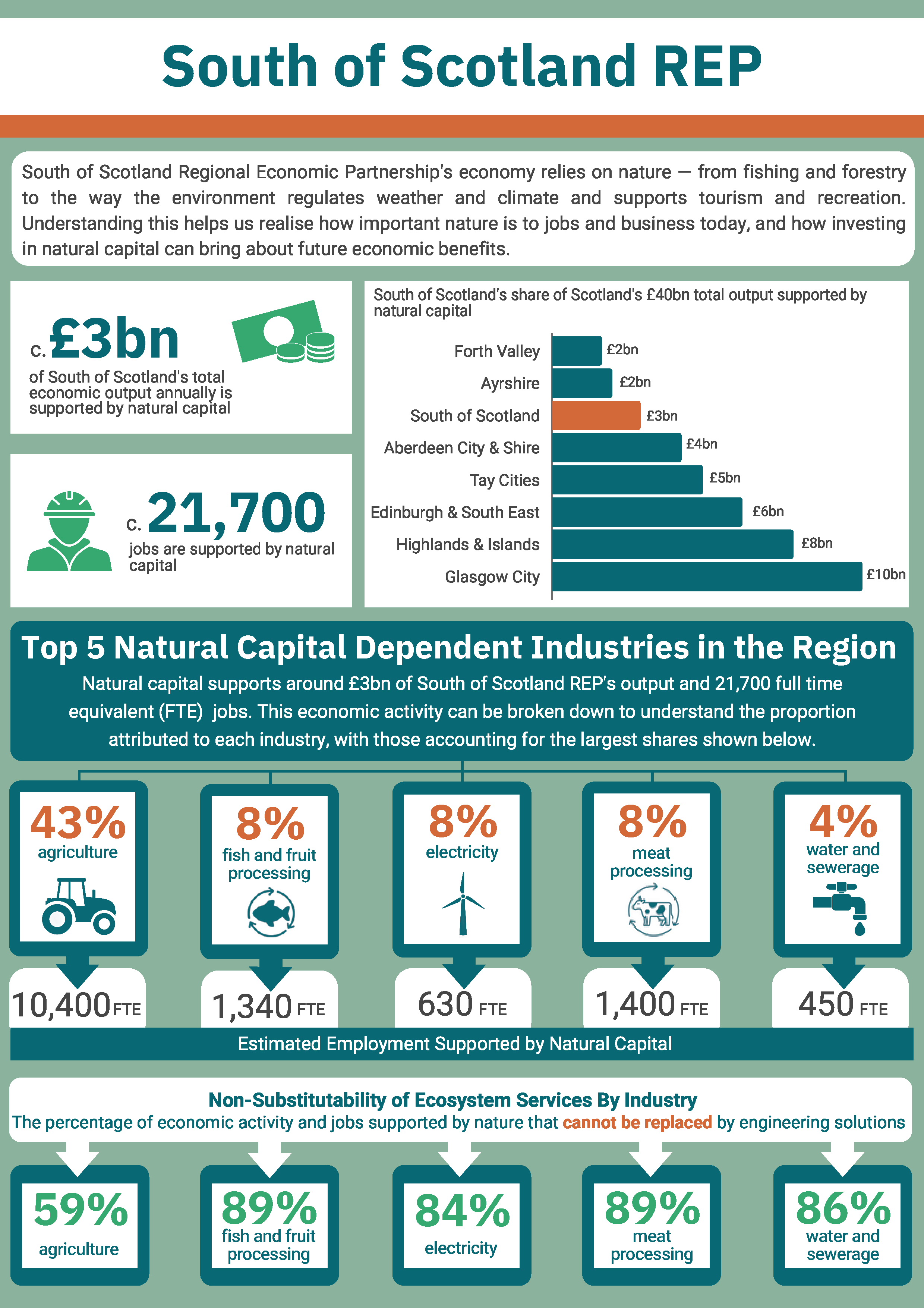
South of Scotland Regional Economic Partnership's economy relies on nature from fishing and forestry to the way the environment regulates weather and climate and supports tourism and recreation. Understanding this helps us realise how important nature is to jobs and business today, and how investing in natural capital can bring about future economic benefits. £3bn of South of Scotland’s output is annually supported by natural capital alongside an estimated 21,700 full time equivalent (FTE) jobs.
Top 5 industries accounting for the largest share of natural capital reliant economic activity are:
- Agriculture: 43% reliant
- Fish and fruit processing: 8% reliant
- Electricity: 8% reliant
- Meat processing: 8% reliant
- Water and sewerage: 8% reliant
Estimated employment supported by natural capital in these industries:
- Agriculture: 10,400 FTE
- Fish and fruit processing: 1,340 FTE
- Electricity: 630 FTE
- Meat processing: 1,400 FTE
- Water and sewerage: 450 FTE
The percentage of economic activity and jobs supported by nature that cannot be replaced by engineering solutions are:
- Agriculture: 59%
- Fish and fruit processing: 89%
- Electricity: 84%
- Meat processing: 89%
- Water and sewerage: 86%
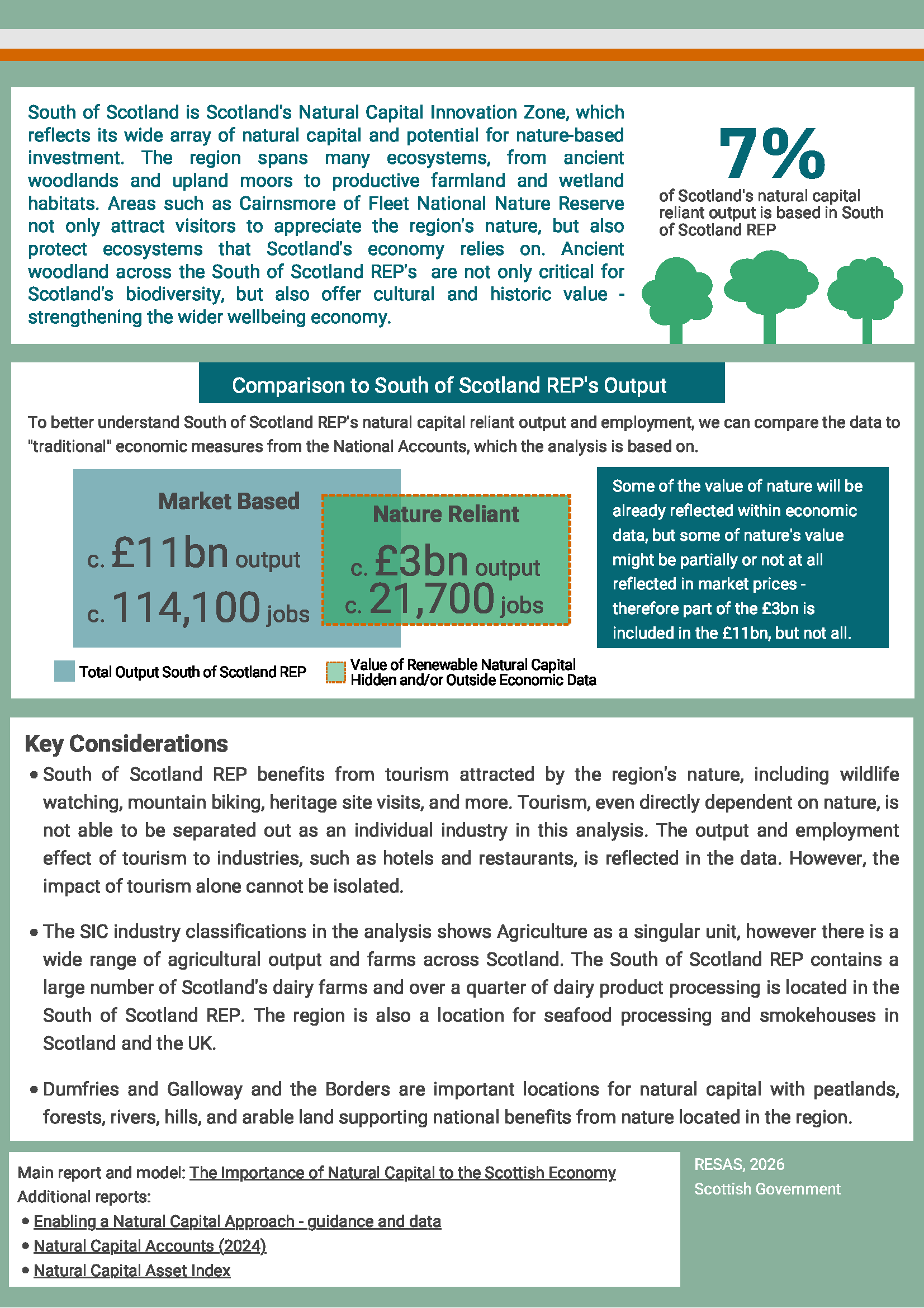
South of Scotland is Scotland's Natural Capital Innovation Zone, which reflects its wide array of natural capital and potential for nature-based investment. The region spans many ecosystems, from ancient woodlands and upland moors to productive farmland and wetland habitats. Areas such as Cairnsmore of Fleet National Nature Reserve not only attract visitors to appreciate the region's nature, but also protect ecosystems that Scotland's economy relies on. Ancient woodland across the South of Scotland REP's are not only critical for Scotland's biodiversity, but also offer cultural and historic value - strengthening the wider wellbeing economy. 7% of Scotland’s natural capital reliant output is based in South of Scotland REP.
To better understand the South of Scotland REP’s natural capital reliant output and employment, we can compare the data to ‘traditional’ economic measures from the National Accounts, which this analysis is based on. Using the National Accounts South of Scotland’s ‘traditional’ output is £11bn and 114,100 FTE jobs, while this model measures nature reliant output at £3bn and 21,700 FTE jobs. Some of this value of nature will be already reflected within the economic data, but some of nature’s value might be partially or not at all reflected in market prices, therefore part of the £3bn is included in the £11bn, but not all.
Key considerations:
- South of Scotland REP benefits from tourism attracted by the region's nature, including wildlife watching, mountain biking, heritage site visits, and more. Tourism, even directly dependent on nature, is not able to be separated out as an individual industry in this analysis. The output and employment effect of tourism to industries, such as hotels and restaurants, is reflected in the data. However, the impact of tourism alone cannot be isolated.
- The SIC industry classifications in the analysis shows Agriculture as a singular unit, however there is a wide range of agricultural output and farms across Scotland. The South of Scotland REP contains a large number of Scotland's dairy farms and over a quarter of dairy product processing is located in the South of Scotland REP. The region is also a location for seafood processing and smokehouses in Scotland and the UK.
- Dumfries and Galloway and the Borders are important locations for natural capital with peatlands, forests, rivers, hills, and arable land supporting national benefits from nature located in the region.
Contact
Email: EnvironmentAnalysis@gov.scot