
Natural capital: regional economic reliance analysis
These infographics, based on the "Importance of Natural Capital to the Scottish Economy" analysis, highlight how natural capital supports economic activity by Regional Economic Partnerships (REP). The infographics outline output, employment, and industry reliance on ecosystem services by REPs.
2. Aberdeen City and Shire REP
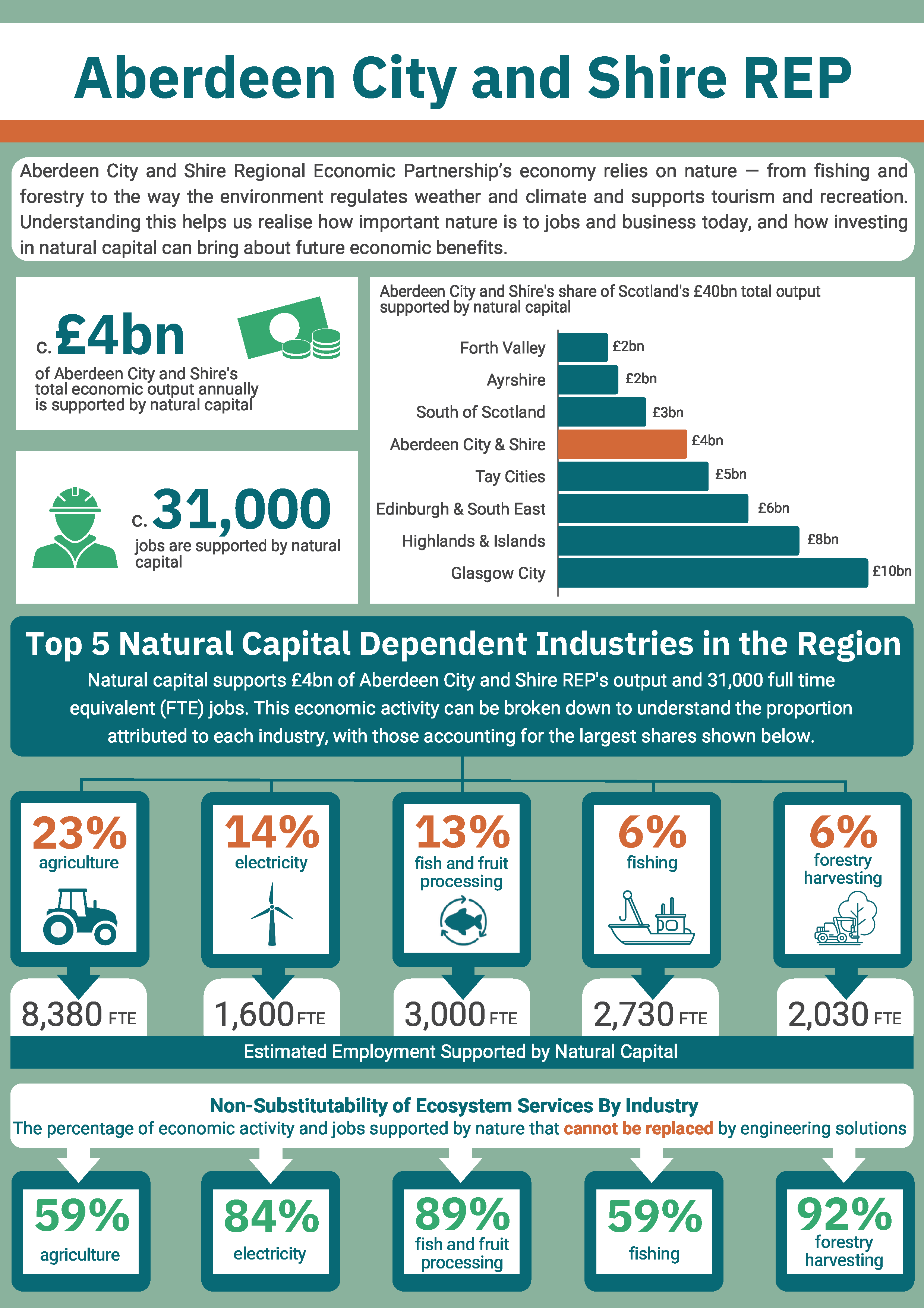
Aberdeen City and Shire Regional Economic Partnership's economy relies on nature from fishing and forestry to the way the environment regulates weather and climate and supports tourism and recreation. Understanding this helps us realise how important nature is to jobs and business today, and how investing in natural capital can bring about future economic benefits. £4bn of Aberdeen City and Shire’s output is annually supported by natural capital alongside an estimated 31,000 full time equivalent (FTE) jobs.
Top 5 industries accounting for the largest share of natural capital reliant economic activity are:
- Agriculture: 23% reliant
- Electricity: 14% reliant
- Fish and fruit processing: 13% reliant
- Fishing: 6% reliant
- Forestry harvesting: 6% reliant
Estimated employment supported by natural capital in these industries:
- Agriculture: 8,380 FTE
- Electricity: 1,600 FTE
- Fish and fruit processing: 3,000 FTE
- Fishing: 2,730 FTE
- Forestry harvesting: 2,030 FTE
The percentage of economic activity and jobs supported by nature that cannot be replaced by engineering solutions are:
- Agriculture: 59%
- Electricity: 84%
- Fish and fruit processing: 89%
- Fishing: 59%
- Forestry harvesting: 92%
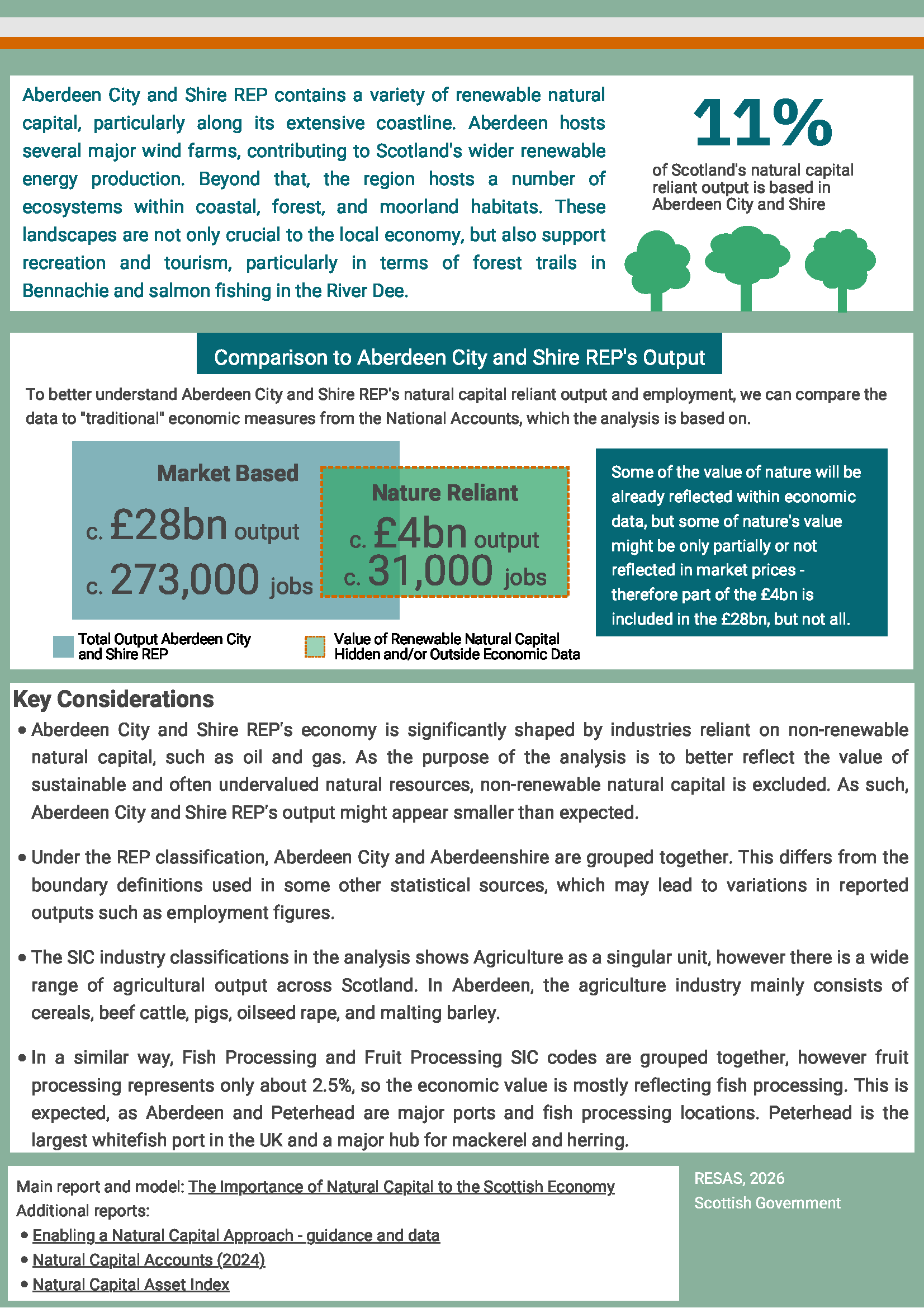
Aberdeen City and Shire REP contains a variety of renewable natural capital, particularly along its extensive coastline. Aberdeen hosts several major wind farms, contributing to Scotland's wider renewable energy production. Beyond that, the region hosts a number of ecosystems within coastal, forest, and moorland habitats. These landscapes are not only crucial to the local economy, but also support recreation and tourism, markedly forest trails in Bennachie and salmon fishing in the River Dee. 11% of Scotland’s natural capital reliant output is based in Aberdeen City and Shire.
To better understand the Aberdeen City and Shire REP’s natural capital reliant output and employment, we can compare the data to ‘traditional’ economic measures from the National Accounts, which this analysis is based on. Using the National Accounts Aberdeen City and Shire’s ‘traditional’ output is £28bn and 273,000 FTE jobs, while this model measures nature reliant output at £4bn and 31,000 FTE jobs. Some of this value of nature will be already reflected within the economic data, but some of nature’s value might be partially or not at all reflected in market prices, therefore part of the £4bn is included in the £28bn, but not all.
Key considerations:
- Aberdeen City and Shire REP's economy is significantly shaped by industries reliant on non-renewable natural capital, such as oil and gas. As the purpose of the analysis is to better reflect the value of sustainable and often undervalued natural resources, non-renewable natural capital is excluded. As such, Aberdeen City and Shire REP's output might appear smaller than expected.
- Under the REP classification, Aberdeen City and Aberdeenshire are grouped together. This differs from the boundary definitions used in some other statistical sources, which may lead to variations in reported outputs such as employment figures.
- The SIC industry classifications in the analysis shows Agriculture as a singular unit, however there is a wide range of agricultural output across Scotland. In Aberdeen, the agriculture industry mainly consists of cereals, beef cattle, pigs, oilseed rape, and malting barley.
- In a similar way, Fish Processing and Fruit Processing SIC codes are grouped together, however fruit processing represents only about 2.5%, so the economic value is mostly reflecting fish processing. This is expected, as Aberdeen and Peterhead are major ports and fish processing locations. Peterhead is the largest whitefish port in the UK and a major hub for mackerel and herring.
Contact
Email: EnvironmentAnalysis@gov.scot