
Natural capital: regional economic reliance analysis
These infographics, based on the "Importance of Natural Capital to the Scottish Economy" analysis, highlight how natural capital supports economic activity by Regional Economic Partnerships (REP). The infographics outline output, employment, and industry reliance on ecosystem services by REPs.
7. Highlands and Islands REP
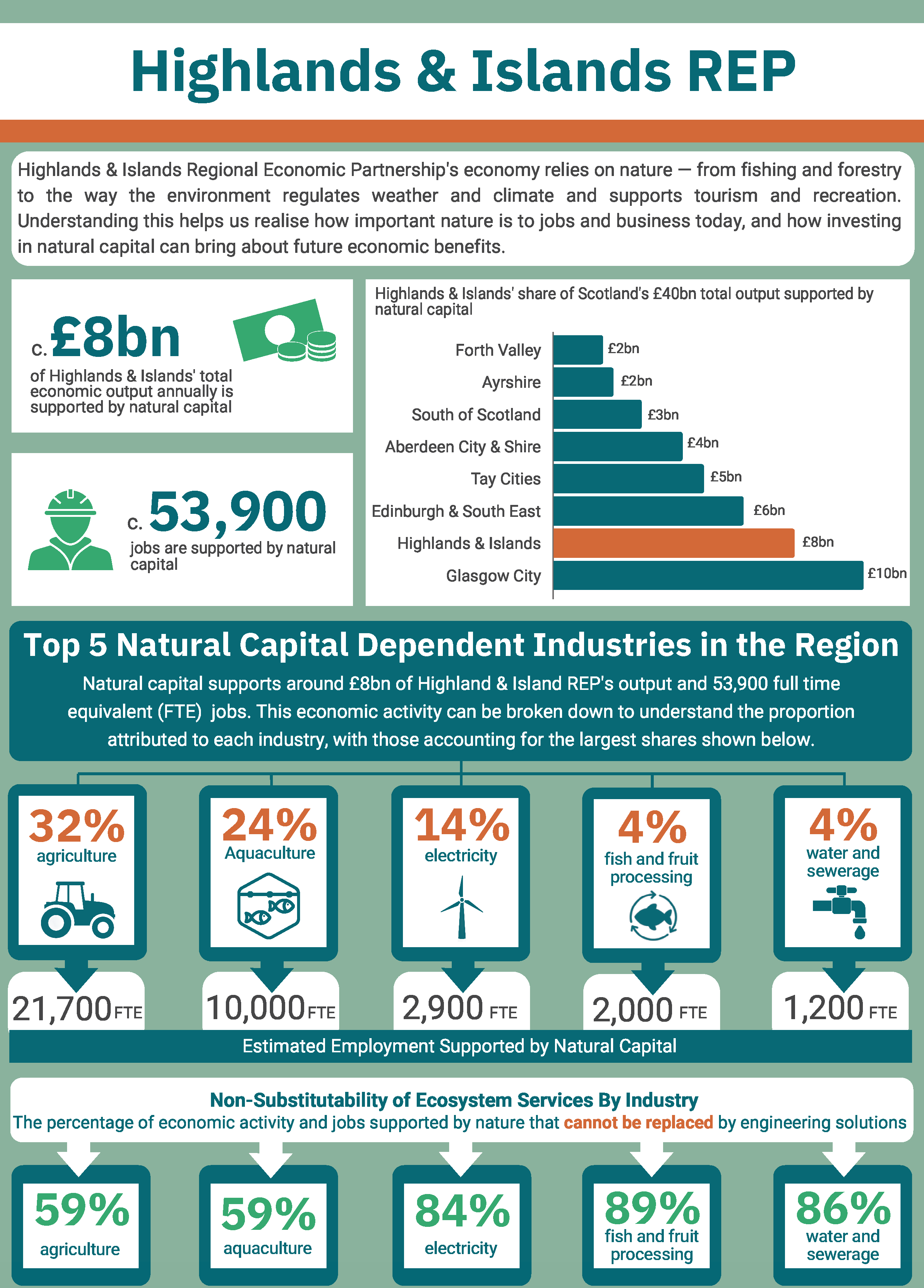
Highlands and Islands Regional Economic Partnership's economy relies on nature from fishing and forestry to the way the environment regulates weather and climate and supports tourism and recreation. Understanding this helps us realise how important nature is to jobs and business today, and how investing in natural capital can bring about future economic benefits. £8bn of Highlands and Islands’ output is annually supported by natural capital alongside an estimated 53,900 full time equivalent (FTE) jobs.
Top 5 industries accounting for the largest share of natural capital reliant economic activity are:
- Agriculture: 32% reliant
- Aquaculture: 24% reliant
- Electricity: 14% reliant
- Fish and fruit processing: 4% reliant
- Water and sewerage: 4% reliant
Estimated employment supported by natural capital in these industries:
- Agriculture: 21,700 FTE
- Aquaculture: 10,000 FTE
- Electricity: 2,900 FTE
- Fish and fruit processing: 2,000 FTE
- Water and sewerage: 1,200 FTE
The percentage of economic activity and jobs supported by nature that cannot be replaced by engineering solutions are:
- Agriculture: 59%
- Aquaculture: 59%
- Electricity: 84%
- Fish and fruit processing: 89%
- Water and sewerage: 86%
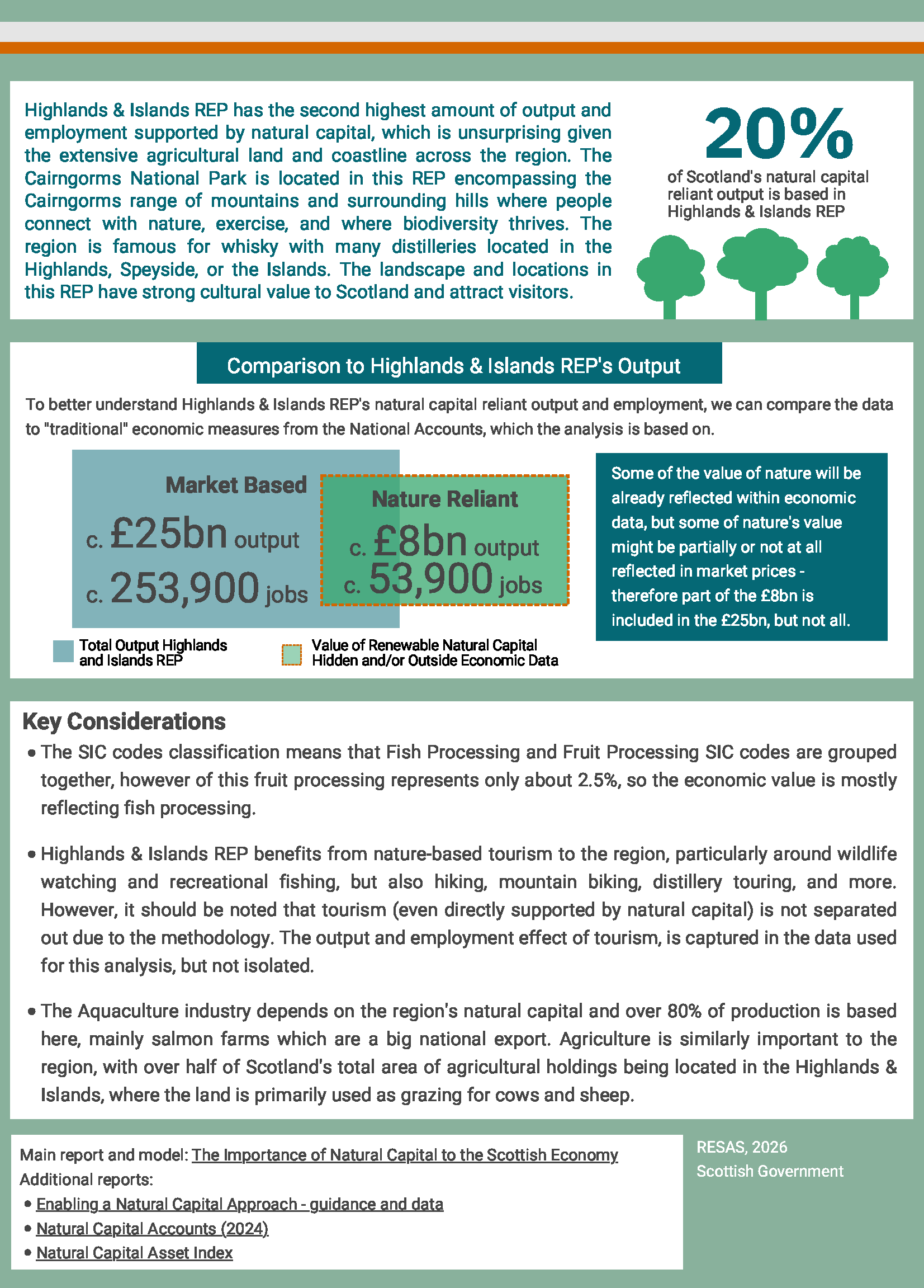
Highlands & Islands REP has the second highest amount of output and employment supported by natural capital, which is unsurprising given the extensive agricultural land and coastline across the region. The Cairngorms National Park is located in this REP encompassing the Cairngorms range of mountains and surrounding hills where people connect with nature, exercise, and where biodiversity thrives. The region is famous for whisky with many distilleries located in the Highlands, Speyside, or the Islands. The landscape and locations in this REP have strong cultural value to Scotland and attract visitors. 20% of Scotland’s natural capital reliant output is based in Highlands and Islands REP.
To better understand the Highlands and Islands REP’s natural capital reliant output and employment, we can compare the data to ‘traditional’ economic measures from the National Accounts, which this analysis is based on. Using the National Accounts Highlands and Islands’ ‘traditional’ output is £25bn and 253,900 FTE jobs, while this model measures nature reliant output at £8bn and 53,900 FTE jobs. Some of this value of nature will be already reflected within the economic data, but some of nature’s value might be partially or not at all reflected in market prices, therefore part of the £8bn is included in the £25bn, but not all.
Key considerations:
- The SIC codes classification means that Fish Processing and Fruit Processing SIC codes are grouped together, however of this fruit processing represents only about 2.5%, so the economic value is mostly reflecting fish processing.
- Highlands & Islands REP benefits from nature-based tourism to the region, particularly around wildlife watching and recreational fishing, but also hiking, mountain biking, distillery touring, and more. However, it should be noted that tourism (even directly supported by natural capital) is not separated out due to the methodology. The output and employment effect of tourism, is captured in the data used for this analysis, but not isolated.
- The Aquaculture industry depends on the region's natural capital and over 80% of production is based here, mainly salmon farms which are a big national export. Agriculture is similarly important to the region, with over half of Scotland's total area of agricultural holdings being located in the Highlands & Islands, where the land is primarily used as grazing for cows and sheep.
Contact
Email: EnvironmentAnalysis@gov.scot