
Fishers' Behaviour and Attitudes Towards Compliance and Enforcement: Research Report
To support the delivery of Scotland’s Fisheries Management Strategy 2020-2030, this research aims to better understand the monitoring and enforcement of fishing regulations in Scotland
7. Experiences of enforcement action
This chapter discusses experiences of taking and being subject to enforcement action, as well as the perceived fairness and the effectiveness of different enforcement actions.
7.1. Types of enforcement action experienced
Of the fishers responding to the survey who reported instances of non-compliance, just over a third (36%) said that these were detected, and had resulted in the following enforcement action:
- Verbal – 25%
- Written warning – 25%
- Fixed penalty notice – 50%
- Referral to the Crown Office – 25%
Of those who had experienced enforcement action, 66% reported that it had no impact on their actions, and 33% reported that it encouraged them to make sure they are always compliant.
7.2. Fairness of enforcement action
During the interviews with fishers, a few reported that they felt the enforcement action against them had been reasonable, or not too onerous, but a few others conveyed a sense that they felt that this was unfair. Others commented on instances of non-compliance carried out by other fishers that had resulted in enforcement action. Again, in some instances, fishers felt the action to be too severe for the type of non-compliance detected and others felt fishers had gotten off too lightly.
Where enforcement action was deemed to be unfair, this was particularly the case in instances where fishers felt the breach had not been their fault. For instance, instances where there had been supply issues were recalled which had prevented fishers from complying with gear regulations or where there was a lack of clarity about the parameters of new regulations.
Aligned to the above, one fisher explained that they felt they had been unfairly penalised, resulting in a significant impact on their business in terms of loss of income and loss of staff. This fisher owns two boats, which were skippered by employed staff. Unbeknownst to the owner, members of the crew were operating non-compliantly; upon detection, the boat owner’s fishing permit was removed, which meant he could no longer operate his boats, while the crew members who had conducted the non-compliant activity went unpunished and continued to work in the industry.
One industry stakeholder felt that it is unfair that vessel owners can be blamed and penalised for fishers’ behaviour at sea, when they are unable to control what fishers do beyond emphasising that they expect the regulations to be complied with. Another stakeholder explained that some fishers feel aggrieved at times by receiving an FPN; however legal fees can prevent them from challenging this through the courts. They stressed that paying an FPN is therefore not an admission of guilt. They called for assurances that receipt of an FPN would not count against fishing businesses applying for grants and that this information would not be released in the public domain as it could potentially harm business with supermarkets and other buyers.
A small number, whose non-compliance was not detected or penalised, were of the view that there had been a lack of policing, or presence among compliance and enforcement staff, or a perception that compliance and enforcement staff might occasionally appear not to notice.
“You're just going to say you didn't catch anything… everyone's got their zero bycatch, you know it's bull and the scientists know that's not what it's like… because what are we supposed to do with it? Where are we going to put it? Put it in a pier… where it'll sit forever more and stink - you can't do that.” (Fisher)
7.3. Effectiveness of enforcement action
The surveys of Marine Directorate staff and fishers asked respondents to rate the effectiveness of different enforcement actions as a deterrent to non-compliance. A breakdown of responses is provided in Figure 14. These comparisons are indicative only given the small sample especially in the fisher survey.
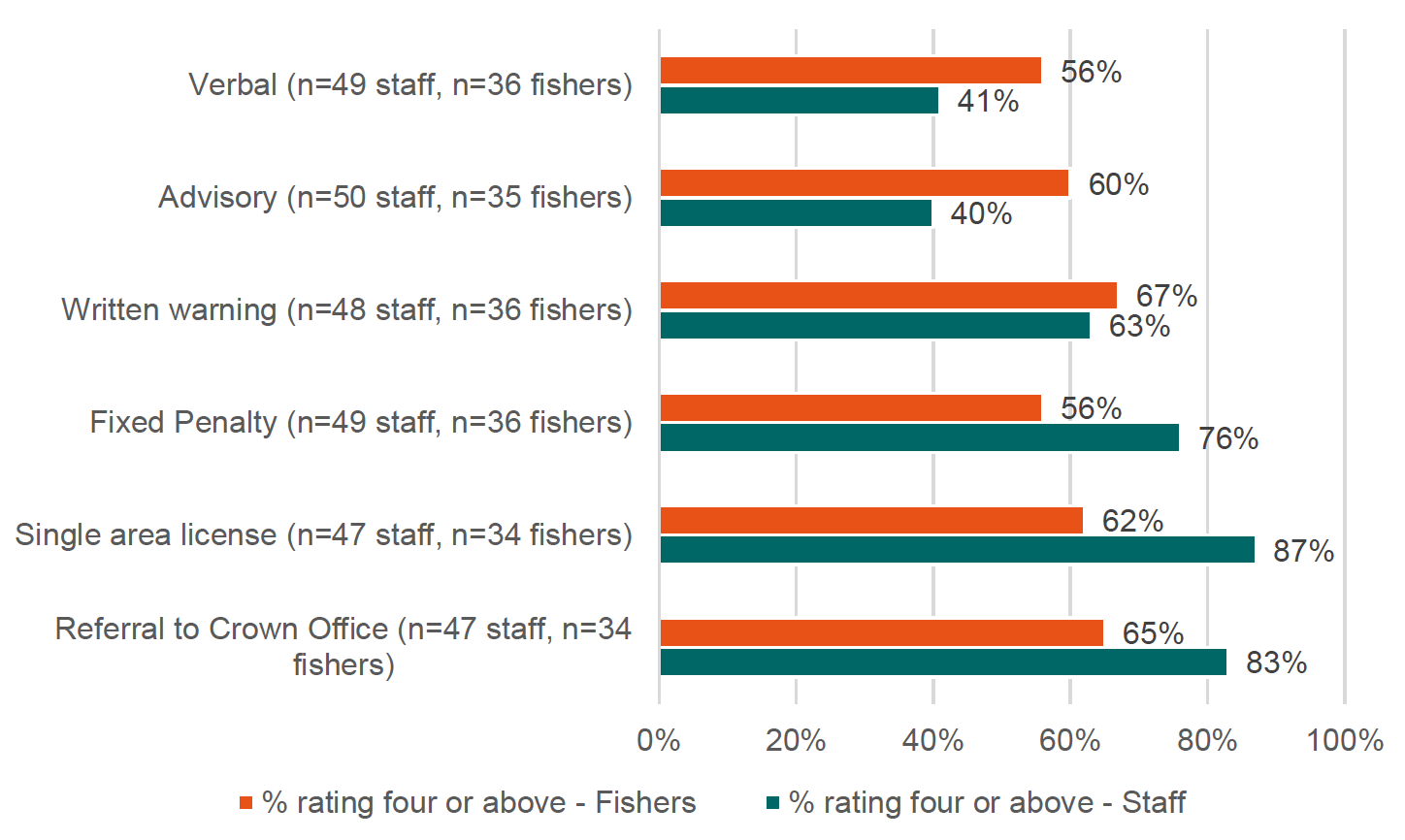
As Figure 14 demonstrates, staff and fishers hold different perceptions about the effectiveness of enforcement actions as a deterrent to non-compliant behaviour. A higher proportion of fishers than staff feel that advisories and verbal actions were effective deterrents.
This topic was explored with fishers during the interviews. Verbal and written advisories, and written warnings, were generally viewed as being an appropriate action for an isolated, low-level or accidental instance of non-compliance. Fishers felt that those who strived to operate compliantly would try to ensure that they did not repeat the offence, and therefore acted as a deterrent to future non-compliance. However, for those fishers who are deliberate about their non-compliance, these forms of action are perceived to have no impact in deterring future non-compliance.
“If somebody's doing something by mistake, you know, or just being a bit lax, sometimes possibly because of weather or there's some other issue, they are an effective deterrent. For the determined criminal… then nothing is an effective deterrent. We experience that in all other areas of our life, not just fishing. The determined criminal will continue to break the law and will find novel and ingenious ways in order to do that. A word in their ear ain't going to stop them.” (Fisher)
Staff, however, felt that advisories and verbal actions were least effective, though some interviewees said that speaking to fishers to advise them of non-compliance can be effective. Staff also pointed out that written warnings can be enough to ensure a fisher is compliant, especially if they had been accidentally non-compliant. Interviewees noted that providing some leeway and adopting a light-touch approach can help to build positive relationships with the fishing industry, making it easier for staff to provide information about new or updated regulations. A small number also noted that this could be the first course of action and serve as a warning before more severe action with repeat offenders.
A small number of industry stakeholders also explained that they valued that Marine Directorate staff have started to use more written warnings and seem to be more appreciative of the complicated situation fishers are working in.
“If we give a verbal, that normally solves the problem… most of ours are verbal or an advisory letter. That normally clears up the situation because they know we're going to be keeping an eye on them.” (Marine Directorate staff)
“We do have an approach where we are still trying to have a fairly positive relationship with industry… it's hard to keep that balance between being, we're still here to advise and we're still here to be as helpful as possible to make sure a vessel or the industry is compliant.” (Marine Directorate staff)
Staff perceived that referrals to the Crown Office are an effective penalty, but some commented on the evidential threshold for court action and the time-consuming nature of preparing a case and waiting for the case to be heard. Restrictions on fishing licences were supported by staff as a strong deterrent and seen to be among the most effective ways to penalise non-compliance. However, one stakeholder felt that the threat of restricting or removing licences had been ineffective for some boats as they would deliberately breach the rules knowing they wouldn’t fish in that area for the rest of the year anyway. They also felt that while some skippers or owners “sail much closer to the wind”, they would not be likely to go as far as risk court action or criminal proceedings.
“I think the only way, I say, the only way you're going to possibly (achieve compliance), is restricting the fishing area or hitting them in the pocket.” (Marine Directorate staff)
Several fishers noted the range of enforcement actions provides options for escalation. Patterns of continued non-compliance or serious and deliberate non-compliance can progress to firmer penalties.
“I think everybody deserves a chance, it could have been a mistake, a trawler could have gone into a box by just simply the weather. Or you know a closed area, he could have nipped into a closed area simply because he just couldn't turn quick enough with weather or whatever. He could have had engine problems or anything. So, to get a warning is fair enough and then if you've got some kind of, you know, if you persisted in doing it… it's got to go all the way.” (Fisher)
“I think starting small and working your way up, you know verbal, then written and then if the problems continue you have to escalate and escalate as well. You know, in everything. But I don't think you should start with a big bang. I think you should work your way up.” (Fisher)
A common view expressed by fishers is that the current enforcement actions are sufficient for those in the industry who want to and are trying to operate compliantly. Where they are felt to be ineffective is in deterring those who are deliberately and repeatedly non-compliant, or where the reward outweighs the risks. For this group of fishers, stiffer penalties were suggested.
“Now, if it was the case that somebody was persistently doing that, to me, the way to stop it would be to stop the licence for a month. If they got caught undeclaring fish, they should stop the licence for a month. If they did it again, they could stop it for two months and that would stop all this undeclared fish that's being landed.” (Fisher)
“It's a deterrent to honest people, but it's not a deterrent to people that's used to doing the system.” (Fisher)
7.4. FPNs and other potential enforcement actions
Fishers responding to the survey were asked to rate the extent of their agreement with statements about Fixed Penalty Notices (FPNs) and other potential enforcement actions. A breakdown of responses across each statement is provided in Figure 15.
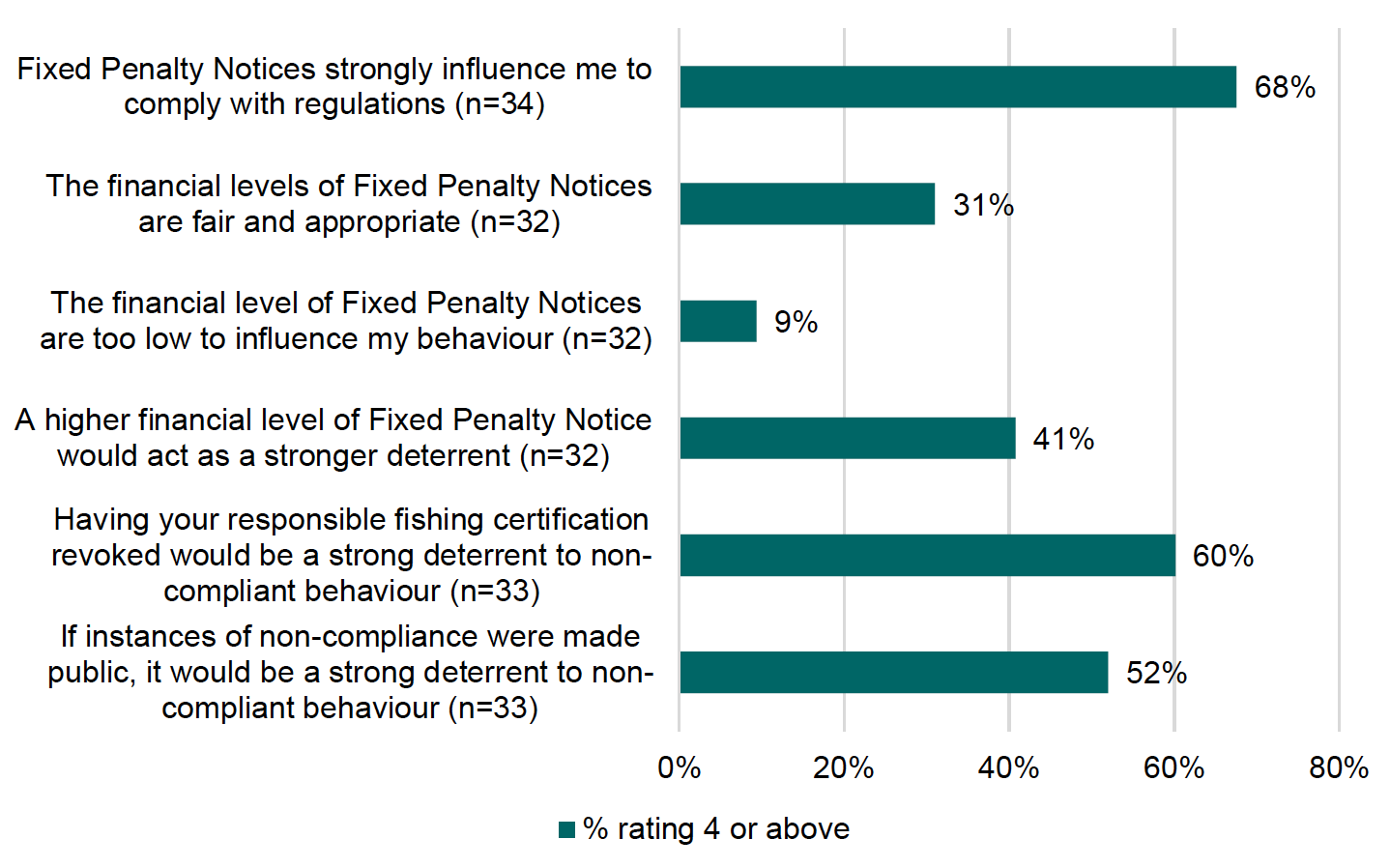
Two fifths (41%) of fishers agreed that a higher level of FPN would act as a stronger deterrent, with only 9% agreeing that FPNs are too low to influence fishers’ behaviour. Only 31% of fishers thought that the financial levels of FPNs are fair or appropriate. However, around two-thirds of respondents (68%) reported that FPNs have a strong influence on their compliance with regulations. This is interesting and contrasts with a lower proportion of fishers agreeing that higher levels of FPNs would act as a stronger deterrent.
Opinion was split almost evenly on whether publicising instances of non-compliance would be a strong deterrent to non-compliant behaviour.
More than half of fishers (60%) agreed that having their responsible fishing certification revoked would be a strong deterrent to non-compliance.
Fishers responding to the survey were given the opportunity to provide their own views and thoughts about FPNs. Responses included:
- They do not act as a deterrent due to the small financial amounts involved.
- FPNs are ineffective if people believe they won't get caught (for example, if there are perceptions of low likelihood of checks).
- A feeling that it is an unfair penalty for people struggling to make a living.
- A refusal to ever pay a Fixed Penalty Notice and would rather go to court to argue their case.
- They discourage fishermen from continuing in the profession.
- A feeling that FPNs are unjustified or unfair when a written warning or advisory would suffice.
There were mixed views among stakeholders about whether FPNs are an effective deterrent to non-compliance. One thought this would vary on a case-by-case basis. Another described skippers as often “gaming it”, i.e. being more aware than in the past of the value of the fine they can expect, building in the cost of FPNs to their fishing plan and writing these off as an operating cost. A third felt FPNs do act as a deterrent as people don’t want to “make that same mistake again”. Stakeholders made the following suggestions for improvements to FPNs:
- Introducing a three-strike rule before receipt of an FPN, rather than a fine after each breach, similar to the approach currently used by the MCA;
- Different levels of fines for different transgressions. It was highlighted, for instance, that where a fine is related to a health and safety transgression, fishers have a double expense if they have to fix the equipment and pay the fine.
The perceived effectiveness of FPNs on encouraging compliance was also explored during the interviews with fishers. While most acknowledged that they would not want to receive a Fixed Penalty Notice and therefore described it as a deterrent, they also explained that the risk of a Fixed Penalty Notice was not what drove them to operate compliantly.
“Well, for us, it doesn't really come into that for us because we're not, honestly, not doing anything uncompliant in the prawn fleet. It doesn't even come into it, you don't break the rules, anybody that I know doesn't, there's no one that does.” (Fisher)
While fishers generally agreed that financial penalties were right for repeat offenders or offences that warranted them, they were not seen as an effective deterrent across the industry for two main reasons. The first was a perception that people who choose to operate non-compliantly understand the risks and accept them. Secondly, for larger operators the financial penalty is dwarfed by the financial reward from operating non-compliantly:
“Well, I think that people who are going to comply will comply. Yeah, I think those that have a different outlook on things will do what they want to do anyway, and they'll run that risk whether they get caught or not.” (Fisher)
“No I don't think they're effective because it's a few hundred pounds when it's tens of thousands of pounds profit. And even when they're caught doing a fairly major infringement, it's just a slap on the wrist.” (Fisher)
Others felt a more punitive approach was required to effectively discourage non-compliance, feeling that blatant and deliberate non-compliance should result in a loss of licence either temporarily or permanently.
“If somebody's out blatantly breaking the rules, a fixed penalty to me makes no sense at all. Take the licence away. Just take the licence away, and okay you'll not get the licence back for six, seven months or a year, or you won't get the licence at all and that's it. And there's no fixed penalties taking them through the court, you either obey by the rules or you lose your licence.” (Fisher)
Several interviewees also commented that they didn’t know enough about when a Fixed Penalty Notice is applied in terms of the type or frequency of offences, and therefore could not comment on how effective they were. One fisher commented that the number of FPNs issued is so low, it doesn’t work as a deterrent. A couple also described witnessing repeat non-compliance which was detected but did not result in a Fixed Penalty Notice when they believed it should have and would have acted as a better deterrent to future non-compliance. Conversely, others relayed examples where FPNs were issued for what they felt were minor infringements and viewed this as harsh.
“Because a fine is not, you know, the number of cases that actually make it through to getting fined are pretty small. And a fine is something that you can find your way around.” (Fisher)
“He got slapped around the wrist and that was that. I don't know if he stopped doing it because of that or whether he got slapped around the wrist and kept going. I’m not sure… My opinion would be that you need to use the full extent of your powers to come down hard on any infractions, anything going on but I don't see any evidence of that.” (Fisher)
“I only heard of one or two that was given on the west coast, and that was the west coast boats that were east at the time and I thought they were pretty harsh. It was two grand on that and it was for something small, like we were talking about the square mesh panel wrong or something like that, and it was pretty harsh. I think it was £2000 my pal got fined… That was harsh.” (Fisher)
The financial level of fixed penalties received mixed views, with fishers reflecting that a £2,000 fixed penalty notice could be significant for a small fishing operation, while it would be inconsequential to a larger operation.
“I mean any fine, the fishing on the small inshore boats like we have, it's a pretty fine margin anyway so any fine isn't going to be good. But if you're looking to guys who've got 2,500 creels and you know they were, they're all over the place and they're making huge amounts of money, well for me to get a £500 fine, yeah, it's not good. For them to get a £500 fine they probably don't even think about it.” (Fisher)
“They could probably factor that into their expenses. You know, we’ll take a wee hit with a fine here and there and, you know, they can just factor that in.” (Fisher)
Marine Directorate staff commented that FPNs can be especially effective for smaller vessels with lower catch values, and because they can provide a swifter penalty than court action. However, interviewees noted that often the size of the penalty is disproportionate to the potential financial gains of non-compliance, especially where larger operators, with higher value catches, are concerned. These interviewees felt larger fines should be available for larger operators so the penalty is more proportionate to the financial rewards of non-compliance.
“The penalties are ridiculously low… I’ve had a case very recently and the catch was worth about a quarter of a million. The fine was very small not because we wanted it to be small, but because we're capped at making it small.” (Marine Directorate staff)
“I think it has to be a percentage of the profit that a vessel's typically going to make. Because for instance, a £4,000 fine for a creeler could be, ‘Oh, that's a killer. That's a few months' work.’ And it might actually cause them just to sell the boat, whereas, that same £4,000 to a pelagic trawler is nothing. It's an operating cost... I'd say that if it was in proportion to their earnings, that might impact or get the desired result of compliance.” (Marine Directorate staff)
Even though some fishers acknowledged that the level of Fixed Penalty Notice is insignificant for larger operators, there was little appetite to increase the financial level of FPNs. Two fishers suggested that improved monitoring and increased use of FPNs were required. They commented that in the areas they operate, they perceived there to be a lack of monitoring and therefore a low risk of non-compliance being detected and therefore a very low risk of receiving a Fixed Penalty Notice. Others suggested that different sanctions could act as a greater deterrent, though one fisher suggested the focus needed to be on education rather than punitive penalties.
“I think they're all right. There's no real reason to put them up. That's for sure. Maybe go the other way. I mean, anybody that's going to break a major rule intentionally will be way above the administrative penalty stakes. And that will be dealt with outside. That will be a court case.” (Fisher)
“Well, catching them more often would help. And that's back to what I say that they're not being monitored. So, the fixed penalty when you're not being monitored is pretty useless.” (Fisher)
7.5. Barriers to taking enforcement action
The staff survey asked respondents to provide examples of barriers that they faced to taking enforcement actions. Responses included the following:
- The evidential threshold is very high for certain offences, which is difficult to meet, and there is a lack of evidence and corroboration. The burden of proof in Scots law makes enforcement action a lot more challenging in some cases.
- Actions by other departments, unless offences are dealt with timeously, can lead to difficulty.
- Lack of autonomy for Marine Directorate staff in deciding which cases to refer to the Crown Office.
- The mobility of vessels and pinning them down to be cautioned/questioned.
- Lack of time/time required.
- Witnessing events and the Public Interest Test (PIT).
- Lack of resources in certain areas and/or experience.
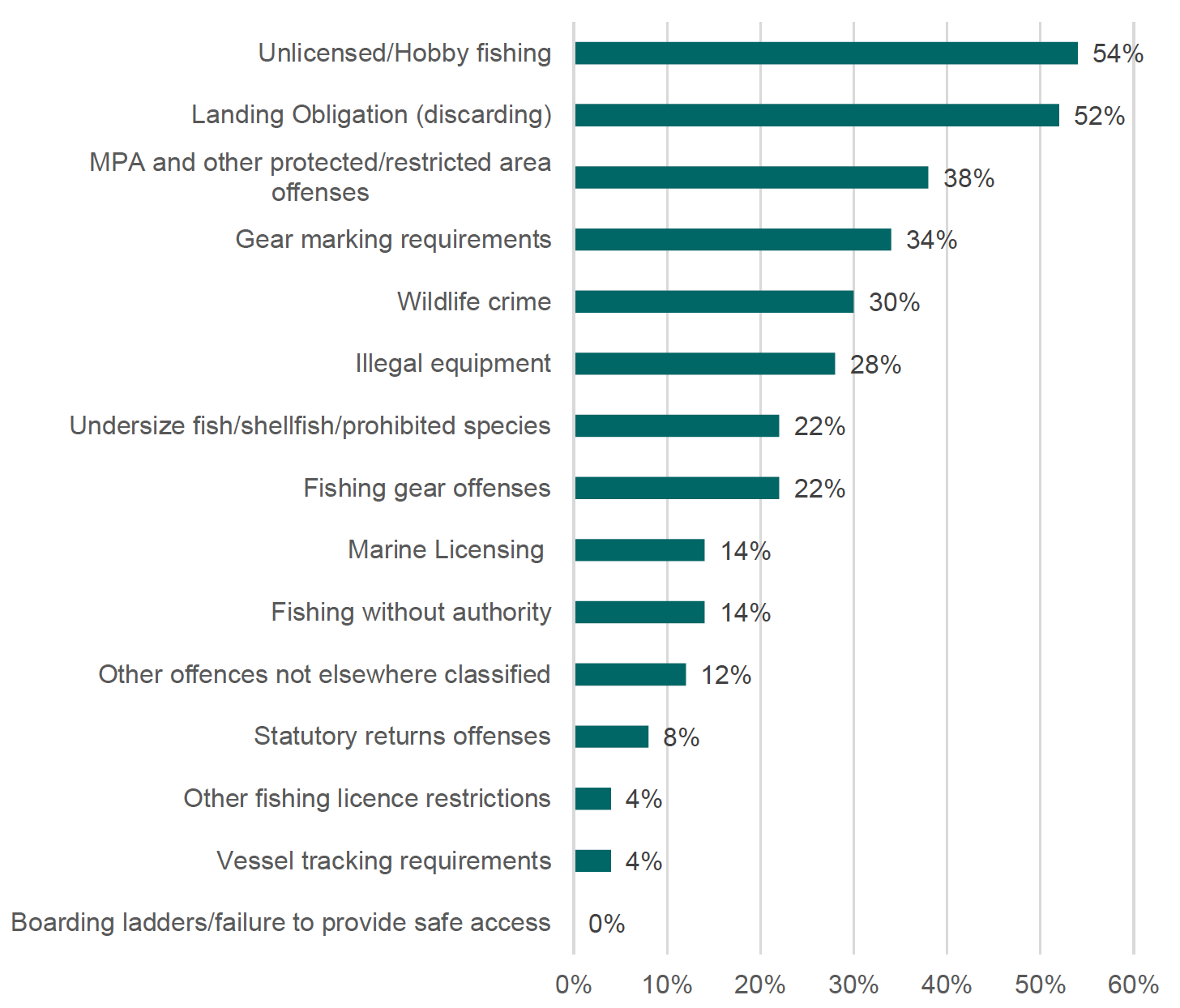
Staff responding to the survey were also asked to detail areas of non-compliance where it is most challenging to gather the required evidence to take enforcement action. Figure 16 provides a breakdown of responses.
The two most challenging areas of work regarding evidence gathering were unlicensed/hobby fishing (mentioned by 54% staff) and landing obligation/discarding (mentioned by 52% staff).
These findings align with the findings from fishers, who during the interviews regularly commented on difficulties of complying with regulations such as landing obligation and discarding, restricted area regulations, fishing gear issues, licensing considerations, undersize and prohibited species and statutory return requirements. There is, therefore, an overlap between regulations fishers find difficult to comply with and offences that are more difficult to enforce (as perceived by the Marine Directorate compliance staff).
7.6. Chapter summary
A small number of fishers whose non-compliance was not detected or penalised felt that there was a lack of presence of compliance and enforcement staff. They also mentioned they felt that compliance and enforcement staff might appear not to notice non-compliance for certain offences, though in fact some activities are difficult for them to detect and enforce.
Most of the staff who responded to the survey agreed that there are significant challenges in detecting non-compliance and taking enforcement action when non-compliance is detected. This could be related to challenges associated with gathering evidence and the perception about Marine Directorate resourcing (discussed in the previous chapter).
Fishers’ experiences of enforcement action ranged from: advice, cautions and 30-day warnings, fines and FPNs and in one instance, the loss of their fishing licence. Two-thirds of fishers who had experienced enforcement said it did not affect their subsequent actions. In interviews, fishers expressed mixed views on whether or not enforcement actions were fair. Perceptions of unfairness were the strongest among fishers who felt the breach had not been their fault.
Staff and fishers hold different perceptions about the effectiveness of enforcement actions as a deterrent to non-compliant behaviour. Fishers were more likely than staff to feel that advisories and verbal actions are effective deterrents. The general view among fishers was that verbal and written advisories, and written warnings, are an appropriate action for an isolated, low-level or accidental instance of non-compliance. However, for those fishers who are deliberate about non-compliance, these forms of action were perceived to have no impact in deterring future non-compliance.
Staff viewed referrals to the Crown Office as an effective penalty, but some commented on the evidential threshold for court action and the time-consuming nature of preparing a case and waiting for the case to be heard.
There were mixed views among fishers and stakeholders about whether Fixed Penalty Notices effectively deter non-compliance. While most fishers acknowledged that they would not want to receive a Fixed Penalty Notice, they also explained that this was not a key factor in whether or not they operate compliantly.
The chapter also looked at difficult to monitor regulations and challenges associated with gathering evidence of non-compliance. Unlicensed/hobby fishing and landing obligations/discarding were viewed by staff as the most difficult to evidence.