
Fishers' Behaviour and Attitudes Towards Compliance and Enforcement: Research Report
To support the delivery of Scotland’s Fisheries Management Strategy 2020-2030, this research aims to better understand the monitoring and enforcement of fishing regulations in Scotland
4. Knowledge of fishing regulations
This chapter discusses fishers’ self-rated knowledge (awareness and understanding) of regulations, and how Marine Directorate staff and industry stakeholders perceive fishers’ knowledge. It also looks into the sources of information fishers use, and barriers to better knowledge.
4.1. Fishers’ knowledge of regulations
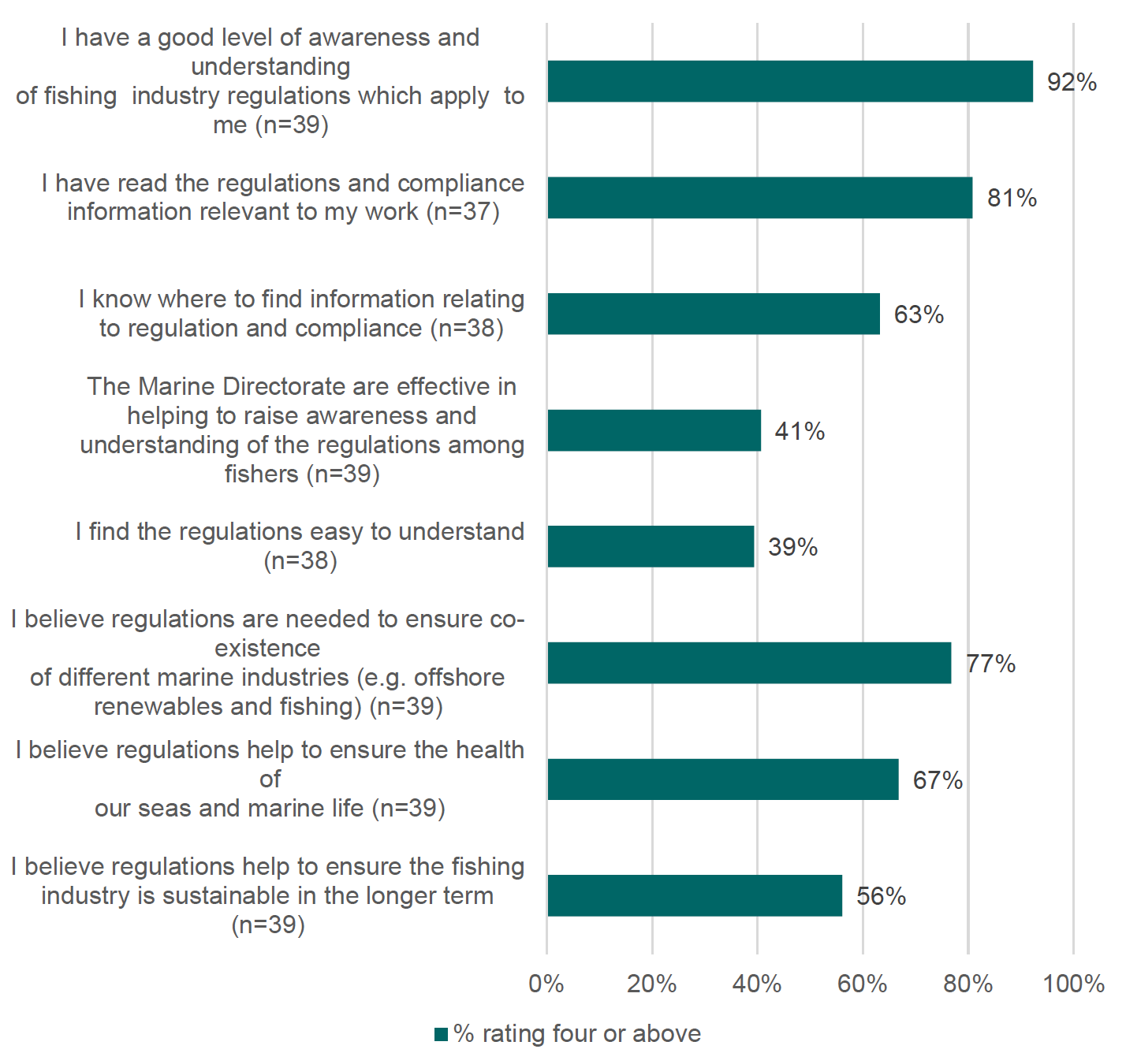
Fishers who responded to the survey were asked to indicate whether they agree or disagree with a range of statements about their knowledge of fishing regulations (Figure 5). The majority of the respondents (92%) stated that they have a good level of awareness and understanding of fishing industry regulations which apply to them. Echoing survey responses, most of the fishers who took part in the interviews said that they are aware of and understand current fishing regulations.
Industry stakeholders interviewed for this project believed that fishers have a reasonably good understanding of the regulations, although some caveats were expressed. For example, one stakeholder commented that fishers have a high to medium level of understanding the regulations, but it could be deeper.
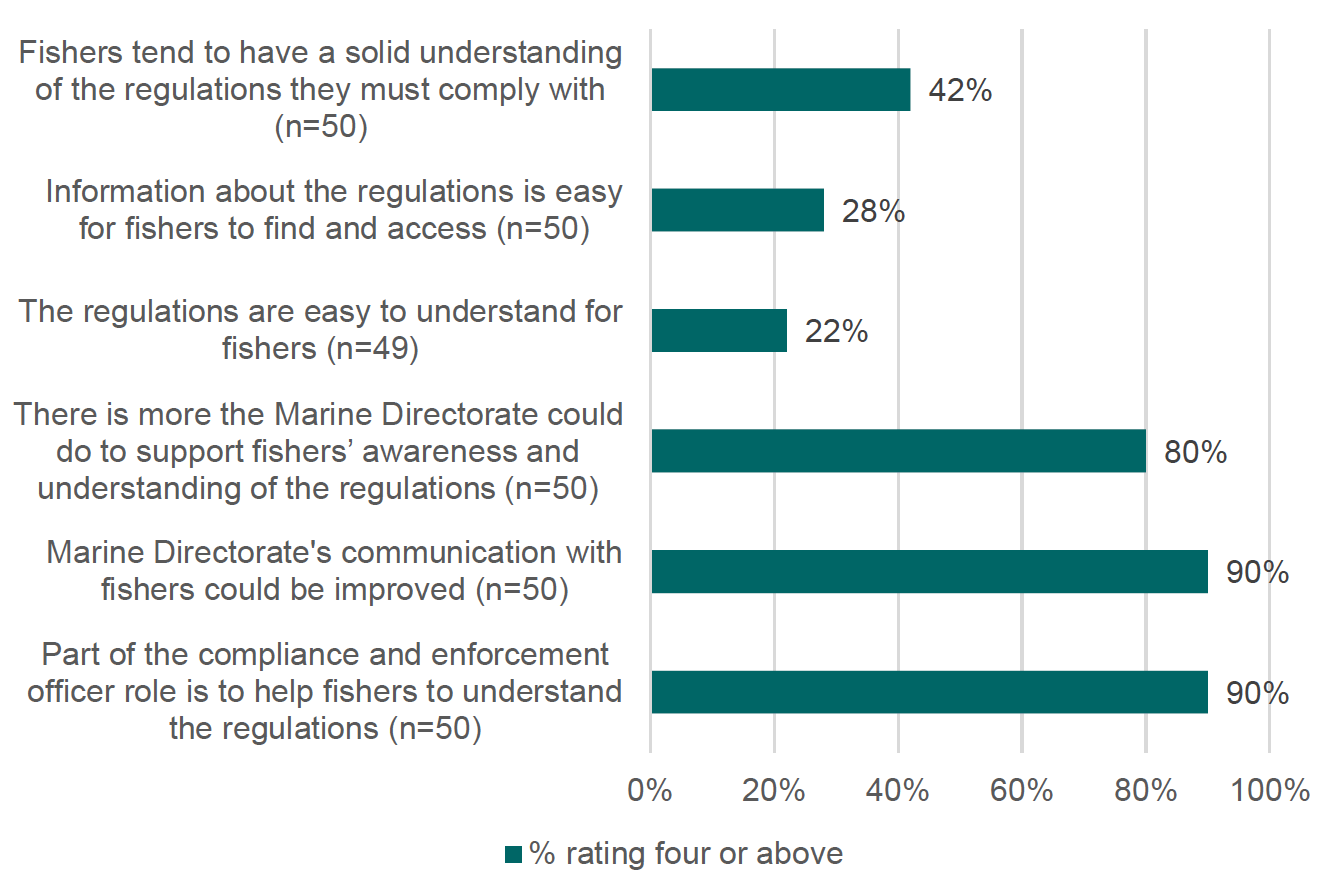
In contrast, a smaller percentage (42%) of Marine Directorate staff agreed with the statement that “fishers tend to have a solid understanding of the regulations they must comply with” (Figure 6). During the interviews, staff suggested that comprehension varies from vessel to vessel, with larger operators being more likely to have a better understanding of regulations, possibly because they face greater financial losses if they break the law.
4.2. Barriers to better knowledge
Less than half of the fishers (39%) who participated in the survey believed the regulations were easy to understand (Figure 5). Marine Directorate staff agreed with fishers, with only 22% of staff agreeing that “the regulations are easy to understand for fishers” (Figure 6). This raises a question about the barriers to better knowledge. All three groups of respondents (fishers, Marine Directorate staff, and industry stakeholders) discussed such barriers during the interviews.
During the interviews, fishers who believed regulations were difficult to understand identified the following reasons that prevented a better understanding of regulations: ongoing changes in regulations, the complicated nature of regulations, a lack of clarity, poor communication, inaccessible presentation, the time-consuming task of staying updated, information overload, and difficulties in identifying relevant information.
One of the fishers mentioned that it was hard to learn about regulations at the beginning of their career, but that due to their method of fishing (they normally fish in one particular area) they managed to learn about regulations relevant to them. They expressed the opinion that it must be harder for nomadic vessels that fish across different marine areas where different regulations might apply.
“I never fish outside of one area…So, it's not like I'm a pelagic guy or one of the big boats that’s moving around or a scallop guy that's maybe working all around the UK. So, I don't have to worry too much about looking at different areas and seeing what I can and can't catch in those areas. Once I've got my head around what's applicable in my area then I don't find it too difficult. I think I probably did when I started fishing, but the language that they use in most of the stuff related to what I do, I find it ok to get through it.” (Fisher)
Similarly, another fisher highlighted that regulations for creel and inshore fishing were more straightforward, with fewer technical measures to consider.
“What I'm doing with the creels at the moment is fairly simple. But when you come to mobile gear and fishing for prawns or whitefish, whatever it is, it's so complicated… with the mesh sizes, the technical measures.” (Fisher)
A few fishers noted that while it is challenging to keep up-to-date with industry regulations in their entirety, they try to keep abreast of the regulations relevant to them.
“There are endless amounts that you should know. You don't have the physical time in the day, or the interest because only a small portion of it is relevant to you. So, I can't actually physically read heavy documents. I can't take them in. So, any information that is coming at you that's relevant, you're likely to miss. So, a lot of it, you pick up word of mouth through other people fishing.” (Fisher)
Industry stakeholders interviewed for this project broadly agreed with fishers’ identified barriers to understanding. They named a large volume of regulations and their highly technical nature, as well as frequent changes in regulations as a challenge. Moreover, they were of the view that sometimes Marine Directorate’s fisheries offices were not aware of the changes, and that a lack of information and guidance from the Marine Directorate was problematic.
During the interviews, Marine Directorate staff agreed that regulations were too complex. For example, one interviewee suggested there was a need for a simplified regulation system to aid understanding.
“It's made up of so many different layers, we're still carrying over EU legislation from prior to Brexit. We've got our own UK legislation, and we've also got Scottish statutory instruments that come on top of that as well. And you've also got licence conditions. I think it's become too much. They're all over the place, and they're scattered… It's so diverse and it needs to be simplified… It's very complex. So, we struggle to understand it. If we struggle, then I'm pretty sure the fishing industry would struggle at the same time.” (Marine Directorate staff)
Suggestions from stakeholders to better support fishers’ understanding of the regulations included: creating a more user-friendly online presence (with the Scottish Government website described as containing a lot of information and therefore being difficult to access); and better training and education of fishery officers before any new regulations are introduced.
4.3. Sources of information about the regulations
The majority (81%) of fishers who completed the survey stated that had read the regulations and compliance information that are relevant to their work (Figure 5). Almost two thirds of fishers (63%) stated that they knew where to find information about regulation and compliance (Figure 5). In contrast to this, only 28% of surveyed Marine Directorate staff believed information was easy to find and access (Figure 6). In the interviews, staff highlighted challenges associated with difficulties of using digital technology to access information (especially among older fishers) and competing priorities, meaning that fishers do not always have time to search for information.
The following sources of information were mentioned by fishers during the interviews: local fishery offices or communications from Marine Directorate; industry groups and bodies, fish producer or professional associations; word of mouth; through their skipper or their business; the internet; licensing variations, and the press. While a few felt it was easy to find information on regulations, others said they struggled to access the information they needed.
On licensing variations, some fishers highlighted challenges in keeping up to date with licensing variations and acknowledged they did not check these as frequently as they should. Here, barriers included not knowing where to look, forgetting, or being too busy to do this. One described difficulties in finding information online, and suggested letters from Marine Directorate were more helpful. There were calls to make information easier to access. One participant suggested Marine Directorate could send text or WhatsApp messages to make people aware of a variation and prompt them to look at, or follow a link to the online portal.
Being part of industry groups or associations was often named by fishers as a way to keep up to date. Similarly, industry representatives interviewed for this project also felt fishers often require support from company owners, producer organisations (POs) or representative organisations to understand regulations. During the interviews, industry representatives recounted instances of support provided to fishers about regulations. This included: keeping abreast of changes and communicating the details in an accessible way; support through dedicated quota managers who update member vessels on their quota uptakes and alert them when they are approaching their limits; email and website reminders or letters from chief executives about updates to policies and fishery management issues; passing on information about policy changes from industry and governmental groups; supporting with and providing advice on financial administration; and highlighting the importance of following the guidelines and advocating for adherence to these.
During the interviews, one fisher gave their view that they felt non-members of associations are more disadvantaged in building their knowledge of regulations. They also identified some barriers to participation in industry groups, such as a lack of local meetings or use of virtual formats which deter those who do not use IT.
“If you're in an association, you're pretty well kept up to speed, but there are people who aren't in associations. I think that's where the difficulties appear because these people are not represented in any way. Marine Directorate has got to deal with them directly, and there are so many individuals. It makes it quite difficult for Marine Directorate, for the compliance people.” (Fisher)
4.4. Marine Directorate’s role in supporting fishers’ knowledge
Where fishers look for information on regulations links to the discussion about the role of Marine Directorate staff in supporting fishers’ awareness and understanding of regulations. Less than half (41%) of fishers who took part in the survey thought that the Marine Directorate is effective in helping raise awareness and understanding of the regulations (Figure 5).
In interviews, some staff felt that the Marine Directorate are effective in helping fishers understand the regulations and their purpose, especially when highlighting new or updated legislation. This was done through information on the licensing variations website and in face-to-face conversations between staff and fishers that occur on the pier and at sea if a patrol vessel boards a vessel.
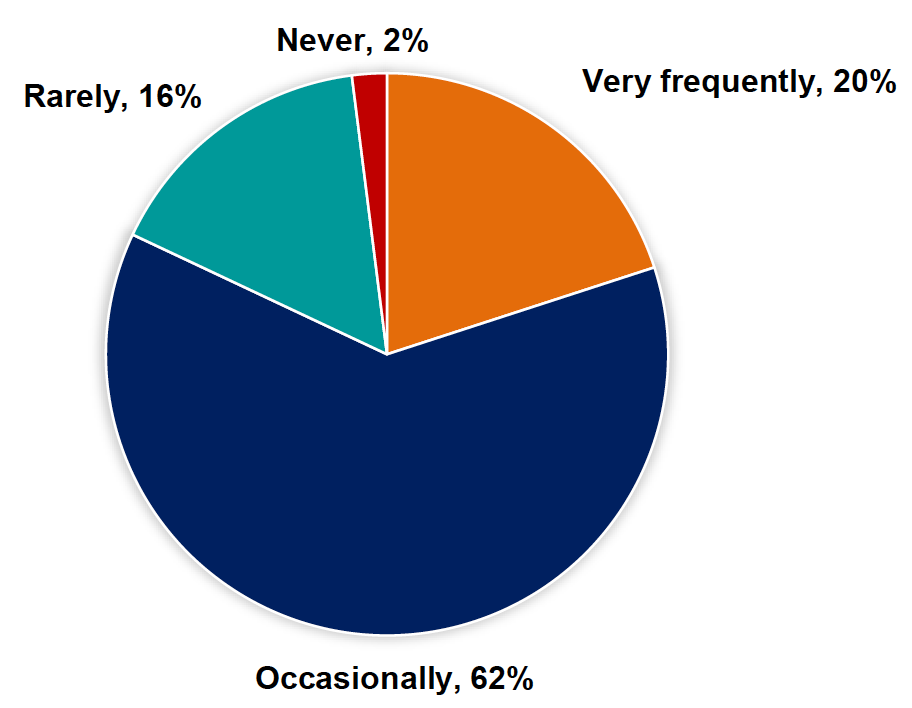
Figure 7 shows the frequency with which fishers approached Marine Directorate staff. A majority of Marine Directorate staff reported that fishers occasionally approach them or contact them for advice on existing or new legislation (Figure 7). A fifth (20%) reported this as very frequent and 16% reported it was rare.
There was also a strong agreement that Marine Directorate’s communication with fishers could be improved (90% staff agreed to this statement) and also that the Marine Directorate could do more to support fishers’ awareness and understanding of the regulations (80% agreed to this statement). Most respondents also agreed that helping fishers understand the regulations is part of the compliance and enforcement officer role (90%) (Figure 6).
Some staff interviewees suggested ways Marine Directorate could ensure fishers are aware of and understand current regulations. Ideas included distributing an A4 sheet with simple, digestible information about the regulations they need to comply with, making online information more easily accessible, disseminating information via fishing associations, and providing information proactively, rather than waiting for fishers to ask.
“I think the simplicity is at its core the most important part… a lot of this stuff can be confusing. I think it's important to make sure that people can easily understand it (and that) fishermen can easily understand the legislation.” (Marine Directorate staff)
Some interviewees, including coastal and offshore staff, emphasised that building a trusting relationship with fishers is crucial in encouraging compliance and in updating fishers about new or changed regulations. These interviewees described positive relationships they felt that have established, noting underpinning factors such as the pragmatic understanding that regulation is part of the industry, pride that fishing is recognised as an important part of Scotland’s identity and economy, and acknowledgement that enforcement officers are ‘just doing their job’.
“We think we work well with industry because we are approachable. They can come in and ask us questions. We give them information. They might come into the office for a cup of coffee.” (Marine Directorate staff)
Marine Directorate staff also noted that relationships with staff in other locations are important for sharing information and supporting each other.
During interviews with fishers, some described their local office staff as helpful and responsive in keeping them informed or responding to queries, or said they felt information from government channels is most reliable.
“Marine Directorate, the compliance team, the local office…they're usually quite good at keeping in touch. Although I'm 30 miles, 40 miles up the road, they come up maybe once or twice a week. If they see you about, they're really good. They've got your phone number anyway. They'll give you a call. Anything that you should know, they're very likely to know.” (Fisher)
However, others raised difficulties with communication from official sources. For instance, one participant noted they do not receive updates from their local fisheries office, explaining that they have to be proactive in asking questions. Another felt it would be helpful if they could sit down with fishery officers to check regulation changes. Another described conflicting advice from local fisheries office and marine-based staff, sharing that they trust local staff more due to their knowledge of regulations in the local area.
A small number of fishers had a perception that Marine Directorate staff did not fully understand the regulations, citing examples where they had asked staff questions about regulations that they did not feel were answered adequately. Others mentioned that they often hear first about regulation changes from other sources, with a small number expressing concern about the short notice of these or Marine Directorate’s lack of consultation with fishers about them.
4.5. Chapter summary
Overall, the majority of fishers believed their knowledge of regulations was strong. However, Marine Directorate staff held mixed views about fishers’ understanding of the regulations. Staff and fishers identified barriers to better knowledge of regulation. This chapter also discussed how fishers access information related to compliance, and the role of industry stakeholders and Marine Directorate staff in promoting a better understanding of regulations.