
Fishers' Behaviour and Attitudes Towards Compliance and Enforcement: Research Report
To support the delivery of Scotland’s Fisheries Management Strategy 2020-2030, this research aims to better understand the monitoring and enforcement of fishing regulations in Scotland
8. Fishers’ interactions with compliance staff
This chapter explores fishers’ experiences of interactions with compliance and enforcement staff.
8.1. Frequency of contact
Almost all fishers (84%) responding to the survey reported having experienced compliance and enforcement staff carrying out inspections to assess compliance with regulations. Of these, 18% had experienced this at sea, 18% onshore, and 63% had experienced both.
The frequency of fishers’ contact with compliance and enforcement staff for the purposes of inspections appeared to vary greatly. This ranged from one fisher reporting that they had been inspected only a few times in their 30 years of fishing, through to another fisher reporting that it had become so frequent that it was starting to annoy them.
“As far as actual compliance, in the sense of inspections...two or three years ago was the first time in 30 odd years I've been inspected.” (Fisher)
"Maybe once every couple of weeks they'll come down and check our landing because they're well aware that they're just doing it to tick boxes because they're well aware that there's nothing to worry about. We're going to be under quota. Our sizes are going to be good and they're quite happy, but they come every so often just to check off that what we're landing is what's going in our logbook.” (Fisher)
“Not very often, but usually a few times throughout the year we will get a random inspection before we land.” (Fisher)
“It's got to the stage, right, where I used to be quite tolerant of the fishery officers when they used to come down, when we were landing [in specific areas]. I used to be quite tolerant when they used to come down and monitor us landing. I never used to mind it, but then, especially over the last three years, it's become more constant… Yes. Not so much the boardings at sea. One to two boardings a year at sea, but it's got to the stage because I've been hassled so much in (three areas), wherever I land, (another area). I'm actually getting really annoyed with it.” (Fisher)
8.2. At sea inspections versus harbour inspections
Across the fishers who participated in the interviews, inspections at sea were rarer than inspections when they land. A few fishers described boardings at sea taking place a couple of times a year, but for most, it was less frequent. One felt that this was influenced by the type of fishing, perceiving those using mobile gear as being more likely to be boarded at sea.
“We’re generally boarded at sea and then we'll be monitored when we come back in so we'll have, quite often in the evening times or whenever we land we'll have a monitor from the local fishery office, they'll appear and they'll compare our landings against what was declared in our logbook. But we'll have both, so we'll certainly have at least an annual boarding at sea which I have no problem.” (Fisher)
“I've never been boarded when we’ve been fishing with pots. I've had the cruiser go round us and monitor what we're doing and then sail away, but never had anybody on board when we're hauling pots. Now, I think if we were mobile gear for all of the year then we would probably see them more than once a year on board for a gear inspection… the potential for you to be acting illegally is much higher when you're using pulled gear because there's more technical measures related to mesh size etc. Whereas a pot is a pot.” (Fisher)
A small number of fishers also felt that approaches by staff carrying out inspections at sea, differed from those who are inspecting at landing. Some shared a perception that staff at sea were more authoritative, less conversational.
“They're (coastal staff) quite polite and, when you see them coming, they're not standing there with their fists up. They're quite respectful. But there is a problem with the boarding parties landing and coming in and boarding some of the vessels at sea. They have an arrogant attitude. Some of them, maybe not them all, but some of them have a very arrogant attitude and they come on board and take over the vessel.” (Fisher)
8.3. Ad-hoc interactions
During interviews fishers explained that the majority of their contact with compliance and enforcement staff took place during inspections at sea or at harbour. However, a few fishers also described contacting or visiting local offices to submit paperwork, seek advice, or other ad-hoc interactions.
“So, on the ground I have very little contact with them. I think I've probably met a fishery officer maybe three or four times in the time I've been fishing. They've come to a landing maybe once or twice and they didn't even bother coming and checking my stuff when I was landing. They were checking somebody else's at that time.” (Fisher)
“I'll see the local office in town, I'll quite often, I'll go in for advice there, you know, if we need to get new logbooks. Sometimes they come down to have a chat on the landing, so yeah, maybe once a month, once every second month.” (Fisher)
“I'm always attracted to the harbour. Every time I'm up in (area) I'll go for a walk in the harbour. You'll see them. You know, they keep us updated… the couple that we've got just now are pretty good. They're down to earth guys. ‘How are you doing? Are you aware of this meeting?’” (Fisher)
“I’ve asked the local fishery officer down a couple of times before when we've been making amendments to the gear on the pier. I've had them down a couple of times with gauges and tape measures, you know.” (Fisher)
8.4. Contact with the Marine Directorate headquarters
Contact with staff at Marine Directorate headquarters was far less common among fishers than contact with staff in their local fishery office. While a few fishers described email and phone contact about administrative queries or tasks, a small number reported interactions with Marine Directorate to discuss particular issues or through attending meetings.
“Once or twice I’ve had to speak to Edinburgh, the head office, but it’s very rarely. I think it was for a quote on a licence, yeah, it was, it wasn't sort of a compliance matter, it was more of a sort of admin, I think it was, just for sorting out detail.” (Fisher)
“The only times I’ve been in contact with them is when we've had problems with the wind farm, and I used to be in touch with them. I know two or three of them, I used to just phone them.” (Fisher)
One fisher reported that they felt staff from Marine Directorate used to be more active in attending local meetings but that this had waned in recent years citing the perceived frequent changing of staff in roles as a potential reason. Aligned to this, one felt that Marine Directorate didn’t appreciate or accommodate fishers’ working patterns, providing short notice about meetings, and setting them for unfeasible times. A couple described meetings with Marine Directorate staff where they felt their input was ignored, with another questioning the level of industry knowledge held by those working in Marine Directorate. One fisher, while not describing direct contact with Marine Directorate staff, took issue with what they perceived to be Scottish Government consultations being issued at the last minute, but felt that responding was futile as those in the industry were not listened to.
“The change we want to see is for these vessels to be monitored accurately and the tonnage they put on the national statistics, so everybody can see what's happening and the scientists know what's happening... I invited (name), a Marine Scotland representative, to come to the fishing exhibition in (area) to meet up with some of the fishing guys…but, oh he didn't have time, and his time was of the premium and so on, so they didn't bother.” (Fisher)
“All the consultation papers they put out, the consultation it's only sent out at the last minute, and we fill it up religiously, everything is filled up, and we fill it up properly, and we detail everything. But they don't listen to it, they've made up their mind what they want to do before they sent the consultation paper out, so it’s the paper exercise. That is wasting my time.” (Fisher)
One stakeholder felt relations between Marine Directorate staff and fishers, associations and POs had improved in recent years, with increased interaction and collaboration. However, another expressed concern about Marine Directorate’s lack of engagement and joint working with industry and consumers; they called for making better use of the knowledge within the industry.
The meetings referred to in this section are likely to be policy meetings and formal consultations, which are separate to Compliance activities.
8.5. Quality of interactions
During the survey, fishers were asked the extent to which they agreed with statements about their experiences of interactions with compliance and enforcement staff. A breakdown of responses across each statement is provided in Figure 17.
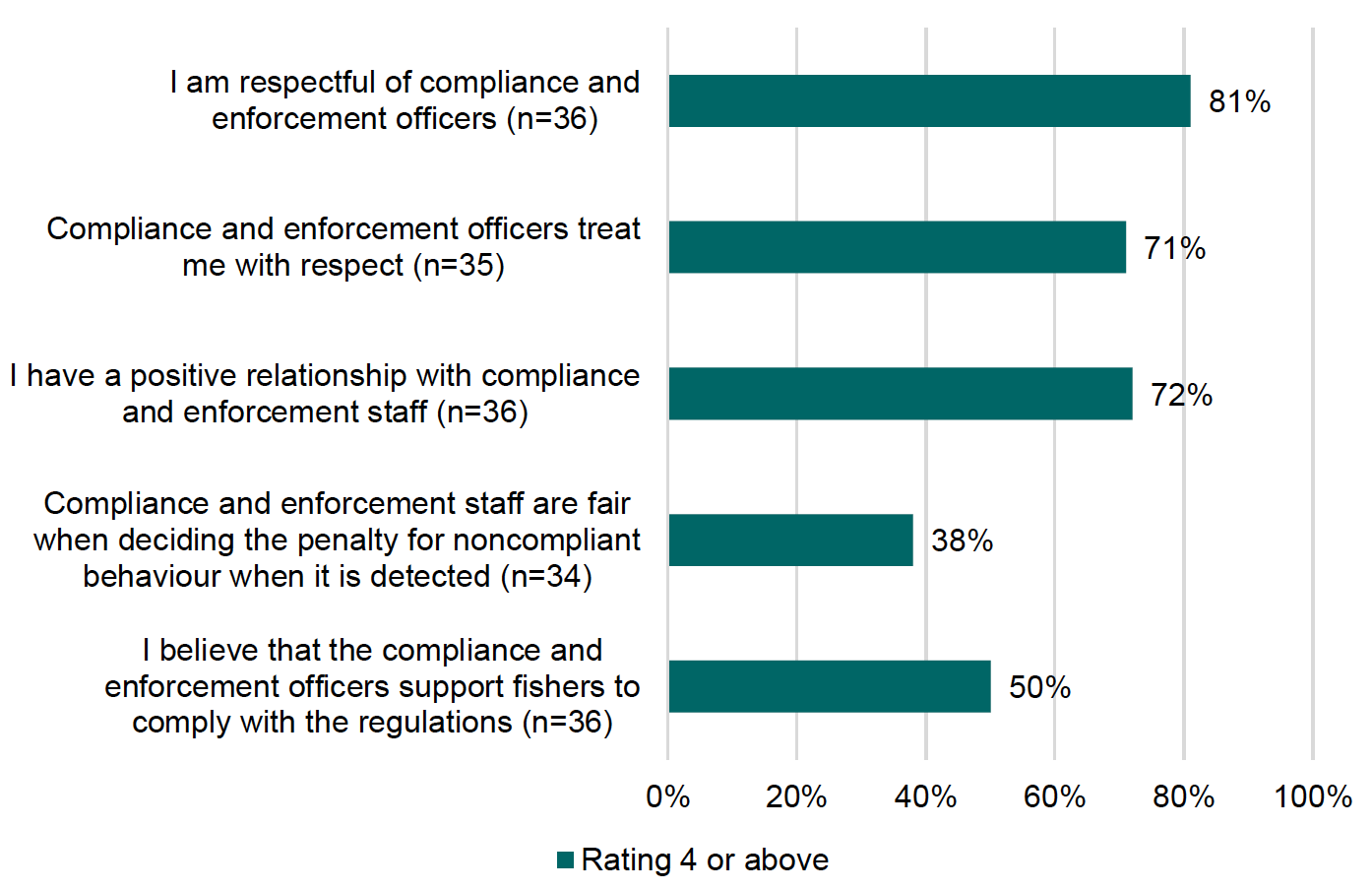
Almost three-quarters (72%) of respondents felt that they have a positive relationship with compliance and enforcement staff, and a higher proportion (81%) reported that they are respectful of compliance and enforcement staff. The majority (71%) felt this was reciprocated with compliance and enforcement officers treating fishers with respect.
Half of fishers (50%) agreed that compliance and enforcement officers support fishers to comply with the regulations; a smaller proportion (38%) agreed that compliance and enforcement staff are fair when deciding the penalty for non-compliance.
During the interviews, most fishers described a positive relationship with compliance and enforcement staff, particularly with those in their local fishery offices. They noted a recognition that the compliance staff are simply doing their job, and generally go about it in a respectful manner, engage in conversation, and are approachable and helpful.
“Yeah, I mean, the guys were great. They just came alongside and they just had a quick chat. They wanted to know how was, you know, what we're fishing for, how your day’s going, do we have any problems, anything we want to speak about, and so, yeah, it was a positive experience, yeah, it was fine.” (Fisher)
“I don’t have a problem. They’re doing their job. I'm trying to do mine. That’s the difference. If you're sticking to the regulations, you shouldn't have a problem with them.” (Fisher)
“We've got really helpful staff here, which is great, yeah. I think we've got a good relationship, yeah, it’s good.” (Fisher)
“We've a good relationship with the local office. Excellent relationship with the local office. No problems at all. You know, like the guy we've got, (name) is excellent and never, never any… You can talk to him. You can discuss things with him.” (Fisher)
However, a small number of fishers described a less positive relationship with compliance and enforcement staff, and inconsistencies in how they had been treated by different staff. One explained that past negative experiences had led to them treating staff in the same way he felt he had been treated.
“Well, the ones that we've dealt with they have this idea that they're better than us. I mean they're like, they’re sitting on a high; they revel at the control they have over the fishermen; they absolutely love it.” (Fisher)
“I would be honest with you and say it tends to follow a kind of good cop bad cop routine. In my experience it’s generally always two guys that come aboard, and almost every time we've had somebody who seems pretty amiable and somebody who seems like a little bit authoritative. And of course you need to have an authoritative approach in a situation like that, but if you're coming aboard somebody's boat at sea, who is a paid licence holder, who is fully compliant and has a history of compliance I don't want to see somebody who's making you feel a little bit uncomfortable in their own surroundings.” (Fisher)
8.6. Chapter summary
Almost all of the fishers who responded to the survey have experienced inspections by compliance and enforcement staff to assess their compliance with regulations. During interviews, fishers explained that their contact with compliance and enforcement staff typically occurs during inspections at sea or harbour. The frequency of fishers’ contact with compliance and enforcement staff for inspections varied greatly. A few fishers described contacting or visiting local offices to submit paperwork, seek advice, or other ad-hoc interactions. Fishers almost never contacted the Marine Directorate main office in Edinburgh directly.
Most fishers felt that they had a positive relationship with compliance and enforcement staff. However, just under 4 in 10 (38%) agreed that compliance and enforcement staff are fair when deciding the penalty for non compliance, and only half agreed that just compliance and enforcement officers support fishers to comply with the regulations. This is interesting in relation to staff’s perceptions of the interactions with fishers that were described in Section 4.4. Marine Directorate’s role in supporting fishers’ knowledge where 90% of staff agreed that it is compliance staff’s role to help fishers gain a better understanding of regulations and that interactions with fishers could be improved