
Fishers' Behaviour and Attitudes Towards Compliance and Enforcement: Research Report
To support the delivery of Scotland’s Fisheries Management Strategy 2020-2030, this research aims to better understand the monitoring and enforcement of fishing regulations in Scotland
3. Methodology
This research was delivered from April to November 2024 by social research contractors The Lines Between (TLB), commissioned by the Scottish Government. To quality assure this work, TLB worked closely with the Research Advisory Group (RAG), which included the Marine Directorate compliance and enforcement staff, the Marine Analytical Unit, and an external academic (Ife Okafor-Yarwood from the University of St Andrews who specialises in environmental justice, security, and maritime governance).
Fishing regulations are complex and factors around compliance can be deep-seated and difficult to discuss. To uncover these complexities, TLB used a mixed-methods approach (survey and interviews). The research methodology included three participant groups: Marine Directorate staff, fishers, and other stakeholders working in commercial fishing. Such a mixture of methods and participants allowed TLB to triangulate the findings and gather perspectives from people with varied experiences. Qualitative research proved useful for exploring fishers’ compliance and is therefore recommended for future work in this area. Other approaches, such as ethnographic research embedded within fishing communities, could also be beneficial, as such approaches allow researchers to observe human behaviour and social practices. However, these approaches are not very practical for government to deliver, as they require lengthy periods of fieldwork, and are, therefore, better suited to research through academic institutions (e.g. doctoral and post-doctoral projects).
It is worth noting that the depth of information collected through the survey and qualitative interviews was more important than gaining a large representative sample. This allowed the TLB to explore fishers’ views and experiences of compliance, monitoring and enforcement in detail.
The study featured a three-stage approach:
- Phase 1: Foundation phase,
- Phase 2: Fieldwork,
- Phase 3: Analysis and reporting.
These stages are explored in more detail below.
Critical ethical considerations for this study included ensuring that fishers could talk openly about their views and any experiences or awareness of non-compliance. That is why the Scottish Government decided to appoint an external independent contractor to undertake the research. The research team ensured that fisher interviewees were not recruited directly via fishery offices. TLB also gave reassurances to fishers that their participation was entirely anonymous and that any disclosure of undetected non-compliance would not be passed on to the Marine Directorate. No raw data was shared with the Marine Directorate.
Data protection was a key consideration with this sensitive topic and the Scottish Government undertook a Data Protection Impact Assessment. The research was designed to ensure the secure collection and storage of data and that no individuals were identifiable in the report.
3.1. Phase 1: Foundation
The research began with a foundation phase. Fishing regulations are a complex subject. To ensure the research team understood the fishing industry and the regulatory environment, TLB carried out exploratory discussions with representatives of the Marine Directorate and a desk-based review of relevant literature, reports and the Marine Directorate’s published compliance statistics.
Exploratory discussions with representatives of the Marine Directorate took place via Microsoft Teams. Discussions spanned the methodology, themes to explore in the research, advice on engaging fishers and how the Marine Directorate could support recruitment of staff and fishers for the research.
The desk-based review of relevant literature, reports and the compliance statistics included exploration of the anonymised data on non-compliance and penalties. This review aimed to enhance TLB team’s understanding of compliance and enforcement activity. It was not a comprehensive formal literature review, so it is not included in the study report.
These activities informed the development of surveys and interview topic guides, which the Scottish Government signed off before use.
After the foundation phase, the research moved into the data collection phase, as described below.
3.2. Phase 2: Fieldwork
The fieldwork phase involved surveys and interviews with fishers, Marine Directorate staff and wider stakeholders.
Survey and interview questions were similar for the Marine Directorate staff, fishers, and stakeholders. However, themes explored with fishers focused mainly on their individual experiences and perspectives. Questions for staff and stakeholders focused on their professional experiences. Research tools used in this research are presented in the Appendix 1: Research tools.
Survey of Marine Directorate staff
An online survey was developed and distributed to all Marine Directorate compliance and enforcement staff. The Marine Directorate effectively supported staff recruitment to the research through the identification of interviewees as well as distribution of the survey link, and regular reminders to staff. The survey remained open for responses for six weeks, with regular reminder emails to encourage participation.
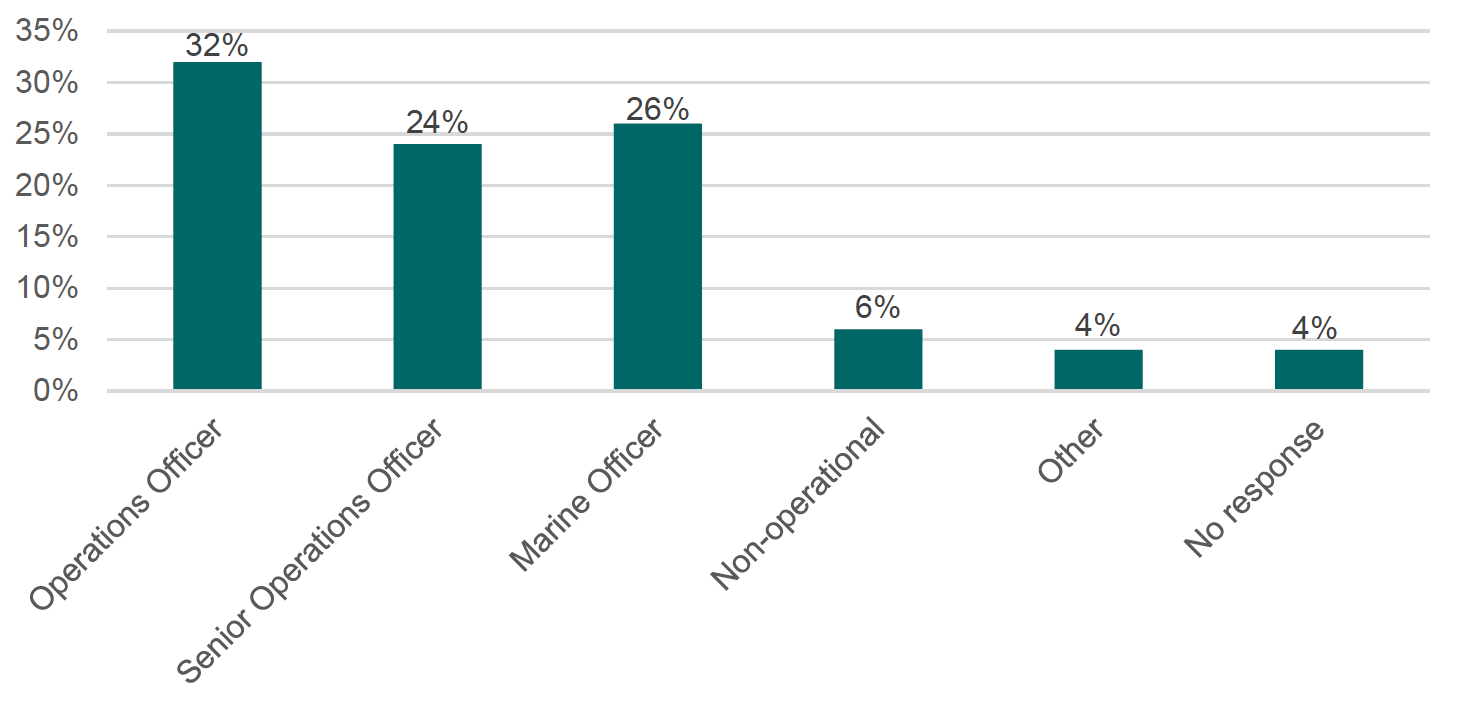
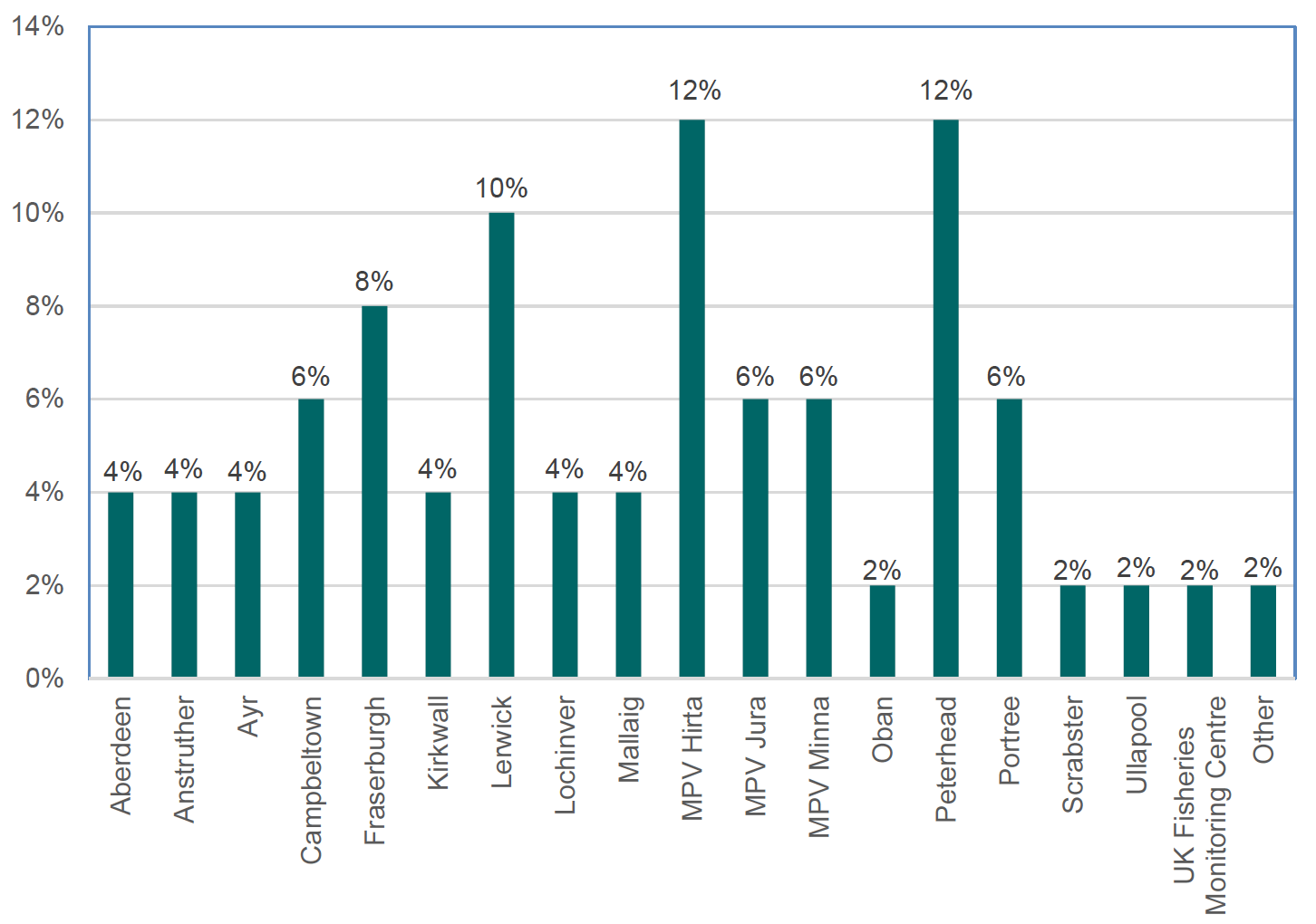
The survey received 50 responses from a cross-section of staff roles and geographic locations. This is a response rate of approximately 42%. Figures 1 and 2 provide a breakdown of Marine Directorate respondents’ roles and work locations.
Interviews with Marine Directorate Staff
In-depth discussions with 16 Marine Directorate staff took place in this research. These included one-to-one and paired discussions. Interviews took place either face-to-face or over Teams. Each interview lasted approximately 30-45 minutes.
This stage involved a visit to a Marine Protection Vessel. This provided TLB an opportunity to interview the staff in person, and also gave the team a more tangible understanding of the topic, the environment within which marine-based staff work, and the resources available to the Marine Directorate.
Interview participants were suggested by the Marine Directorate’s Head of Enforcement Risk and Assurance to ensure a mix of coastal and marine-based staff at different grades and roles. The time and resources available for the study restricted the number of staff TLB could interview. To make best use of resources and achieve participation from a broad range of staff, a sampling strategy was implemented and agreed with the steering group. In addition to this, all Marine Directorate staff had a chance to contribute their views through the staff survey.
Survey of fishers
An online survey for fishers was developed and distributed through the following channels:
- Messaging about the survey on the ‘Licence Variation page’ that each fisher is expected to check regularly.
- Requesting that fishers’ representative organisations share the survey link with members.
- Marine Directorate staff distributing a flyer to fishers in person and via social media.
Recruiting fishers was more challenging than recruiting Marine Directorate staff. The survey remained open for responses for eight weeks and received 39 responses. A profile of respondents is provided below. Given the range of distribution methods used, the number of fishers who received the invitation to complete the survey is unknown. Scottish Government statistics show that 4,117 people were employed as fishers in 2022. Hence, 39 responses equates to approximately 1% of Scottish fishers. This is a small sample. As we have noted earlier, because of the small sample of fishers, the findings cannot be interpreted as fully representative of the entire fishing industry but only to the group of participants who took part in the research. Caution is advised when reading and using the fisher survey findings.
The survey achieved responses from a broad range of fishers. Most (87%) reported having been fishers for over ten years, 10% have been fishers for between five and ten years, with 3% between one and five years. Just over half use a small vessel (registered length of up to 12 metres - 54%), followed by large vessels (registered length of 18 metres and above - 30%) and medium vessels (registered length of 13 to 17 metres - 16%).
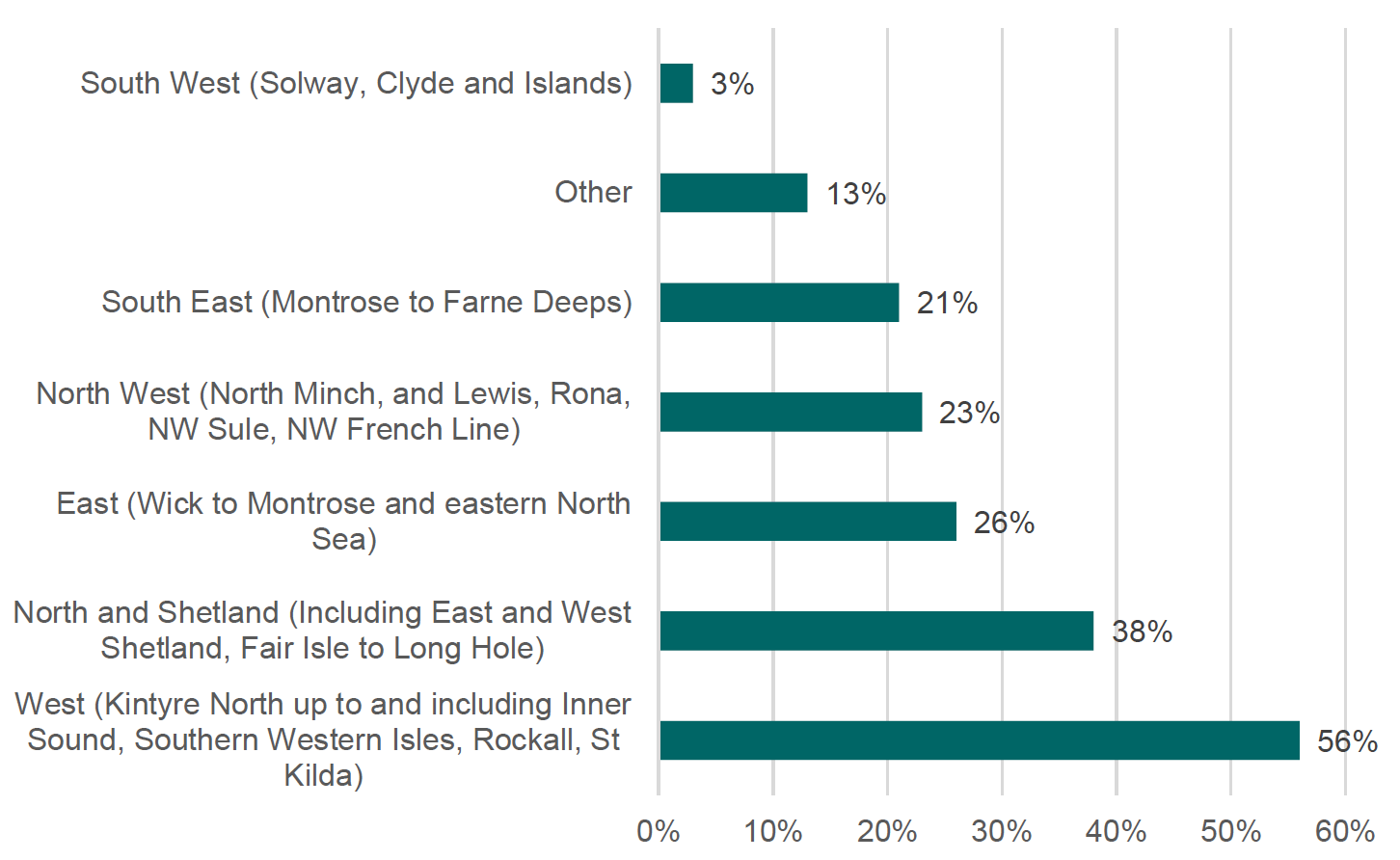
Two-thirds of respondents (69%) reported that their fishing was carried out inshore, with 31% reporting offshore. Figure 3 presents a breakdown of the fishing areas of respondents, and Figure 4 provides a breakdown of the type of gear used to fish.
To protect respondents’ anonymity, the findings are not reported in relation to the specific gear type or linked back to the specific fishing areas.
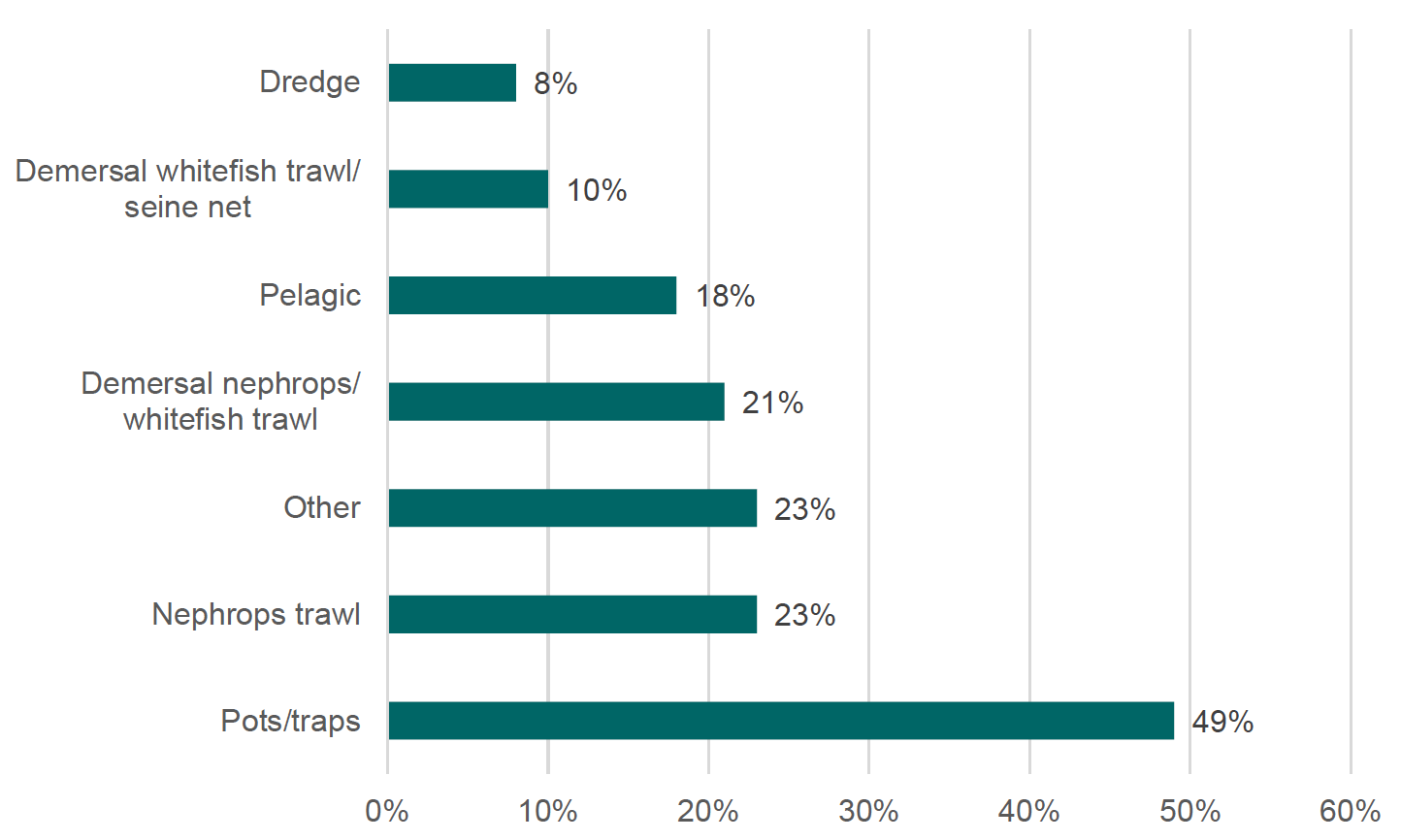
The sample of fishers is not wholly representative. For example, a quarter (24%) of registered fishing vessels in Scotland are over 10 metres long, but 46% of fisher survey respondents work on boats that are 12 metres or longer. However, in terms of fishing gear, creels, pots or traps make up the largest proportion in the Scottish fleet (58%) and the largest number of fisher survey responses (49%) (Scottish Sea Fisheries Statistics 2022 – gov.scot).
It is important to note that this study consisted of predominantly qualitative, exploratory research, and TLB did not aim to achieve a fully representative sample. Rather, the study has involved in-depth research with fishers from a range of backgrounds to explore their views and experiences of regulations, monitoring and compliance.
Interviews with fishers
Twenty one interviews with fishers were undertaken. These interviews were conducted face-to-face, by phone or Microsoft Teams, depending on each participant’s preference, and lasted around half an hour. One fisher opted for an in-person meeting.
The research team considered visiting harbours to interview fishers. However, in discussion with the Scottish Government, it was decided this approach should not be taken on the basis that discussions in harbours would not offer the required level of privacy or discretion given the sensitive nature of the research. There were also concerns about whether fishers would have time to engage with a researcher while working.
Fishers were recruited for interviews through two routes:
- An online survey provided an option for respondents to opt in to an interview. Twelve fishers were recruited through this channel.
- The Scottish Government contacted fishers who had participated in previous research and had provided consent to be contacted about future research. These fishers were initially approached by the Scottish Government to explain the purpose of this study, gauge interest, and request consent for their contact details to be shared with TLB research team. Nine fishers were recruited through this route.
The research team was conscious of the impact that taking part in the research had on participants’ time, so interviews and surveys were designed to be as brief as possible. In addition, a gift card was offered to fishers who took part in interviews as a thank you for their time.
Interviews with stakeholders
Five industry stakeholders participated in one-to-one interviews. Stakeholders were suggested by the Marine Directorate staff. This included four commercial fish selling organisations to collect their views on regulations and compliance. One industry representative organisation also took part in an interview. More representative organisations were approached but did not respond. Representative organisations were approached to seek their views on how regulations, compliance and enforcement are viewed among their membership and their own perspectives on what could be changed or improved with regards to compliance.
3.3. Phase 3: Analysis and report writing
The final stage of the research involved analysing all collected data. This included a detailed thematic analysis of all qualitative data gathered through interviews and surveys using a robust coding process. Quantitative analysis of the closed-ended survey questions was undertaken by creating frequency tables. Differences in responses between fishers, staff and stakeholders were analysed.
The fishers who took part in the survey and interviews provided insightful and valuable information about their views and experiences. The final report provides a summary of the key themes emerging from the research based on this analysis. Unfortunately, TLB cannot discuss each fisher’s experience in detail in the report, but all the data has been analysed and has informed the findings reported in this document. TLB presented the research findings to the Scottish Government’s Marine Analytical Unit shortly before submitting the report.
On presentation of survey results, both the staff and fishers’ surveys contained questions and statements that respondents were asked to rate. These statements measured the extent to which respondents agreed/disagreed to specific statement or rated effectiveness/ineffectiveness of specific measures. All scales were from one to six where a score of one was either completely disagree or not effective at all, and six was strongly agree or very effective. For ease of presentation, TLB presents charts not as a breakdown of ratings (i.e. how many respondents voted for each rating option) but as the “% rating 4 and above”. This indicates what percentage of respondents rated that they agreed with particular statements.