
Fishers' Behaviour and Attitudes Towards Compliance and Enforcement: Research Report
To support the delivery of Scotland’s Fisheries Management Strategy 2020-2030, this research aims to better understand the monitoring and enforcement of fishing regulations in Scotland
5. Compliant behaviour
Some Marine Directorate staff mentioned during the interviews that fishers’ willingness to abide by regulations relates to whether they believe that regulations are serving a good purpose and are fair. This chapter looks at attitudes towards compliance and the factors driving compliant and non-compliant behaviour.
5.1. Attitudes towards the regulations
Just over half of surveyed fishers (56%) agreed that regulations were in place to help ensure the fishing industry is sustainable (Figure 5). A slightly higher proportion (67% of fishers) agreed that regulations are needed to ensure the health of our seas and marine life (ibid.). In line with the survey responses, the majority of fishers participating in interviews believed the purpose of Marine Directorate regulations is to conserve marine stocks, ensure their sustainability and protect the future of the fishing industry.
“I care dearly about the environment. I have two young children. I want to leave the world a better place for them than I received it in.” (Fisher)
“The purpose of the regulations is to control the fishing and to ensure that the stocks are fished in a sustainable manner. You want a future. You don’t want everything to be a free-for-all and a situation where you end up with no industry.” (Fisher)
One fisher commented that fishers did not want to “go back to the blackfish era, when there was a black market in fishing, fish prices were poor, and stocks suffered, (and) fishermen suffered in the long run” (Fisher).
While several fishers believed that regulations are useful and support the sustainability of the industry in the future, many fishers criticised how regulations are created, disseminated, and monitored by the Scottish Government. These discussions focused on the involvement of environmental groups in policy-making, the effectiveness of regulations, perceived insufficient engagement with fishers, and issues of fairness (for example how UK vessels are perceived to be treated in comparison to foreign vessels).
Just over one-quarter of the fishers who participated in the survey thought the regulations were fair (26%). Perceptions of unfairness included:
- A perception that the industry is over-regulated and that many regulations are unnecessary.
- A perception among some that non-UK vessels do not face the same compliance and enforcement measures as the UK fleet.
- A perceived lack of consultation with fishers about regulations.
- The view that there are blanket regulations that are not applicable to part of the industry.
- A perception that multiple boats might be used by a single operator to flout restrictions in a specific fishery.
- A view that regulations are based on incorrect information.
- A perception of a lack of enforcement action by relevant bodies for 15m+ vessels for turning off their automatic identification system (AIS). (AIS is a marine safety tool and falls under the MCA’s jurisdiction. The Marine Directorate have no powers to enforce this).
- Lack of rules for ‘hobby fishers’ i.e. those fishers who are unlicensed. There are tight restrictions on the amounts of shellfish unlicensed vessels can catch, however, as they are unlicensed, they are not presently bound by mandatory reporting and gear marking restrictions.
- A quota system that is regarded as being impractical.
During the interviews, some fishers expressed a view that fishing regulations were potentially designed to appease the green movement and environmental non-governmental organisations (eNGOs) more than to protect the seas.
An industry stakeholder called for more engagement with the fishers and the wider industry, for more value to be placed on fishers’ knowledge of the seas to support scientific data. They urged for less weight to be given to what they described as “green” voices, who they did not feel have a good understanding of the industry and its impacts. Many fishers similarly expressed a view that they are not listened to or consulted with enough.
“We are not being fully engaged with… I think the fishing industry has got a really important part to play in monitoring what’s happening there. There’s a huge knowledge and understanding within the fishing community that really scientists… have disregarded.” (Fisher)
There were comments about the regulations being based on what fishers perceived to be “flawed” science or not designed in collaboration with fishers. These perceptions included views held by some that regulations can unhelpfully disrupt the natural eco-system balance; are devised by people with limited knowledge of the industry; are sometimes lax and slow to come in; gear regulations lead to an increase in by-catch; and inconsistencies in inspection reduce the effectiveness of protecting marine life. Some fishers thought that regulations are driven by the desire to enforce compliance rather than a desire to boost the industry and that quotas are not effective and result in fish dumping.
Monitoring of compliance of foreign boats occupied an important space in fishers’ interviews. Some fishers thought that the regulations are applied inconsistently with different rules for different parts of the fleet, that these favour non-UK vessels, and this is unfair.
“When you've created in your area a decent fishery and then boats from outside (the UK) come with thousands of creels and clean it out. And this is where the regulations need to come in. In my opinion, either they do something drastic now or it's going to be too late.” (Fisher)
Wind farms were also cited by a small number of participants as being a challenge for the fishing industry, potentially leading to less area for fishing and overcrowding of boats. The majority of fishers who participated in the survey (77%) agreed that regulations are needed to ensure the co-existence of different marine industries.
Marine Directorate staff felt that fishers were generally supportive of the regulations and understood their importance in conserving stocks from an environmental and industry point of view.
“I think 99% of the fishermen do want to comply, they do try to comply, and it's just 1% that go out there to (work non-compliantly). So, overall I think they do, because I think they realise as well that we’re protecting fish stocks, and the areas they do fish in. It is important for the future and sustainability.” (Marine Directorate staff)
“Some of them will appreciate the regulations and try to abide by them, and others maybe don't think the regulations are right. Depending on what species they're targeting as well, they might find that for them, that the regulations shouldn't be the way they are, maybe more lenient, not as restrictive.” (Marine Directorate staff)
Similarly, industry stakeholders thought that fishers appreciate the need for regulation to ensure industry sustainability or noted that fishers do not set out to purposefully break the rules. However, they also noted that some fishers have different views about the appropriateness of regulations. One stakeholder felt there is often a disconnect between fishers’ and the government’s view of sustainability and the measures needed to achieve it. Another reflected that the younger generation of fishers and skippers are increasingly more supportive of the need for regulations, with older fishers also showing an increased awareness of the role of regulation in helping to protect the industry and providing them with a market to sell their assets when they are ready to retire.
5.2. Factors encouraging compliance
Fishers responding to the survey were asked about their attitudes towards compliance; their responses are presented in Figure 8.
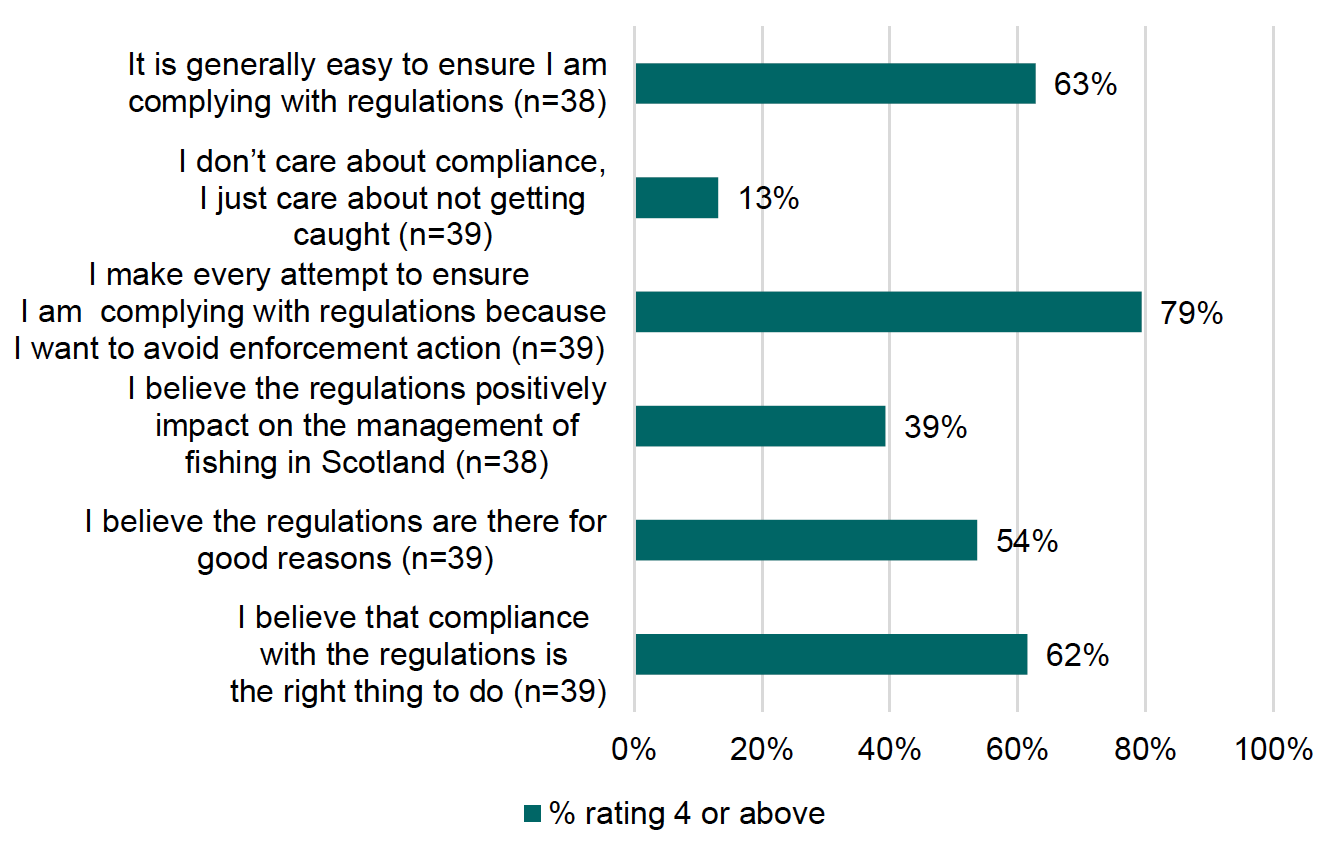
Some of the questions touched on attitudes towards the regulations covered in the previous section. For example, over half (54%) agreed that regulations are there for good reasons. Just under four in ten (39%) fishers agreed that regulations positively impact the management of fishing in Scotland. These numbers indicate that some fishers may be sceptical about the purpose of regulations.
On compliance, a minority of respondents stated that they do not care about compliance, but they just care about not getting caught (13%). Note that this point was made by a very small number of respondents (five). In contrast to this, 62% of fishers believed that compliance is the right thing to do, and 79% of fishers agreed that they complied with the regulations because they wanted to avoid enforcement action.
Fishers were asked about any other factors beyond the potential for enforcement action that encourage them to operate compliantly. Responses included:
- A belief that it is the right thing to do.
- It is the smart thing to do to protect the health of the seas/for the benefit of the seas/the future of the industry.
- Experience, which means being able to make sensible, sustainable and safe decisions without the need for compliance.
- To make it fair for everyone in the industry.
Interviews also explored factors that encouraged compliance with regulations among fishers. Concerns about overfishing and care for the future of fish stocks and the fishing industry were most commonly mentioned.
“You can't just run an industry taking everything that you get and not put anything back into it, and the legislations are a way of putting something back and trying to control stocks. I'm getting to the end of my fishing career, but my sons are at the beginning of theirs so… I don't want to start to say, oh well I had a very good fishing life I don't know what's in it for you… I'd rather them to be able to have a good fishing life too.” (Fisher)
Some highlighted moral reasons for compliance, describing following the rules and obeying the law described as being “the right thing to do”. A few cited fear of being caught or penalised for breaking the rules as a deterrent to this.
“I think just morally, to be honest… You could start picking and choosing what you followed or didn't follow but it would break down in general so I just choose to go along with it.” (Fisher)
“It's just in general to try and be working in the right way… there's a fear of penalties as well because £2,000 is a lot of money.” (Fisher)
“You want to be compliant with the rules as best as you can, we are compliant…you've got no choice, you get boarded that often, it wouldn't be worth the risk.” (Fisher)
A small number of fishers explained that it is important to their reputation to comply with the regulations, and that market and seasonal drivers align with the Marine Directorate regulations.
“If I'm seen to be landing stuff that isn't sustainable, whether that be small or poor quality stuff, that's not going to do my business any good. My reputation is going to suffer. I live in a very small community and I don't want to be seen as a dodgy guy doing dodgy things.” (Fisher)
5.3. Barriers to compliance
Figure 8 showed that almost two thirds (63%) of fishers responding to the survey thought that it was easy to comply with regulations. Figure 9 provides reasons for fishers’ difficulties in complying with the specific areas of regulation, spanning fisheries legislation, Marine and Coastguard Agency (MCA) and Health and Safety Executive (HSE) requirements. Note that some of these regulations such as MCA and HSE are not the Marine Directorate’s responsibility.
Figure 9: Areas of regulations that fishers said are difficult to comply with
Area of regulation: Submission of Fish1 form by 23:59 on a Saturday
Reason it is difficult to comply: The form does not list all species (and should be electronic/an app).
Area of regulation: Elog
Reason it is difficult to comply: When Elog fails.
Area of regulation: Quota
Reason it is difficult to comply: Not adequate or impractical; (e.g. difficult to avoid catching Pollock when targeting Saithe).
Area of regulation: Discards
Reason it is difficult to comply: No reason provided for why it is difficult to comply.
Area of regulation: Keeping up to date with licence variations
Reason it is difficult to comply: Have to get access online, and it is easy to forget.
Area of regulation: Minimum landing size for velvet crab
Reason it is difficult to comply: Unrealistic to gauge every crab.
Area of regulation: Scupper size (responsibility of MCA and not Marine Directorate)
Reason it is difficult to comply: Fishers know what is required to evacuate water from the deck. Forcing them to make vessel alterations is onerous and unnecessary.
Area of regulation: Berried lobsters
Reason it is difficult to comply: At certain times of the year, berried lobsters make up a significant part of the catch. Would rather see an increase in minimum size, giving all lobsters longer to breed before captureArea of regulation: Minimum brown crab size (set too large)
Reason it is difficult to comply: Crabs are naturally smaller in the local area, and it is difficult to get any that measure 150mm.
Area of regulation: Mandatory lifejackets (responsibility of MCA and not Marine Directorate)
Reason it is difficult to comply: Able to make own experienced, educated and calculated decisions about when and where to wear a life jacket.
Area of regulation: Most of the Marine Guidance Notices (MGN) and Marine Shipping Notices (MSN) (responsibility of MCA and not Marine Directorate)
Reason it is difficult to comply: Blanket rules do not fit individual vessels and circumstances.
Area of regulation: HSE regs for scallop diving (responsibility of HSE and not Marine Directorate)
Reason it is difficult to comply: Three divers on board make the process unsustainable and potentially more dangerous.
Regulations raised by some stakeholders as more challenging for fishers to comply with included some European Union legislation (e.g. the ability of organisations to be recognised as a PO, landing obligation and discarding requirements) and regulations related to the management of cod in the West Coast of Scotland. One stakeholder commented that the challenge lay with what they perceived to be inappropriate regulations, noting that when there is a robust argument for regulations and they serve to improve fishers' management, they are likely to be followed.
During the interviews, fishers echoed difficulties raised in the survey, including:
- Submitting paperwork /fish one forms on time, with one participant raising issues with the online submission system.
- MCA regulations, including mandatory lifejackets (this is not the Marine Directorate responsibility).
- Scallop diving regulations for three divers on a boat, which one felt makes the job much harder and does not improve safety (this is not the Marine Directorate responsibility).
- Impractical quotas, landing targets, or discard bans.
A small number of interviewees also raised challenges in complying with gear regulations; one found it difficult to keep up with changes and to obtain clarity from enforcement staff about them. Two fishers raised an issue with electronic net measurement gauges used by compliance and enforcement staff, feeling they did not provide an accurate measurement and meant they were deemed not to be complying. They felt this meant fishers had to buy new nets more frequently, and in their view unnecessarily. Difficulties sourcing the correct sized square mesh panels to meet regulations were also reported.
Over half (59%) of all fishers responding to the survey felt that fishers need more support to enable them to comply with regulations. Their comments on the types of support needed included:
- Allocation of quota that provides fishers with an adequate level of income.
- More awareness/training/workshops.
- Communicate regulations in easy-to-access formats using accessible language.
- Funding to support fishers to operate compliantly or make changes to gear and/or vessel to ensure compliance.
- More input into the forming of regulations.
- Having more fishery officers with more time available.
- Better communication from Marine Directorate.
It is important to note that some fishers responded with comments relating to MCA regulations (regarding lifejackets) and diving regulations. The Marine Directorate is not responsible for the imposition and enforcement of lifejacket or diving regulations. These are the responsibility of the Maritime and Coastguard Agency (MCA) and the Health and Safety Executive (HSE) respectively.
5.4. Impact of regulations on business
Most fishers responding to the survey reported a view that regulations make it more difficult to run a business (85%) and earn an income (87%).
Fishers who stated that regulations make it difficult to run a business or to earn an income raised the following concerns:
- Relevance of regulations – blanket regulations not always applicable.
- Level of administration required.
- Time spent ensuring that they are operating compliantly or ‘dealing with red tape.’
- Acknowledgement that regulations are required but they felt that they have been drafted by people who do not understand the industry.
- The perceived lack of regulation of foreign fleets makes an uneven playing field.
- Costs of compliance operations.
- Quota restricts income generation.
- Adding more rules to an already over-regulated industry.
- Lack of help or guidance after leaving the EU.
Respondents who felt that regulations help them to run a business or to earn an income, suggested the following reasons:
- The removal of grey areas and knowing what you should and should not do makes it easier to run a business.
- A well-regulated industry makes it easier to run a business and should contribute to healthy fish stocks.
- Ground rules are needed due to unscrupulous operators.
- They believe regulations help ensure that smaller companies can survive or thrive.
During the interviews, most fishers indicated that the regulations can make it more difficult to run a business or earn an income. Reasons given included that the regulations are perceived to:
- Cost money (increase fuel requirements, increased wage and equipment costs);
- Require that fishers accept a lower price from UK-based processors to meet target landing quotas;
- Make it harder to compete with foreign vessels, as some fishers believed that non-UK vessels are less regulated;
- Require time spent on bureaucracy and compliance issues taking time away from fishing activity; and
- Cause fishers to abruptly stop fishing in their local area with little warning.
One interviewee discussed that protection of one economically invaluable species (flapper skate) is making it more difficult to fish others. Another suggested that the complexity of adhering to the regulations had caused some to leave the industry, especially those from the older generation who may be less computer literate.
“Today, we've got 106 lobsters, and I threw away 102… That's quite common. So, financially we're taking a massive hit.” (Fisher)
A small number expressed concern about working under pressure to fish more sustainably. In these conversations they described legal cases brought against fishers by eNGOs and negative social narratives about fishers, who felt that they are treated with suspicion rather than recognition of their contribution to sustainability. Others raised wider business pressures fishers face, such as fuel costs, Maritime and Coast Guard Agency regulations, financial losses associated with bad weather and storms, Brexit, and regulations related to windfarms.
Some interviewees contradicted others and felt that regulations either make it easier or have no impact on their ability to run their business. These fishers did not see regulations as a barrier to earning an adequate income. Reasons given included that the creel fishing quotas (for nephrops) are unreachable anyway, the market already dictates the size of the creel catch, with the regulations just mirroring this, and the need to have rules to ensure the sustainability of the stock.
“Probably makes it easier because everybody has to abide by the same rules… if you don't have any rules… there's going to be nothing left.” (Fisher)
One stakeholder stressed the difficult economic climate and described the industry as “being squeezed from all angles” due to high interest rates, fuel prices and expensive quota leases. Legislation changes were described as making business planning even more difficult. They argued that regulations made the industry a lot less profitable and felt that introducing more would threaten the sustainability of the industry. They also called for a greater understanding of the economic impact of the fishing industry on coastal communities and for this to be weighed up against the introduction of any future regulation changes.
Among creel fishers, a few raised that current market demand and prices act as more effective deterrents than regulations; they explained that due to the lack of market for certain stock, such as small or berried lobsters, these do not come ashore. One interviewee called for large fines to be imposed on buyers who accept non-compliant produce.
5.5. Reasons for non-compliance
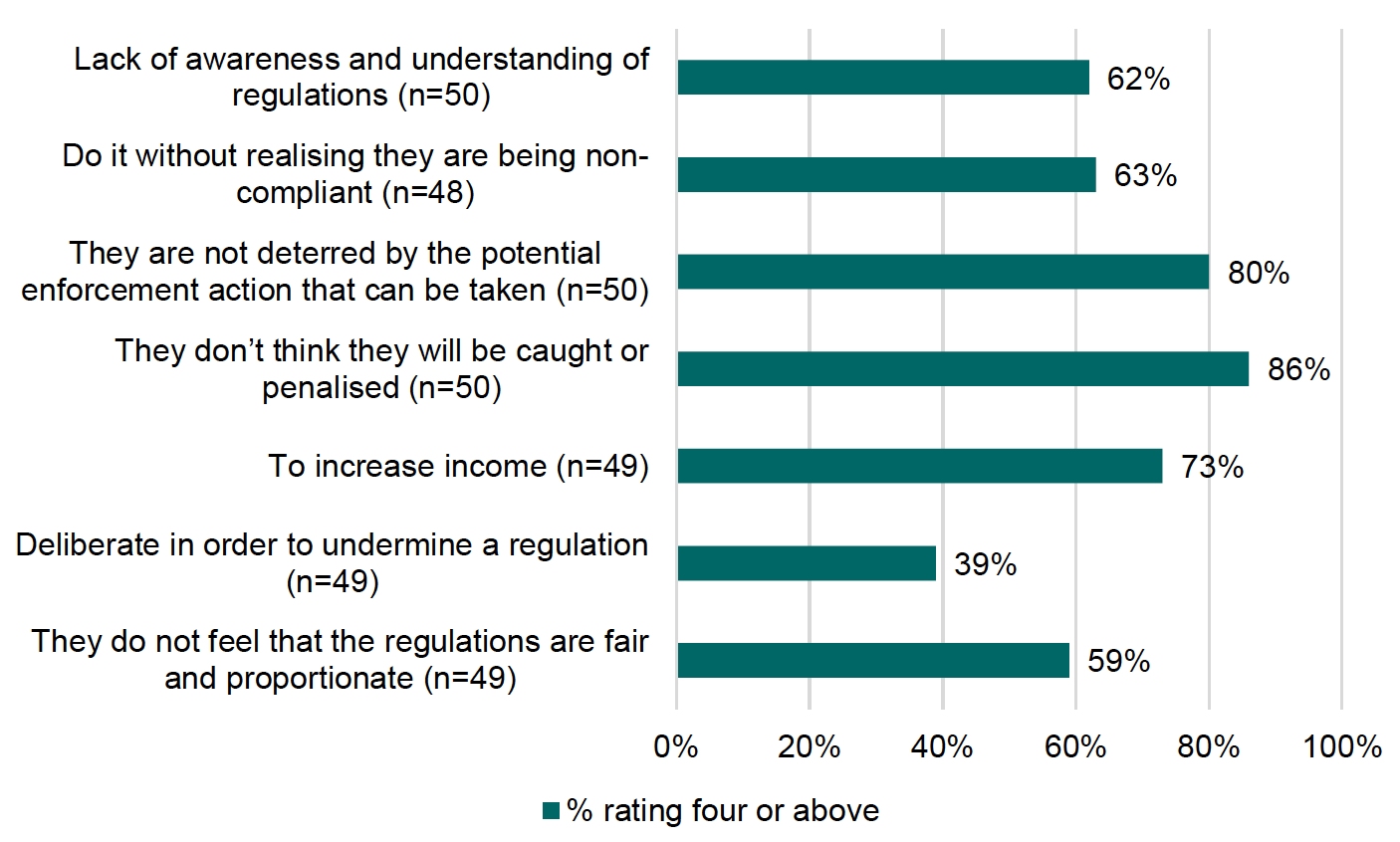
During the survey, Marine Directorate staff were asked to rate a range of reasons for non-compliance and how common they thought these offences were (see Figure 10).
The most common perceived reason for non-compliance among staff survey respondents was a belief among fishers that they will not get caught (86% agreed with this statement). There was also a feeling among interviewees that fishers may take the risk of non-compliance in the belief that, if they are caught, they will not be penalised but will be given a chance to comply at that point.
“If they know that they can get away with it for a few months or potentially they may only be asked to change it within 30 days, then there's no urgent need to do it. It's like ‘I'll do it when I get told to do it’.” (Marine Directorate staff)
“One of the main factors for instances of misreporting, for example, would be the fact that they know it's quite hard for us to police. So, it's maybe worth them taking the risk in their eyes, because the chances of us catching them in the act are quite small, just due to the nature of the offence and what is required in evidence to prosecute someone for those offences.” (Marine Directorate staff)
In interviews, some fishers suggested that financial gain or a perceived lack of enforcement of regulations were factors that may encourage non-compliance, with some wanting to see greater enforcement taking place.
“There's guys landing some pretty small stuff… We almost never get checked here… people are just going to keep (breaking the rules) if they know that I'm never going to get pulled up for it… It's a shame but I guess they don't have the manpower to be able to send people out to check the landings… I'd like to see them down in the landings more.” (Fisher)
A few fishers highlighted personality, attitudes towards following the law, or mindsets towards ways of fishing as contributory factors. A small number held the perception that those who have been fishing a long time as being less likely to agree with new rules and regulations, to find these more difficult to adhere to, or be more prepared to ‘take the risk’ than the younger generation who don’t “know any differently and learn the modern way”.
Many staff survey respondents (80%) felt fishers may not be deterred by potential enforcement action (Figure 10). For example, during interviews staff explained that the financial penalty may be disproportionate to the additional income the fishers can make from non-compliance. The potential rewards of non-compliance may render the penalties ineffective as a deterrent. We return to this issue later in this chapter when discussing FPNs.
Financial reasons were named as another driver for non-compliance identified by 73% of staff. These include taking risks, for example exceeding their quota or landing berried lobsters to make more money because some buyers may be willing to pay a premium. Similarly, staff mentioned that fishers may avoid the cost of and time involved with installing new equipment, such as new nets. Complying with the landing obligation and discarding requirements and quotas related to certain species can also cost money in terms of crew time spent sorting through the catch on deck, so this can be a reason for non-compliance.
"The main cause will be because they want to put it off. It's an expense they want to put off. It's a hassle. It takes time to change a net and mend a net and do all those other things." (Marine Directorate staff)
“I guess the drive for it is financial gain, I guess it always comes down to short-term financial gain.” (Marine Directorate staff)
Fishers commented on the potential financial drivers of non-compliance. While some highlighted the economic pressures fishers face, others attributed this to attempts to maximise profit. One fisher commented that they would find it easier to adhere to net sizes rulings if the Scottish Government covered the costs of making changes to gear.
“Most boats now are hard pressed financially and it's as simple as that… if they have a catch of mixed fish, they're going to throw the small ones over the side and try and maximise the amount of money they can get for the catch they have... (Fisher)
“Like I put new cod ends on them, that's a thousand pounds a cod end. We put two of them, we might get two years out of it, you might get three years out of it, but if they decide that 179mm, you've got 30 days to change it and that's another thousand pounds down the swanny… if they want to pay for it, I'll change them all they want, but they won't want to pay for it that's for sure”. (Fisher)
A lack of awareness of the regulations (62%) and being unaware that they are operating non-compliantly (63%) were also seen to be common reasons (Figure 10). For example, net mesh sizes may change naturally with use over time, and fishers may be unaware if they are breaching the required limits. Difficulties understanding complex regulations could also be a reason for accidental non-compliance.
“The complexity of the gear construction… that is the example of complex legislation that can be hard to adhere to at times.” (Marine Directorate staff)
Fishers believe the most common reasons for non-compliance are accidental mistakes or a lack of awareness and education, with most fishers holding a perception that those who deliberately operate non-compliantly are in the minority. The influencing factors included: not checking the species quota variations and making assumptions about how much they were allowed to catch; forgetting to or not getting round to submitting paperwork due to other demands, and difficulties being certain about the size of nets or catch due to lack of equipment. One fisher called for Marine Directorate to make an official lobster measure gauge to increase fishers’ confidence in their sizing of catch.
“If the cod end gets to a certain age, what happens is the sand and mud goes into the twine and the mesh size shrinks... we don't carry gauges in the boat, you know, to measure them… Some poor guy that could be using a cod end for about a year and then they come and measure his nets ‘Oh, this is illegal’… It's not his fault that’s happened. He's doing that unknowingly”. (Fisher)
Some survey respondents (59%) felt that fishers may not comply with the regulations if they feel they are unfair or disproportionate (Figure 10). Deliberate non-compliance to undermine a regulation was reported to be least common, with only 39% of survey respondents agreeing that it is an important consideration (Figure 10). However, some staff also commented about various regulations that fishers are most likely to disagree with, including issues around landing obligation and discarding, mesh sizes, area-based quotas and e-log reporting which can also influence non-compliant behaviour.
Amateur or unlicensed fishing, or fishing by those not invested in the industry was identified by fishers as a factor underlying some creel fishing non-compliance.
“I think you get an element of ones who are in it and maybe don't really treat it as an industry. They treat it more as, ‘oh we're just getting in it for a few years and see what we can get out of it’. One of the biggest things is boats fishing with no licence… In the summertime when lobsters become a bit more plentiful you can't move for people with creels. Even holidaymakers come up with them… The law says that you can catch one lobster a day and five crabs or something, but in August and September there's guys with 30, 40 creels out and they're maybe coming in with 20 lobsters. They'll swap it or sell it to B&Bs or whatever.” (Fisher)
The market for non-compliant catch among B&Bs, shellfish shacks, fish merchants or other vessels, for instance, was also mentioned by fishers as a factor that they believed was increasing the likelihood of regulation breaches. There were calls for more buyers to be included within routine inspections.
“Where there is a market for illegal shellfish then it will continue, enforce the current rules by having coastal out and about visiting premises and if necessary prosecute for breaches.” (Fisher)
Other potential reasons for non-compliance, less commonly suggested by Marine Directorate staff, include:
- Failure to take responsibility in cases of vessels skippered by non-owners.
- Fishers may feel that regulations are too obtrusive and ‘over the top.’
- Resistance to change – ‘We’ve always done it this way.’
- Tiredness, which can lead to human error and inadvertent non-compliance.
Factors identified by stakeholders as influencing fishers to operate non-compliantly included being unaware of the regulations, new rules being at cross purposes to older rules, such as not retaining catch versus having to retain all your catch; being caught out due to the fast-paced nature of rule changes; relief skippers not being up-to-date with procedures or regulation changes; and different and confusing licensing arrangements between Scottish and English waters and different fishing zones.
Other perceived drivers for non-compliance among fishers included: concern that the regulations are not devised with input from fishers; poor relationships between enforcement staff and fishers; and a view that the regulations are based on “outdated science”. For example, one interviewee talked of net sizes rules being devised for cod conservation where there are no longer cod in that area and said the regulations were a barrier to prawn fishing.
“For effective management, you have to have the input of the people in the ground. The people who know what can be done and what can't be done. And again, I think one of these marine protected areas, you know, they're being dictated to us without regard. They're not being discussed. And so, I believe in the future there will be greater non-compliance.” (Fisher)
5.6. Chapter summary
This chapter discussed a range of topics related to compliance behaviour. These topics included: attitudes towards the regulations, factors encouraging compliance, barriers to compliance, impact of regulations on business, and perceived reasons for non-compliance. Most fishers agreed that regulations are required, reasonable, or should be complied with. However, the discussion about the purpose of regulations revealed that some fishers perceived that regulations are sometimes unfair in relation to how UK and non-UK vessels are treated, that the Marine Directorate does not engage enough with fishers when creating and disseminating regulations, and that the impact of eNGOs should be limited in the industry.
Most of the fishers believed that complying with the regulations is the right thing to do, and almost two thirds agreed that it is easy to comply with regulations. Over half of all fishers who responded to the survey felt that fishers need more support to comply with regulations. Most respondents agreed that they comply with regulations to avoid enforcement action. A view among Marine Directorate staff was that some non-compliance stems from some fishers’ belief that they will not get caught, and they felt fishers are not deterred by potential enforcement action. Financial drivers were also identified as an important reason for non-compliance.