
Fishers' Behaviour and Attitudes Towards Compliance and Enforcement: Research Report
To support the delivery of Scotland’s Fisheries Management Strategy 2020-2030, this research aims to better understand the monitoring and enforcement of fishing regulations in Scotland
6. Experiences of non-compliance
This chapter examines various types of non-compliance, as well as the challenges of monitoring compliance.
6.1. Staff’s perception of the most frequent offences
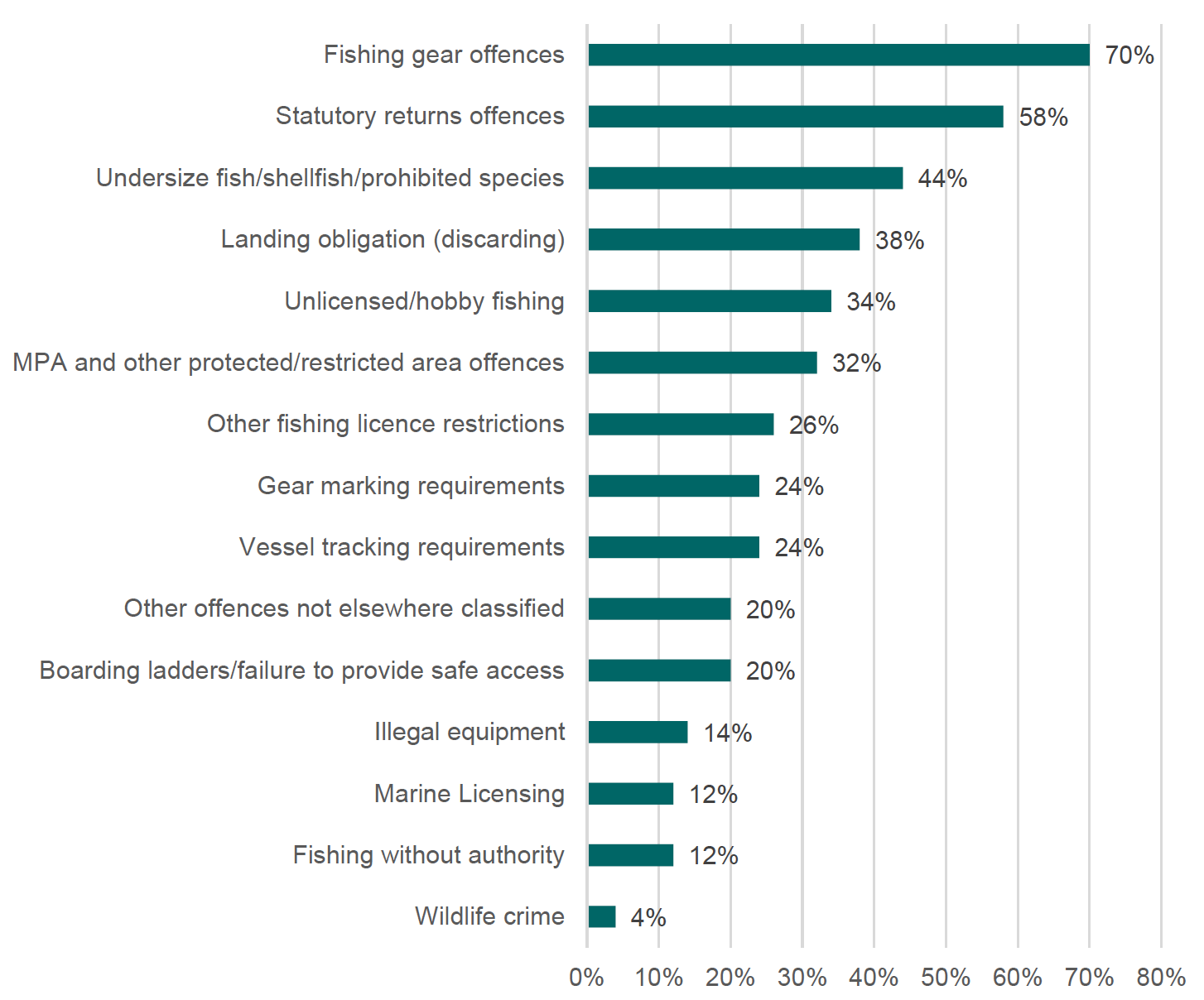
Figure 11 shows Marine Directorate staff’s perception of the most frequent offences. Five most common offences, according to staff, included: fishing gear offences, statutory returns offences, undersize fish/shellfish/prohibited species, discarding, and unlicensed/hobby fishing. The latter was closely followed by MPA/protected/restricted area offences. The rest of the offences were less commonly noted by staff.
6.2. Non-compliance reported by fishers
Fishers responding to the survey reported that just under a third (30%) had instances where they had operated non-compliantly in the last 12 months. The reasons for non-compliance among this small number of respondents included accidental non-compliance (55%), deliberate non-compliance (27%) and a mix of deliberate and accidental (18%). We stress that the very small sample size means these numbers cannot be considered representative of fishers more generally.
The small number of fishers who reported making a deliberate decision to operate non-compliantly provided the following reasons for doing so:
- Did not wear a life jacket because they did not want to. They had access to one but chose not to wear it. (As noted previously this is not a Marine Directorate responsibility).
- Trust their own judgement over blanket regulations.
- Market forces demand a catch to fulfil orders.
- Catching too much of one species in a calendar month so logged as a different species in an attempt to avoid being caught.
- Poverty.
During the interviews, most fishers described occasions when they had not complied with regulations or where they were aware of others’ non-compliance. While some reported regular and widespread breaches, others explained these were one-offs, infrequent or historic. Both accidental and deliberate breaches were described.
“The only deliberate breach I can recall was the fitting of an outboard engine that was over my declared horsepower on my fishing licence. I should have informed my local Fishery Office and the Registry of Shipping and Seamen but I chose not to. I could not source the correct size of engine with a reasonable date of delivery so went bigger as I could get it that day. Had I informed Marine Scotland/RSS at that time I would more than likely have been forced to tie up until I had either changed the engine to the correct power output or purchased more kilowatt units to increase my licence, both options would have cost money and at that time I had a young family." (Fisher)
“On a regular basis I get letters through the post saying that I had declared, say, 3 tonne of haddock when I actually landed 4 tonne, or I declared 6 tonne of haddock when I actually landed 4.5 tonne…You've got to realise, we're on a fishing boat, that's rolling about in the high seas, you do a typo sometimes.” (Fisher)
Echoing staff’s perceptions that the most frequent offences relate to gear (Figure 11), breaches of gear regulations (such as incorrect net sizes) were most commonly reported by fishers. Other areas of reported non-compliance included: over-fishing, non-adherence to quotas or dumping of by-catch; landing of undersized shellfish for personal use or due to accidental incorrect sizing; MCA regulation breaches or late or inaccurate paperwork including late landing documents and not declaring fish caught for bait or discards.
“You can't physically gauge each velvet crab. You'd be out there 24 hours a day if you were doing that. You're basically doing it all by sight... I don't land anything that is far too small, but if fisheries came down and went through each basket… there would be a small proportion of them that were under size.” (Fisher)
“I got caught out this year with the pollock because I hadn't checked the variations, hadn't really looked at it for a while, just kind of presumed that the quota for pollock in this area was pretty high… So, what I did was, there's plenty of quota for hake as well which are very similar species. So, when I did my returns I just put hake down instead of pollock” (Fisher)
Some explained that their non-compliance had been detected. Enforcement action experienced ranged from: advice, cautions and 30-day warnings, fines and FPNs and in one instance, the loss of their fishing licence. The fisher below reflected on the impact of them receiving a fine.
“Since then I have never broken a regulation at all ever, and I wouldn't do it again.” (Fisher)
6.3. Difficulties of monitoring non-compliance
Respondents to the staff survey were asked to rate the extent to which they agreed with a series of statements about monitoring compliance and taking enforcement action. Figure 12 provides a breakdown of responses against each of the statements.
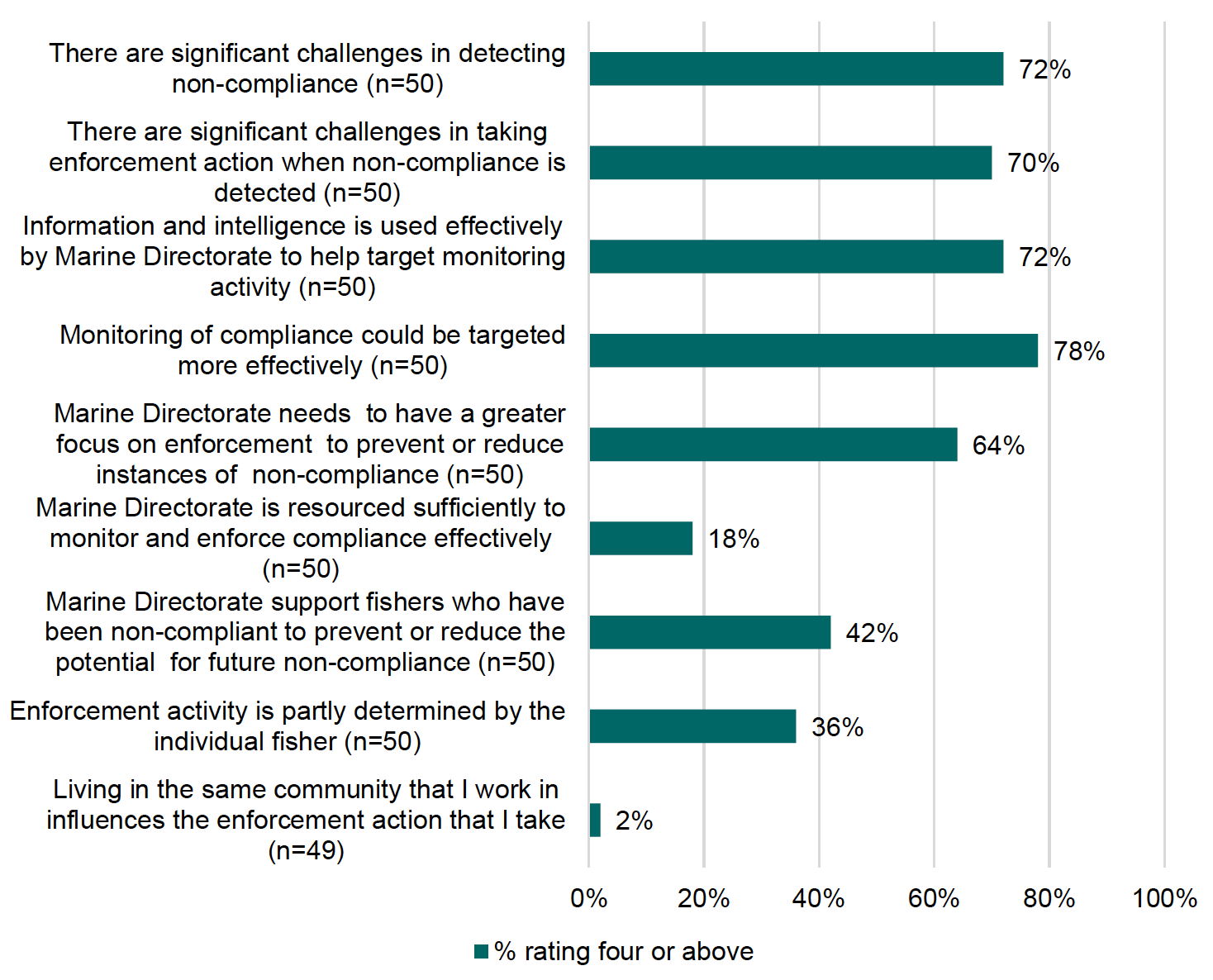
Most staff (70%) responding to the survey agreed that there are significant challenges in detecting non-compliance and taking enforcement action when non-compliance is detected. Aligned with this, only 18% of staff agreed that the Marine Directorate is sufficiently resourced to monitor and enforce compliance effectively. Interviewees also commented on a lack of resources to detect non-compliance and to corroborate evidence.
“I think really the manpower issue is probably one of the bigger hindrances to what we do.” (Marine Directorate staff)
While almost three-quarters (72%) of staff respondents agree that information and intelligence are used effectively to help target monitoring activity, most also agreed that monitoring of compliance could be targeted more effectively (78%).
Only 2% of respondents felt that living in the same community where they work influenced the enforcement action that they take. A couple of interviewees, however, noted that it can be helpful to have informal interactions with fishers in the community. This helps to build the relationship and provides another opportunity for fishers to ask questions. Staff interviewees did not note any negative consequences of living and working in the same community, but one warned that staff and fishers being too friendly or close could have a detrimental effect on the Marine Directorate’s monitoring and enforcement role.
Just over four in ten (42%) staff agreed that the Marine Directorate supports fishers who have been non-compliant to prevent or reduce future non-compliance, and almost two-thirds agreed that Marine Directorate needs to have a greater focus on enforcement to prevent or reduce instances of non-compliance (64% rating four or above). Only 36% of staff agreed that enforcement action is partly determined by the individual fisher.
Marine Directorate staff were invited to detail any areas of the regulation that they found difficult to monitor and the reasons for this. Figure 13 provides a breakdown of the different areas reported by respondents.
Figure 13: Marine Directorate staff’s views on difficult to monitor regulations
Regulations that are challenging to monitor:- Seasonal fisheries for inshore vessels in summer and larger-scale pelagic fisheries can overlap. MPAs are especially problematic as it is difficult to prove that an offence has taken place.
- Landing obligation and discarding, misreporting area of catch.
- Prohibition on retention and landing of "berried" lobsters and crabs.
- Marine licensing.
- Hobby/unlicensed fishing.
- Fishing net offences.
- Discarding or under declaration.
- Illegal gear, marked gear.
- Creel marking order.
- Marine Protected Areas (MPA).
- Misreporting of catch.
- RBS and sales. Communication with agents can be difficult if they refuse to work alongside MD.
- Small vessels have no VMS on.
- Difficult to count boxes of individual species of fish when boarding at sea.
6.4. Chapter summary
One third of fishers who responded to the survey reported instances of non-compliant operation in the last 12 months. This included accidental non-compliance, deliberate non-compliance, and a mix of deliberate and accidental non-compliance.
Fishers described a range of factors which drive non-compliance. Views that these are accidental mistakes or a due to lack of awareness were common. Most fishers believed that those who deliberately operate non-compliantly are in the minority. Other perceived drivers for non-compliance identified by fishers included: concern that the regulations are devised without input from fishers; poor relationships between enforcement staff and fishers; and a view that the regulations are based on outdated science. Across the survey and interviews, staff suggested changes that could help reduce deliberate and accidental non-compliance.
During the interviews, most fishers described occasions when they had not complied with regulations or where they were aware of others’ non-compliance. While some reported regular and widespread breaches, others explained these were one-offs, infrequent or historic. Breaches of gear regulations (such as incorrect net sizes) were perceived as most common offences by the Marine Directorate compliance staff.
Most staff agreed that there are challenges in detecting non-compliance and taking enforcement action, and that insufficient resourcing is a factor in areas of the Marine Directorate. While the majority of staff respondents agreed that information and intelligence are used effectively to help target monitoring activity, a higher proportion of staff thought that compliance monitoring could be targeted more effectively.