
Dementia post-diagnostic support evaluation: final report
Independent evaluation undertaken to understand the impacts of Post Diagnostic Support (PDS) for people across Scotland who have been diagnosed with dementia. Scottish Government commissioned IFF Research to undertake this evaluation to inform future developments.
3. Approaches to delivering PDS
This chapter provides an overview of the different approaches to delivering PDS across Scotland, including the delivery models used, staffing and resource structures and how PDS is connected to other providers of dementia support.
Key findings
- In-house delivery was the most common staffing approach for providing PDS, but a significant portion use a hybrid mode with both internal NHS staff and commissioned providers delivering PDS to service users.
- High referral numbers and limited staff meant caseloads were high, and capacity stretched.
- Case study HSCPs were positive about the training and support they received, cultural competency training might be a gap worth focussing on.
- Relationships with primary care, secondary care, wider community health and social care services were generally strong, but there were numerous challenges that posed threats to sustaining these connections.
PDS delivery
PDS was delivered across Scotland via three different commissioning arrangements. These were:
- In-house: PDS is delivered by NHS staff within the HSCP (often through a dedicated PDS team).
- Commissioned: HSCPs commission an external provider to deliver PDS within their area.
- Hybrid: delivery of PDS is split between NHS staff and a commissioned external provider.
In-house delivery was the most common approach for delivering PDS across Scotland. According to the latest monitoring return data, 13 Integrated Authority Areas (IAAs) delivered PDS entirely in-house. Six IAAs[21] used commissioned services, while 11 IAAs used a mix of both in-house and commissioned provision (known as a hybrid approach). The commissioned service most commonly used was Alzheimer Scotland. Figure 1 shows the distribution of these commissioning arrangements across Scotland.
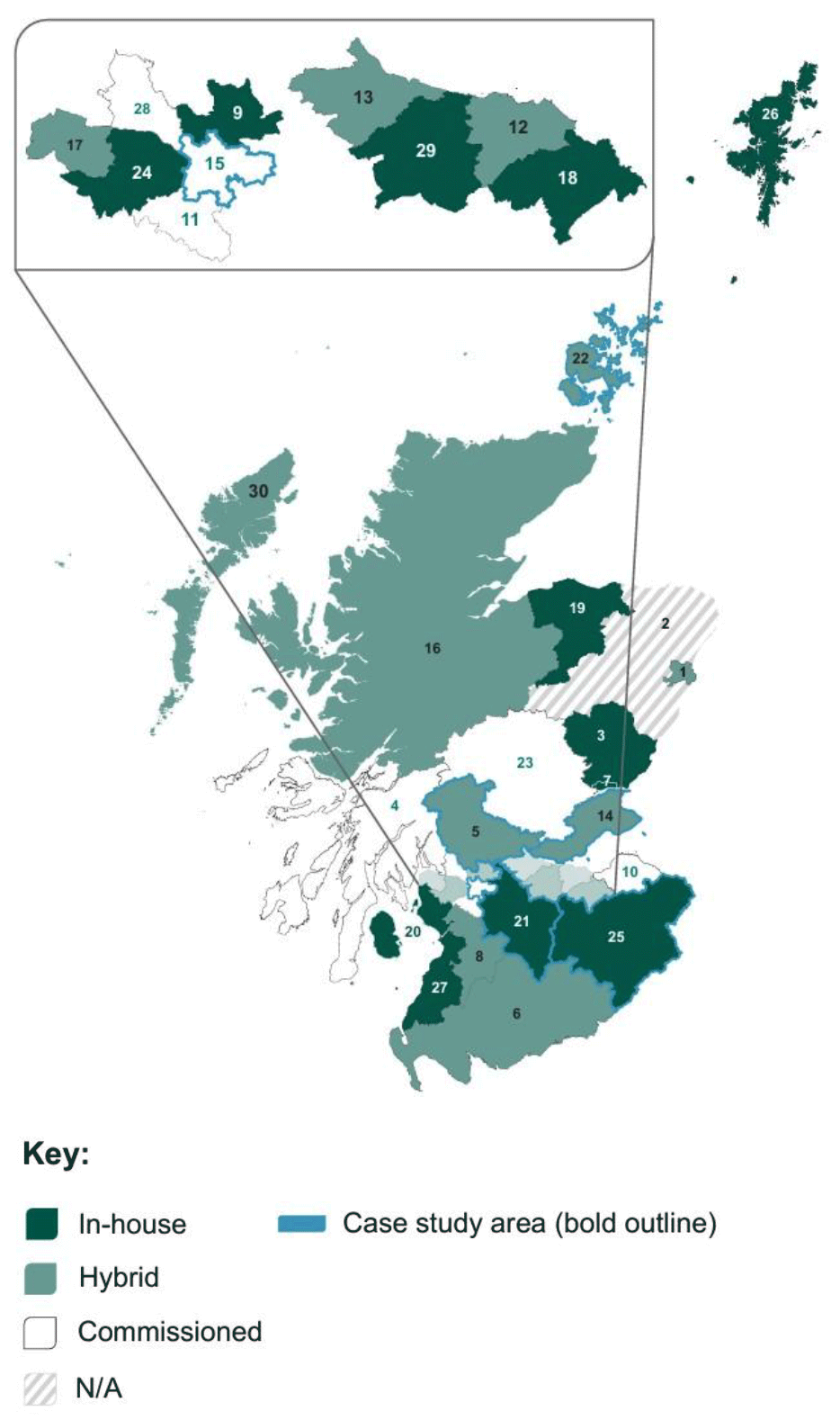
|
Number |
Area |
Number of referrals |
|---|---|---|
|
1 |
Aberdeen City (Hybrid) |
315 |
|
2 |
Aberdeenshire |
N/A |
|
3 |
Angus (In-house) |
343 |
|
4 |
Argyll & Bute (Commissioned) |
158 |
|
5 |
Clackmannanshire & Stirling (Hybrid) |
296 |
|
6 |
Dumfries and Galloway (Hybrid) |
440 |
|
7 |
Dundee City (In-house) |
286 |
|
8 |
East Ayrshire (Hybrid) |
142 |
|
9 |
East Dunbartonshire (In-house) |
329 |
|
10 |
East Lothian (Commissioned) |
361 |
|
11 |
East Renfrewshire (Commissioned) |
223 |
|
12 |
Edinburgh (Hybrid) |
816 |
|
13 |
Falkirk (Hybrid) |
214 |
|
14 |
Fife (Hybrid) |
707 |
|
15 |
Glasgow City (Commissioned) |
950 |
|
16 |
Highland (Hybrid) |
580 |
|
17 |
Inverclyde (Hybrid) |
120 |
|
18 |
Midlothian (In-house) |
146 |
|
19 |
Moray (In-house) |
185 |
|
20 |
North Ayrshire (In-house) |
218 |
|
21 |
North Lanarkshire / South Lanarkshire (In-house) |
1090 |
|
22 |
Orkney (Hybrid) |
90 |
|
23 |
Perth & Kinross (Commissioned) |
275 |
|
24 |
Renfrewshire (In-house) |
559 |
|
25 |
Scottish Borders (In-house) |
245 |
|
26 |
Shetland (In-house) |
149 |
|
27 |
South Ayrshire (In-house) |
261 |
|
28 |
West Dunbartonshire (Commissioned) |
130 |
|
29 |
West Lothian (In-house) |
1004 |
|
30 |
Western Isles (Hybrid) |
71 |
Within the six evaluation case studies, staff provided insight into the benefits and challenges of their commissioning arrangements, as well as rationales for their approach.
Among the six evaluation case study HSCPs, two delivered PDS entirely in-house, which meant they employed their own PDS practitioners to act in the Link Worker role. Here, the knowledge of the local area of NHS staff was really valued. Strategic staff noted that they did not think external providers without this local knowledge would be able to provide the same level of high quality person-centred PDS. Both HSCPs had previously commissioned Alzheimer Scotland to deliver PDS but had decided to bring it in-house to have more control over the service and how it was delivered. This was primarily related to reducing waiting times for starting PDS and increasing capacity to offer PDS to a higher number of people.
In one HSCP, the diversity of dementia cases of people needs of those being referred into the service led them to offer PDS through three separate teams defined by the type and level of support required. This allowed the care to be person-centred and respond to individual needs. Please see the good practice spotlight below for a full illustration of this support.
Good Practice Spotlight: Lanarkshire – specialist teams
- According to 2024/25 monitoring returns, Lanarkshire received a total of 1,090 referrals into PDS in the 2024/25 period.
- Lanarkshire delivers PDS fully in-house, but has three separate teams each specialising in different cohorts:
1. The core PDS team delivered PDS for most people living with dementia.
2. The Community Mental Health Team (CMHT) delivered PDS for challenging cases involving severe mental health conditions (they also intervene when medication is required).
3. A third team supported individuals with early-onset dementia, defined as those under the age of 65. Early-onset dementia cases tended to be more complex due to the additional challenges related to employment and the impact on working-age individuals. This dedicated team ensures that service users in this category receive specialised support that considers their unique circumstances.
Two case study HSCPs used external providers, with one working with Alzheimer Scotland and another with Age Scotland[23]. For the former, they had a pre-established working relationship with Alzheimer Scotland regarding PDS, and were satisfied with delivery. For the latter, the decision to use Age Scotland was made to provide the best support for PDS users. This was because the NHS team in this area was small and there was not much prior infrastructure or experience to set up a PDS team internally; commissioning externally was seen as the only viable approach.
The remaining two case study HSCPs adopted a hybrid approach, where both NHS and Alzheimer Scotland staff delivered PDS. One of these HSCPs used a split delivery model where service users had two Link Workers. In this HSCP, in-house PDS practitioners acted as Link Workers for the first three months of support, then Alzheimer Scotland Link Workers delivered the remaining nine months. Originally, this HSCP relied exclusively on Alzheimer Scotland staff for PDS delivery, but increased demand led to long waiting times. Strategic staff therefore decided to start delivering support internally during the first three months to provide PDS immediately post-diagnosis.
One ongoing challenge raised was the waiting time between the three months of support delivered by HSCP staff and the remaining nine months by Alzheimer Scotland. According to monitoring returns for 2024/25 this waiting time in this area is just under 12 months, whereas for most areas the waiting time is less than three months. PDS is therefore not delivered continuously and there is not yet evidence as to whether this segmented approach has been more beneficial to service users. HSCP staff told us they initially planned for this approach to be a “short-term fix”. However, it has since become a longer-term model because they had not been able to find an alternative solution. Still, this HSCP did not flag any major issues with communicating or co-ordinating between their internal caseload and Alzheimer Scotland’s waiting list.
For the other HSCP that used a hybrid approach, Alzheimer Scotland had been involved from an early stage. Here, because of the large size of the HSCP, Alzheimer Scotland Link Workers were spread across the three geographical teams within the HSCP. They were hosted within the Community Mental Health Teams (CMHTs) where internal PDS practitioners also provided PDS. The strategic staff at this HSCP wanted to supplement Alzheimer Scotland delivery with the expertise of NHS staff. They did this because they deemed this to be crucial to allowing them to deliver high quality support (i.e. person centred support where users were provided with sufficient access to each of the five pillars). In addition, having this additional capacity allowed them to provide one dedicated PDS practitioner for services users, avoiding the need to be transferred from one team to another. In their previous experience with PDS, the strategic staff felt this had been a major barrier to users accessing timely support.
Delivery models
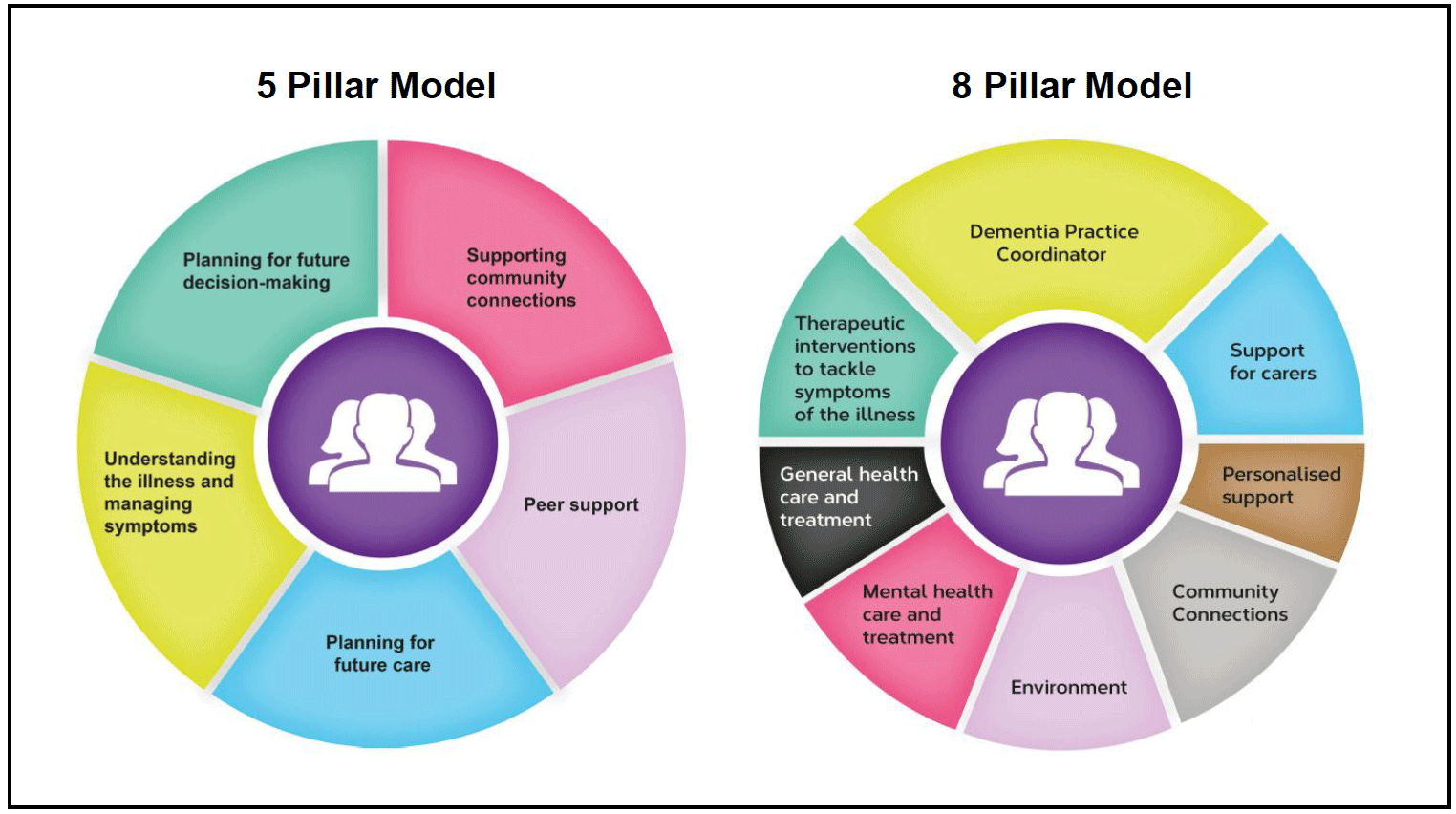
There are two main delivery models, both developed by Alzheimer Scotland, used to inform how PDS is delivered by frontline PDS practitioners. The “5 Pillar Model[24]” was originally framed with a focus on people receiving an early diagnosis and living at home or in the community, with little formal health or care service support. The “8 Pillar Model of Integrated Community Support[25]” is aimed at those living at home at more severe stages of the dementia, where support is delivered by a Dementia Practice Coordinator. Compared to the 5 Pillar Model, the 8 Pillar Model increases the level and focus of integrated care coordination.[26] The specific pillars that make up both models are outlined in Figure 2 below.
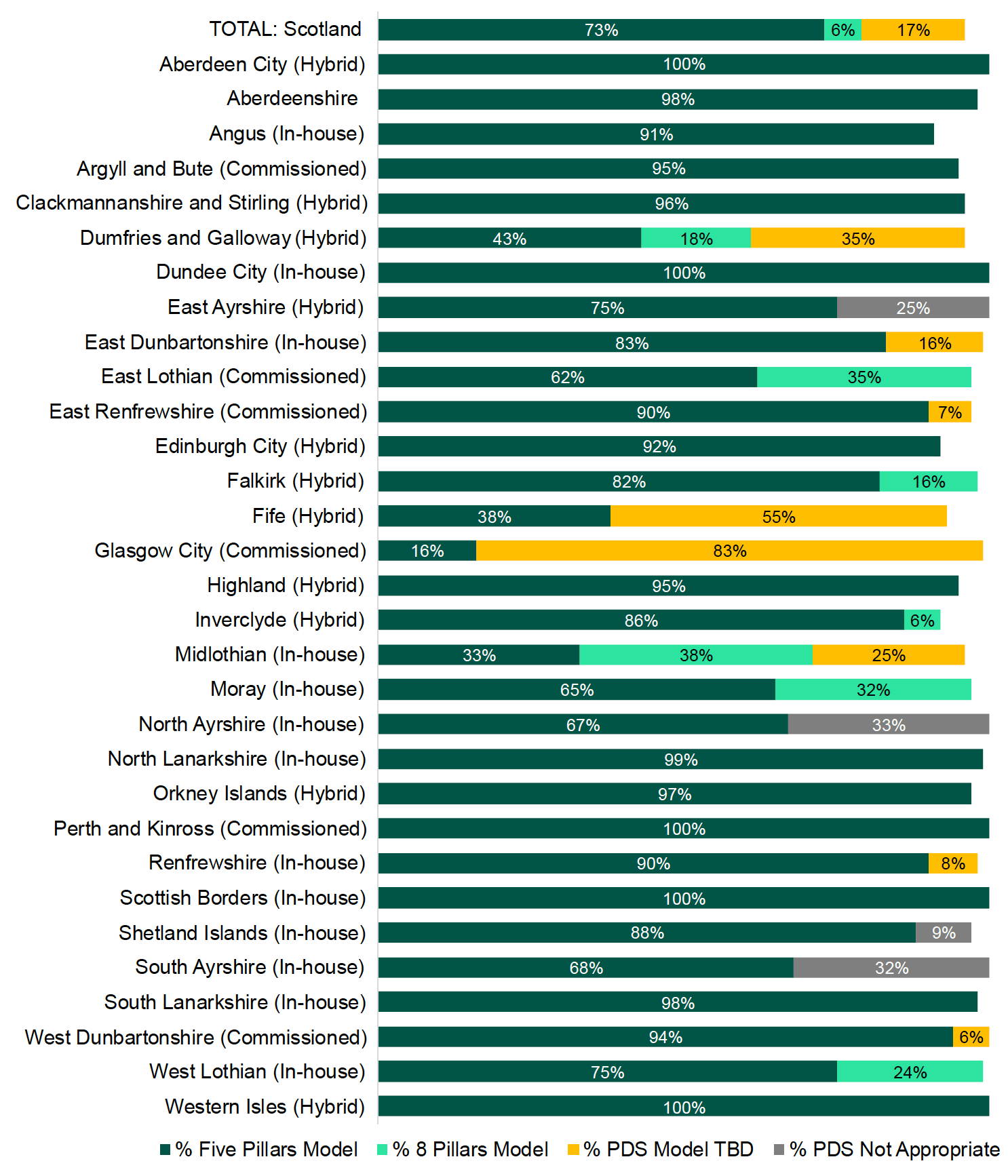
According to the most recent available quantitative data from 2021-22, the 5 Pillar Model was more widely used across Scotland. It was being used to support a high proportion of service users across all Integration Authority Areas (IAAs). As seen in Figure 3 below, only eight IAAs reported using the 8 Pillar Model. IAAs that delivered PDS using internal only staff tended to use the 8-pillar model slightly more compared to IAAs that used external providers or a hybrid approach.
Even in these areas, the 8 Pillar Model supported only a minority of cases and the 5 Pillar Model continued to be the main delivery method. Across Scotland, 73% of service users received support through the 5 Pillar Model. In contrast, only 6% received support through the 8 Pillar Model – although it is worth noting that for 17% of service users, the delivery model used was still to be determined (TBD).
All six evaluation case study HSCPs used the 5 Pillar Model. The Model was generally well regarded as being sufficiently person-centred to meet local strategic priorities regarding dementia care as well as being in line with the National Strategy. Most case study HSCPs also thought the model provided a suitable framework for providing service users with the range of support needed.
Across case study areas frontline practitioners highlighted that they were flexible in how they used the 5 Pillar Model depending on the support the service user required. For example, some practitioners referenced that they would not cover all five pillars if the service user did not want to, or would provide additional support outside the five pillars if that was required. In particular, where users had advanced physical or mental health needs outside of their dementia, or when they had crises in their personal life (such as financial, social, or health crises) practitioners would spend a lot of time at the start of the journey focussing on resolving or managing these issues. While this work would not fall under any of the five pillars, staff thought it was essential to provide this tailored support early on.
“The five pillar model works really well for the right people at the right stage.” – PDS practitioner
One HSCP case study used the 8 Pillar Model for more complex cases, e.g. those with other mental health conditions. They felt the 8 Pillar Model was more suitable for meeting the needs of these users, because of its broader scope and intention to be used for those individuals with more severe declines in cognitive function.
Although the 5 Pillar Model was widely praised, strategic leads and frontline staff in two case study HSCPs reported that the model can be constraining, and frontline staff often needed to expand beyond the Model for service users with more advanced needs. One of these HSCPs was actively considering moving to the 8 Pillars Model in the future, as they felt the 5 Pillar Model was not meeting the needs of all service users.
Resource and staffing capacity
Across the evaluation case studies, resources were highlighted as a key challenge to delivering high quality PDS. Not only levels of funding, but the way it was allocated, impacted delivery in terms of caseload sizes and the ability to employ and retain staff.
Various HSCPs told us that the limited funding available led to implications for their ability to adequately staff PDS. One HSCP explained that although SG provided them funding which they were expected to match, the actual cost of delivery reached over three times that amount. With no other funding sources, their staffing capacity was limited, current staff overworked, and they could not provide all the support they wanted to. Another HSCP noted due to the lack of funding, they had not been able to increase the salaries of PDS practitioners, making it harder to convince staff to stay on or to attract new recruits.
Another problem widely shared by case study HSCPs was the lack of certainty around whether PDS funding would be continued and the fact funding is only allocated on a year-by-year basis. HSCPs thought this was too short, and it was difficult for them to plan future delivery, for example they were unable to offer staff long-term contracts. The problem was particularly acute for those areas who commission external partners and so needed to go through extra tendering processes.
As shown in Figure 4 below, the total Work Time Equivalent (WTE) staff delivering PDS varied considerably between Integration Authority Areas (IAAs), according to 2024-2025 monitoring return data. Staff numbers usually reflected the size of the area and the number of referrals. For example, Fife had the highest staffing levels with 16.5 WTE staff to cover 707 referrals. Glasgow had 14.8 WTE to cover 950 referred users. In contrast, Moray operated with only 1.0 WTE staff to cover 185 referrals, and Shetland had 0.8 WTE staff to cover 149 referred users. West Lothian stood out as an exception to this. For unclear reasons, it had a very high number of referrals (1,004 in the 2024-25 period) but only 5.0 WTE staff.
Figure 4 also includes the delivery approach for each IAA. There does not seem to be any notable relationship between delivering PDS in-house, externally commissioned or a hybrid approach, and the numbers of staff deployed.
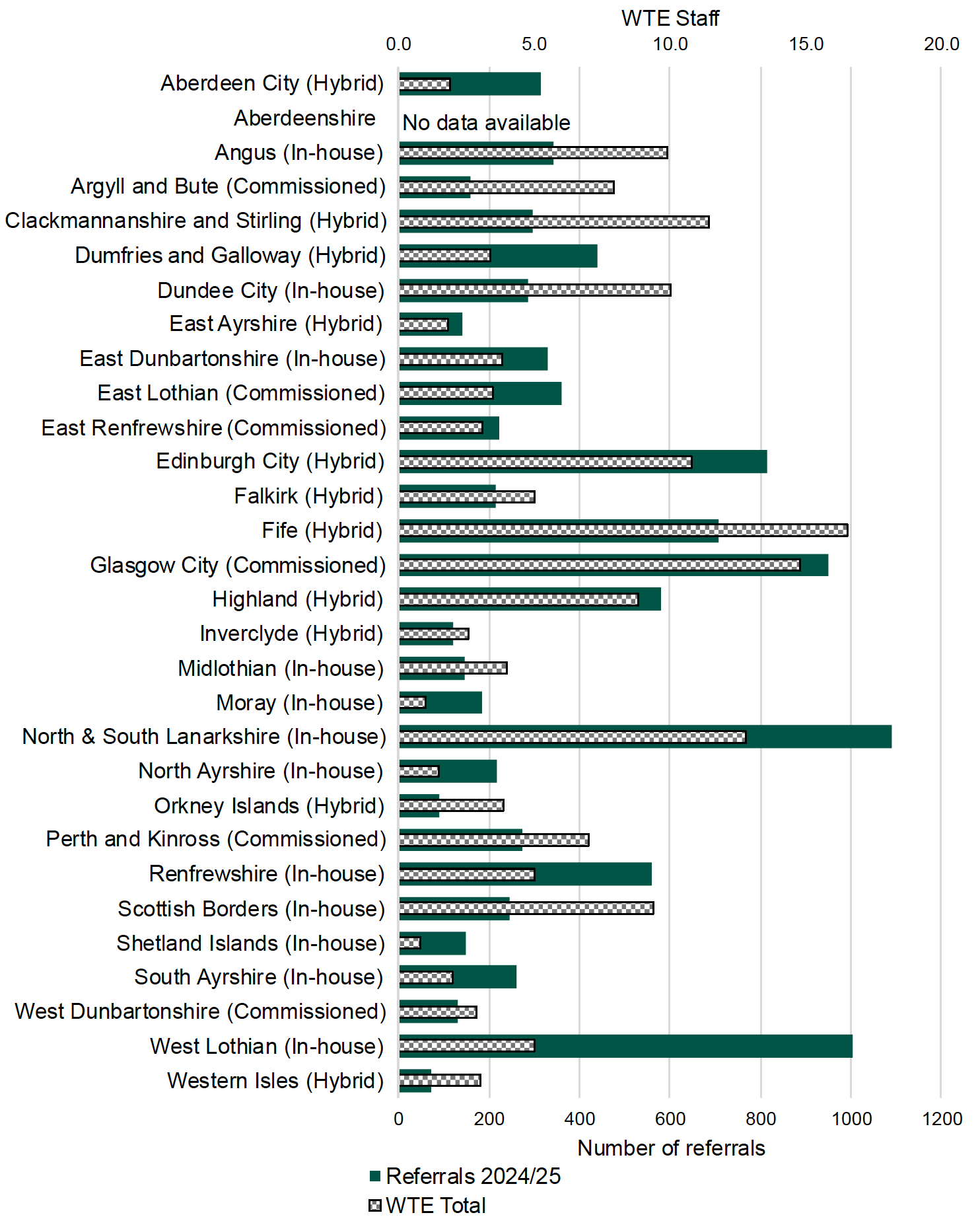
The combination of high referral numbers and limited staff meant caseloads were high, and capacity severely stretched in some areas. High caseloads meant some case study HSCPs struggled to meet demand and expressed an urgent need for more PDS frontline staff. Since strategic staff were unsure of the amounts of funding they would receive over the next few years, they found it harder to plan resourcing for future delivery and therefore struggled to address these challenges. In one HSCP, when frontline practitioners left, strategic staff felt forced to sometimes reduce the hours of replacement roles to save costs. This effectively cut the support they could offer.
Challenges related to high caseloads were compounded when PDS practitioners had to cover large geographical areas. PDS practitioners suggested that they had to spend a lot of time travelling, which meant they were restricted in how often they could visit service users.
Staff training and support
The training and support offered to PDS practitioners varied across the six case study HSCPs, with a mix of informal and formal training offered. Regardless of the type of training received, most staff expressed positive views about the training they received.
One case study HSCP (that commissions Alzheimer Scotland to deliver PDS) invited external speakers to deliver sessions to their Alzheimer Scotland frontline practitioners four times a year. They also provided group and individual reflective sessions, ensuring staff had opportunities to discuss their experiences and challenges. Additionally, this HSCP made use of Alzheimer Scotland’s dedicated policy research team that shared new innovations and practices with staff, keeping them informed about developments in dementia care. This access to Alzheimer Scotland materials and expertise was not explicitly referenced by any other case study area.
In one HSCP, staff described training as crucial to their work. Here, the training offered by Age Scotland and Playlist for Life[28] were particularly well-regarded. Staff praised Age Scotland’s training for greatly developing their understanding of dementia, in particular the range and variation of different types of dementia. Meanwhile the Playlist for Life training opened up the opportunity for staff to offer a new form of cognitive support that they viewed as incredibly impactful and uplifting.
However, one HSCP that relied solely on in-house staff for delivery reported a lack of formal or established training for PDS practitioners. Staff in this area often had to learn through experience and on-the-job training. Nevertheless, this area used the Promoting Excellence Framework[29] (which was devised by the SG) and emphasised that all staff were at the “expert” level in term of the care they provided to people living with dementia. PDS frontline staff also attempted to address this challenge by making sure to share knowledge with local community teams, which helped build their expertise over time. This HSCP also had regular meetings of PDS practitioners to share any challenges they were facing so that the group could come up with solutions together.
In some HSCPs, PDS practitioners had undergone dedicated trauma-informed training or shared learnings between themselves around trauma-informed approaches to care. This was seen as being particularly relevant for people living with dementia as, due to the condition, past traumas or negative experiences can come to the fore and deeply influence how people respond to support.
A potential area for improvement identified was the need for cultural competency training. Staff expressed a lack of confidence and knowledge about delivering PDS in different cultural contexts, particularly for service users from racialised minority groups or non-English-speaking backgrounds. Addressing this gap via formal training courses could help ensure PDS delivery is more inclusive and tailored to the diverse needs of service users, especially important in areas with greater diversity.
Connections between support providers
Connections between PDS practitioners and primary, secondary, and wider community care professionals were generally strong. These relationships played a crucial role in not only providing points of referral for PDS, but also ensuring effective PDS delivery and facilitating access to additional support for service users.
Firstly, PDS teams relied heavily on primary and secondary care providers for referrals into PDS. Then during the delivery of PDS, staff often signposted service users to relevant primary and secondary care services to address their broader health needs (including provision of physical therapy[30] and cognitive stimulation therapy[31]). In some HSCPs, where relationships with primary care providers were particularly close, PDS practitioners conducted joint visits with GPs and practice nurses. These collaborative efforts helped ensure that service users received coordinated and comprehensive care.
Relationships between PDS practitioners and community and district nurses were especially strong in some HSCPs. These connections enabled PDS practitioners to work closely with nursing teams to address the health and care needs of service users. Such partnerships were identified as key enablers for delivering person-centred support and ensuring continuity of care. This was facilitated by integrating frontline practitioners into community mental health teams. In one HSCP that commissioned Alzheimer Scotland Link Workers, hosting these Link Workers within their mental health and multi-disciplinary teams alongside NHS staff meant they were aware of changes in medication or dietary needs to the service users they were working with. Likewise, in an HSCP that delivered fully in-house, their PDS team sat within the wider mental health team so that they had access to medication records, doctors, nurses and psychologists to assist with any user needs.
Relationships with wider community health and social care services beyond primary and secondary care were also strong. PDS practitioners worked closely with a broad range of services, including day-care centres, arts and crafts groups, choir groups, and dedicated support for carers. These community groups are integral to PDS delivery, as they offer core components of the 5 Pillar Model, namely support community connection and peer support. In one HSCP, where PDS was delivered through Age Scotland, the PDS practitioner was based in the Age Scotland hub and through this hub had direct connections to local community groups and could also draw on wider Age Scotland staff to support with delivery (see good practice spotlight below).
Good Practice Spotlight: Orkney – Use of wider Age Scotland staff to support delivery
- In Orkney, PDS is delivered by Age Scotland staff, who are based in a central Age Scotland hub.
- Due to this, if the main PDS practitioner is facing any challenges in delivering PDS, they can draw on other Age Scotland carer staff to deliver PDS for a certain amount of time for specific people.
HSCPs did indicate that their PDS services were open to referrals from community organisations, but in practice it was very rare for referrals to come from outside primary or secondary care. Please see chapter 4 for more detail on referral sources.
However, funding shortages had caused some primary, secondary, and community services to diminish in recent years, particularly in areas with higher deprivation. Signposting to these services was seen as an integral part of PDS delivery, but increasing gaps in support made it harder for PDS teams to provide comprehensive care for all service users. In one HSCP, staff were particularly concerned about the lack of respite support for carers, which led to high levels of carer stress and crisis situations.
Other challenges to effective collaboration included the use of different IT systems across organisations, which prevented seamless information sharing and coordination. For example, in one HSCP, a service user was moved out of the PDS team and referred to a CMHT nurse and stopped receiving PDS. When the service user was discharged from CMHT, their PDS did not resume (there was no evidence as to why exactly this happened), highlighting potential gaps in communication and coordination and can directly harm service user experience. Staff in this area expressed concerns that there might be “too many people involved,” leading to fragmented care.
Contact
Email: dementiapolicy@gov.scot