
Dementia post-diagnostic support evaluation: final report
Independent evaluation undertaken to understand the impacts of Post Diagnostic Support (PDS) for people across Scotland who have been diagnosed with dementia. Scottish Government commissioned IFF Research to undertake this evaluation to inform future developments.
5. Experiences of PDS
Key Findings
- Most service users described PDS as highly supportive, valuing both the practical and emotional help it provided.
- Staff often tailored support around individual needs, including adapting how and when pillars were introduced.
- Many service users benefited from being introduced to groups and activities, which increased confidence and reduced stigma.
- Rural populations were more likely to face barriers accessing PDS. People from minority ethnic communities also faced barriers in engaging with PDS including stigma around dementia.
- Limited availability of community services, social care, and transport reduced the effectiveness of PDS and frustrated both staff and users.
Positive aspects of PDS
Range and tailoring of available support
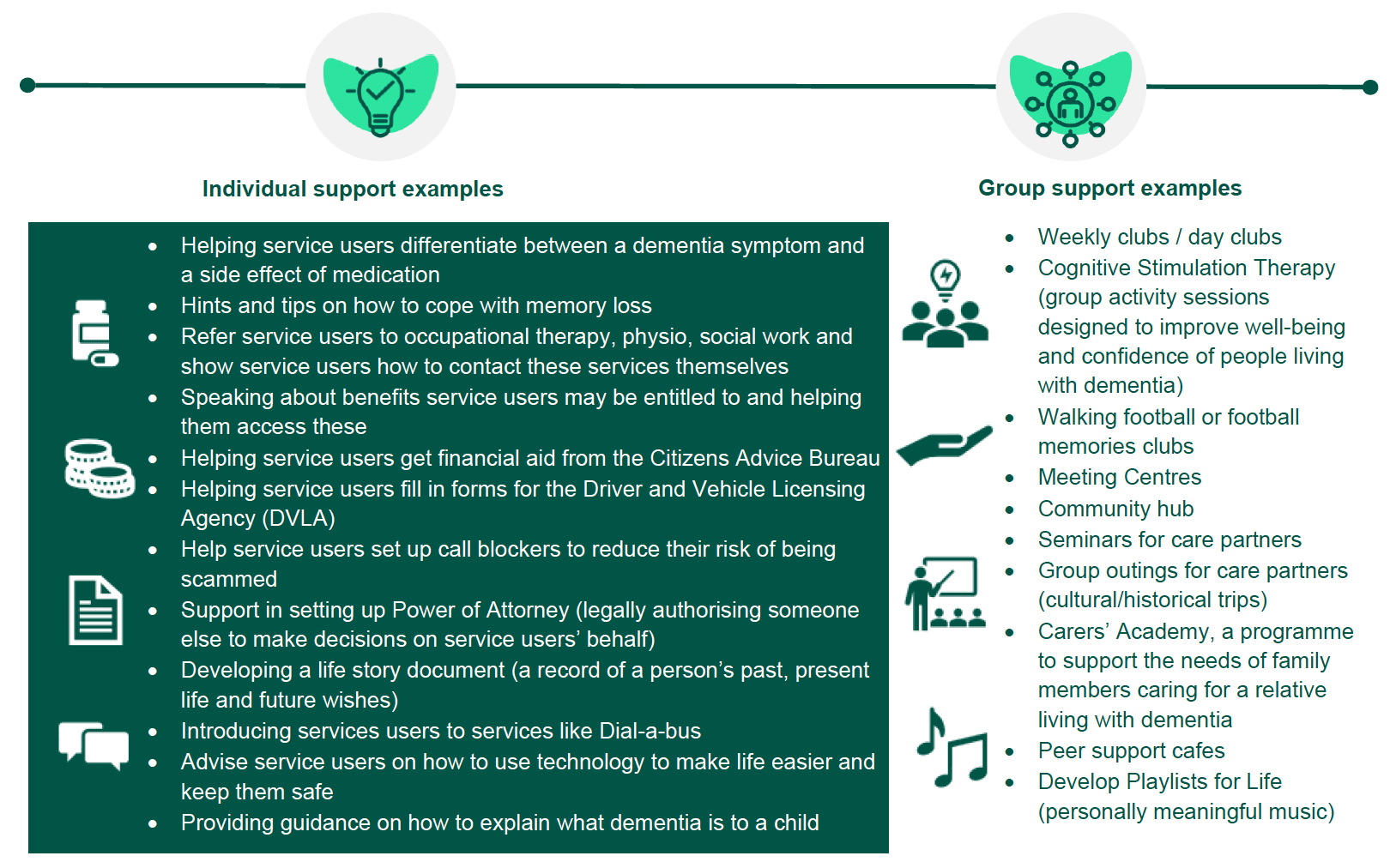
Qualitative interviews with service users suggested the vast majority had positive experiences of PDS. Service users particularly valued the range of support available (Figure 8). Service users particularly valued the blend of emotional and practical support they had received from their PDS practitioner. They mentioned it was useful to have a knowledgeable perspective on challenges they were facing, particularly when they did not feel their family and friends could advise them. Service users considered their PDS practitioners to be very knowledgeable on the subject of dementia, which meant they could provide helpful advice.
“It helped us having that sounding board to talk about things because family and friends tried to help but they were shocked too […] so to have people that are professional […] that's helpful.” – Service user
“I think it's to do with the calibre of the people who are there, their interpersonal skills, their understanding of the system and it's backed up with excellent administrative support.” – Service user
Staff felt that a key enabler of this range of support was collaboration with community services. For instance, in one area the local carers team would come to PDS group sessions and identify carers who needed additional support. PDS practitioners felt that it was important to inform themselves of the services available within the community. They were aware they could tap into the CMHTs if they needed support or advice. Some staff mentioned that learning how to do the role was very peer led, so it was very beneficial to have that support easily available.
Flexibility and tailoring of support
Service users valued receiving support tailored to them and their circumstances. Service users reported that their Link Workers would help them find support that interested them and support them in getting involved. This was echoed by staff, who highlighted that this was key in delivering truly person-centred support and encouraging service users to fully engage with the support available.
Staff appreciated the flexibility inherent within PDS. For instance, being able to go through the Pillars of support (see Chapter 3) in an order which made sense for the person and without broaching topics which they were not ready to discuss. This flexibility was particularly useful when staff needed to tackle stigma around dementia itself. Staff could take their time in helping service users to reframe dementia, or they could avoid the word altogether (e.g. referring to ‘memory issues’ instead) if they felt this could help keep the person engaged.
“You can have some initial wins like helping getting the money they're entitled to that they weren't already claiming and then that helps build the relationship and then gradually they become a bit more open to talking about more difficult things like the dementia itself.” – PDS practitioner
PDS practitioners also valued being able to build strong relationships with service users, as a high level of trust was conducive to service users being open with them, allowing staff to get to know the person better and deliver more person-centred support. Staff acknowledged that building this relationship takes time and highlighted the importance of sufficient resource within the team. A frontline practitioner in one case study area reported that they felt lucky to have a one-hour slot for their PDS sessions, as this allowed them sufficient time to get to know the person and personalise the support.
PDS practitioner qualities, skills and knowledge
High levels of satisfaction with PDS support was also driven by a feeling of being listened to. Service users especially valued how responsive their Link Worker was and appreciated being able to reach out whenever they needed support. Service users consistently mentioned being told by their Link Worker that they could phone up at any time if they had any questions, and that their Link Worker was there if they needed them. This made service users feel listened to, supported and reassured. Some mentioned they also found it reassuring to have someone checking up on them regularly.
“Obviously at each meeting it was stressed that in between those [appointments], if there was any issue, just call.” — Service user
The expertise of staff was echoed by strategic leads who highlighted that the clinical background of PDS practitioners made a big difference to the quality of PDS offered. Both staff at commissioned partners and in-house teams were praised for their expertise and ability to deliver a high-quality service.
Service users also highlighted how passionate staff were. The interpersonal and communication skills of staff was seen as a particular strength. For example, service users appreciated the calm and unhurried way in which support was given.
“Having staff who are absolutely passionate about what they do definitely makes a difference. [...] having people who, [...] have got that kind of firsthand clinical background.” – Strategic lead
Challenges and limitations of PDS
A small number of service users interviewed mentioned some areas of dissatisfaction with PDS, whilst some PDS practitioners and community stakeholders pointed out some factors which limited the effectiveness of PDS.
Waiting times to access PDS
As explored in Chapter 4, long waiting times between diagnosis and starting PDS had negative impacts on some service user’s initial perceptions of PDS. Waiting times also meant that some service users and care partners felt they missed out on the person living with dementia receiving support at a useful time to support with understanding of the diagnosis and planning next steps.
One care partner was very positive about their loved one’s Link Worker, but expressed that they wished they could have received the support earlier. This was because if they had started receiving support sooner, they felt their loved one would have been able to recognise the Link Worker more, whereas at the time of interviewing they tended to get confused about who she was and why she was there.
As mentioned in Chapter 4, the issue of a time lag between diagnosis and PDS support starting affected some HSCPs more than others. This issue was perceived by strategic leads and PDS practitioners as limiting the effectiveness of PDS, as in some cases the person’s stage of dementia had progressed significantly by the time PDS started. This meant that some components of PDS were no longer suitable, and the extent to which the support could be directed by the service user was more limited. The measures taken in some HSCPs to manage long wait lists and ensure people who were diagnosed with dementia had immediate access to some care also meant a disruption to continuity of care (see Chapter 3 under PDS Delivery).
“So in terms of their experiences as well, it can be a little bit jolting, especially in terms of you might have built up a rapport with somebody and then it just changes.” – PDS practitioner
Accessibility issues
PDS practitioners and strategic leads across HSCPs recognised that accessibility was hugely important in the extent to which people living with dementia were able to access PDS. The distance to support centres and/or lack of suitable transportation discouraged people from making the most of the services available within PDS. For example, they would not be able to attend day centres or weekly clubs alongside other people living with dementia. PDS practitioners added that those living in remote areas not only had difficulties accessing suitable support services, but also tended to be diagnosed later which meant that some PDS activities were no longer suitable by the time they were provided.
Community stakeholders also highlighted difficulties in reaching service users living in remote areas, and added that having a service spread across multiple localities meant that the support provided was not always suitable for everyone.
“We cover [location 1] and [location 2] locality and more so for the people in [location 1] because the transport links are poor, it's quite remote, it's difficult for people and actually what works for people living in [location 1] is different to what works for people in [location 2], some of the time because they've got different experiences.” – PDS practitioner
A solution to the rural access issue which was due to be implemented in one HSCP was the introduction of a satellite clinic to reduce people’s travel time and ensure people living remotely could be assessed promptly.
Unmet support needs
Some service users felt they would have liked additional support from their PDS Link Worker beyond what they were able to provide. For example, one service user was signposted to relevant online forms but struggled to fill these in by themselves. This was compounded by difficulties using technology.
“I don't know if we generally have the capacity to do it at the point [...] So again, there's certain points and things that would have been helpful to me, that if they could have taken over and helped you fill in the forms.” – Service User
Another service user would have liked peer support groups to meet more frequently (twice a week), as this was what they got the most benefit from within PDS.
People with young onset dementia were also more likely to highlight unmet needs. PDS practitioners and community stakeholders echoed the view that there was a gap in terms of offering community support specifically for people with young onset dementia. Strategic leads linked this to a lack of resources and the issues with funding allocation (i.e. funding allocated for older people’s care not being able to be used for supporting those with young onset dementia).
“That [support for those with young onset dementia] is a big stumbling block for us a lot of the time in PDS. We tend to get a bit of the backlash of it […] our hands are tied because we don't have the resource to be able to provide these sorts of groups or provision for people.” – PDS practitioner
PDS practitioners suggested that online groups were more suitable for service users with young onset dementia as they often led busy lives (e.g. they still had childcare responsibilities, full-time jobs etc), but online peer support groups were reportedly only used across a small number of HSCPs.
The strategic lead in one HSCP also highlighted that people with learning disabilities might fall outside the remit of in-house PDS teams and therefore have unmet needs. Within their own HSCP, at the time of interview, people with learning disabilities who were diagnosed with dementia received PDS from their community mental health nurse, but this was not monitored by the central PDS team. The PDS lead was therefore unclear about the level of support people with learning disabilities were receiving and if this was appropriate and meeting their needs.
Although care partners in case study HSCPs suggested they felt supported themselves through PDS, they did still have some unmet needs. One care partner shared that they would like PDS to include more practical support, for example to fill in forms, as they felt like they had to undertake a lot of this work themselves. Community stakeholders also suggested that care partners, particularly those who cared full-timed, needed more support in the form of respite services. Community stakeholders and care partners both suggested that speaking with other care partners was a valuable source of support, suggesting that more efforts to facilitate this communication, either informally or through peer groups would be beneficial.
Difficulties experienced by minority ethnic communities
The findings related to people from minority ethnic communities are based on discussions with PDS practitioners as well as a member of the PDS Evaluation Assurance Group who was from a minority ethnic background and had lived experience, and a staff member from Minority Ethnic Carers of People Project (MECOPP) who had insight into the experiences of care partners of people living with dementia who received PDS.
People from minority ethnic communities often found it harder to engage with PDS. Fewer people from these backgrounds used the service, as the support offered did not always match their cultural, language, or religious needs. Sometimes, religious or cultural views or feelings of embarrassment stopped people from asking for help, and family members sometimes turned down support they thought would not be suited to their needs.
Barriers to diagnosis and care (including but not limited to PDS) were made worse by systemic issues. Symptoms of dementia could be mistaken for language difficulties, and families could struggle to find residential or social care that respected dietary, religious, or cultural practices. Even small missteps, such as home‑care staff not removing shoes, could cause discomfort and lead to individuals withdrawing from services. Individuals from minority ethnic communities tended to have more barriers in accessing information about dementia due to not understanding the technical language used or the lack of translated materials, particularly as many people revert to their first language as dementia progresses.
Culturally inappropriate activities, food, and social support structures left some people feeling alienated. Many mainstream services are built around the habits of the majority of the population, which may not resonate with minority ethnic communities, especially in later life when cultural identity becomes more important. Minority ethnic communities were reportedly often treated as a single homogeneous group, despite the significant diversity within them, which could lead to misaligned care and support.
These views were supported by findings from focus groups with PDS practitioners. Some staff mentioned experiencing challenges delivering PDS to service users from minority ethnic backgrounds. One frontline practitioner mentioned having difficulties building a relationship with a service user because they were concerned that the service user felt their attempts were potentially intrusive. Language barriers were also an issue. Whilst translators could be used for visiting service users, support was not felt to be as effective as when delivered in someone’s first language.
A broader context of mistrust of authorities, stigma surrounding dementia, expectations of caring for elders within the family, and fears of community judgement all contributed to low engagement with PDS. Many were unaware of their rights or entitlements, and some faced additional barriers due to immigration status, lack of funds, or complex family dynamics that traditional support services did not fully recognise.
Solutions suggested by the people we spoke to included reframing dementia communication to be more culturally resonant, improving awareness of dementia within minority ethnic communities, and raising cultural awareness among professionals. They advocated for service planning to integrate the needs of minority ethnic communities from the outset rather than relying solely on specialised organisations in the community, which are already overstretched. Workforce training, culturally sensitive social care practices, tailored engagement strategies, and better continuity planning after PDS were all considered essential. Long‑term care models must adapt to the realities of multicultural, multigenerational households and ensure that support is culturally respectful, accessible, and equitable.
Lack of community services and secondary care
Where services were available within the community to support those living with dementia and their care partners, connections between PDS practitioners and these services were strong. However, PDS practitioners across case study HSCPs expressed frustration at the lack of services available and linked this to funding cuts experienced by these services in recent years. These services were seen as hugely valuable and an integral part of PDS. Staff perceived the support in the community to help people live well in a way that was proactive rather than reactive. They highlighted that people often won’t get access to certain services (e.g. social care) unless they come to a crisis point, so access to care packages and support in the community can help remedy this.
Crucially, community support enabled PDS practitioners to personalise the support provided, using their local knowledge to link up service users to relevant services. Some staff felt the lack of capacity within these services affected their ability to properly support service users, as they could signpost them to services whilst knowing service users would be kept on a waitlist.
“I've signposted you, you're on a waiting list and at the same time you're still going in and things are becoming worse and worse and worse. You feel as a practitioner that you're letting people down.” – PDS practitioner
Continuation of support after receiving PDS
PDS practitioners were aware that the end of PDS should be handled with care, to ensure the service user has a suitable care plan in place. Several steps were mentioned by PDS practitioners in supporting people after PDS. Staff mentioned (re)signposting service users to relevant services in the community. In some cases, this involved sharing contact details and encouraging them to reach out in advance of PDS ending. Staff consistently reported reassuring service users that they could reach out to them after PDS ended if they needed further support. Service users who were approaching the end of their support reported that they knew they could get back in touch with their support worker if they needed to.
Some staff reported sharing the personal plan which had been developed throughout PDS with service users, though this was not explicitly mentioned in all HSCPs. In some areas, staff would ask for the service users’ consent to upload the personal plan to a shared portal, making it accessible to medical or secondary care professionals.
A small number of service users interviewed felt PDS coming to an end had been difficult. Some had built a strong relationship with their Link Worker, and mentioned they were upset that support was ending. However in these cases, this feeling was combined with feeling grateful for all the help they had received.
“I was a bit taken aback when it was basically ‘right but that's it with [name redacted] you're now under the care of the GP’ and it was very much until you need this is when it finished yes and I know that everything's in short supply but it was just a bit, well, it was a bit cold turkey.” – Service user
“[Link worker]'s help has just been, well, I've come to rely on it really. Yes, that's the thing, just losing it […], I suppose I'm entitled to so many visits and I'm very grateful of course for that, of course I am, but yeah.” – Service user
One service user mentioned they would have wanted a yearly check-in with their Link Worker once PDS ended and mentioned having that point of contact would have made them feel calmer. This person’s care partner emphasised that the person living with dementia would not take the initiative to call their Link Worker, so having a meeting planned in would help flag any issues, acting as a ‘safety net’.
Ending PDS was often even more severe for minoritised ethnic communities due to a shortage of appropriate follow‑on services, long waiting lists, and very limited provision in rural areas. This includes shortages in language‑appropriate services, culturally aligned group activities, single‑gender services, or culturally matched Befrienders (volunteers who provide support and companionship to vulnerable people).
Contact
Email: dementiapolicy@gov.scot