
Dementia post-diagnostic support evaluation: final report
Independent evaluation undertaken to understand the impacts of Post Diagnostic Support (PDS) for people across Scotland who have been diagnosed with dementia. Scottish Government commissioned IFF Research to undertake this evaluation to inform future developments.
4. Referrals, access and engagement with PDS
The following chapter gives an overview of PDS service users introduction to, and engagement with, PDS. This includes their experiences of being referred to PDS, wait times between diagnosis and first contact with a PDS practitioner.
Key Findings
- Only half of those estimated to be newly diagnosed with dementia in Scotland were referred to PDS.
- Waiting times between diagnosis and first contact with practitioners varied from a few weeks to several months, which negatively impacted service users’ experiences.
- PDS was typically introduced at diagnosis through face-to-face conversations, with personalised and practical-focused introductions leading to positive experiences for service users.
- Only a small proportion of people refused or terminated PDS, with refusal rates varying by geography, age, deprivation, and stigma.
- Service users’ readiness to accept PDS after diagnosis was an important factor that encouraged their engagement with PDS, with better engagement seen in service users in early and middle stages of dementia.
Referrals to PDS
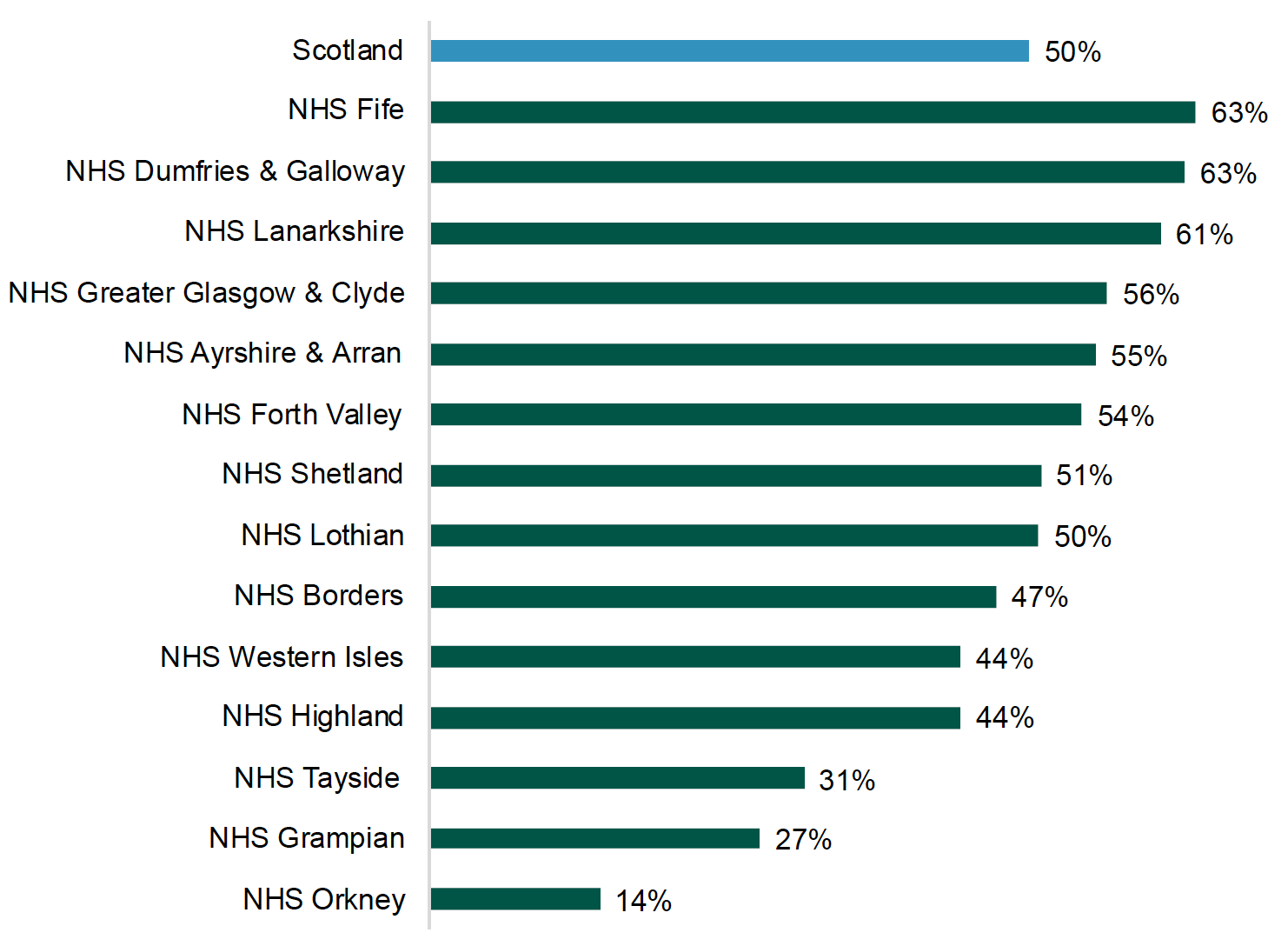
Despite the stated ambition that everyone newly diagnosed with dementia should be offered PDS as per the Local Delivery Plan (LDP) standard (more detail can be found in the Appendix), only half (50%) of people estimated to be newly diagnosed were referred to PDS in Scotland. PHS data for 2022/23 showed that there was large variation between Health Boards. Some Boards, for example NHS Dumfries and Galloway, reported rates of 63% while the lowest reported level was 14% in NHS Orkney (Figure 5)[32].
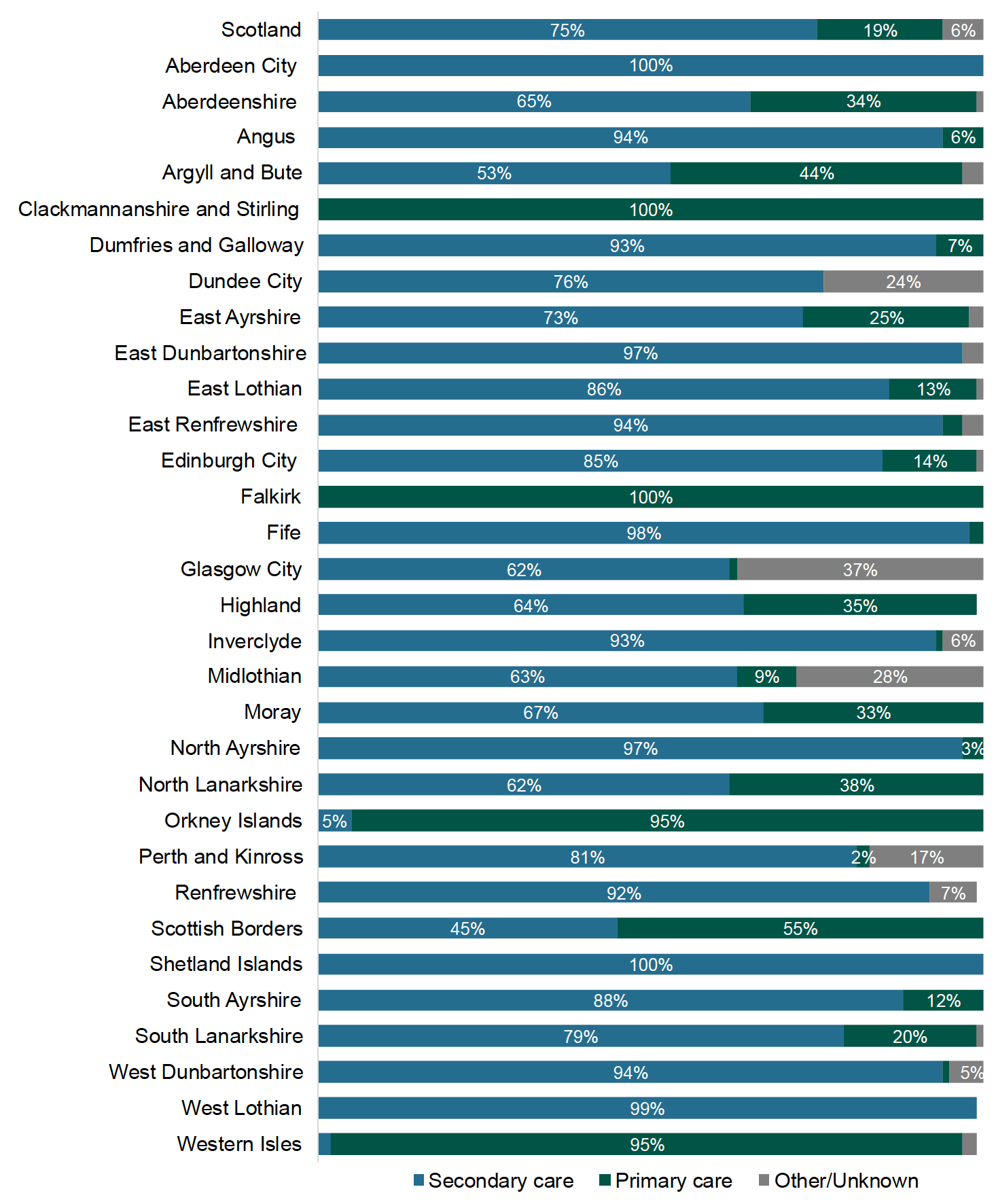
The most common source for referrals to PDS was through secondary care (Figure 6). PHS data from 2021/22 shows that this ranged from 100% in Aberdeen City and Shetland Islands, to 45% in the Scottish Borders. Among case study HSCPs, referrals were often received from a range of secondary care providers, including community mental health teams, consultant psychiatrists, hospitals or intermediate care units as well as primary care service like GPs.
Staff in case study HSCPs generally described referral as being a smooth process. Some HSCPs mentioned that referrals happened at the point of diagnosis, describing the process as ‘almost automatic’. Community Mental Health Teams (CMHT) were central to the referral process, either sending out referrals to external partners where these were commissioned or processing them internally. Half of case study HSCPs mentioned having a regular screening meeting to allocate referrals to the appropriate person to deliver the PDS (for example where there were multiple in-house teams that could deliver PDS) or determine whether the 5 or 8 Pillar Model should be employed. Two HSCPs stressed the importance of having these meetings on a weekly basis to ensure referrals keep moving through the system, whilst one only had them on a monthly basis.
However, there was some evidence of referral opportunities being missed. One HSCP described how there was an initial lack of confidence in referring into the PDS team through the CMHT due to this being a new team, suggesting that some referrals may have been missed.
Waiting times for accessing PDS
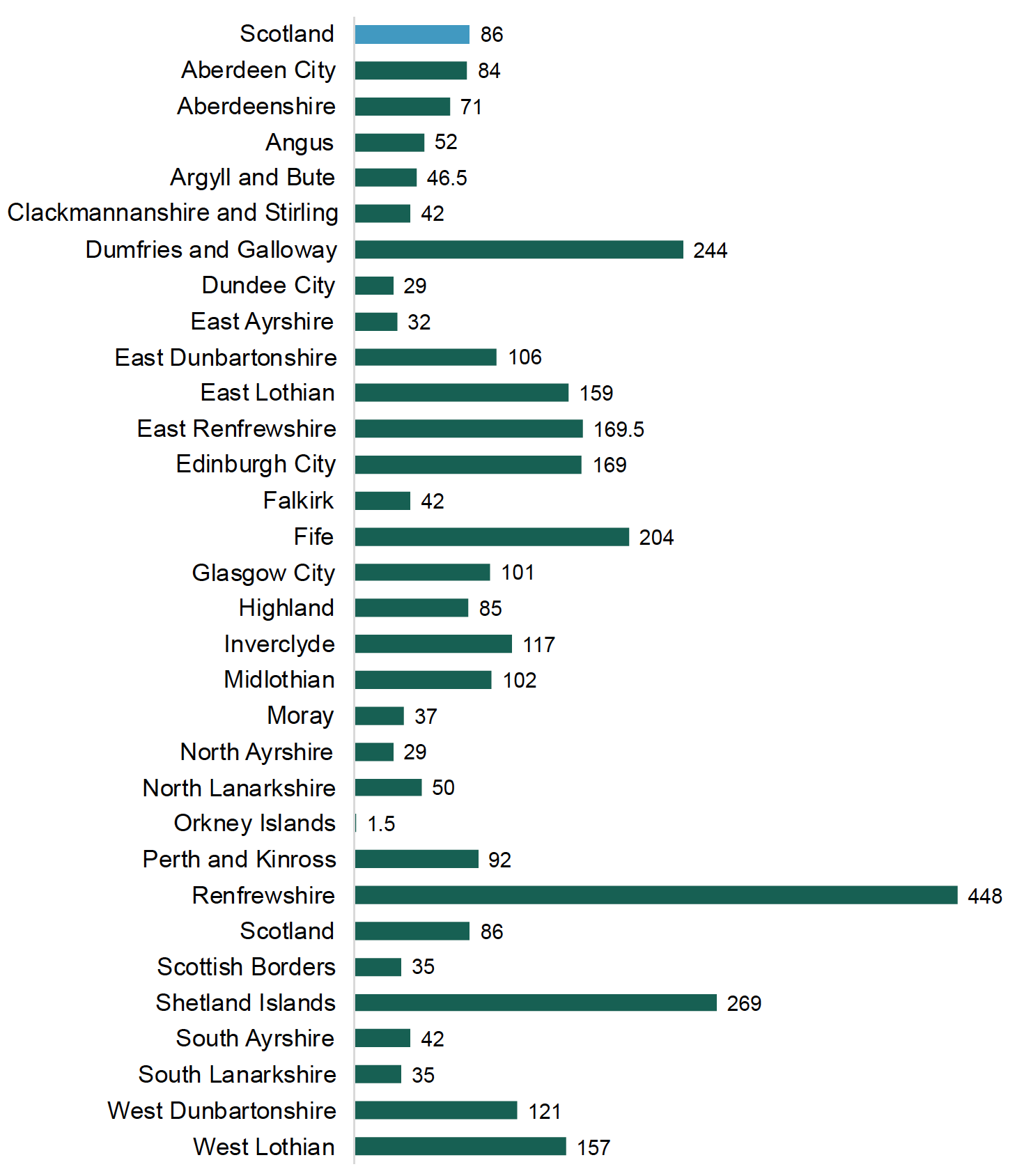
Wait times from diagnosis to first contact by a PDS practitioner varied across Scotland. According to PHS data in 2023/24, the median wait time in Scotland was 86 days. This ranged from 1 and half days in Orkney to 448 days in Renfrewshire (Figure 7[33]). Among IAAs with lower wait times, a large majority had an in-house or hybrid commissioning arrangement model. For one case study HSCP, low wait times reflected that diagnosis often happened in the same building that the PDS team was based in, meaning they could sometimes see them straight after the appointment. Other evidence pointed to additional funding improving waiting times in one HSCP whose waiting times decreased from 2021/22 to 2022/23.
PHS data from 2021/22 also demonstrated variation in wait times by age, deprivation quintile and referral source:
- Older service users had shorter median wait time (62 days for those over 90 compared to 81 days for those aged 65 to 69).
- Service users that lived in the least deprived areas had shorter median wait times (74 days compared to 91 days for services users that lived in the most deprived areas).
- Service users that were referred through primary care had shorter median wait times than those referred through secondary care (36 days compared to 84 days).
Wait times for PDS were an area for concern in all case study HSCPs. Delays of several months were often attributed to long triage processes, full caseloads or handovers between providers. Some service users reported long wait times as a reason for a negative experience in their introduction to PDS, particularly when little explanation for the delay was provided by the referrer.
There were some examples of HSCPs providing support whilst people living with dementia were waiting for PDS to start, these included providing people with information packs they could refer to or starting people on medication if that was necessary. However, according to service users, the support offered was generally not sufficient to mitigate the negative impacts of long waiting times.
How PDS is introduced to service users
Across case study HSCPs, PDS tended to be introduced at the point of diagnosis. At this point, it was common for high-level information about what PDS is to be shared, and people living with dementia also sometimes received an information pack or contact list, signposting to important contacts for local community and social care services. After this initial introduction, the next step was generally that people living with dementia either received a phone call from their PDS practitioner or a referral later to provide additional detail.
When it came to the first meeting with a PDS practitioner, most service users reported a positive experience. This was primarily driven by a feeling of being listened to and the shared decision-making around how PDS was delivered in accordance with personal preferences. Introductions that focused first on practical needs, for example setting up a power of attorney, were welcomed as they helped build relationships and shifted attention away from the dementia diagnosis.
“So people [PDS service users] say to us that the [it’s the] positive relationships. I'm literally quoting from the first visit, [PDS practitioner] established a positive relationship with my aunt. Without the input of [PDS practitioner], my aunt would not now be attending the day centre. Information about and referral to other support networks was also much appreciated. Having someone to listen to concerns and give practical guidance helped me to develop confidence on the journey” - PDS practitioner
Good Practice Spotlight: Lanarkshire – Introducing PDS with care
- Introductions were flexible and adapted to users’ needs – for example offering phone introductions for those uncomfortable with home visits.
- Technical terms like “5 Pillar Model” were avoided and replaced by simpler, phrases such as “general support”.
- Essential but limited information was shared to avoid overwhelming the service user.
- Main objective of initial discussions was to create good rapport to set a foundation for effective engagement with PDS.
It was rare for service users or care partners to report negative experiences of being introduced to PDS. Where there were negative experiences reported, these related to receiving too much information and it being overwhelming or not feeling like the support was relevant or useful for them. There were also isolated examples of errors made by PDS practitioners that reduced trust, for example mistakenly marking someone as refusing PDS or sending incorrect email communications.
Engagement with PDS
Findings from the HSCP case studies indicated allowing service users the agency to choose when it started had a positive influence on service user engagement with PDS. This is because it gave time for individuals to process and understand their diagnosis before engaging with PDS. Service users valued not being “pushed” to engage before they were ready. Desire for reassurance, practical help, and a consistent point of contact were among other reasons for strong service user engagement.
“They're pleasant. They're not pushy. And if you want to ask anything, they're quite happy to talk to you” - Service user
Data from PHS demonstrated that a small proportion of service users refused PDS. Across Scotland in 2021/22, only 5% of people referred for PDS declined it. Whilst refusal of PDS was rare across HSCP case studies, staff did provide insight into the reasons why some people chose not to engage with PDS. These included:
- Stigma: case study HSCPs in rural settings reported that stigma relating to diagnosis was prevalent due to small, close-knit communities where people feared being judged.
- Denial: PDS practitioners described that individuals with young onset dementia struggled to come to terms with their diagnosis and often refused the service due to perceptions of dementia as a condition associated with older age. Older generations of PDS users also declined PDS as they had attributed dementia symptoms, like memory loss, to old age.
- Lack of understanding: Another dimension included lack of understanding of dementia as a condition, which was reported among minority ethnic communities. This was exacerbated in some cases by language barriers and lack of translated information materials related to PDS.
“The biggest one is stigma. The stigma around having dementia…especially in a small community where everybody knows who you are…People don't believe that they have the diagnosis that they've got”– PDS practitioner
It is important to note that these challenges did not always lead to refusal of PDS. For example, in the case of denial or stigma, PDS practitioners described how mirroring the language people use to talk about their own condition and not overtly referencing dementia could support people to engage with the support.
In terms of sustaining engagement with PDS, participating in community and peer support groups had a positive influence, as did the delivery of PDS using a tailored and person-centred approach. Service users and their care partners described that support that continued to meet their needs and address changing situations meant PDS stayed relevant and valuable for them as the 12 months progressed. Peer groups also had a positive influence on engagement with PDS. This was because these groups helped to build comradeship among service users.
“Because you're socialising with other people, you know, even though it's just draughts or, you know, or domino or whatever, you know, it's the[...] It makes a big difference.” – Service user
As outlined by Alzheimer’s Society, dementia progresses from early stages of mild memory problems but remain largely independent, to a middle stage of increasing confusion and support needs and finally to a later stage of severe decline and full dependency[34]. Service users in early and middle stages of dementia were more likely than those in later stages of dementia to engage with PDS to a greater extent. PDS practitioners suggested that this was because these service users had the capacity to understand their diagnosis and also participate in community social groups. By contrast, service users in later stages of dementia found it difficult to understand their diagnosis and PDS activities due to more limited capacity. It is important to note that this is based on anecdotal evidence from service users and their care partners, and also relates to a wider point about timing of diagnosis (which was out of scope for this evaluation).
“I don't think it's helped him because he just doesn't understand. I think he's enjoyed [PDS Practitioner] being there, he's enjoyed talking to [PDS Practitioner], but I don't think he's understanding. Because he keeps saying , what is it you're doing? Why are you here again? And she has to explain to him every time. She's left him leaflets, booklets, trying to read through that. But he doesn't understand” – Care partner of service user
Format of PDS delivery
PDS was primarily delivered by a Link Worker as individual support rather than group support across case study HSCPs. One HSCP referenced providing online group support for people with young onset dementia specifically. This was to help service users accommodate PDS within their lives, since service users of this age group tended to still be in work and have other competing priorities. Other HSCP staff mentioned being aware of PDS being delivered in a group setting but did not offer this themselves.
PDS was delivered primarily through home visits, particularly at the start of support. This was the preferred method, as PDS practitioners highlighted benefits including seeing people in an environment they are comfortable in and being able to observe potential health risks in the home (e.g. trip hazards). If someone was initially reluctant to engage with PDS, or they were in a particularly hard to reach area, support could also be provided over the phone.
“If you do get a visit in and get to see them again in their own environment talk about what they want to talk about, it's just all a lot more relaxed and comfortable for them.” – PDS practitioner
Visits typically followed regular patterns, for example once a month or once every six to eight weeks. Where visits were less frequent, this was sometimes linked to capacity issues. Visits tended to be more frequent at the start of support, with staff in one area mentioning support could start weekly and reduce over to time to as infrequently as every three months: this was adapted based on the person’s needs. Service users also reported speaking to their PDS practitioner on the phone, or less commonly by email if something specific came up between visits. Visits tended to last around one hour according to service users, though could last longer on occasion.
Duration of PDS
Part 2 of the LDP standard is the percentage of people referred to PDS who received a minimum of one year’s support coordinated by a Link Worker, including the building of a person-centred support plan (see below). Of those referred for PDS across Scotland, 81% received a minimum of one year’s support.[35] This rate was similar across different HSCPs and commissioning arrangements (84% where PDS was commissioned to an external partner, 80% where PDS was delivered through a hybrid arrangement and 79% where PDS was delivered in house).[36]
Case study HSCPs said they typically felt they were meeting the LDP standard and offering 12 months of support. Even in cases where a service user might feel they had received all the support they needed in a shorter timeframe (e.g. six to eight months), they would still be kept on PDS records until the 12-month point. Here, the frontline practitioner would typically take a lighter touch approach, checking in over phone call rather than in-person meetings up to the 12-month point.
Reasons for some individuals not receiving the full 12 months of support were often practical, including users passing away or relocating out of the HSCP area. In some instances, users reached such an advanced stage of dementia that other support was deemed more appropriate. It is crucial to note in these instances, despite not receiving the full 12 months of PDS, users still received alternate modes of support and so their needs were still met.
However, some HSCPs suggested that if a person initially declined PDS, this might affect the duration of support they received if they did eventually accept it. In theory, if someone initially declines PDS, they should be able to accept it at a later date and still receive 12 months support. In practice however, there were examples of people accepting PDS three months later and only receiving nine months in total.
HSCPs were generally not able to offer PDS beyond 12 months, due to limited capacity. A couple of HSCPs said they might go beyond 12 months in certain circumstances. For example, if there was a social care concern for a person receiving PDS that had not been resolved within 12 months. Alternatively, if the person was at a more severe stage of dementia, was clearly not self-managing and was still in need of support, some HSCPs said they would also provide more than 12 months support in these circumstances.
Personal plans
Personal plans were consistently developed as part of PDS, but the content and uses of these varied across areas. Terminology for these plans also varied, with PDS practitioners referring to ‘care plan’ (in-house and hybrid commissioning arrangements), ‘support plan’ (in-house and hybrid commissioning arrangements), ‘personal health plan’ (hybrid commissioning arrangement), ‘individualised care plan’ (hybrid) or ‘personal outcome plan’ (hybrid).
According to best practice, a personal plan can vary in terms of format, but should be put together with the person living with dementia and it should “assist with living well, informing future support…documenting coping strategies, future wishes and anticipatory care planning.”[37] In practice, across our case study areas, there was variation in whether personal plans were referred to as a document specifically for the service user or more of a guiding framework for staff.
The range of purposes for personal plans included:
- A summary of the person’s past, present and future, including what has been and what is important to them.
- A toolkit for staff to use throughout PDS support, often based on the five-pillar model. Staff would set goals based on these five pillars.
- A summary of support provided during PDS, to be used as a reminder to the service user, their care partners, their nurse etc. after PDS has ended. This was seen as a resource for future care providers, for example it could save a nurse having to ask all the same questions and prevents people from having to repeat themselves
- A resource for service users containing contact details for future care needs, e.g. information on potential additional support that might be needed in the future.
“It doesn't necessarily need to be this big written document. Some people love that, but actually it's just about how we are formulating a plan, using our 5 Pillars Model as best as we can, but also adjusting that to what's going on for that person and their needs and their situation.” – PDS practitioner
In terms of how personal plans were created, there was some evidence from PDS practitioners that they developed personal plans collaboratively with service users. PDS practitioners also emphasised that the plan was a living document that was kept updated throughout PDS to reflect changes in the person and their preferences. However, when asked about whether they had a personal plan, not all service users were aware of what this was or been involved in developing it. These findings suggest that whilst there is some evidence that personal plans are being developed and used for their intended purpose, this is not happening consistently for everyone, everywhere.
In one case study HSCP, two types of plan were developed to be used by future care professionals on one hand and the service user and their care partners on the other. The former was referred to as the Five Pillars care plan (containing information like appointments attended and when, the details of the person’s social worker, a copy of their referral and the referral date). The latter was referred to as a personal health plan, containing information that the person with dementia and those supporting them would need to know such as the name and contact details of the social worker who would be able to help them go to the day centre. According to staff, this separation helped ensure the plan held by the person with dementia was easy to use, without superfluous information:
“So having that personal health plan helps them to know the things we've talked about, but without having all the professional guff that they don't understand.” – PDS practitioner
Personal plans have the potential to be highly effective tools for both service users and people involved in their care. When these are created alongside the person living with dementia and regularly updated, they can provide a useful picture of who the service user is as a person and what their care needs and preferences are. They serve as a strong basis from which PDS practitioners and future practitioners involved in their care can ensure care remains person-centred.
Contact
Email: dementiapolicy@gov.scot