
Dementia post-diagnostic support evaluation: final report
Independent evaluation undertaken to understand the impacts of Post Diagnostic Support (PDS) for people across Scotland who have been diagnosed with dementia. Scottish Government commissioned IFF Research to undertake this evaluation to inform future developments.
8. Appendices
Logic Model
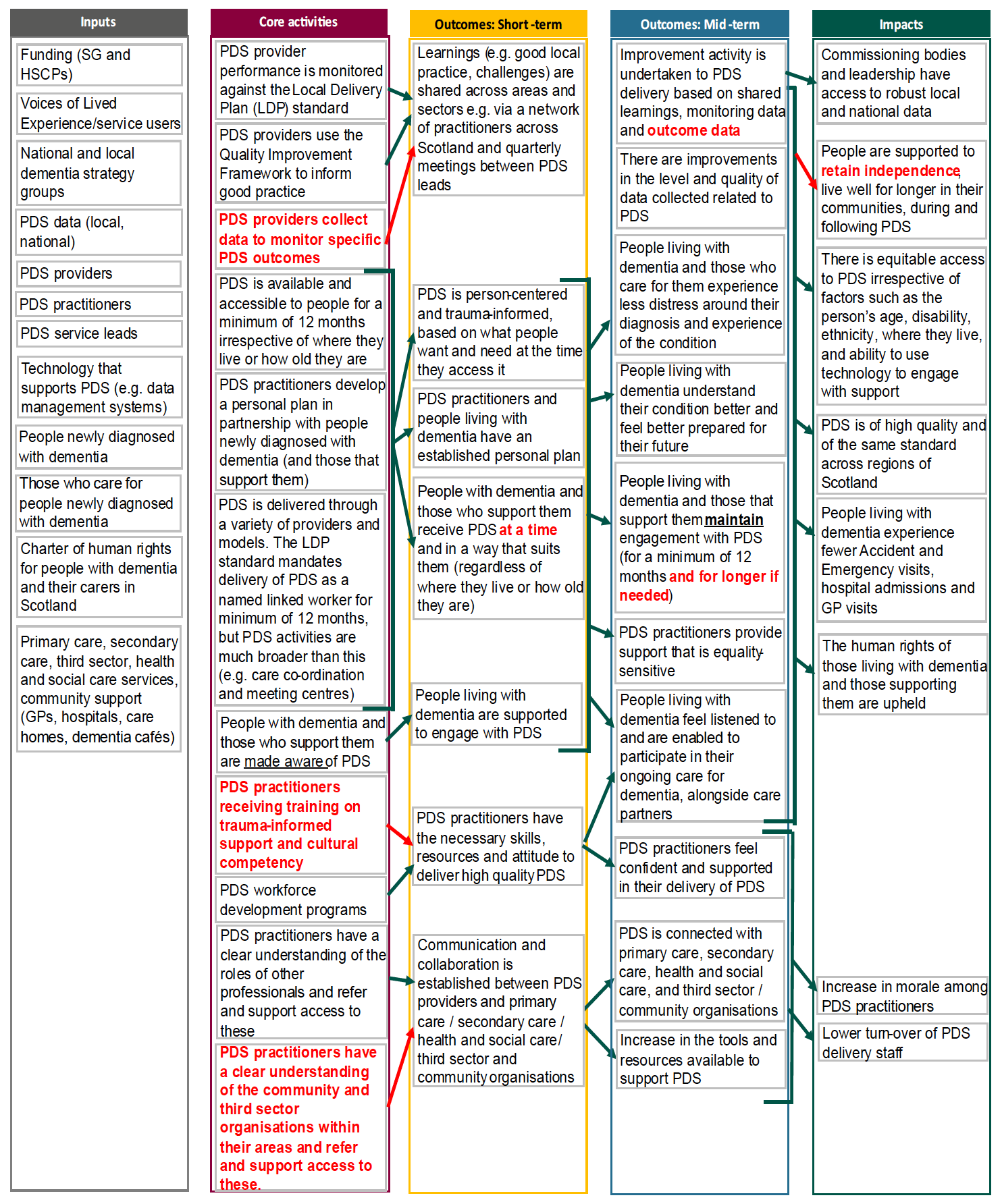
The Logic Model is a visual diagram that shows how the inputs and activities central to PDS should lead to specific short-term outcomes, mid-term outcomes and longer-term impacts. The full narrative flow in this section provides a full description of the visual diagram in Figure 9[43]. In the diagram, the text in red and bold in the diagram are additions we have made following the evaluation to reflect additional elements we have found to be important to the effective delivery of PDS. In the narrative, this text is underlined.
Inputs and activities
The following resources, organisations and people are inputs for PDS:
- Funding (from Scottish Government and HSCPs)
- Voices of Lived Experience and service users
- National and local dementia strategy groups
- PDS data (local and national)
- PDS providers
- PDS practitioners
- PDS services leads
- Technology that support PDS (e.g. data management systems)
- People newly diagnosed with dementia
- Those who care for people newly diagnosed with dementia
- Charter of human rights for people with dementia and their carers in Scotland
- Primary care, secondary care, third sector, health and social care services, community support (GPs, hospitals, care homes, dementia cafés)
The core activities involved in the delivery of PDS are:
- PDS provider performance is monitored against the Local Delivery Plan (LDP) standard
- PDS providers use the Quality Improvement Framework to inform good practice
- PDS providers collect data to monitor specific PDS outcomes
- PDS is available and accessible to people for a minimum of 12 months irrespective of where they live or how old they are
- PDS practitioners develop a personal plan in partnership with people newly diagnosed with dementia (and those that support them)
- PDS is delivered through a variety of providers and models. The LDP standard mandates delivery of PDS as a named linked worker for minimum of 12 months, but PDS activities are much broader than this (e.g. care co-ordination and meeting centres)
- People with dementia and those who support them are made aware of PDS
- PDS practitioners receiving training on trauma-informed support and cultural competency
- PDS workforce development programmes
- PDS practitioners have a clear understanding of the roles of other professionals and refer and support access to these
- PDS practitioners have a clear understanding of the community and third sector organisations within their areas and refer and support access to these.
Outcomes and impacts
The above activities should lead to short-term outcomes as a direct and immediate result of engaging with the programme activities. These short-term outcomes are:
- Learnings (e.g. good local practice, challenges) are shared across areas and sectors e.g. via a network of practitioners across Scotland and quarterly meetings between PDS leads. This outcome is driven by the monitoring of PDS provider performance against the LDP standard, use of the Quality Improvement Framework by PDS providers and collection of data to monitor specific PDS outcomes by PDS providers.
- PDS is person-centred and trauma-informed, based on what people want and need at the time they access it. And PDS practitioners and people living with dementia have an established personal plan. And people with dementia and those who support them receive PDS at a time and in a way that suits them (regardless of where they live or how old they are). These three outcomes are driven by PDS being available and accessible for a minimum of 12 months, development of a personal plan, and delivery of PDS regardless of model and provider.
- People living with dementia are supported to engage with PDS. This outcome is driven by people living with dementia and those that support them being made aware of PDS.
- PDS practitioners have the necessary skills, resources and attitude to deliver high quality PDS. This outcome is driven by PDS practitioners receiving training on trauma-informed practices and PDS workforce development programmes.
- Communication and collaboration is established between PDS providers and primary care / secondary care / health and social care/ third sector and community organisations. This outcome is driven by PDS practitioners having a clear understanding of the roles of other professionals and community and third sector organisations and referring people to these where this would be useful.
If these short-term outcomes are achieved, they should lead to the following mid-term outcomes:
- Improvement activity is undertaken to PDS delivery based on shared learnings, monitoring data and outcome data. And there are improvements in the level and quality of data collected related to PDS. (These outcomes build upon the short-term outcome of learnings being shared across areas and sectors.)
- People living with dementia and those who care for them experience less distress around their diagnosis and experience of the condition. And people living with dementia understand their condition better and feel better prepared for their future. And those that support them maintain engagement with PDS (for a minimum of 12 months and for longer if needed). And people living with dementia feel listened to and are enabled to participate in their ongoing care for dementia, alongside care partners. (These outcomes build upon the short-term outcomes of PDS being person-centred and trauma-informed, a personal plan being in place, people living with dementia receiving PDS in a way and at a time that suits them and being supported to engaged with PDS.)
- PDS practitioners feel confident and supported in their delivery of PDS. (This outcome builds upon the short-term outcome of PDS practitioners having the necessary skills, resources and attitudes to deliver high-quality PDS.)
- PDS is connected with primary care, secondary care, health and social care, and third sector / community organisations. And increase in the tools and resources available to support PDS. (These outcomes build upon the short-term outcome of communication and collaboration being established between PDS providers, health and social care providers and third sector an community organisations.)
If these mid-term outcomes are achieved, they should lead to the following impacts:
- Commissioning bodies and leadership have access to robust local and national data
- People are supported to retain independence, live well for longer in their communities, during and following PDS
- There is equitable access to PDS irrespective of factors such as the person’s age, disability, ethnicity, where they live, and ability to use technology to engage with support
- PDS is of high quality and of the same standard across regions of Scotland
- People living with dementia experience fewer Accident and Emergency visits, hospital admissions and GP visits
- The human rights of those living with dementia and those supporting them are upheld
- Increase in morale among PDS practitioners
- Lower turn-over of PDS delivery staff
Additional methodological detail
List of quantitative data sources
- Scottish Government Annual monitoring returns 2024/25
- Public Health Scotland: Analysis of 2021/22 data. Note this analysis had statistical disclosure applied, where some figures have been suppressed, therefore percentage figures presented in Figure 3 may not add up to 100%
- Public Health Scotland annual publication: Dementia Post-Diagnostic Support Statistics (including Local Delivery Plan Standard - Figures to 2022/23)
Monitoring returns
Annual monitoring returns for Integration Joint Boards (IJBs) were provided by the Scottish Government for the 2024/25 period. We triangulated the quantitative data in these returns with our qualitative findings from the six case study HSCPs as well as the most recent PHS data on PDS performance against the LDP standard for the year 2022/23. This allowed us to contextualise our qualitative findings within the picture across Scotland. We also analysed monitoring return data by whether PDS was delivered in-house, externally commissioned, or both, allowing us to see whether any patterns emerged by delivery approach and how, if at all, this interacted with factors such as number of staff, referrals, and funding.
We had initially hoped to have access to a demographic profile of service users in the monitoring returns (e.g. age, gender, ethnicity, stage of dementia, type of dementia, setting residing in). In practice, this data was not captured in any of the monitoring return forms we had access to and remains a key data limitation. Likewise, data on outcomes and engagement was mainly limited to achievement of the LDP standard. While there was a section for IJBs to provide additional outcome metrics, detail was generally lacking here and less than anticipated.
Please also note that for the monitoring returns data, we received 30 out of 31 monitoring returns for 2024/25; we were not provided with Aberdeenshire’s return. One joint monitoring return was submitted for North Lanarkshire and South Lanarkshire, and so in certain charts in the main report these have been combined.
Case study selection
The six case study HSCP areas were selected so that we had an even split between delivery approach:
- 2x HSCPs where they commissioned an external provider to deliver PDS
- 2x HSCPs where PDS is delivered by NHS staff within the HSCP
- 2x HSCPs where there is a hybrid model i.e. delivery of PDS is split between NHS staff and a commissioned external provider.
Areas were also selected so that there was a mix of geographies, populations served, rurality and deprivation levels. Scottish Government provided us with six suggested HSCPs, as well as six back-up areas. All six of the initial suggested areas were successfully recruited and opted in to the research after speaking to their PDS leads. These were:
- Fife
- Glasgow
- Lanarkshire
- Orkney
- Scottish Borders
- Stirling and Clackmannanshire
Qualitative fieldwork
Qualitative fieldwork began by video interviewing two PDS lead staff in each of the six case study HSCPs, allowing us to get a comprehensive overview of PDS delivery from a strategic point of view in each area.
In the second strand of fieldwork, we conducted virtual focus groups with frontline practitioners and link workers to get their perspectives of PDS and in particular what was working well, less well, and which elements they felt more or less confident delivering. There was one focus group per HSCP with each including around 4-8 staff. 36 frontline practitioners were involved in total. The staff involved in these focus groups were either NHS staff or Alzheimer Scotland or Age Scotland link workers, depending on the delivery approach of the HSCP.
The third strand of qualitative fieldwork was with local and community organisations that worked with PDS teams and helped provide support to those living with dementia in the case study areas. Again, there was one virtual focus group per HSCP with 3-7 participants in each. In total we spoke to 30 individuals, representing a range of organisations including local dementia cafes, dementia charities, admiral nurses, and Age Scotland social hubs.
The fourth strand of fieldwork was conducted in-person and we spoke directly to those living with dementia or their care partners. Often we spoke to the person living with dementia and their care partner together to facilitate smooth discussions and ensure participants felt comfortable.
Recruitment of non-users of PDS (those who had been offered the support but declined it) as well as minority ethnic users was done on a best-efforts basis. We recruited and completed two interviews with non-users, and one interview with a user from a minority ethnic background.
A breakdown of key demographics for service users we interviewed in each of the six case study HSCPs can be found below:
| Case Study Area | Case Study 1 | Case Study 2 | Case Study 3 | Case Study 4 | Case Study 5 | Case Study 6 | Total |
|---|---|---|---|---|---|---|---|
| Total | 6 | 5 | 4 | 5* | 4* | 5 | 29 |
| Sex: Male | 5 | 0 | 3 | 3 | 3 | 4 | 18 |
| Sex: Female | 1 | 5 | 1 | 2 | 1 | 1 | 11 |
| Age: 18 - 65 | 0 | 2 | 0 | 0 | 0 | 3 | 5 |
| Age: Over 65 | 6 | 3 | 1 | 5 | 4 | 2 | 21 |
| Age: Unknown | 0 | 0 | 3 | 0 | 0 | 0 | 3 |
| Ethnicity: White British | 5 | 5 | 4 | 5 | 4 | 4 | 27 |
| Ethnicity: White Irish | 0 | 0 | 0 | 0 | 0 | 1 | 1 |
| Ethnicity: Minority Ethnic | 1 | 0 | 0 | 0 | 0 | 0 | 1 |
| Stage of dementia: Early | 3 | 5 | 0 | 1 | 2 | 5 | 16 |
| Stage of dementia: Early - middle | 1 | 0 | 3 | 0 | 1 | 0 | 5 |
| Stage of dementia: Middle | 1 | 0 | 1 | 3 | 1 | 0 | 6 |
| Stage of dementia: Middle - late | 1 | 0 | 0 | 0 | 0 | 0 | 1 |
| Stage of dementia: Late | 0 | 0 | 0 | 1 | 0 | 0 | 1 |
* Please note that in both of these case study HSCPs, one interview was conducted with a non-user of PDS.
Qualitative analysis
All interviews were recorded with consent and stored on IFF ’s secure drive in a folder to which only designated team members had access. Interview transcripts were systematically coded using qualitative analysis software, with researchers looking for patterns by theme within and across interviews.
The initial code frame was informed by the evaluation framework but this was developed throughout analysis based on the emerging findings. Researcher analysis sessions, led by the director, during which the team came together to discuss and test emerging themes and insights, were conducted at and interim and final stage to support interpretation of the data.
All evidence sources were analysed in their own right; the analysis process then went on to compare and contrast the findings across evidence sources.
Additional contextual/background information
Alzheimer’s and other Dementia Deaths, 2023[44]
This report provides data surrounding Alzheimer's and dementia related deaths. These are deaths are defined by the International Classification of Diseases (ICD), which is maintained by the World Health Organisation (WHO), as the following:
Vascular dementia (ICD code F01)
Unspecified dementia (ICD code F3)
Alzheimer's disease (ICD code G30)
There were 6,491 deaths caused by Alzheimer's diseases and other dementias in Scotland. The rate of mortality was 125 deaths per 100,000 people, making these conditions one of the leading causes of death in Scotland.
Local Delivery Plan Standard: Figures to 2020/21– 2023 Release[45]
This release by Public Health Scotland (PHS) reports on the Scottish Government’s Local Delivery Plan (LDP) standard that everyone newly diagnosed with dementia will be offered a minimum of one year’s PDS, coordinated by an appropriately trained link worker, including the building of person-centred support plan. Main findings include:
There were 6,569 people diagnosed and referred for PDS in 2020/21, compared to 8,137 in 2019/20. The effects of measures relating to the COVID-19 pandemic are likely to have contributed to this reduction.
Of those referred in 2020/21 for PDS, 81% received a minimum of one years support, the same proportion in 2019/20.
In Scotland, 33.7% of those people estimated to newly diagnosed with dementia in 2020/21 were referred for PDS, compared to 42.9% in 2019/20. The effects of measures relating to the COVID-19 pandemic are likely to have contributed this reduction.
PDS and Care Co-ordination Improvement Delivery Programme update: January 2026[46]
The programme launched in April 2025 and ran in 2 cohorts over 12 months, aiming to ensure people with dementia will have an improved experience of, and access to, person-led PDS and care co-ordination, which meets their individual needs. The programme used the PDS Quality Improvement Framework to support self-evaluation and improvement planning with 16 participating health and social care partnership (HSCP) teams. Examples of impact include:
Increase in person plans: one HSCP has 100% of new PDS service users using a new improved personal plan since December 2025
- Improved use of frailty assessment in PDS Service: One HSCP has had three-fold increase in the median number of frailty assessments per week as part of PDS, enabling additional support for frailty
Previous research on PDS
As mentioned in the Introduction, this evaluation builds on a range of relevant research relating to PDS. The findings from two major research pieces are included below.
National Conversation to Inform a new Dementia Strategy for Scotland – What People Told Us
The National Conversation discussions with communities across Scotland.[47] It found that:
- There was a stigmatising view of what dementia was and what a diagnosis meant. This negative societal perception often led to people to “put off” seeking a diagnosis or asking for help, and limited the type of support made available to people when they needed it.
- The importance of community in the lives of those living with or caring for someone with dementia came through strongly, as did the need to leverage a community-led, peer-support ethos wherever possible.
- There was a gap between Scotland’s world leading commitments on dementia policy and people’s experiences of receiving support (“what it feels like”). This included a lack of person-centredness towards individuals, their families and their carers in delivering or tailoring support that worked for them.
- The availability and provision of support, including the commitment of a minimum of 12 months PDS, was inconsistent.
- The challenge in providing care which support people where and when they need support in a way that worked for them was a consistent message.
- A lack of education and training about dementia was resulting in an under skilled workforce in both social care and health.
- The trauma of diagnosis; the perception that dementia should be seen as a ‘brain health’ condition rather than a mental health one; the need for an upscaling of preventative and early intervention activities (to reduce demand at the crisis end), and; the prohibitive cost of seeking specialist care and support were also highlighted.
New Dementia Strategy – Literature Review
SG commissioned the University of Stirling to do literature review of dementia research, to inform the new Dementia Strategy for Scotland.[48] The review concluded that although there are a range of care models and interventions that show promise in supporting people living with dementia and their care partners, there are also areas where significant improvements are needed. Key findings include:
- Clinical, social, economics, and lifestyle factors are all thought to have preventative role of dementia.
- Evidence suggests that a range of non-pharmacological interventions can have a positive impact for both the person with dementia and their care partners.
- Domestic environment and neighbourhoods can play an essential role in keeping people at home and connected to the community.
- For those living at home care should focus on facilitating independence and providing support for care partners.
- Attitudes and perceptions amongst the public, healthcare professionals and structural prejudice within healthcare services can prevent people from accessing and benefitting from support. Some may fear discrimination, marginalisation and social exclusion.
- Improving public awareness of dementia and related health care approaches, establishing culturally appropriate services, promoting health services that seek to rectify the negative impacts of racism, and ensuring equitable service provision, especially to ethnic minority groups, LGBTI groups, homeless people and those who do not receive unpaid care from family and friends were among suggested measures to rectify inequalities.
- Care partners themselves can be at risk of poor health outcomes, for a variety of reasons. Some research suggests more work needs to be done in developing intervention and training programmes to support care partners.
Evaluation framework
Key evaluation aim 1: Understand PDS from a process perspective
Key research questions: How is PDS currently delivered across Scotland?
Measures: Description of the range of PDS operational delivery models across Scotland; Ways in which PDS delivery extends beyond the mandated LDP standard; How decisions are made about PDS delivery approach in HSCP and perceptions on whether this works well/not well and why; Ways in which learnings are shared between HSCPs and perceptions on whether this works well/not well and why; Ways in which PDS delivery responds to local circumstances; Perceptions of what is working well/not working well with PDS delivery, and enablers and challenges to delivery
Source: Secondary data
HSCP lead interviews
Community/national partner focus groups
Frontline practitioners focus groups
Key research questions: What inequalities and inconsistencies currently exist in provision?
Measures: LDP achievement part 1 and 2; Profile of beneficiaries; Profile of those referred to PDS; Percentage of people who have refused or have not taken up PDS following referral; Types of support offered; Levels of engagement with PDS and view on the reasons for this; Perceptions of access to support (e.g. any underserved groups) and any gaps in delivery / content of support
Source: Secondary data
HSCP lead interviews
Frontline practitioners focus groups
PDS users / those supporting them
Key research questions: What were the experiences of those delivering (staff) and accessing PDS support (those living with dementia/their carers)?
Measures: Extent to which practitioners feel supported; Staff morale levels; Views on the quality and effectiveness of PDS support received; Perceptions of any gaps in the PDS support received; Ways in which people living with dementia / those supporting them are first made aware of PDS and views on the effectiveness of this; Information PDS users / those supporting them received and would have wanted to receive when they were first made aware of PDS; Suggestions for improving experiences of PDS support
Source: Community/national partner focus groups
Frontline practitioners focus groups
PDS users / those supporting them
People living with dementia / those supporting them who did not take up PDS support
Key research questions: What encourages or discourages people from taking up PDS when offered?
Measures: Reasons for those living with dementia and those supporting them choosing to access or not access PDS support; Perceptions of what is working well / less well to encourage uptake; Suggestions for improving uptake; PDS referral sources; Scale/frequency of collaboration with / referrals to other professionals/external partners and perceptions on whether this works well/not well and why
Source: Community/national partner focus groups
Frontline practitioners focus groups
PDS users / those supporting them
People living with dementia / those supporting them who did not take up PDS support
Secondary data
Key research questions: What does effective and ineffective implementation and delivery look like? For whom and in what circumstances? And how does this vary by service delivery model?
Measures: Implementation and delivery barriers; Implementation and delivery enablers; Suggested areas for improving effective implementation and delivery; Perceptions of effectiveness of links with primary care and reasons for this
Source: Frontline practitioners focus groups
Community/national partner focus groups
Key research questions: What is the role of wider community support?
Measures: Overview of community/national partners involved in each delivery model and how they contribute to PDS delivery and perceptions on whether this works well/not well and why
Source:
HSCP lead interviews
Community/national partner focus groups
Key evaluation aim 2: Understand the impact of PDS
Key research questions: To what extent have the outcomes outlined in the Dementia Strategy been achieved?
Do outcomes vary by service delivery model and/or across Scotland?
How do outcomes vary by different groups (including marginalised groups, those with young-onset dementia etc.)?
Outcomes: Short-term
Measures: Availability of local and national data and views on its usefulness; Suggestions for additional data required and how this could be compiled; How learning is shared across areas and sectors, views on the effectiveness of this and how it could be improved
Experiences of PDS in terms of Dementia strategy outcomes – person-centred and trauma informed; Extent to which users/those who support them feel that the timing of PDS was appropriate to their situation; Extent to which users/those who support them feel that the support they received was relevant to their situation; Extent to which users/those who support them feel that the support they received was delivered in an appropriate way which took their specific situation into account Ways in which PDS support responded to the personal circumstances/background of users/those who support them
Extent to which PDS consistently involves the development of a personal plan, and why/why not; Views on how useful personal plans are and any suggestions for improvement
Ways in which service users/those who support them are first made aware of PDS and the perceived effectiveness of this; Enablers and challenges to engaging with PDS; Ways in which staff can promote better engagement with PDS
Training and resources available to staff who deliver PDS support and views on the effectiveness of this; Perceptions of staff attitudes regarding PDS delivery and whether the programme is fit for purpose
Source: All secondary data
HSCP lead interviews
PDS users / those supporting them
Frontline practitioners focus groups
Community/national partner focus groups
Key research questions: To what extent have the outcomes outlined in the Dementia Strategy been achieved?
Do outcomes vary by service delivery model and/or across Scotland?
How do outcomes vary by different groups (including marginalised groups, those with young-onset dementia etc.)?
Outcomes: Short-term
Measures: Extent to which PDS practitioners have a clear understanding of the roles of other professionals; Extent to which PDS practitioners feel able to refer service users to other professionals; Extent to which community/national partners feel able to refer service users to HSCPs for PDS; Frequency of contact between PDS practitioners and other professionals and views on whether this frequency is suitable; Perceptions of the strength of relationships and collaboration between PDS practitioners and other professionals
Source: All secondary data
HSCP lead interviews
PDS users / those supporting them
Frontline practitioners focus groups
Community/national partner focus groups
Key research questions: To what extent have the outcomes outlined in the Dementia Strategy been achieved?
Do outcomes vary by service delivery model and/or across Scotland?
How do outcomes vary by different groups (including marginalised groups, those with young-onset dementia etc.)?
Outcomes: Mid-term
Measures: Extent to which activities are undertaken to improve PDS delivery based on shared learnings and monitoring data; Examples of instances where activities were undertaken to improve PDS delivery based on shared learnings / monitoring data
Extent to which service users'/those who support them's distress level around their diagnosis has changed since receiving PDS (and reasons why); Comparison with the experiences of those who did not access PDS support
Extent to which service users'/those who support them's understanding of their condition has changed since receiving PDS (and reasons why); Extent to which how well prepared service users/those who support them feel for the future has changed since receiving PDS (and reasons why); Comparison with the experiences of those who did not access PDS support
% of those referred to PDS who received a minimum of one year's PDS support and reasons for this; Percentage of PDS users who stop receiving PDS prematurely
Extent to which PDS is 'equality sensitive' and ways in which this is achieved; Barriers / enablers to delivering 'equality sensitive' support; suggestions for improvement; Extent to which PDS users and those supporting them feel PDS support is 'equality sensitive' and why; suggestions for improvement
Source: All secondary data
HSCP lead interviews
PDS users / those supporting them
People living with dementia / those supporting them who did not take up PDS support
Frontline practitioners focus groups
Community/national partner focus groups
Key research questions: To what extent have the outcomes outlined in the Dementia Strategy been achieved?
Do outcomes vary by service delivery model and/or across Scotland?
How do outcomes vary by different groups (including marginalised groups, those with young-onset dementia etc.)?
Outcomes: Mid-term
Measures: Extent to which PDS users / those supporting them felt listened to while receiving PDS; and reasons why/why not; Extent to which PDS users felt enabled to participate in their ongoing care for dementia, alongside care partners; and reasons why/why not;
Extent to which PDS practitioners feel confident and supported in their delivery of PDS; and reasons why/why not
What tools and resources are available and views on the effectiveness of these; Suggestions for improving the tools and resources available to support PDS
Source: All secondary data
HSCP lead interviews
PDS users / those supporting them
People living with dementia / those supporting them who did not take up PDS support
Frontline practitioners focus groups
Community/national partner focus groups
Key research questions: To what extent have the outcomes outlined in the Dementia Strategy been achieved?
Do outcomes vary by service delivery model and/or across Scotland?
How do outcomes vary by different groups (including marginalised groups, those with young-onset dementia etc.)?
Outcomes: Impacts
Measures: Extent to which HSCP leads feel they have access to robust local and national data on PDS delivery; and reasons why/why not
Triangulation of evidence for all outcomes including sub-group analysis by key demographics
Perceptions of PDS's contribution in reducing A&E visits, hospital admissions and GP visits among PDS users; and perceived mechanisms behind this contribution
Source:
HSCP lead interviews
PDS users / those supporting them
Frontline practitioners focus groups
Key research questions: To what extent have the outcomes outlined in the Dementia Strategy been achieved?
Do outcomes vary by service delivery model and/or across Scotland?
How do outcomes vary by different groups (including marginalised groups, those with young-onset dementia etc.)?
Outcomes: Any unintended outcomes? Difference PDS support made to those who received it? Vs those that were offered but chose not to receive it. Key mechanisms /drivers that contributed to outcomes being achieved
Measures: Perceptions of unintended/other outcomes achieved and the mechanisms for achieving these
Changes which are perceived to have occurred as a result of receiving support (and why the support led to these changes)
Other sources of support which led to changes (and why this support led to these changes)
Experiences of other dementia support, outcomes and what contributed to those outcomes
Important contributing factors to the change experienced as a result of receiving PDS (and why this factor is perceived to have led to this change)
Source:
HSCP lead interviews
Frontline practitioners focus groups
PDS users / those supporting them
Community/national partner focus groups
People living with dementia / those supporting them who did not take up PDS support
Key evaluation aim 3: What learnings can we take away from the evaluation?
Key research questions: What can we learn by comparing and contrasting the different service models of PDS delivery, including the challenges, risks, best value, quality and opportunities from different approaches?
Measures: Aspects that worked well and why in their local context and delivery model – including what they intend to keep
Aspects that didn't work well and why in their local context and delivery model – including what might have worked better
Source: Triangulation of all evidence
Key research questions: What improvements could be made to support the future development of PDS across Scotland?
Measures: Ways to strengthen future outcomes
What more could be done to support people following a diagnosis
Views on the sustainability of the intervention and what changes (if any) would be needed to make this sustainable
Source:
HSCP lead interviews
Frontline practitioners focus groups
Community/national partner focus groups
Key research questions: What additional monitoring data would be beneficial to support ongoing understanding of people's experiences of PDS experience and service quality?
Measures: Useful data measures not currently collected by / available to HSCPs and ways in which this data could be feasibly / practically collected
Source:
HSCP lead interviews
Monitoring return template
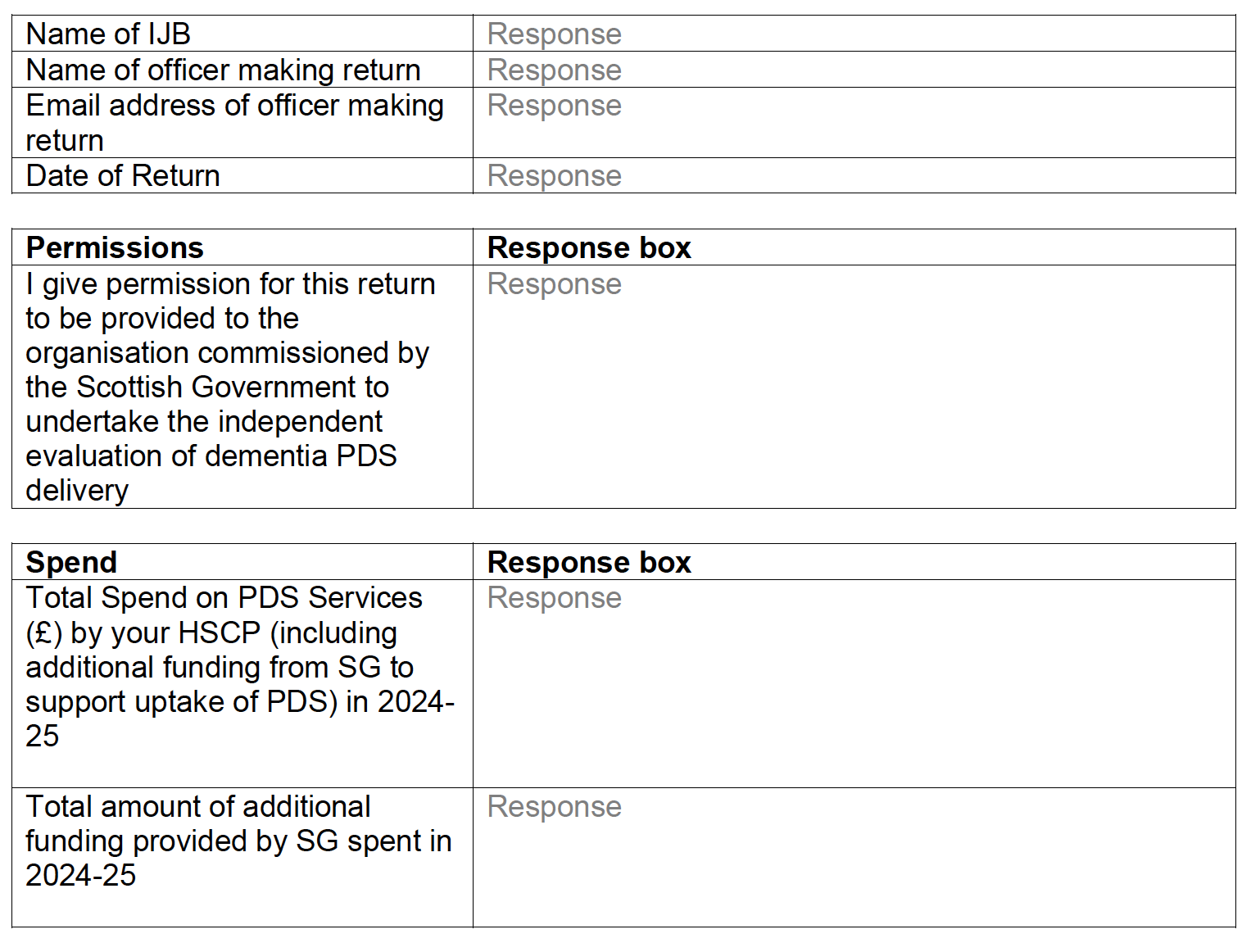
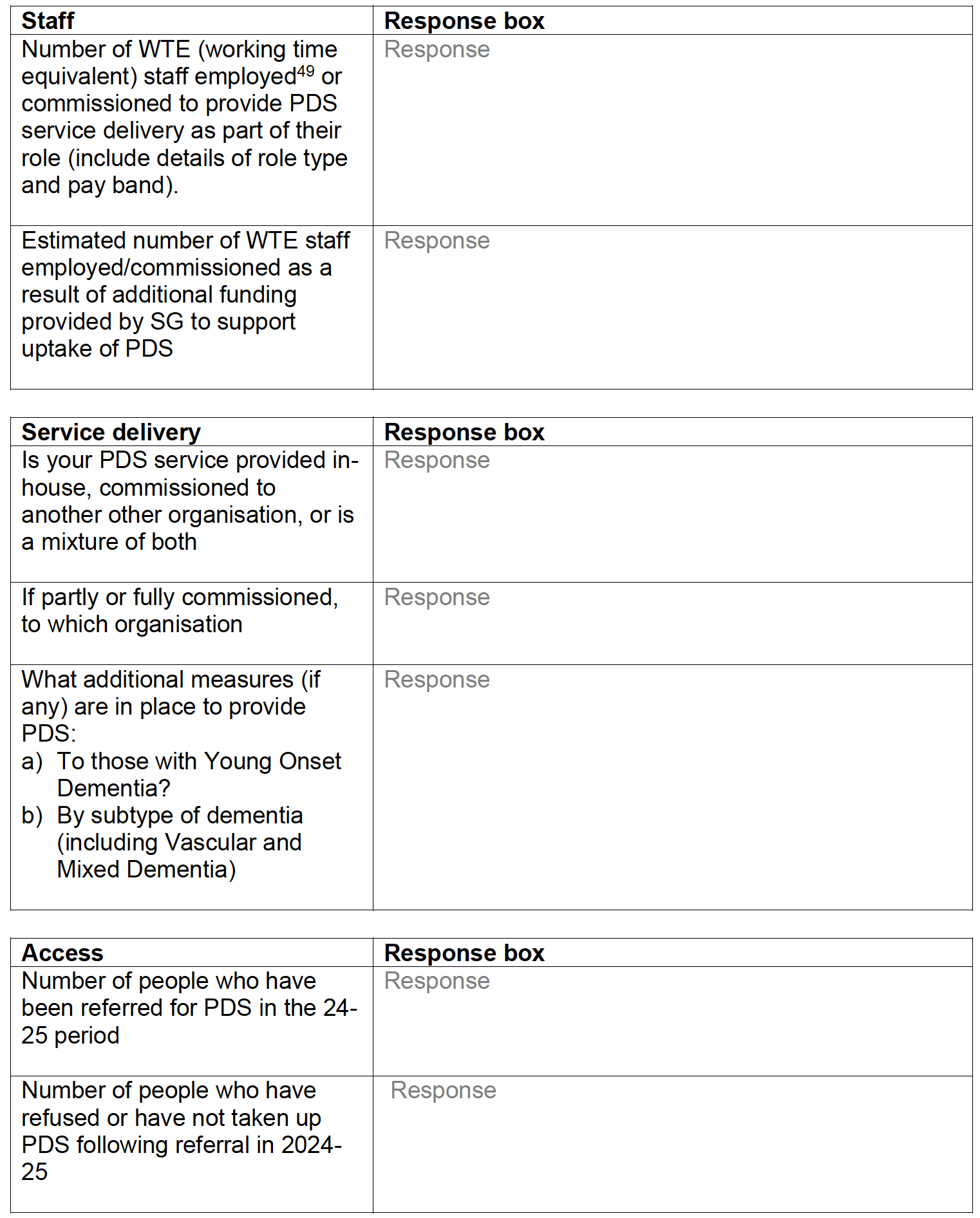
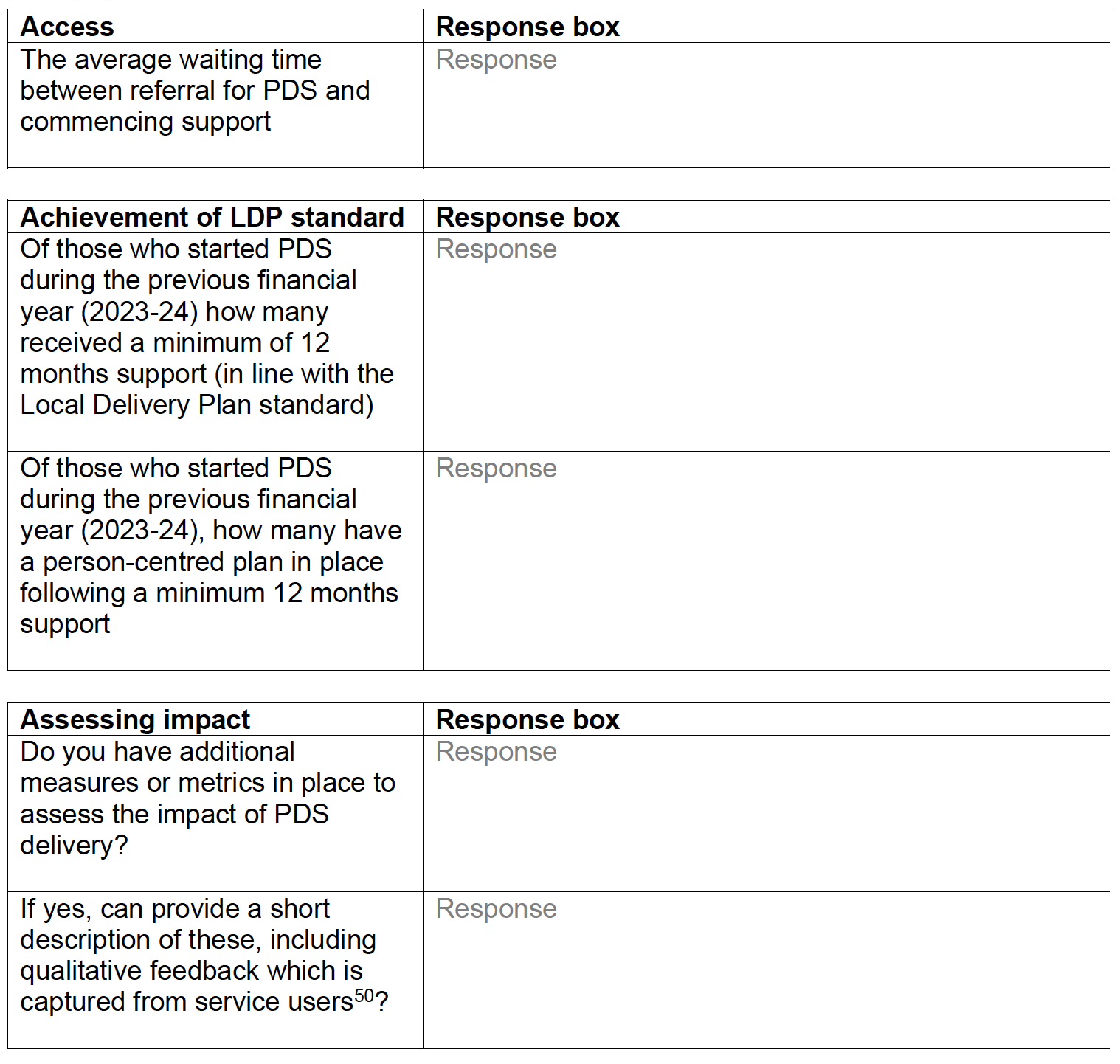
Template for Dementia post diagnostic support services: Progress reporting & monitoring returns – 2024-25
To:
JB Chief Officers
IJB Chief Finance Officers
Copied to:
NHS Board Chief Executives
NHS Board Chief Operating Officers
NHS Board Directors of Finance
Please return your completed monitoring return to dementiapolicy@gov.scot by 16 May 2025. To note:
- Receipt of a monitoring return is required for us to be able to process any allocation of additional funding from SG to your IJB in 2025-26.
- An independent evaluation of dementia PDS delivery will take place in 2025-26 as part of the Dementia Strategy’s delivery. We will seek to enable information provided in these returns to help inform that evaluation’s direction and focus.
“IFF Research helps organisations, businesses and individuals to make better-informed decisions.”
Our Values
1. Being human first
Whether employer or employee, client or collaborator, we are all humans first and foremost. Recognising this essential humanity is central to how we conduct our business, and how we lead our lives. We respect and accommodate each individual’s way of thinking, working and communicating, mindful of the fact that each has their own story and means of telling it.
2. Impartiality and independence
IFF is a research-led organisation which believes in letting the evidence do the talking. We don’t undertake projects with a preconception of what “the answer” is, and we don’t hide from the truths that research reveals. We are independent, in the research we conduct, of political flavour or dogma. We are open-minded, imaginative and intellectually rigorous.
3. Making a difference
We aim to make a difference to the lives of our partners, our people and wider society, through the research we do and the way we work. We’re proud to work with partners who share our ambition for positive change, and choose to work on projects that can make a positive impact.
Contact
Email: dementiapolicy@gov.scot