
Hospital at Home in Scotland evaluation: phase 1 findings report
The report presents findings from the first of two phases within a national evaluation of Hospital at Home services in Scotland. Phase 1 of the evaluation is a process evaluation.
Delivery of H&H Services
This chapter of the report presents findings from the workforce survey, focus groups and interviews, and explores the experiences of staff in relation to delivery of H@H services. The chapter comprises two sections: ‘what works well’ and ‘existing barriers’. Sub-sections are included for both sections, based on salient key themes within the findings.
The presentation of themes into the ‘what works well’ and ‘existing barriers’ sections were based on the dominant perceptions within the findings, following thematic analysis. It should be noted, however, that the collective views from across survey respondents and research participants were very rarely homogenous. As such, themes within ‘what works well’ may also include contrary views, in the minority, which identify challenges, whilst themes within the ‘existing barriers’ section may also include positive views or suggestions for improvement opportunities.
Delivery: what works well
Delivery teams’ skills and experience
In the workforce survey, around two thirds of delivery respondents agreed (51%) or strongly agreed (16%) that the skill set in their team was sufficient to meet their requirements, whilst around a quarter either disagreed (21%) or strongly disagreed (4%).
In interviews and focus groups, most delivery staff reflected that their local H@H teams comprised a strong mix of staff from different professional backgrounds, and with different expertise. This was viewed as a strength of the H@H model. The service also provided lots of opportunities for staff of different professional backgrounds to work collaboratively that more traditional service settings maybe did not afford. For some of the newer/developing pathways, being able to recruit a wide mix of staff, and doing so relatively quickly, was also cited as a key strength of the service:
“I think we have a mixture of professionals in the team…which I think is a real positive. And I think there’s lots of opportunities for there to be staff of different professional backgrounds working.” (Deliverer: Other)
Point of Care testing[19] and equipment for specialist treatment
Overall, in the workforce survey, nearly two in three delivery respondents agreed (43%) or strongly agreed (20%) that they had the required medical equipment to undertake their work effectively, whilst a quarter disagreed (15%) or strongly disagreed (10%) with this.
A large number of deliverers who took part in the workforce survey and focus groups mentioned access to key tests and clinical equipment as being one of the main things that was currently working well. Whilst there was resistance by some staff to undertake the process - something that teams were working to address where appropriate - the introduction of Point of Care (POC) testing in particular was seen as a positive development:
“We started using point of care blood testing equipment…I think are a game changer to help with efficiencies in the service because, with point of care blood testing, you don’t have to wait for 3 hours while you take the bloods back to the lab. You can get an answer - not for everything - but some things there and then and make a decision. So, definitely that’s been helpful.” (Deliverer: Consultant)
Similarly, being able to provide intravenous antibiotics or fluids, oxygen, etc. was seen as a key strength:
“We have oxygen cylinders that we’re able to deliver at home and monitor them at home, which quite often prevents a hospital admission. So, I would say that that’s a practice for us that reduces admissions on chronic COPD patients like frequent fliers that we get that would have previously been admitted to hospital. So, that’s quite a good service that I think we have.” (Deliverer: Other)
Limitations of POC testing and other equipment challenges were also identified and are discussed below (see ‘Medical equipment availability’).
Remote monitoring
Access to remote monitoring[20] was praised as assisting delivery of H@H among interview and focus group participants. Participants reflected that remote monitoring was also largely welcomed by patients as a way of helping them to retain ownership over their care:
“We’ve also got remote monitoring that’s working. We’ve done quite a few different systems and the patients, and the families love that aspect of it. They’re taking part in the service, they’re taking part in the care, and it gives them ownership of the whole cycle.” (Deliverer: Other)
While widely valued, one participant noted the limitations of remote monitoring. They suggested that it may increase the emotional and cognitive burden on patients’ families/carers, which should be borne in mind, i.e. such systems might not be relevant for all patient demographics. If equipment or systems were used in cases where patients and their carers found it challenging, it was suggested this could result in additional unanticipated visits to the home for reassurance purposes, which could reduce the efficiency of the service and could be counter-productive:
“We’ve introduced the [remote monitoring devices] system…in theory, that should cut down on some of our visits but, in practice, because we look after frailty, a lot of the patients and even their carers, husbands, wives, they find it quite challenging with the equipment…So, I think all these things are quite helpful in some ways, but…it’s only for a specific group of patients, I think.” (Deliverer: Other)
Senior leadership promotion and support
Deliverers were asked as part of the workforce survey to what extent their senior leadership actively promoted H@H[21]. Figure 5 shows that, overall, 18% indicated that there was limited, very limited or no promotion; 38% said there was some promotion; and 44% said there was strong promotion of H@H.
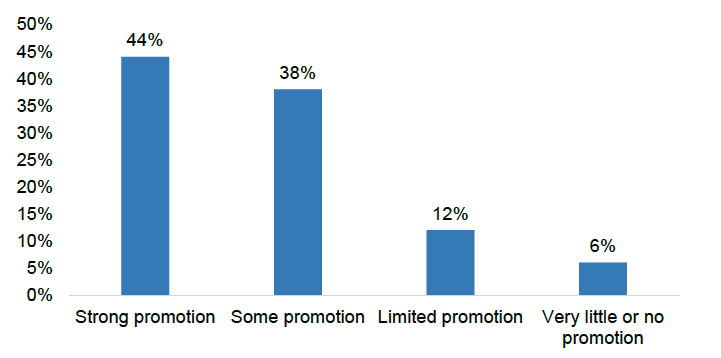
Table 2 below shows the proportion of delivery respondents who agreed or strongly agreed with statements about H@H, cross-tabulated by whether or not they reported ‘strong promotion’ of H@H by senior leadership. Those who reported strong promotion of H@H were significantly more likely than those who did not to agree or strongly agree with each of the statements.
| Agree/Strongly Agree with Statement: | Strong Promotion of H@H | Not Strong Promotion of H@H |
|---|---|---|
| There are enough staff in my team to meet the level of demand | 46% | 25% |
| The skill set across my team is sufficient to meet our requirements | 82% | 56% |
| My team is able to fill vacancies quickly and effectively | 51% | 16% |
| I have the required medical equipment to undertake my work effectively | 79% | 51% |
| My team has clear goals and strategies for improving efficiency and expanding our service | 80% | 43% |
| My service has clearly defined and agreed referral criteria | 91% | 73% |
| My service proactively engages with our referral pathways, for example through sharing standard operating procedures and referral criteria | 86% | 67% |
Note: ‘Not strong promotion’ comprises three response options ‘Some promotion’, ‘limited promotion’ and ‘very little or no promotion’.
In interviews and focus groups, most referral staff also noted that there appeared to be strong levels of support for H@H among their respective senior strategic leads, with strong leadership promotion of the service:
“I think they do have a high level of visibility…I think it is robust and, yeah, I think there is fair leadership…I think they have created structures to support that.” (Referrer: Other)
Different views were offered by delivery staff - among this cohort there was consensus that while there was strong leadership promotion and support for H@H, communication about expectations and rapid changes to the service and future plans were not always sufficiently well communicated to teams:
“I think certainly from that medical oversight, we have got that support and things, you know. I think it is just around probably that more of the on the ground, day to day, you know, roles who’s doing what…people just feeling a little bit unsettled, change is happening and that’s quite normal.” (Deliverer: Allied Health Professional)
Teamwork, processes and training
Findings from the workforce survey suggest that delivery respondents’ felt that their teams had appropriate processes in place, aligned to the HIS (2025a) Guiding Principles for H@H. Specifically, a majority agreed or strongly agreed that:
- Relevant training and professional development opportunities were available (69%, whilst 18% disagreed or strongly disagreed).
- Their team has clear goals and strategies for improving efficiency and expanding their service (59%, whilst 21% disagreed or strongly disagreed).
- Their service has clearly defined and agreed referral criteria (81%, whilst 11% disagreed or strongly disagreed).
- Their team has clear processes for gathering and responding to feedback from patients, families, referrers and other stakeholders (78%, whilst 9% disagreed or strongly disagreed).
Several participants viewed that a strength of H@H was the collegiate nature of the approach, and the strong sense of ‘team’ that had built up locally among the practitioners delivering on the ground:
“…we have got quite a close knit team that we all work from the same office, you know, so it’s in one…there’s good linkage and communication between the staff, so if there’s any concerns, then it’s kind of escalated quite quickly.” (Deliverer: Consultant)
The standardisation of operational and management processes such as the use of Standardised Operating Procedures (SOPs) and effective use of clinical protocols was also mentioned as working well by just a few respondents:
“IV Fluids SOP has been completed for a more streamlined approach.” (Workforce survey response: Nurse)
Some interviewees cited examples of practice which they felt could be replicated across Scotland to positive effect. This included opportunities for H@H team staff to work alongside specialists (e.g. heart failure specialist nurses) in a reciprocal way to help build relationships, collaborations and ease referral pathways going forwards. Examples of reciprocal shadowing of colleagues in other areas/teams are also covered in the “Engagement and collaboration” sub-section below. Importantly, gaining or increasing knowledge across a range of professions and services involved in delivering H@H care was noted as enabler of success in the survey (by health professionals directly delivering H@H).
A view was also given that while integration of strategic planning, delivery of education, and professional development was currently very good both within and between local areas, there was less clinical integration.
While some H@H team members said that they had been well supported to attend relevant training, a suggestion was made that more could also be done to invest in training and development of H@H nursing staff specifically, including protected time away from clinical work to undertake learning:
“I think we could do more to develop and support our staff, particularly our nursing and ANP colleagues…I think, again, the pressure for service delivery can often overlook their professional development.” (Deliverer: Other)
Similarly, a view was given that professional placements within H@H teams could usefully become a part of core training for nurses or the core rotation for GPs in training, since it provided exposure to a different way of working which would be beneficial for everyone’s learning.
Others questioned if robust training could be delivered when services were still evolving and ever-changing, since there were so many unknowns about H@H both now and in the future.
Engagement and collaboration
Feedback from delivery participants suggests that most H@H teams felt that their H@H services integrated well with wider health and social care services in their area. One thing that worked particularly well was where teams had established good working relationships with district nursing teams who could support the activities of H@H. In addition, where H@H nursing staff could access a patient’s community notes, this was seen as particularly helpful in terms of sharing information.
Some teams had also undertaken reciprocal shadowing of colleagues in other areas/teams, which was seen as beneficial for sharing good practice. More reflective practice, collaboration and communication within and between teams (including different H@H teams, hospital clinicians and other stakeholders) was also encouraged for service improvement purposes, although it was recognised that there was currently often limited scope for this given workloads:
“I think it’s a mixture of people exchanging ideas, people being open to criticism or reflection maybe of what they’re doing could be improved. But I think everyone is just so busy kind of fire-fighting, delivering a service, feeling like they’re working hard but we need people to look up a bit and go, right, how could this be better?” (Deliverer: Other)
Across both new and more developed pathways, between and within different areas, there were also views among delivery participants that H@H services were engaging well with one another to share learning around ‘what works’ with H@H. The physical co-location of H@H teams was also seen as a strength where this existed.
Survey respondents, as well as interviewees and focus group participants also identified effective partnership working, underpinned by multidisciplinary and collaborative teamwork and communication as something that was working well:
“Have been lucky to have an engaged respiratory Consultant and clinical lead MDT daily huddle - ensure safe decision making.” (Workforce survey response: Nurse)
National conferences, facilitated meetings, local collaboratives and memos/publications linked to H@H were also seen as essential in helping to keep up momentum and allowing teams to share learning and experiences as the services evolved:
“…we have attended like the HIS learning event. They have sort of some HIS events… a monthly meeting with clinicians involved throughout Scotland that are involved in Hospital at Home, so we do kind of shared learning throughout that.” (Deliverer: Other)
While existing opportunities to attend conferences and cross-border meetings were present for senior and mid-level staff, more networking, knowledge exchange and educational opportunities were encouraged for lower graded members of H@H teams:
“Networking with key stakeholders. Relationship between specialty and community nursing areas to establish skill set and provide support and education.” (Workforce survey response: Advanced Nurse Practitioner)
Some deliverers spoke of challenges of raising awareness of H@H among community partners (including, for example, local social work services and third sector organisations). This meant that concerted effort was required including, for example, attending local community huddle meetings to discuss any particular issues around care needs or community team needs related to H@H patients.
Patient awareness and understanding
In areas where H@H services were well established, there were views that patients were aware of it as an option and some requested this when they felt at risk of a hospital admission:
“…people will proactively ask for Hospital at Home. Sometimes even when it’s not appropriate, you know, somebody probably who does need hospital care but they don’t want to go back into hospital because it’s really not a nice experience for them.” (Referrer: GP Partner)
Even in lesser established areas, staff felt that the public had an awareness that they could now be seen at home rather than in hospital, and this was met with a great deal of positivity.
Some referrers also noted that, while welcomed, not all patients had sufficient clarity around their admission to H@H and what this meant in terms of who was managing their care:
“There seems to be an issue sometimes with patients understanding whose care they’re under while they’re being looked after by the Hospital at Home team. We quite often get contact from patients while they’re under the care of the Hospital at Home team.” (Referrer: GP Partner)
Others noted that patients who called first responders might also be confused about H@H being offered as an alternative to admission, and that this sometimes created challenges for ambulance staff in explaining the H@H model and rationale to patients who were reluctant to engage:
“It’s difficult sometimes, especially for those older people that we do tend to refer, you know, they very much are - if you phone an ambulance, you’re going to hospital. They usually have their bags packed ready, you know. But then to try and explain, actually, you can unpack your bags and stay at home - they’re like, what? That’s not how it works!” (Referrer: Allied Health Professional)
Promotion of the service among the general public was suggested as one area where H@H teams could focus their energies more:
“…people have a level of expectation that a hospital is always the best place for them, I think there’s still a percentage of the public who have that assumption. So, maybe something around that - this is who we are, this is what we do, if your GP suggest this, then consider it…” (Referrer: GP)
It should be noted that insight into patient experience and public awareness of the service will be covered during Phase 2 of the evaluation.
Delivery: existing barriers
Staffing levels, recruitment and retention
Around a third of workforce survey delivery respondents agreed (31%) or strongly agreed (3%) that there were enough staff in their team to meet the level of demand, whilst nearly three in five disagreed (31%) or strongly disagreed (25%) with this. Furthermore, only around three in ten agreed (22%) or strongly agreed (8%) that their team was able to fill vacancies quickly and effectively, whilst around half disagreed (29%) or strongly disagreed (21%) with this.
In corroboration with this, the main qualitative themes to emerge in relation to staffing were staff shortages, problems with staff recruitment/retention, and gaps in specific staff input affecting delivery. Indeed, staffing levels and staff retention were mentioned in almost half of all survey open text responses when asked to identify the main barriers that need to be overcome to improve the delivery of H@H. This was also identified by a number of participants as being a key issue:
“Staffing!!!! We often don’t accept patients as there is not enough staff to safely care.” (Workforce survey response: Allied Health Professional)
Some participants mentioned that staff shortages were affected by protracted recruitment processes which meant there were delays in filling available posts. Short-term funding for H@H also made it difficult to both recruit suitable candidates as well as to retain them:
“We’re having quite a lot of staffing issues with quite a few vacancies at the moment, but still being expected to provide the same level of service and try and take as many patients as we can...waiting for jobs to go out to adverts to fill vacancies that have been sitting for a while.” (Deliverer: Other)
“Lack of permanent contracts discouraging people to apply for jobs when wanting to expand the service.” (Workforce survey response: Advanced Nurse Practitioner)
Several survey respondents highlighted staffing shortages in specific specialties and at particular times, especially during weekends and evenings (linked to out-of-hours provision, discussed earlier in this report). Difficulties in backfilling unplanned absences was also noted in survey responses.
Another gap was in administrative support, with some delivery participants reporting that their teams were struggling with the heavy burden of administration generated by the H@H caseload and process:
“We’re quite administrative heavy…we’re doing the admission, we’re doing the clinical assessment and the medicine reconciliation, and then we’re coming back and [doing] the treatments and the formulation of the diagnosis and a treatment plan. And then we’re coming back, admitting them on to TrakCare, doing all the writing up, you know, referring them for diagnostics, speaking to the Consultant, prescribing, putting all the admission drugs on to a prescribing system - so, yeah, it’s a lot.” (Deliverer: Nurse)
A suggested solution to managing staff shortages included sharing nursing provision across H@H teams where they were within the same HSCP or Health Board area. This was seen as something that worked well where it was currently in operation.
It was also posited that there was scope within multi-disciplinary teams to look at ways that staff from different disciplines could perhaps widen or expand their own existing practice, which would give H@H teams more flexibility and reach:
“So, there’s nothing stopping us as a [Allied Health Professional] learning how to take bloods. There’s nothing stopping us learning how to listen to a chest and start making those sorts of assessments…it’s thinking about broadening our scope of practice…” (Deliverer: Allied Health Professional)
It was suggested that, if H@H staff could be trained and trusted to support one another in their respective routine tasks, such as gathering the data/metrics required for diagnosis/treatment, this might reduce demand on colleagues (who were often working part time hours for H@H), speed up service delivery for patients, and potentially mean that more people could be treated under H@H.
Similar sentiments were raised in relation to specialist support for services, e.g. from heart failure specialists, where this was currently not available. Participants suggested that introducing shared care for some patients may be appropriate where multi-disciplinary teams, comprising of more than one specialist, could usefully oversee a patient’s progress. This was seen as something which will become ever more important over time as more and more patients were presenting with co-morbidities.
Having full-time or near full-time administrative support was seen as something which would be beneficial. Increasing the number of ANPs was also mentioned by one service, as something which would help them to better manage workload.
Limited pharmacy support within H@H teams was also identified as a challenge for teams, affecting their ability to gain access to required medication for patients at home in a timely manner. Most delivery participants reported that their team did not have a dedicated pharmacist, and some were operating with non-digital prescriptions, which added unnecessary risk and complications to case management:
“We really need pharmacy input just because of the patient population and the complexity, it’s a huge amount of things that need pharmacy input in Hospital at Home.” (Deliverer: Other)
Medical equipment availability
Across delivery interviews and focus groups, there was consensus that, while generally well provided for, gaps remained in equipment and materials available to some teams. This included insufficient supplies/cartridges for POC testing (plus difficult to manoeuvre equipment), limited numbers of ultrasound machines, portable x-rays and equipment for bladder scans, etc.:
“One of the challenges we have with point of care testing is getting the cartridges. Quite often, there’s a short shelf life with them and, when we go to use them, they’ve expired and then we can’t use the point of care testing when we need it.” (Deliverer: Other)
“Own equipment for each person - i.e. ECG machine, scales etc. would be very beneficial.” (Workforce survey response: Nurse)
Frail and older adults in one area were seen as potentially missing out of access to rehabilitative equipment in the home environment (e.g. adapted toilet seats) which they would otherwise be able to easily access in hospital:
“…if you need more than just a Zimmer frame, we can’t necessarily get you equipment, toilet seats, these sorts of things, easily which, again, feels like we’re not being treated like an acute hospital in that sense.” (Deliverer: Other)
IT equipment availability and remote working
Around half of workforce survey delivery respondents agreed (39%) or strongly agreed (10%) that they had the required IT equipment - including hardware and software - to undertake their work effectively, whilst around four in ten disagreed (24%) or strongly disagreed (18%) with this.
Many survey respondents highlighted a need for additional IT equipment and resources to support case management and decision making. In the workforce survey open text responses, laptops were mentioned most often, with some respondents emphasising the importance of ensuring consistent access for all H@H staff to enable real‑time information gathering:
“Everyone should have their own laptop, there isn’t enough IT equipment in general and you have to come in early to ensure you have IT access.” (Workforce survey response: Allied Health Professional)
Many survey respondents also highlighted the need for a more efficient remote working environment, particularly a streamlined software infrastructure that allows key medical documentation to be accessed smoothly and promptly. A few noted that this would reduce duplication across the different systems currently in use:
“We could be more efficient with better IT systems that link between acute/intermediate/primary care, so that information can be shared with reduced duplication (or a single IT system?)” (Workforce survey response: Pharmacist)
Whilst delivery survey respondents noted that improvements with IT systems - in particular shared patient information across relevant services - were strengths of the service, two deliverers mentioned that necessary IT systems were not joined up, making it difficult to track a patient across the care process (for example, TrakCare). Furthermore, other respondents suggested that having a single discharge letter system for the whole of NHS Scotland along with national guidance in this regard was urgently needed.
Poor connectivity was also a problem reported by some participants who were involved in the delivery of H@H services in more remote and rural locations meaning that, even where people had sufficient IT resources and laptops, etc., problems could still ensue:
“We all have laptops and in order to try and improve efficiency, we’re meant to take these laptops out with us and kind of clock our patients in when we’re seeing them. But, literally, 75 to 80% of the time, you don’t get kind of cellular signal, and you can kind of be halfway through a clock-in and then lose it multiple times …that’s one of the things that we find very difficult.” (Deliverer: Advanced Nurse Practitioner)
To address poor connectivity, some delivery participants mentioned staff taking handwritten notes or completing paper proformas in patient’s homes, which were later uploaded to digital systems. This created a duplication of effort for staff, introducing inefficiencies and increasing risks of errors or lost of documentation. Participants also highlighted that even in areas without connectivity issues, duplication sometimes persisted, with staff maintaining both paper-based and online records in the absence of having access to computers/internet in people’s homes:
“We use TrakCare and the nurses are able to upload notes onto that but it’s not part of the patient’s official record. So, they have to duplicate their information, so there is an electronic record for anyone like who is on site to be able to review the patient’s notes if a nurse who is in the home updates that, but it’s duplication for that staff member. They have to keep a record of it as a paper note and that forms their official clinical record which then gets scanned.” (Deliverer: Manager)
Funding structures
A small number of participants mentioned that lack of specificity around funding could determine the shaping of services over time. A lack of certainty regarding funding was also seen to impact on how much planning teams could achieve. For example, in one area where a new pathway was being set up, there was uncertainty around how much of the funding given to the local Health Board for urgent and unscheduled care would be set aside for H@H and, within that, how much would be allocated for new service development:
“So, the money’s been given with a very broad open range, which means, essentially, NHS (region) then can decide where that funding goes.” (Deliverer: Allied Health Professional)
“Small pockets of fixed term money is just terrible for growing any kind of service, and that’s what we’ve been facing the last few years. It’s just short-term investment but no - what we need is long-term growth to make any meaningful impact.” (Deliverer: Consultant)
While the flexibility of overall Scottish Government funding for H@H was seen as a strength in some ways (to allow local boards and teams to decide on what services would best meet local needs), having a clear stipulation on what proportion of money should be dedicated to H@H (including potential new pathways) was seen as something which might be helpful.
Travel and transport
Inefficiencies attached to significant amount of time spent travelling to and from patients’ homes was raised as a challenge by staff from different H@H teams in different contexts (i.e. rural areas with long distances between sites, and urban areas where traffic congestion could cause delays travelling even short distances):
“We probably have the opposite issues to the kind of rural guys in that we can actually be sitting in traffic for ages, stuck on the bypass for an hour to kind of get to one side of [the city] to another and, obviously, that does have an impact on capacity.” (Deliverer: Other)
There was general agreement that a solution was needed (including, for example, funding for dedicated driver support) to ensure that teams could spend their time productively instead of driving, which took their attention away from clinical work:
“…we do cover such a wide area, we can sometimes be travelling for quite a long time in order to carry out patient care…we’ve been talking about getting drivers as well to help us kind of note-taking sort of as we go round…” (Deliverer: Consultant)
A suggestion was also made in the workforce survey that there was a need for additional drivers to collect bloods. Indeed, one of the concerns that was offered around lack of POC testing was that the alternative could result in a significant amount of travel for staff, especially in rural areas, where testing occurred and the results required a (sometimes same day) return visit to the patient’s home.
Access to social care and community services
Across all research strands, limited availability of social care to support individuals at home who may have increased care needs whilst experiencing acute illness was raised.
In focus groups, some H@H teams noted that they did not have priority access for home care provided by social services. They felt that some vulnerable patients under H@H were perhaps being overlooked or treated as less of a priority than similarly vulnerable adults in or leaving hospital, who would have a social worker assess if they did or did not need help in the community:
“They’re not being treated as if they’re hospital inpatients, and that’s not equitable if that’s how we’re positioning the service.” (Deliverer: Other)
The lack of social care support for people in their own homes was also cited by a more rural team who noted that the absence of this care had been a determining factor in planning how they delivered their H@H service. They had observed over time that the main reason why some people who might have been suitable for H@H but who were not getting home on early discharge was that they did not have a care at home package in place. This was echoed by staff in other teams who noted that a cap on short-term care packages provided by the local authority meant that, quite often, patients could end up being admitted into hospital for that reason, even when H@H was in place to meet their acute medical needs.
In contrast, another more established urban service also noted that H@H may be working with patients who required wider social care as a priority, rather than medical care. The absence of such support meant that some patients under H@H were not necessarily ‘hospital bound’ patients based on clinical need, but would be admitted for social care needs instead:
“…if the community services were probably better, then the patient may not have come to our service…there are some patients that we do get that, and that’s partly primary care struggling, social work and home care struggling…if we didn’t have a Hospital at Home service, would that patient have been admitted to hospital? Possibly not…occasionally, we do get patients that we’re seeing that actually could have been a GP home visit rather than us.” (Deliverer: Consultant)
Access to care integration and community rehabilitation teams, occupational therapists and physiotherapists was also raised as a current barrier to delivery. In one area, an issue was raised regarding differences in access to wider services experienced by patients in H@H compared to traditional hospital settings. They explained that a lot of the pathways for accessing rapid rehabilitation required the patient to be admitted to the physical hospital, who would then access rehabilitation as a priority on discharge.
Integration with wider health and social care services was seen as less problematic among those working in Paediatric or Neonatal pathways where social care was less likely to be required. These pathways were, however, integrating well with midwifery colleagues and community midwives, with clear understanding of how services could work together and complement one another.
Reliance on families and carers
Interview and focus group participants perceived that patient’s may sometimes opt out of receiving H@H care to avoid placing a burden of responsibility on their family/caregivers. Similarly, some may be encouraged not to accept a referral into H@H by relatives, for the same reason:
“I’d say that I’ve had more resistance from relatives I think…than patients themselves…often, people will try and cope for as long as they can at home and often by the time we’re thinking about a Hospital at Home referral, people are tired, they’ve had enough. They want an easier solution and that can be hospital sometimes…” (Deliverer: GP Partner)
Success of H@H was also described as being very much dependent on the home environment in which the patient lived and the wider support available to them (i.e. those sharing a home with family or carers were more likely to have support to enable them to complete an episode of H@H care than those who lived alone):
“…it comes down to identifying the right patients, so the patients that do have some degree of family support and do have some social support…that’s the most important thing when you’re going to get a good outcome from using Hospital at Home that doesn’t perhaps result in an admission within 24 hours or anything like that. You have to make sure that home environment works.” (Referrer: GP)
The personal, emotional and social costs for carers attached to caring for someone at home was something that referrers viewed as important to consider when assessing the overall value of the service. It should be noted that insights from families/carers of H@H patients will be included in Phase 2 of the evaluation.
Contact
Email: socialresearch@gov.scot