
Hospital at Home in Scotland evaluation: phase 1 findings report
The report presents findings from the first of two phases within a national evaluation of Hospital at Home services in Scotland. Phase 1 of the evaluation is a process evaluation.
Referral to H&H services
This chapter presents findings from the workforce survey, focus groups and interviews, exploring feedback in relation to the referral of patients into H@H. The chapter comprises three sections: ‘Existing referral experiences’, ‘what works well’ and ‘existing barriers’. The ‘Existing referral experiences’ section provides findings from the workforce survey based on the frequency and ease with which respondents referred patients to a H@H service. The latter two sections are categorised into sub-sections based on salient key themes within the findings.
The presentation of themes into the ‘what works well’ and ‘existing barriers’ sections were based on the dominant perceptions within the findings, following thematic analysis. It should be noted, however, that the collective views from across survey respondents and research participants were very rarely homogenous. As such, themes within ‘what works well’ may also include contrary views, in the minority, which identify challenges, whilst themes within the ‘existing barriers’ section may also include positive views or suggestions for improvement opportunities.
Existing referral experiences
Frequency of referrals
Just over a third of referrers in the workforce survey said they referred to a H@H service very often (7%) or quite often (28%), whilst roughly three in ten reported doing so not often (31%), and a similar proportion either rarely (12%), very rarely (7%) or never (9%) (see Figure 2).
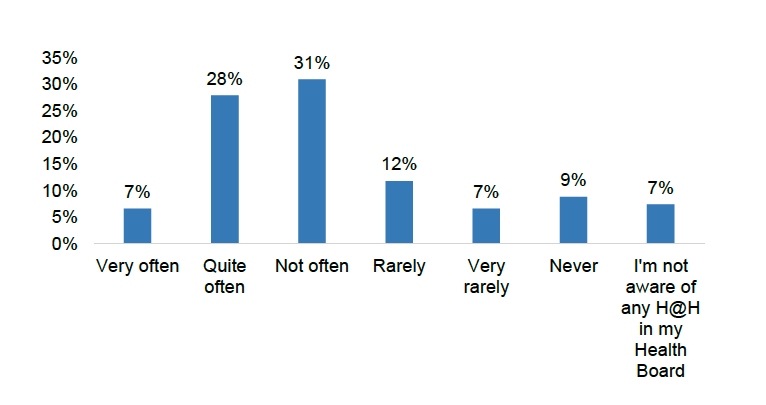
It should be noted that workforce survey respondents who said that they were not aware of any H@H provision in their Health Board were routed directly to the end of the survey, and were not asked any further questions. Those who said that they had ‘never’ referred into H@H were not asked the following question in the survey[15] but were asked the remaining questions thereafter- see the Workforce Survey Questionnaire in Appendix C.[16]
Most referrers who took part in an interview or focus group reported that they “regularly” referred into H@H (although no clear definition of ‘regularly’ was provided and so this may have related to a broad range of different frequencies of referral depending on interpretation and role). Frequency of reported referral among participants overall ranged from daily (for paramedics) to weekly or monthly for GPs.
Ease of referrals
Around half of workforce survey referrer respondents who had previously completed a referral to H@H[17] said that the referral process was mostly (33%) or almost always (18%) straightforward. A minority said that it was mostly (6%) or almost always (9%) difficult. A third (34%) reported that the process of referring patients to a Hospital at Home service was sometimes straightforward and sometimes difficult (see Figure 3).
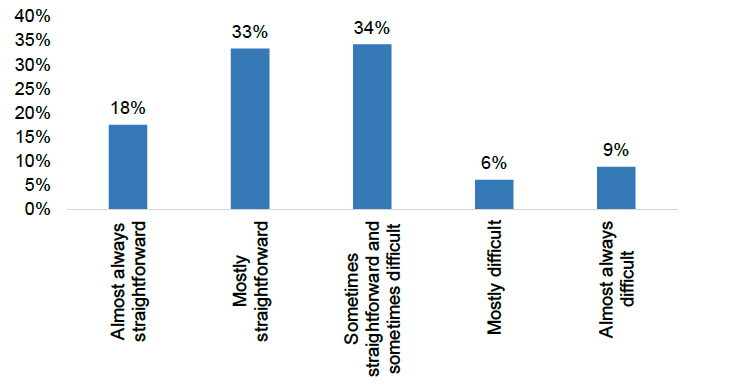
The proportion describing the referral process as mostly or almost always straightforward showed significant variation by area of work (see Table 1). Those working in General Practice were the most likely to describe the process as mostly or almost always straightforward (62%). Although numbers are small, those in the ED/MIU based emergency medicine (100%) and primary care out-of-hours (83%) mostly described the process as something other than almost always or mostly straightforward.
| Area of Work | N | Mostly or almost always straightforward* % | Other response** % |
|---|---|---|---|
| General Practice | 61 | 62% | 38% |
| Hospital inpatient emergency medicine | 12 | 50% | 50% |
| Scottish Ambulance Service | 22 | 45% | 55% |
| Community/District Nursing | 8 | 38% | 63% |
| Primary care out-of-hours | 6 | 17% | 83% |
| ED/MIU based emergency medicine | 5 | None | 100% |
| Total | 114 | 51% | 49% |
Notes:
* ‘Mostly or always straightforward’ comprises two response categories: ‘Almost always straightforward’ and ‘Mostly straightforward’.
** ‘Other response’ comprised three response categories: ‘Sometimes straightforward and sometimes difficult’, ‘Mostly difficult’ and ‘Almost always difficult’.
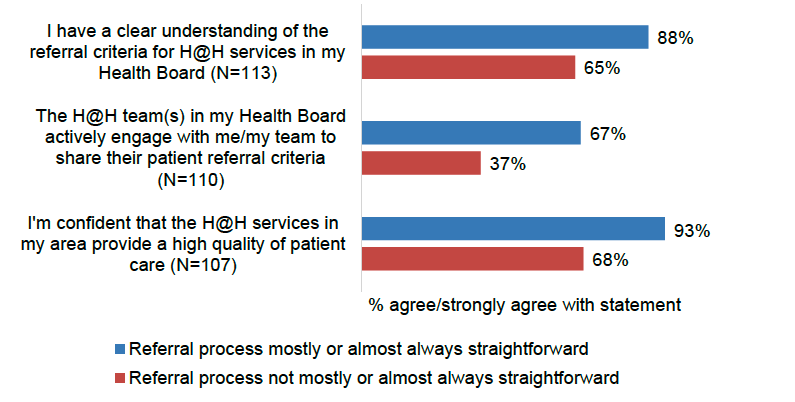
As Figure 4 below shows, those who rated the referral process as always or mostly straightforward were significantly more likely to agree or strongly agree with a number of statements about the H@H service compared to other respondents. These included:
- That they had confidence in the quality of H@H care given to patients (93%, compared to 68%).
- That the H@H team(s) in their area actively engaged with them to share patient referral criteria (67%, compared to 37%).
- That they had a clear understanding of the H@H referral criteria in their area (88% compared to 65%).
Notes:
‘Referral process mostly or almost always straightforward’ comprises two response categories ‘Almost always straightforward’ and ‘mostly straightforward’.
‘Referral process not mostly or almost always straightforward’ comprises three response categories ‘Sometimes straightforward and sometimes difficult’, ‘Mostly difficult’ and ‘Almost always difficult’.
Referral: what works well
Buy in and utilisation of H@H
Workforce survey findings showed that a clear majority of referrers agreed (46%) or strongly agreed (48%) that, where clinically appropriate, they would actively seek to refer a patient to an available H@H service, whilst just 4% disagreed or strongly disagreed. Furthermore, around three in four either agreed (38%) or strongly agreed (39%) they were confident that the H@H services in their area provide a high quality of patient care, whilst 8% disagreed or strongly disagreed with this.
Qualitative responses from referrers also evidenced a positive view of the service, particularly aligned to the aim of reducing hospital admissions:
“It's very helpful to facilitate an early discharge from the hospital where there is ongoing acute medical and multidisciplinary need. It is also helpful to provide an alternative to hospital admission.” (Referrer: Consultant)
“Comprehensive service. Especially good for avoidance of hospital admission in frail/elderly/multimorbid patients. Very pragmatic approach.” (Referrer: Consultant)
Support for the concept of the H@H service was also shared by some referrers, in spite of a view that the existing delivery processes could be improved:
“Brilliant concept which needs more support. Even one patient accepted has marked benefit for the individual and for the hospital too. Frustrating that referrals are always challenged…The numbers that can be accommodated are too low.” (Workforce survey response: Consultant)
A small number of referral staff explicitly indicated that they felt the scope and range of services offered could be extended to maximise access to a wider range or patients for whom H@H may be appropriate. This was especially the case where it was currently only open to older adults:
“I find it quite challenging actually because…many of my patients do not sit under MFE [Medicine for the Elderly] umbrella as in Geriatric Medicine. Lots of them are younger and they have the same needs but have no service provision…we have so many patients who’re in their 40s and 50s who are multi-morbid, who are housebound, who do not have access and support to that range of services and interventions which is sometimes challenging.” (Referrer: Other)
One respondent also noted that they would like to see H@H used more for palliative care, if that is what the patient wished:
“I’ve had a lot of…palliative patients as well that, again, have maybe slipped through the net and not only maybe need like community palliative care input but also I felt Hospital at Home would be appropriate and, unfortunately, they’ve not been able to…” (Referrer: Allied Health Professional)
Another participant noted that there was perhaps scope for secondary care colleagues to think more about H@H as an option when discharging patients. They perceived that this was currently an underutilised option which may be inadvertently and negatively impacting primary care workloads:
“I think it would be useful if hospital colleagues maybe thought about Hospital at Home a bit more. Sometimes I find a patient is discharged from hospital, they’re probably not quite ready for home and could have just done with that bit of extended medical support, because otherwise a GP will end up with a massive very complex patient who’s not quite stable… So, maybe use Hospital at Home to just dial down the complexity before it becomes primary care again.” (Referrer: GP Partner)
Engagement between H@H teams and referrers
Findings from the workforce survey showed that 75% of deliverers agreed or strongly agreed that their service proactively engaged with their referral pathways, for example, through sharing standard operating procedures and referral criteria, while only 13% disagreed or strongly disagreed. A smaller proportion of referrers (49%) agreed or strongly agreed that the H@H team(s) in their Health Board actively engaged with them/their team to share their patient referral criteria, whilst 28% disagreed or strongly disagreed. It is worth noting, however, that these findings cannot be compared like for like, as delivery and referral participants could have been reflecting on different services.
Communication from H@H teams was generally described in very positive terms by referrers who took part in interviews and focus groups:
“…the local service has communicated well with us. They’ve come to speak to us to ask what we think, what we want to do. It appears to be reasonably advertised…there’s an email address that we can refer patients to. So, no, I think, locally, they’ve done their best to try and set up a limited site to get started.” (Referrer: Consultant)
Some referrer respondents noted that, while they recalled being sent emails, weblinks, information sheets, etc. about H@H by their local teams, these were not always read and often got lost in the plethora of other correspondence received by staff working in primary care. This was corroborated by a view that awareness for the service was variable among GP and Scottish Ambulance Service colleagues. Having face-to-face contact with teams was suggested as the best way to ensure that practitioners engaged in learning about the service:
“..we get bulletins and emails and all sorts but…the majority of people don’t really look at stuff like that, you know. I think if there was even more like, again physical contact, you know, if the pathways team were able to come out to stations or to hospitals and actually discuss that, you know, I think that would break some barriers for like people actually having knowledge about it.” (Referrer: Allied Health Professional)
“There are still cases where [the team] have to prompt like both SAS [Scottish Ambulance Service] and GPs to say, have you thought about this because there’s still a lot of GPs that don’t maybe recognise what we can and can’t do from a service point of view.” (Deliverer: Consultant)
Referral: existing barriers
Capacity to accept referrals
Around a quarter of the referral staff who took part in the survey, and a number of focus group and interview referral participants shared frustrations around the perceived lack of capacity in H@H services, which was hindering the level of referrals they were able to make:
“I have given up attempts at using it due to the fact it’s nigh on impossible to get a patient accepted. Even if they clearly fit the pathways shared, there is always an excuse as to why the service is unable to accept referrals. Patients from nursing homes that would be better cared for in the community are constantly brought to ED [emergency department] because there is no capacity in the service or crews just do not even attempt to refer.” (Workforce survey response: Consultant)
“Hospital at Home in my experience have only taken about 10% of my referrals. At weekends they have no doctor, and say they can only take a patient if I give them a treatment plan as the named Consultant. They often tell me they can’t take a patient and I should phone the patient’s GP to do a house call. Like many of these services…they are inaccessible in real terms and do little to prevent admission from ED [emergency department].” (Workforce survey response: Consultant)
“…they’ve now started to reserve the right to email and say, we have no capacity today. Sometimes I phone them up and they’ll say, our capacity is extremely limited…I think that can be a bit frustrating. But I think, in general, the process works well.” (Referrer: GP Partner)
Others in primary care discussed how it would be helpful for them to access accurate, up-to-date or real-time information around capacity of H@H in their local area, to allow them to make informed referral decisions. Some time was currently wasted, they felt, assessing and considering if a patient was suitable for H@H only to be turned away when reaching the point of referral due to lack of capacity:
“It would be helpful to understand the capacity on a daily basis and [among colleagues] there were questions about how we actually communicate that to individual clinicians who are seeing patients, so they know it’s an option. I think sometimes it can be a little frustrating when you have perhaps assessed a patient and you feel as though the option is available and then, when you go to the individual team, you then realise that you’re going to have to backtrack and end up with an admission because they clearly don’t have the capacity on that individual day.” (Referral: GP)
“More capacity and some way of knowing without calling them that they are at capacity.” (Workforce survey response: GP)
Some participants noted that the challenge of limited visibility over service capacity was further compounded by there being multiple referral routes into H@H, i.e. via a Flow Navigation Centre, from GPs directly, from hospitals for early discharge and from the ambulance service.
Allied Health Professionals also described using the Joint Royal Colleges Ambulance Liaison Committee (JRCALC) ‘app’ and noted that this was particularly helpful in guiding referrals. The app details information on all current pathways open to referrals from paramedics, including H@H:
“So, that’s where I always go to get the numbers for any pathway, not just Hospital at Home. That’s very useful to have that…And then it also includes your inclusion and exclusion criteria for every pathway as well, which I find works quite clearly as well.” (Referrer: Allied Health Professional)
Among those referral participants who used the JRCALC, it was noted that a new feature had recently been added to show bed availability for different referral pathways. This was seen as helpful in reducing time spent calling services to explore admission options only to be told that there was no availability.
Issues with the referral process were also raised by some delivery participants in relation to the timing, volume and spread of referrals received at different points in the day and their capacity to accept referrals at different times. In one team, staff explained that there was pressure to respond to referrals within a specified timeframe which meant that, if numbers were high, they were likely to close to any new referrals until the backlog was cleared or they freed up sufficient time to deal with new/incoming queries:
“So, it often feels like referrals don’t come in until mid-morning, and then there’s a hiatus of lots of them, and I think the team have a target about how quickly they respond, which leads to them feeling under pressure and often closing to referrals because they’re worried that they won’t get to see people quickly enough. So, I think there’s some target about them having to respond within an hour, particularly if people haven’t been assessed or haven’t like got paramedic with them or somebody with them.” (Deliverer: Other)
Adherence to referral criteria
Some delivery participants reported that not all referrals being made were appropriate. In some cases, where non-eligible referrals came in (i.e. those not complying with referral criteria), these were nonetheless accepted, whilst at other times not. This grey area was then having the onward impact of more non-eligible referrals being made, on the basis that previous similar cases had been accepted:
“…we do have set criteria but, more and more, we’re getting patients referred that are outwith that criteria and the Consultants are actually happy to take that. So, that becomes more challenging for the people kind of triaging the referrals when they’re meant to be kind of patients that you don’t accept and there’s a conversation with the Consultant and then, suddenly, they are accepted…all referrals become a little bit grey…” (Deliverer: Other)
Some delivery participants also noted that their service was receiving what they called ‘soft’ referrals. This was perceived to be because local GPs were very busy, and some home visits which may have previously been undertaken by GPs were being undertaken by ANPs, who in turn were potentially less likely to manage the patients themselves and so refer into H@H.
Alternatively, it was suggested in one area that GPs had become familiar with the H@H system and were using it as a way to fast-track certain aspects of their patient’s care (where a visit from a district nurse may have been more appropriate, for example):
“…a GP knows the key words to say to the Flow Navigation Centre, who will then refer on to us correctly because of the information from the GP. But when we go out there, we find it’s nothing like what we’re asking for or looking for or supposed to be working with…We also find that GPs now are using us more and more as an emergency blood service. And what I mean by that is we can get referrals and get a referral in and we’re there within an hour, so they’ll get their bloods and if it’s not done the technical way in the home, they’ll get the bloods within a couple of hours. Now, a GP can’t do that.” (Deliverer: Other)
Referral acceptance decisions
A common frustration aired by referral staff in focus groups and interviews was around the decision-making process for acceptance onto H@H and, specifically, who was making those decisions. A view was shared that variation in the approach taken by whoever answered the call in the local H@H team impacted on whether a referral was or was not accepted, potentially leading to confusion for referrers:
“The challenge that is associated with lots of different routes in and different criteria, and criteria potentially could be different based on whether or not there’s a nurse answering the phone or a clinician answering the phone at the Hospital at Home team. Sometimes it’s a non-clinician because all the clinical staff are out working, which is of course appropriate, but their threshold for accepting a referral or accepting that risk is totally different as well. It’s just not consistent for us in terms of a day-to-day knowing what we can and can’t refer in…” (Referrer: Other)
“The criteria are fuzzy and it depends who speaks to you on the day.” (Workforce survey response: GP)
“…it is all down to the consistency and thresholds of the individual who’s on the other end of the phone, one week I can refer this, one week I can’t. And I suspect that’s not all down to the individuals…It’s to do with the skill mix of the people on duty that day…” (Referrer: GP)
There was frustration in one area where referral calls were fielded by an administrative member of staff before the referrer could speak to a fellow clinician, which one perceived as a superfluous step in the referral process. Similar views were also shared in the workforce survey:
“The phones are answered by admin staff who do not have clinical experience and the referral process can be long and difficult due to this.” (Workforce survey response: Advanced clinical practitioner)
A suggestion was made that referral processes can be complicated by unnecessary bureaucracy in the context of communication, insofar as the process often did not allow for easy conversations between referring staff and the H@H clinical team:
“There’s been recent centralisation in [region] for referrals to all be coordinated through a central point through the Flow Navigation Centre and that has meant that the Hospital at Home team are not taking their own referrals and are not speaking to the people making those referrals. And my experience of my colleagues is that they find that very difficult, cos they don’t feel that they have all the information that they previously had, and I guess some of those relationships can be strained by adding too many layers to the conversation.” (Deliverer: Other)
In interviews and focus groups, there was a perception that the eligibility rules and scope for H@H was perhaps too rigid in some cases:
“…when you speak to somebody that is perhaps following protocol or looking directly at scope, there’s less often space for that grey area where someone can say, actually, I understand what you’re saying and I can see now why you phoned me. More often, you’re likely just to get - no, actually, I don’t agree with that.” (Referrer: GP Partner)
Views were given as part of the workforce survey where respondents suggested that one key area for improvement might include widening criteria for existing pathway(s), introducing new pathways or reintroducing pathways no longer in operation locally:
“I feel the criteria for hospital at home has become more strict not taking chronically ill patients as not frail enough as per frailty scale.” (Workforce survey respondent: Other)
“Expand eligible pathways - broaden inclusion beyond COPD to include Pneumonia (low risk), Bronchiesctasis, ILD, Palliative end of life respiratory care. Agreed rapid re-admission pathways.” (Workforce survey respondent: Nurse)
As a point of note, survey respondents also suggested widening who can refer and under what circumstances e.g. being able to refer after remote consultations, being able to refer on the basis of a district nurse visit, etc.
“Being able to discuss and accept H@H referrals after a remote consultation, not just face to face. I appreciate some teams permit this but not many.” (Workforce survey respondent: Other)
“I’ve been ‘told off’ for making a referral when I hadn’t seen the patient myself, I as making the referral on the basis of a visit made by an experienced district nurse who provided a good history and set of obs. The referral was ultimately accepted but very reluctantly. Some flexibility here would be appreciated.” (Workforce survey respondent: GP)
Out-of-hours[18] provision
Around a fifth of referrers in the workforce survey and several participants who took part in focus groups raised lack of out-of-hours provision as something which diminished the volume of referrals the service can receive:
“When H@H is available this can be very positive for patients and their families, however, H@H does not cover the full OOHs [out-of-hours] period, often shutting at 8pm and then patients are told to contact 111.” (Workforce survey response: Allied Health Professional)
“The timing of the service is not adequate and I think the fact that referrals have to stop being received at about 4 o’clock in the afternoon, I guess doesn’t align with where the demand is…I would like to see us being able to offer working in to the evening…and at the weekends in an ideal world…that would help the system, help the patients and help the flow of things…” (Deliverer: Other)
Similarly, a common theme to emerge from delivery participants was the frustration that services could not take more referrals, principally due to a lack of senior staff time outside of core operating hours. Even where services were open for 12 hours a day (e.g. 8am to 8pm), they were often unable to take referrals directly from the community after 4pm (as the chances of giving patients access to a GP or Consultant after that time was limited). A few referral participants mentioned that at weekends, some H@H services were only set up to take early discharge referrals (i.e. ‘step downs’). This meant that ambulance crews, in particular, were unable to refer at the weekend, as well as out-of-hours doctors being unable to refer in.
One referrer also noted that their local existing out-of-hours service may be absorbing a reasonably high number of patients who might otherwise be accepted into H@H if the local service had extended hours of operation. Allied Health Professionals also reported that they were referring into other services where H@H may have been their preference, simply because of the time that they received the calls to attend a patient’s home and the lack of out-of-hours service at that time:
“If that provision was there to be using the service, the Hospital at Home service after 6 o’clock, then potentially that might reduce hospital admissions presented with the correct patients at the right time.” (Referrer: Other)
It is worth noting that, while some referral staff who engaged in interviews and focus groups expressed a slight lack of clarity around referral pathways out-of-hours, most did not feel that this presented them with any major challenges or concerns, as the backup option remained to refer a patient to hospital to mitigate any risk:
“It’s a Monday, 9 to 5 service, it’s not 24/7 and it’s not weekends. I’m unclear what the out-of-hours pathway would be if the patient became unwell, but I guess they can come back to hospital, so that’s not a huge concern for me.” (Referrer: Consultant)
Where concerns were raised, these were mainly linked to the fact that risk for patients could not be managed unless there was full out-of-hours provision, and this meant that some decisions were being made to divert patients away from H@H who may otherwise have been deemed suitable:
“…there is a bit of clinical risk…that we don’t have a clear out-of-hours provision. And actually, probably what happens is that changes our risk assessment on whether or not the patient would be suitable for that [H@H]…So, I think a slicker, safer out-of-hours process…might allow us to get more of those patients kind of seen through that route.” (Referrer: Other)
When considering solutions to the out-of-hours problem, in one area where the H@H service had been expanded from 5 to 7 days a week, this was seen to work very well. It widened the window to all referrers, especially on Thursdays and Fridays, for people who needed input over the weekend. GP colleagues were also now able to refer right up to their closing time at 6pm, and referrals were also taken from A&E until 7pm.
One team also commented that they had introduced a process whereby one member of staff always had a mobile phone to answer any calls from patients who were unwell out-of-hours who may have otherwise ended up in hospital.
Clarity on responsibility for the patient
One of the most frequently cited areas of concern among referrers who took part in interviews and focus groups was around where responsibility would sit for a patient referred into H@H. Currently, there was perceived to be a disconnect between primary care and secondary care and who had overall responsibility for a patient once accepted into H@H.
Some referrers felt that there were risks attached to ambiguity in responsibility and that this was highest where acceptance onto H@H was delayed after the initial referral had been made:
“They’ve now started saying, so we agree that we should see this person but today’s Monday, we can see them on Friday. Meanwhile, you hold that risk. I mean, I don’t mind but I think to make the whole system work well, you need to have wheels that turn quickly.” (Referrer: GP Partner)
Others expressed concern around whether all teams had sufficient expertise to cover the needs of all patients accepted with some discomfort around non-specialist staff looking after patients in a non-hospital environment. Concerns were also raised about responsibility for patients at different points in their H@H journey, and whether responsibility for their care sat with H@H, their local GP or wider social care practitioners:
“One of the areas that really isn’t clear now that social care is under pressure, is where that responsibility lies. You might have got an elderly patient who needs a Hospital at Home team to do a bit of a medical sort out. I mean, it’s not really clear who’s going to pick up the pieces when the patient comes home and patients maybe end up contacting the practice saying, I’m on these antibiotics but I still can’t make it to the toilet. It’s not always clear, you know, whose responsibility that becomes.” (Referrer: GP Partner)
“…that timeframe when they’ve been accepted from Hospital at Home and you’re waiting for that discharge letter, that is a little bit of a grey area that certainly needs kind of smoothed over, or the patients and their families to know exactly who they should be escalating things [to] - is it Hospital at Home? Is it the GP? And I’m not sure we’ve quite got there yet, certainly in our patch.” (Referrer: GP)
While it was felt that communication from H@H teams would typically always be sent to GPs setting out aftercare plans (following discharge from H@H), this was often slow and not always readily forthcoming (meaning that there might be a period of time during which GPs were unaware that they were now holding responsibility for the patient again). This was an area where it was felt that tighter and more transparent, consistent practice could be set out:
“So there can, on the back end of it [H@H], be more work that needs done by the practice. That’s not always the case when they’re in-patients and so, from that point of view, you know, kind of the wrap around care afterwards is probably a little better organised, and sometimes we need to pick up some of the pieces.” (Referrer: GP)
Similarly, some delivery staff commented that they would take active measures to avoid any prolonged period in the handover of patients due to concern around managing risk during the transfer of clinical responsibility. This meant, sometimes, closing the service for referrals unless they could be processed quickly.
Importantly, views around challenges with discharge from H@H (and associated ambiguity around responsibility for the patient) were not unanimous across interviews and focus groups. One GP commented that, as long as discharge from H@H was done in a timely manner, with communication being sent promptly to a patient’s GP by H@H teams to alert them that the patient was now discharged back into their care, this was part of the process that worked particularly well (i.e. a smooth handover/transition process). Another GP flagged the handover of the clinical responsibility to the H@H team as a strength of their local service:
“…when it does work well, it works very well. It’s responsive, there’s a clear auditable trail…I can only really speak for myself but certainly the responsibility and the clinical responsibility is passed over to the team clearly and they are - you know, they’ll give a time frame to myself and the patient when they’re going to come and visit. It then is able to be responsive to the patient’s needs and arrange equipment that would take other teams much longer to sort out in order to keep these individuals at home.” (Referrer: GP)
Contact
Email: socialresearch@gov.scot