
Hospital at Home in Scotland evaluation: phase 1 findings report
The report presents findings from the first of two phases within a national evaluation of Hospital at Home services in Scotland. Phase 1 of the evaluation is a process evaluation.
Background
Evaluation scope and definitions
Hospital at Home is described as an intervention which provides time-limited, acute care, face-to-face to suitable people in their home, a relative’s home or in nursing homes (Public Health Scotland (PHS), 2026). This can be as an alternative to a hospital admission or early supported discharge from hospital. For the purposes of this evaluation, specified related admission alternative services which provide clinical care for patients who would otherwise have been admitted to hospital (e.g. patients attending an outpatient clinic to receive Outpatient Parenteral Antimicrobial Therapy (OPAT)) are also included within the scope. Both Hospital at Home and specified related admission alternative services have been collectively referred to as H@H+ (PHS, 2026) but in this report the term H@H will be used to capture both. The full definitions for Hospital at Home and specified related admission alternative services can be found in the quarterly summary of Hospital at Home activity data published by PHS (2026).
Policy and delivery context
For a number of years, there has been significant pressure on the health system in Scotland, including on unscheduled care (Audit Scotland, 2025). These pressures are demonstrated, for example, when considering acute specialties hospital occupancy which have been above the optimal level of 85% from 2015-16 to 2024/25, with the exceptions of 2020/21 and 2021/22 (PHS, 2025a). Given the existing pressures and with analysis of possible future demand on the system showing a projected increase in unplanned acute hospital admissions between 2024 and 2034 (PHS, 2025b), significant reform and renewal of the NHS has been proposed to ensure the NHS is sustainable for the future (Scottish Government, 2025). One of the commitments within NHS Scotland’s Operational Improvement Plan is to shift the balance of care from acute hospitals to the community (Scottish Government, 2025). Hospital at Home is cited in the Operational Improvement Plan as one of the programmes to support this transition, as it aims to help avoid admissions into hospital and support early discharge.
Prior to the programme being referred to as H@H, the term ‘Virtual Capacity’ (Scottish Government, 2023) was used to refer to inpatient care and treatment being provided in alternative settings. Virtual Capacity covered distinct condition specific services namely Acute/Older adults (at that point in time this service was referred to as Hospital at Home), Heart Failure, OPAT and Respiratory (Scottish Government, 2023)[5]. These services are included within the present H@H definition as are Paediatric and Neonatal services. It is important to emphasise that these services were not all introduced at the same time and Heart failure, Paediatrics and Neonatal services are viewed as the latest to be introduced and developed within H@H.
Alongside this, the more established pathways (e.g. Acute/Older adults) also vary in their maturity across NHS Boards. For instance, as seen in the Healthcare Improvement Scotland (HIS) annual report (2025b), whilst an Acute/Older adult service may be well-established in one NHS Board, elsewhere the service can be relatively new. As mentioned by HIS (2025a), H@H services develop at different rates (and are structured differently) subject to resource availability and local demand. The existence of specific H@H services varies across different territorial Health Boards[6].
At the point of fieldwork (November 2025 to March 2026) there was some form of H@H available to patients in every territorial Health Board[7]. However, because some H@H services are delivered at a Health and Social Care Partnership (HSCP)[8] level, the service is not currently available to patients in certain areas of some Health Boards.
The current H@H services and their respective definitions are provided below (PHS, 2026). These services are provided either in the patient’s own home, a relative’s home, a nursing home or in a non-admitted setting under the alternative to admission outpatient service[9]. Each of these H@H services aim to prevent hospital admission or enable early discharge from hospital:
- Acute / Older adult services - provide care for adults, including frail or older people, suffering with acute illnesses and health conditions requiring secondary care assessment and intervention.
- Respiratory Services - specialist support to patients with breathing conditions.
- Heart Failure Services - specialist support to patients with heart failure.
- Outpatient parenteral antimicrobial therapy (OPAT) - provide IV or complex oral antimicrobial therapy for suitable patients.
- Paediatrics and Neonatal - specialist support to patients under the age of 16 years.
Figure 1, below, demonstrates the admission avoidance and early supported discharge referral pathways into H@H services (HIS, 2025a).
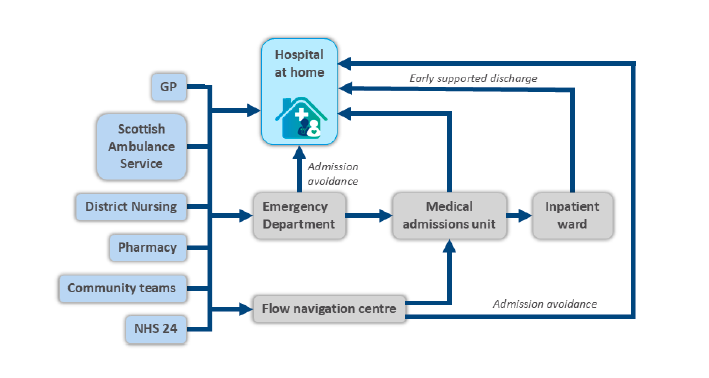
For admission avoidance, referrals are made by professionals who the patient has presented to in the community. This can include their GP, the Scottish Ambulance Service, District Nursing, Pharmacy, Community teams or NHS 24.[10] The professional may decide to refer the patient to the Emergency Department, a Flow navigation centre or if eligible, the patient can subsequently be referred to receive acute level care via H@H, as an alternative to an inpatient stay. If a patient is referred to the Emergency Department or Flow navigation centre (recognising that the Emergency Department could also be the first place a patient goes for help) they could subsequently be referred into H@H or they may be admitted into a Medical admissions unit. Following assessment in the Medical admissions unit, a patient could be referred into H@H. In other instances, the patient may be admitted to an inpatient ward but subsequently referred into H@H to finish their treatment at home, hence reducing their length of stay in hospital which would be referred to as an early supported discharge pathway (HIS, 2025a).
The information provided in this Policy and delivery context section, outlining the variations in clinical specialisation, target population, maturity and referral dynamics should offer an indication on the heterogeneity of the services which are delivered across the scope of H@H in Scotland. Readers should be cognisant of this heterogeneity when interpreting the findings presented in this report.
Existing H@H data and evidence
Previously, data collection had been undertaken by HIS for the Acute/Older adult service with quarterly publications providing insight into the delivery of this service across Scotland. While data were collected for other services, methodologies varied and a lack of consistency meant that a national overview of H@H delivery could not be determined.
Given that a commitment was made to expand H@H beds to at least 2,000[11] by the end of December 2026 (Scottish Government, 2025), a new standardised approach to data collection across the various services was required. PHS were therefore commissioned by the Scottish Government to develop and support the data collection and reporting of H@H activity across all of these services. As part of this work, the national definitions provided earlier in this report were developed (PHS, 2026).
On June 30th 2026, the second quarterly summary of H@H activity, using a standardised approach was published by PHS (2026). This presented the number of patients accepted into and discharged from 43 H@H services (both H@H and specified related admission alternative services) across all Health Boards between February and April 2026. As the data collection is in its early stages, the data are recognised as provisional. Across Scotland, 7,506 patients were accepted onto a H@H service and 7,101 were discharged. Of the 7,506 patients accepted onto a H@H service, 20% were treated via an alternative to admission outpatient service. Rejected referrals are also recorded, by source of referral and reason for rejection. Between February and April 2026, 31% of rejected referrals were coded as ‘no capacity’, whilst 24% were coded as ‘inappropriate referral’. In the same period, GP and primary care accounted for almost half of all rejected referrals (48%), whilst inpatient ward referrals accounted for 30%. This may reflect the higher overall volume of referrals from these sources rather than a higher rejection rate.
In addition to activity data, there is empirical evidence on various aspects of H@H (e.g. patient satisfaction). HIS (2025a) conducted a literature search to explore the current evidence on Hospital at Home. Whilst the literature search identified high-quality evidence for older adult H@H pathways, there were notable gaps identified for disease specific pathways and patient and caregiver satisfaction. No studies were identified looking at the impacts on adults under the age of 65. These findings corroborate recommendations from a Scottish Government (2023) report which advocated for additional research and analysis into a number of H@H components. Additionally, McGlen, et al (2026)[12] recently published a qualitative research study which aimed to explore the key factors that enable or impede the successful development and implementation of H@H services in NHS England, which may offer some parallels with Phase 1 of this evaluation, given the focus on process and the sampling of NHS workforce.
Evaluation purpose, structure and aims
Given the significant financial investment[13] to support the expansion of H@H services, and the notable evidence gaps mentioned above, there is an increased need for data on the implementation, delivery and impact of H@H to support learning, continuous improvement and to assess H@H’s cost effectiveness.
Subsequently, a Scottish Government research team (based in the Whole System Intelligence Analysis Division, Directorate for the Chief Operating Officer NHS Scotland) undertook a procurement exercise which resulted in an evaluation of H@H services being commissioned to KSO Research. Whilst the majority of the evaluation delivery will be conducted by KSO Research, the Scottish Government research team led on an earlier research component of the evaluation (the workforce survey, discussed later in this report) and act as evaluation managers for the evaluation contract. A logic model, which aims to set out the objectives of H@H as well as the inputs and activities which are needed to achieve these, has also been developed by the Scottish Government research team (see Appendix A). This has been used to support the development of the evaluation’s aims.
The H@H evaluation is split into two phases. Phase 1 is a process evaluation of H@H services. This report focusses on Phase 1 and includes findings from the workforce survey as well as subsequent workforce focus groups and interviews with relevant NHS workforce involved in delivering H@H services or referring patients to them.
Phase 2 will be an evaluation of the impact of H@H services. This will involve patient and family/carer interviews, workforce focus groups and/or interviews and quantitative analysis assessing the impact of H@H on relevant NHS Scotland system performance metrics. An economic component to explore the cost-effectiveness or value for money of the H@H intervention will also be included in the Phase 2 report.
The aims of the evaluation as a whole are to provide an improved understanding of the following:
- Effective processes, blockers and aspects of service delivery requiring improvement from the perspective of the delivery and referral workforce.
- The impacts of the H@H service from the perspective of the workforce.
- The experience and impacts of the H@H service from the perspective of patients and their families/carers.
- The impact of H@H services on relevant NHS Scotland system performance metrics.
- The cost-effectiveness or value for money of the H@H intervention.
Methodology
Phase 1 of the research comprised two distinct elements which both sampled Health and Social Care professionals involved in the delivery of or referral to H@H:
- An online survey designed and administered by the Scottish Government between November 2025 and January 2026.
- Focus groups and interviews, conducted in March 2026.
A detailed description of the methodologies used to deliver each of these elements is provided in Appendix B, whilst the high level overview is described below.
Workforce survey
The purpose of the workforce survey was to gather the views and experiences of NHS Scotland staff involved in H@H services, including those in teams delivering H@H care to patients and those who refer patients to a H@H service. An online survey was administered in late 2025 which asked a total of 27 questions (see Appendix C). Separate questions were asked of those involved in delivery of H@H services (i.e. ‘deliverers’) and those involved in referring into H@H (i.e. ‘referrers’).
A total of 236 responses were received, comprising 100 respondents delivering H@H services and 136 respondents referring patients into H@H services. Respondents came from a broad range of professional backgrounds and worked across multiple different territorial Health Boards. The full sample profile is shown in Tables A1 to A3 in Appendix B.
Workforce survey data were exported to SPSS (a statistical analysis platform) for analysis. Frequencies (counts and percentages) were run for all closed question responses. Where crosstabulations were conducted, only differences between groups which are statistically significant (p<0.05) are reported. Data from all open ended workforce survey questions were analysed thematically.
Workforce focus groups and interviews
Workforce survey respondents were invited to opt in to further qualitative engagement by way of a focus group or one-to-one interview. As numbers who opted in this way were relatively small, invitations to take part in the research were also cascaded to various professional networks, which resulted in a higher uptake (as detailed in Appendix B).
A total of six online focus group sessions were run - three with delivery staff (attended by 13 participants in total) and three with referral staff (attended by six participants in total). In addition, nine participants took part in individual/paired interviews - (including seven delivery staff and two referral staff). Overall, 28 participants took part, representing a wide range of professional backgrounds across 10 territorial Health Board areas (further information can be found in Appendix B).
All qualitative engagement sessions were voice recorded with permission from participants and transcribed verbatim. Thematic analysis was undertaken to expose key emerging themes across all sessions. Anonymised verbatim quotes were selected for inclusion in the report to highlight key findings.
Caveats and reporting conventions
Participation in both the workforce survey and focus groups and interviews was on a self-selecting, opt in basis. This may have resulted in some sampling bias in the views and experiences that were captured. For example, those who took part may have been more or less familiar with H@H, or may have taken part because they had particularly strong views or experiences compared to other colleagues. Due to the sampling strategy, the total number of individuals who received the workforce survey is unknown, and therefore a response rate cannot be calculated.
Throughout the report, those who took part in the workforce survey are referred to as ‘respondents’. Those who took part in interviews or focus groups are referred to as ‘participants’. This is to make the source of the feedback clear, as well as to highlight where there were differences in findings between the different cohorts. It should be noted, however, that some people who took part in the survey may have been the same people that took part in the interviews and focus groups. This categorisation is, therefore, for reporting clarity only. In addition, where reference is made to ‘respondents’ or ‘participants’, this typically refers to both delivery and referral staff (unless otherwise stated in the text).
While the range of respondents and participants was quite diverse (both in terms of the geographical areas that they worked in and their professional roles), not all Health Board areas were represented. There was also no representation from some groups of primary and secondary care professionals, meaning that the feedback should not be generalised from either the workforce survey or qualitative engagement. The profile of respondents/participants in each element of the research was also different and so findings from each research element should be considered as complementary (i.e. in some cases findings were consistent between research strands and in others cases they differed).
It should be noted that not all workforce survey respondents answered each question. In the reporting of the findings, unless otherwise stated, ‘I don’t know’ responses have been excluded from analysis. The number of respondents answering each question (excluding ‘Don’t know’ responses) is shown on charts and tables. Furthermore, the number of interview and focus group participants was relatively small overall, and staff represented a wide range of different backgrounds and experiences. As a result some views were expressed by only one or two individuals. Where views were provided by only one participant, this is flagged in the reporting of the findings.
Percentages presented in the Tables or Figures throughout this report are shown to zero decimal places. Some of the descriptive text included alongside Tables or Figures will refer to findings in a combined or banded way (e.g. agree or strongly agree, etc.). Where banded findings are presented in the text the banded total may not match the sum of the constituent figures presented in the table, and may vary by plus or minus 1 percentage point (e.g. 10% and 10% presented in a Table may sum to 19% or 21% when banded, given that the 10% presented may denote 9.5% to 10.49%). Further denotations used in this report are as follows:
- “#” denotes a response option which has been suppressed to mitigate disclosure risk.
- “0%” denotes a percentage which is <0.5%, presented to zero decimal places.
- “None” denotes a response option which received 0 responses.
It became evident in the interviews and focus groups that participants were using different terminology to describe the same concepts. For example, some staff spoke of H@H ‘pathways’, while others spoke of H@H ‘services’, yet both were used in the same context. As such, the terms have been used interchangeably through the report. Similarly, when asked about H@H pathways, some discussed referral pathways rather than the different services delivered by H@H teams. Further, some participants spoke about H@H affiliated or alternative services, instead of services which they recognised as being specifically branded as H@H, but felt that these were the closest fit to the model that was in scope of the evaluation.
Contact
Email: socialresearch@gov.scot