
Five Family Payments evaluation: annex A - mixed methods research
This report presents findings from research which informed an evaluation of the Five Family Payments.
7. Employment, education and training impact of Scottish Child Payment
Another main aim of this research was to explore the extent to which SCP has made progress toward medium-term outcome to help reduce barriers to education and the labour market. The survey and qualitative interviews explored whether and how FFP have enabled people to undertake qualifications and/or employment.
7.1. SCP impact on employment
Survey respondents in receipt of SCP were asked if SCP had helped them with work and were provided with a list of different impacts from which they could select all that were applicable to them. For example, with work costs such as travel or clothing, with looking for work or starting work, with staying in work/working more hours or stopping work/working fewer hours, and with taking a longer period of parental leave. Survey respondents were asked to indicate whether SCP had helped both them and their partner in these ways.
7.1.1. Impact on respondent
Survey respondents were asked if SCP had helped them with work.
The majority (69%) of respondents receiving SCP reported that SCP had no impact with work or that this was not applicable to their circumstances.
For the 29% (n=1,050) of those who did report that SCP had helped with work, the most commonly reported way in which SCP helped was with work costs such as travel or clothing (45%), followed by enabling respondents to stay in work or work more hours (23%). Around a fifth of respondents (19%) reported SCP ‘helped in another way’. Some respondents who selected 'helped in another way' provided written text to explain how SCP had helped them with work. These responses broadly aligned with the other survey options but are explored in more detail in section 7.3.
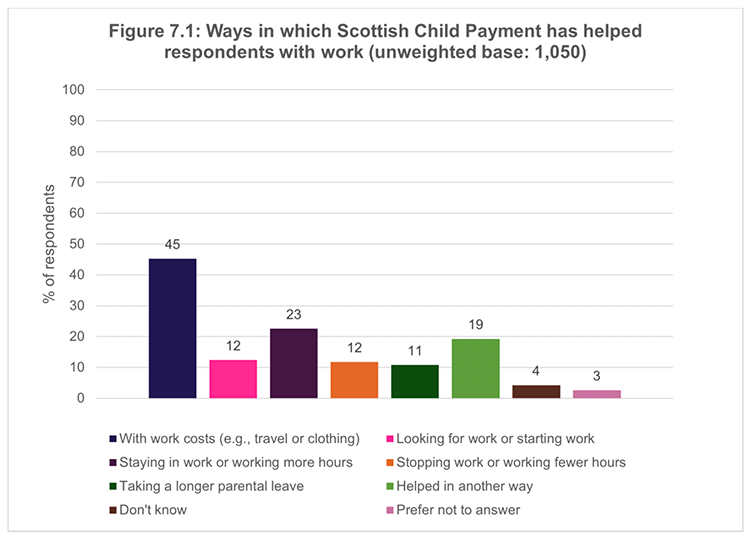
Respondents more likely to report that SCP had helped with work costs such as travel or clothing were households with one parent/carer (57%, compared with 37% of household with two or more parent/carer).
However, respondents more likely to report that SCP helped them to look for work or stay in work were:
- Households with two or more parents/carers (16%, compared with 10% of households with one parent/carer)
- Respondents from minority ethnic backgrounds (22%, compared with 10% of respondents from white ethnic backgrounds)
Furthermore, respondents more likely to report that SCP helped them to take longer parental leave were:
- Households with two or more parents/carers (18%, compared with 7% of households with one parent/carer)
- Respondents from white ethnic backgrounds (12%, compared with 6% of respondents from minority ethnic backgrounds)
- Households without a disabled family member (13%, compared with 9% of households with disabled family member(s))
Finally, respondents more likely to report that SCP helped them stop work or work fewer hours were households with two or more parents/carers (18%, compared with 8% of households with one parent/carer).
7.1.2. Impact on respondent’s partner
Respondents receiving SCP were also asked if the payments helped their partners with work. The majority of respondents (72%) indicated that SCP had had no impact on their partner’s work or was not applicable.
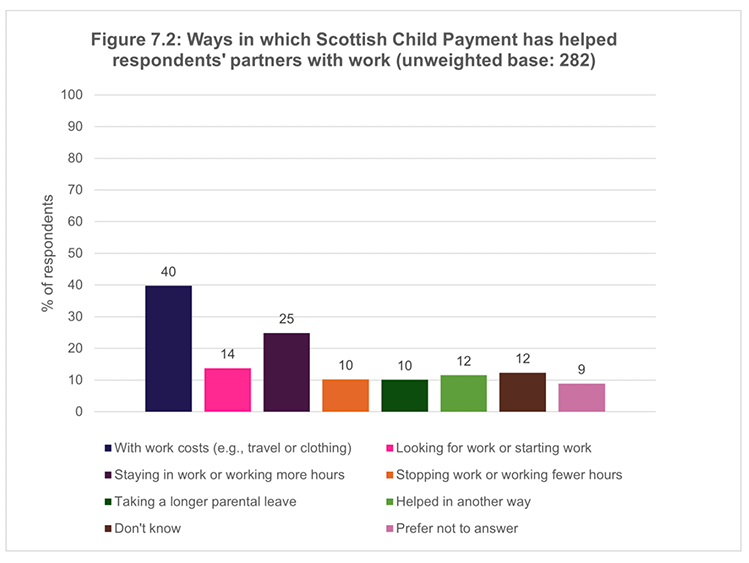
As with respondents themselves, for the 28% (n=282) of those from two-parent/carer households who did report that SCP had helped with work the most commonly reported way in which SCP helped respondent’s partner with work was with work costs such as travel or clothing (40%), followed by enabling respondents’ partners to stay in work or work more hours (25%) and looking for work or starting work (14%). One in ten (10%) said SCP had helped them to stop work, work fewer hours or take longer parental leave.
Subgroup analysis was not possible due to small base sizes.
7.2. SCP impact on education and training
Respondents were also asked whether SCP had helped them or their partner with education or training and were provided with a list of different impacts which they could select all that were applicable to them.
7.2.1. Impact on respondents
The majority of respondents (86%) reported that SCP had no impact on their education or training or was not applicable to them.
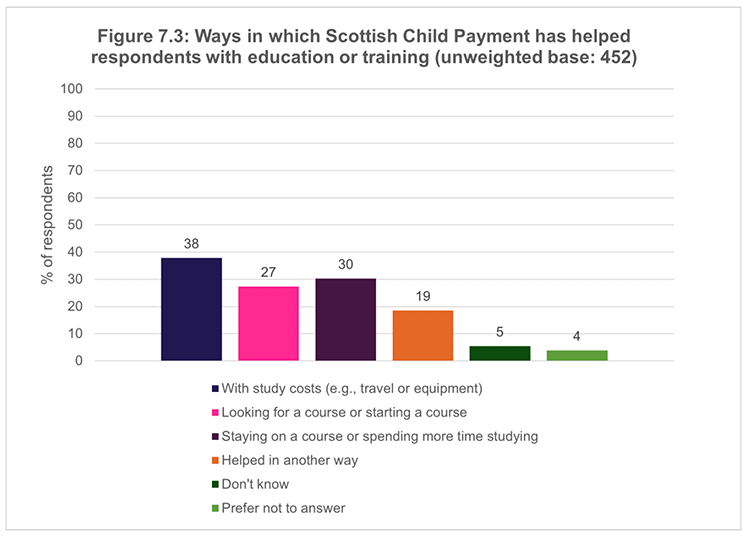
For the 14% (n=452) of those who did report that SCP had helped with education or training, the most commonly reported way in which SCP helped was with study costs such as travel or equipment (38%), followed by staying on the course or spending more time studying (30%), and looking for a course or starting a course (27%).
Respondents more likely to report that SCP helped with looking for a course or starting a course were:
- Households with two or more parents/carers (35%, compared with households with 23% of households with one parent/carer)
- Respondents from minority ethnic backgrounds (35%, compared with 23% of respondents from white ethnic backgrounds)
There were no other notable differences by priority family groups, area deprivation, or length of receipt of SCP.
7.2.2. Impact on respondent’s partner
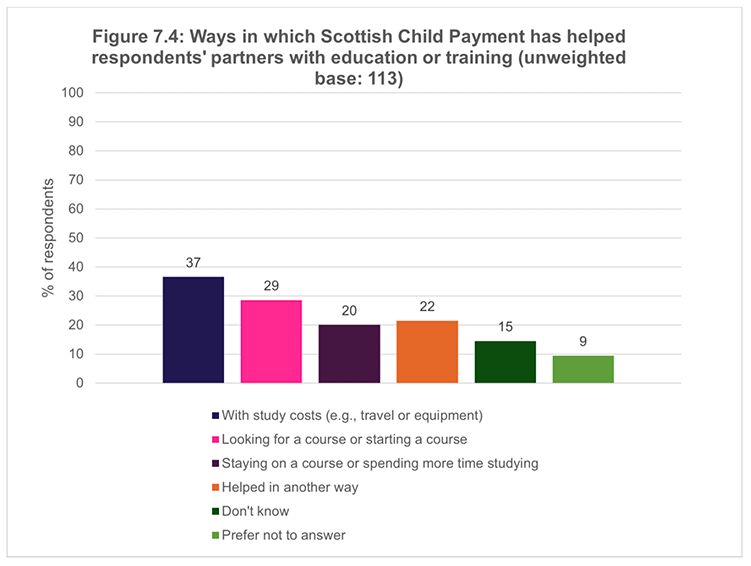
When asked about whether SCP had helped their partner with education or training, the majority of respondents (89%) reported that SCP had had no impact or was not applicable. For the 11% (n=113) of SCP recipients who did report that SCP had helped with education or training, the most commonly reported way in which SCP helped was with study costs such as travel or equipment (37%), followed by looking for a course or starting a course (29%), helped in another way (22%) and staying on the course or spending more time studying (20%). Subgroup analysis was not possible due to low base sizes.
7.3. Experiences of impact on employment, education and training
As highlighted by the survey, the majority of parents and carers reported SCP had no impact on their or their partner’s employment, education and training decisions. However, for a small proportion, SCP did have an impact. In the survey open-text responses to ‘helped in another way’ and qualitative interviews, parents and carers shared how SCP had impacted their or their partner’s employment, education and training decisions. However, they also noted challenges regarding these choices and other factors which impacted the ability to work or study. These are discussed below.
7.3.1. Support to cover employment and education related costs
As reflected in the survey, one way SCP helped parents and carers with employment and education was by helping them to cover costs related to employment and education. For example, in qualitative interviews and survey open-text responses, parents and carers reported using the payments to cover car and petrol costs, and bus fares to enable them to commute to work. SCP was also used to help them afford work lunches, without taking money away from their children’s food. Receiving SCP helped parents and carers to meet these work costs while meeting the essential needs of their children.
It [SCP] is a needed income to pay for essentials needed by my daughter and to ensure I can cover car/petrol costs to enable me to work and earn an income. This payment means we are just managing to keep out of poverty and debt. A life saver. Thank you Scottish Government. (Survey respondent)
Being able to take a lunch to my work and not worry that I'm takin’ food away from kids, we weren't getting benefits so this helped loads. (Survey respondent)
SCP, in combination with income from employment and Universal Credit, also helped with education related costs which enabled some parents and carers to go into or continue further or higher education. Although entering further or higher education had affected their Universal Credit payment, parents and cares said SCP had to some extent supplemented this loss in income, making it a more affordable choice.
I have obviously dropped money going back to uni[versity] but then I’ve then still been getting the Scottish Child Payment which has definitely helped. So yeah I mean it is…I am kind of like living day to day but it is…it has definitely helped. I had been wanting to do this for a long time, I just financially couldn’t do it […] So yeah I would definitely say it has probably helped me being able to go back and try and better myself for the future for me and my kids. (Parent and carer interview)
7.3.2. Support to remain in education and employment
Parents and carers also reported in interviews and survey open-text responses that SCP helped them or their partner to continue or return to work or study by helping to cover the cost of after school activities for their children. The cost of childcare was a barrier to employment and education and for some, SCP helped allivate this barrier.
This payment has been a lifeline to me. It's meant I can pay toward my child being in ELC so I can work more hours, or we'd be in the red. (Survey respondent)
Other parents and carers reported that SCP helped them to cover other essential costs such as food and household bills which helped them to afford to pursue education opportunities, which would also support them with future employment opportunities and pay.
Able to go to college so I can then get a job. (Survey respondent)
Again helped survive as there is no help on Scotland for single parents going back to full time education. (Survey respondent)
Started university so I can eventually make more money. (Survey respondent)
7.3.3. Provide more choice with working hours
For some parents and carers, SCP helped them with employment by giving them more choice around their working hours, whether that was to maintain, increase or reduce their working hours to meet their family’s needs while meeting essential household expenses. For example, SCP helped some parents afford to work part-time hours, or choose flexible work, to fit around the needs of their children. For many, this was a positive choice to enable them to spend more time with their children.
It helps me stay in a job that works for me and my daughter. […] I’d love to work and earn more but it’s just me and her now so I’m limited to what I can do and how many hours I can work, this payment helps take the pressure off my wages one week of the month and I am grateful for it. (Survey respondent)
It has meant I have been able to remain on my 28hr contract, working hours around caring for my children, since my separation. Without it I would have had to increase to full time hours and due to lack of child care availability in our area (rural) and cost, the boys would have had to be left home along for a few hours before/after school. (Survey respondent)
For others, SCP enabled them to work more hours to increase their overall household income. However, for those receiving Universal Credit, this was a delicate balancing act to ensure the extra income from working more hours was greater than the income they lost from Universal Credit and other qualifying benefits.
When discussing the impact on employment and education decisions, parents and carers emphasised the cumulative impact of receiving multiple benefits in addition to SCP. The income from SCP, along with other financial support, therefore allowed some parents and carers to pursue career and educational opportunities.
It [SCP] helps a lot because we know that we will manage to give our family everything we need and go to study and improve ourselves. So yeah that’s a lot. Maybe one payment, it’s not that much impact on your but when you put it altogether we can work with that and we can make it work. (Parent and carer interview)
7.3.4. Alleviating costs to support employment decisions
Another way in which SCP helped parents and carers with employment is by supplementing their household income when they were not working. Reasons for not working included caring for a disabled family member, high childcare costs, challenges with their own physical and mental health and a desire to spend more time with their family. Receiving SCP helped them to cope financially while they were not working which helped to relieve financial stress and, for some, a sense of guilt about contributing to the household.
The Scottish Child Payment is a great help for our family. This relieves the pressure off of me to not have to rush back to work as soon as my baby is 1. I can spend a bit more time with her knowing I contribute to household bills before she goes to nursery. (Survey respondent)
My partner has mental health [problems] and this helps him feel like he is still providing as he has always worked but due to mental health he can’t at the moment.(Survey respondent)
One of my children is disabled and I’ve had to give up my career to provide them with the care they need. Without the payment this would not have been possible and it is unlikely she would be engaging in education or be able to undertake schoolwork. (Survey respondent)
While SCP helped supplement income, for some parents and carers SCP was not sufficient to replace income from employment. There were parents and carers who shared that SCP had eased the pressure to immediately find employment rather than replacing the need to find a job completely.
It's more just supplemented my partner's income. It hasn't had a big decision on whether or not I've worked. It's more I need to go back to work because it's kind of not enough. What's coming in from my side isn't enough. We're still a one-wage family, so I wouldn't say it's affected me not working. It's more affected that I need to go back to work. (Parent and carer interview)
There were parents and carers who highlighted that they had always intended to or would like to return to work. The financial support offered by SCP gave them more time to consider their options and they were motivated to improve their financial circumstances by completing education and finding employment.
It helped me go back to work in the terms of self-actualisation of I want to keep doing these really nice things for my kids, I want to have this money to be able to go and do it and not rely on this money which there’s no shame in reliance that’s the way the world is now but I thought you know I love having this life that I can like pay for gymnastics and pay for swimming and not have to worry about it. So it really helped motivate me to get to my goal and graduate and get a really good job and live that life. (Parent and carer interview)
As a result of not working or working fewer hours, parents and carers reported being able to spend more time with their children and family. SCP enabled some parents and carers to be more active with their children, take part in activities together and look after younger or disabled children.
Getting this payment literally is the difference between me affording to be a stay-at-home mummy and not. If those payment stopped I’d have to return to work. (Survey respondent)
7.3.5. Other factors influencing employment, education and training decisions
The complexity of the benefits system and the impact of Universal Credit on employment decisions were also discussed in stakeholder and parent and carer interviews. Parents and carers who were on the cusp of no longer qualifying for Universal Credit reported declining pay increases, or diverting pay into pension contributions, as increasing their monthly pay would have a detrimental effect on their overall household income. Parents and carers also shared that having a single income was financially more beneficial for their families, as the increased income of two wages could affect their receipt of Universal Credit and consequently SCP and other benefits. The lack of clarity or advice on how employment or education would affect their household income and receipt of benefits and the FFP was also raised.
So I know that even the slightest movement in my salary could impact it. It wouldn't just be a case of losing that £50 on the Universal Credit, it would then impact on the Scottish Child Payment. So there is that feeling of anxiety round about it. Actually, this year I even asked my line manager not to move me up my annual pay award band because it would have meant maybe a £30 or £40 a month addition on my salary for myself, but it would have cost me around £300 in benefits. So it actually made more sense to not take the band increase. (Parent and carer interview)
You’re just hit with the immediate ‘well this will affect this, this will affect that, this will affect’…there’s no like incentive, encouragement or even free courses you could go on where you could attain a certificate, like there’s no help like that because one person has work but one person in your house always has to work or you would receive no money do you know what I mean? It’s an impossible circle. (Parent and carer interview)
Survey respondents also reported concerns about the potential impact of taking on employment on their finances and subsequent loss of payments of Universal Credit and SCP.
It does not benefit me financially to work as I could have had a job that matched universal credit but then I would’ve lost child payment and then had to pay nursery fees. (Survey respondent)
Stakeholders also identified the link between Universal Credit and FFP creating a ‘tipping point’ where a family would potentially be worse off in work than out of work.
But because there’s a tipping point where Universal Credit will stop. There is actually a point where somebody can earn a pound too much and it actually costs them £26 a week per child. So, in Scotland there is a weird thing that you don’t get anywhere else, where the general answer of, ‘Yes you’ll be better aff in work’ does’nae necessarily apply because there is a point where you’re actually worse aff earning that pound or two too much. (Stakeholder interviews)
However, Universal Credit had also helped some participants with their employment decisions. For example, by Universal Credit covering a substantial amount of their children’s nursery fees, there were interview participants who highlighted the benefit of being able to work.
So I could see why it would deter people from wanting to go back to work. Whereas I had like maybe a bigger incentive there and I know I was going to get help with childcare costs. But I think overall like because I was looking after them the majority of the time I definitely need that extra help because I wouldn’t be able to do it all the time without having some additional support for the nursery. (Parent and carer interview)
Other factors influencing employment, education and training decisions included being disabled or having caring responsibilities for a disabled family member, mental or physical health problems, pregnancy and maternity leave and the availability and cost of childcare. Participants reported leaving work for their own or another family members’ health, immediate childcare needs and for maternity leave. The availability of childcare in their local area and associated costs impacted parents and carers’ ability to work, whether that involved working less, more, or not working at all.
Contact
Email: socialresearch@gov.scot