
Five Family Payments evaluation: annex A - mixed methods research
This report presents findings from research which informed an evaluation of the Five Family Payments.
6. Health and wellbeing Impact of Five Family Payments
Another aim of this research was to explore the extent to which FFP are meeting the medium term outcomes of improved health and wellbeing outcomes for children and families. The survey and qualitative interviews explored the extent to which FFP have influenced shopping and health eating behaviour of families and the physical health and mental wellbeing/happiness or children and families.
6.1. Scottish Child Payment (SCP)
Survey respondents were asked about the extent to which the Scottish Child Payment (SCP) had improved their physical health and mental health and/or happiness, and the physical health and mental health and/or happiness of their child or children.
6.1.2. Physical and mental health and/or happiness of respondents
The greatest impact of SCP on health and wellbeing was on the respondents’ mental health and/or happiness. Over two thirds (69%) of survey respondents receiving SCP ‘agreed’ or ‘strongly agreed’ that SCP had improved their own mental health and/or happiness.
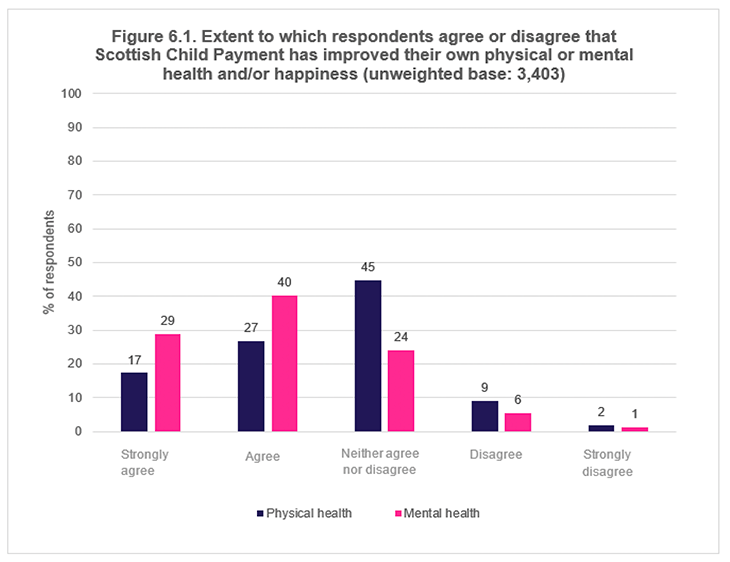
Respondents most likely to ‘agree’ or ‘strongly agree’ that SCP had improved their own mental health and/or happiness were:
- Families with three or more children (75%, compared with 68% of families with one or two children).
- Two or more parent / carer households (74%, compared with 67% of one parent or carer households).
- Families from minority ethnic backgrounds (75%, compared with 68% of families from white ethnic backgrounds).
- Households without disabled family members (71%, compared with 68% of households with disabled family members).
While not as frequently reported as mental health and/or happiness impacts, respondents also reported a positive impact of SCP on their physical health, with around half (44%) of respondents receiving SCP ‘agreeing’ or ‘strongly agreeing’ that SCP had improved their own physical health. Respondents more likely to ‘agree’ or ‘strongly agree’ that SCP had improved their own physical health were:
- Families with three or more children (52%, compared with 42% of families with one to two children).
- Families from minority ethnic backgrounds (63%, compared with 41% of families from white ethnic background).
- Households without disabled family members (49%, compared with 41% of families with disabled family members).
- Two or more parent or carer households (48%, compared with 42% of one parent households).
There were no other notable differences by priority family groups, area deprivation, or length of receipt of SCP.
As can be seen from the results above, SCP had a particular impact on the mental and physical health of respondents from families with three or more children and respondents from families from minority ethnic backgrounds. These subgroups were more likely to ‘agree’ or ‘strongly agree’ that SCP had improved their mental health and/or happiness, and their physical health.
6.1.3. Physical and mental health and/or happiness of children
When asked about the extent of the impact of SCP on their child, around half (53%) of respondents receiving SCP ‘agreed’ or ‘strongly agreed’ that SCP had improved their child’s mental health and/or happiness.
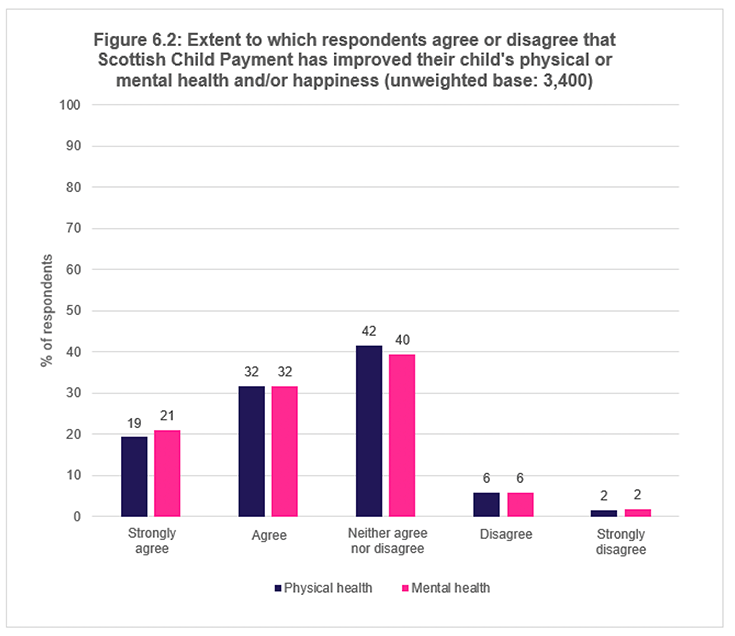
Those more likely to ‘agree’ or ‘strongly agree’ that SCP had improved their child’s mental health and/or happiness were:
- Families with three or more children (63%, compared with 51% of families with one to two children)
- Respondents from minority ethnic backgrounds (70%, compared with 50% of those from white ethnic backgrounds
- Respondents from two or more parent households (56%, compared with 51% of those from one parent households).
There were no other notable differences by priority family groups, area deprivation, or length of receipt of SCP.
Similarly, just over half of respondents receiving SCP (51%) ‘agreed’ or ‘strongly agreed’ that SCP had improved their child’s physical health. Respondents who were more likely to ‘agree’ or ‘strongly agree’ that SCP had improved their child’s physical health were:
- Families with three or more children (60%, compared with 49% of families with one to two children).
- Families from minority ethnic backgrounds (70%, compared with 48% of families from white ethnic backgrounds).
- Two or more parent or carer households (57%, compared with 48% of one parent or carer households).
There were no other notable differences by priority family groups, area deprivation, or length of receipt of SCP.
6.1.4. How SCP improved health and wellbeing
When asked to reflect on the differences, if any, SCP had made to them and their families, parents and carers described the positive mental health and wellbeing impacts of receiving the payments. Some described how SCP, by helping to improve their financial security, had reduced feelings of financial stress and anxiety and improved their mental wellbeing. SCP also enabled their children to fit in with their peers and take part fully in social and educational opportunities available to other children.
Improves financial position
As outlined in section 5.1, parents and carers talked about the intense relief that came from knowing they could pay for basic household essentials such as food, rent or mortgage payments and utility bills.
Just it always being such a struggle, and that mental load of, ‘Can I - what can I buy?’ So, every time you go into the supermarket, every single time, having to count everything in your basket so that you know exactly how much things are going to come to, and that you know that you don't take too much out of your account, so that one of your bills is going to bounce. Just that breathing space that I suddenly got when the Scottish Child Payment started. I genuinely can't describe what that was like for me, and the amount of anxiety that it removed. It was just incredible to feel that you could almost take that deep breath. (Parent and carer interview)
Knowing money was available to buy essential items, such as clothing, for their children helped also to reduce financial anxiety (see Chapter 5).
I try and keep [SCP] for them. If they have…I don’t know burst a pair of shoes or suddenly growing out of all of their shoes, which is not uncommon practice for them, things like that, it allows me to go and get that extra pair of shoes or that extra item that they need without having to worry about it. (Parent and carer interview)
The [Scottish Child] Payment has kept my children out of poverty and been a lifeline. It allows me to give them a treat every now and again whilst providing hot dinners and clothes for them. The extra money brings some happiness to our lives. (Survey respondent)
Parents and carers who had themselves experienced poverty as children, shared their relief that their children would avoid the shame and stress they had felt growing up. SCP helped them shield their children from witnessing their financial distress.
I am so infinitely grateful that, however tight our income is on a monthly basis, that I know without any doubt, that between what I earn from my salary and what comes in the Scottish Child Payment, Universal Credit, and Child Benefit, covers all the direct debits, the household bills, our food, and my petrol, which means that even if there's no money for holidays or anything like that, those things being there, having a roof over our heads, having that security, it's priceless. I didn't grow up with that security. So having that and being able to make sure that my boys don't ever know the strain, and the stress, or the poverty that I knew when I grew up, that's the difference that it makes. (Parent and carer interview)
Single parents and carers described how SCP helped to reduce the mental strain of trying to live on one income.
Obviously if you’re struggling financially, it’s a massive stress on you and I didn’t need to worry too much about that before when I was…with two parents, but then when you’re on your own you’re just like…any help is really…[SCP] takes a massive weight off your shoulders. (Parent and carer interview)
The Scottish Child Payment has been, at times, a lifeline. I do not get any help from anyone else, and the baby box and the child payment has made a huge positive impact on myself and my child mental and physical wellbeing. I appreciated it as a first-time single mother. (Survey respondent)
Not having to always say no when their child asked to do something was identified by interview participants as helping to improve parent and carer relationships with their child(ren) by enabling them to spend more quality time together as a family.
I mean it’s definitely a positive one for sort of like our own wellbeing, definitely. I mean I’m able to say yes more often, which then builds a better relationship with the kids, and they’re pleased because they’re hearing yes. (Parent and carer interview)
Promoted inclusion and reduced social isolation
Two of the long-term aims of SCP are to reduce inequality of outcomes for children and reduce incidences of social isolation. In interviews, parents and carers spoke of the ways in which the payments were improving their children’s emotional wellbing by enabling them to take advantage of the opportunities available to their peers in more affluent families.
Scottish Child Payment was helping children to experience what one parent described as a ‘normal childhood’. Parents and carers spoke about using their SCP to allow their child to feel part of their community by doing everyday things like meeting friends, and buying the occassional lunch during the school day. Parents and carers who had themselves grown up in low-income families described the detrimental effects of being excluded by poverty. In interviews, parents and carers shared the ways in which SCP helped enable their child to fit in with their peer group. For teenagers, having the right clothes and shoes were identified as hugely important for their self-confidence and self-esteem. A kinship carer described the impact of the SCP on their grandchildren’s emotional wellbeing.
Definitely for my grandchildren because they’ve been rejected by their parents it’s…it’s difficult for them to not feel that they’re not good enough. When money is tight and they’re seeing that their peers have got things that they haven’t, then that is just…it just reinforces that thought that they’re kind of not good enough. This is making a huge impact as far as I can see on them feeling that they do match their peers. (Parent and carer interview)
Parents and carers reported that fitting in with their peers, reduced the risk of their children being bullied for looking different, with one sharing that her child’s engagement with school had improved after she was able to boost his confidence by using SCP to buy new clothes.
[My son] just wants to be like everybody else, because he's been bullied an awful lot, and wouldn't go to school and everything. So just to build up his confidence, I bought him some nice clothes and some nice trainers, and it did wonders for him because he did start going back to school. So, I did need it for that […] You could see, the way he walked, he was feeling a bit more proud of himself. [He] just wanted to be like everybody else. He doesn't want to be any different. (Parent and carer interview)
Another spoke about using their SCP to support their daughter’s dignity by helping to buy the personal hygiene items she needed. Others were using their SCP to treat their children and incentivise positive behaviour. Using SCP to pay for activities was identified by parents and carers as hugely important in helping develop their child’s confidence and improve mental wellbeing. In interviews and survey open-text responses, parents and carers frequently described the role SCP played in helping their children to take part in everyday childhood activities. By enabling both them and their children to take part in activities and join in with social occasions, SCP had reduced feelings of social isolation.
I feel like the Scottish Child Payment has been the single most powerful factor in allowing my children to feel inclusive and participate in society as children doing the things that children love to get the chance to do. (Survey respondent)
It kind of gets to that point where you become even more isolated because you think well I can’t actually do anything and the kids are asking can we go to this, can we go to that, taking them to the park, or take them to…we do that but then if they’re invited places and you can’t attend birthday parties because you can’t afford things then it just makes it really difficult. I think it makes you feel stressed as a parent because you feel like you’re not able to provide and I think it was just that extra support and help that I really…I have benefitted so much from. (Parent and carer interview)
Parents and carers with disabled family members spoke about the challenges of meeting the needs of all their children when one had additional needs that often had to be prioritised. One parent described how SCP had allowed their non-disabled child to feel that her needs were also being met.
I signed up for the council classes and was able to start her doing arts and crafts classes and music lessons. So, for her, it actually made a massive difference because she had spent so long - all the things that she was asking for, she could never get […] It felt like everybody else's needs would come above hers. (Parent and carer interview)
In addition, parents and carers talked about the potential longer-term impacts on children of taking part in activities. They reflected that hobbies helped their children with skill and self-development which helped them in other areas of their lives. For example, parents and carers reported that taking part in activities helped to improve their children’s attainment at school.
I'm not going to lie, [the increase in SCP] was what allowed the one group a month to be two groups a month […] which had a massive or is having a massively positive impact […] That sense of achievement as well is hugely noticeable. It kind of extends from there to going to school and getting involved at something at school. She now has that small confidence boost that she'll now take part in something at school like a drawing contest or she'll try a bit harder with her assignments and we've noticed this and with her report. So, she'll realise that she can achieve something if she tries, so she does try. (Parent and carer interview)
Because of SCP, my daughter attends gymnastics, is learning to play basketball and attends art class which has improved her social, mental and physical health. Her teacher told me she's doing great at parents evening, and I know it's because of the joy she gets from extra-curricular activities listed above. (Survey respondent)
Stakeholders also spoke about the positive impacts of SCP on the mental wellbeing of the families they worked with. While noting that SCP was not a large amount of money per week, stakeholders felt that the payments helped some families’ wellbeing by helping them to afford things for their children that other, more affluent families, might take for granted.
There’s the monetary terms, but it’s the wellbeing in the family and how that family can do things, like small things that might not mean an awful lot to a lot of people, but when you’re on basic benefits and you’re a single parent struggling to try and do the best for your family, it’s things like that, that make the difference. We’ve got loads of stories like that. The difference that these benefits have made to the wellbeing of parents and kids and how they’ve been able to sort of provide small things that make a big difference. (Stakeholder interviews)
Promoted physical health
Finally, parents and carers also described the ways in which they felt the SCP was helping to improve their child’s physical health. Using SCP to pay for clubs and activities outside school helped children to be physically active. As discussed above, parents and carers also spoke about using their payments to buy healthy food for their child(ren). A parent shared the impact on their own mental wellbeing and the health of their young family now that SCP meant they could feed and clothe their baby.
Scottish Child Payment really helped me to stop going to friends’ houses and beg for food before me and my baby can survive. Before the Scottish Child Payment I usually sort for used clothes and things to care for my baby, but now I usually get anything my baby wants. He is looking more lovely, healthy and handsome. It really helped me to stop crying and thinking of how we can survive. It stops insults and it gives me joy when people look at my baby and say you look healthy and beautiful. (Survey respondent)
6.2. Best Start Foods (BSF)
6.2.1. Healthy shopping, cooking and eating
The short-term aims of Best Start Foods payments were to make healthy foods more affordable for families, enable families to increase their intake of healthy foods, and support healthy shopping habits and meal planning. The medium-term outcomes is that healthy eating behaviours are increased.
Survey respondents currently in receipt of BSF were asked on a scale of 0-5, how much the payments helped them to shop and eat more healthily, where 0 means the payments have ‘not helped at all’ and 5 means they have ‘helped a lot’.
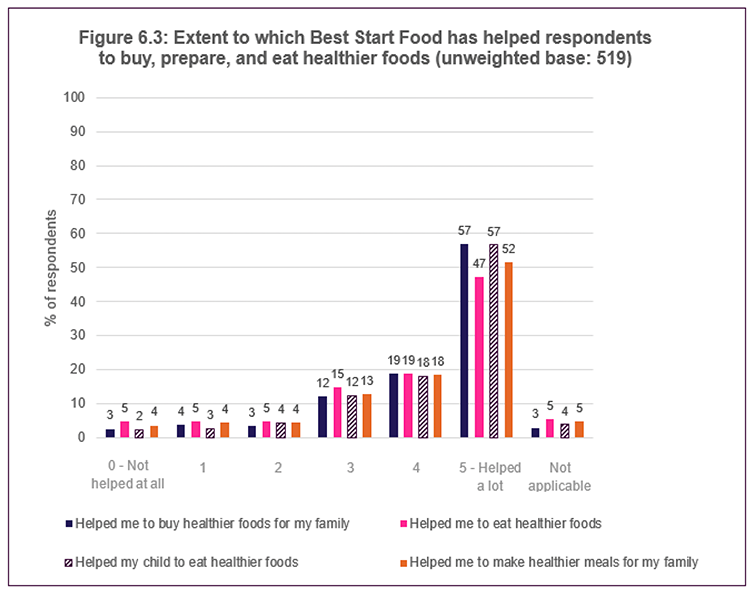
Respondents reported the BSF payments had helped them to buy, prepare and eat healthier foods.
- Over half (57%) of respondents reported that BSF had ‘helped a lot’ with buying healthier foods for their family.
- Over half (52%) reported that BSF had ‘helped a lot’ with making healthier meals for their families.
- Over half (57%) also reported that the payments had ‘helped a lot’ with their child eating healthier foods.
- Around half (47%) of respondents reported that the payments had ‘helped a lot’ with eating healthier foods themselves.
Large families were more likely to report that BSF had helped to buy, prepare and eat healthier foods, compared with families with one or two children. For example, two-third (66%) of respondents from families with three or more children reported that BSF had ‘helped a lot’ with buying healthier foods for their family compared with around half (53%) of those from families with one or two children. Similarly, respondents from families with three or more children were also more likely to report that BSF had ‘helped a lot’ with eating healthy foods themselves (55%) compared with those with one or two children (44%).
Respondents who had been receiving BSF for over 12 months were more likely than those receiving the payments for less than 12 months to report that BSF had ‘helped a lot’ with the following:
- Buying healthier foods for their family (63% of families in receipt of BSF for over 12 months compared with 52% of families receiving the payments for 12 months or less).
- Making healthier meals for their family (57% of families in receipt of BSF for over 12 months compared with 47% of families receiving the payments for 12 months or less).
- Their child eating healthier foods (63% of families in receipt of BSF for over 12 months compared with compared with 51% of families receiving the payments for 12 months or less).
6.2.2. Physical and mental health and/or happiness of respondents
As with SCP, survey respondents were asked about the extent to which BSF payments had improved their own physical health and mental health and/or happiness.
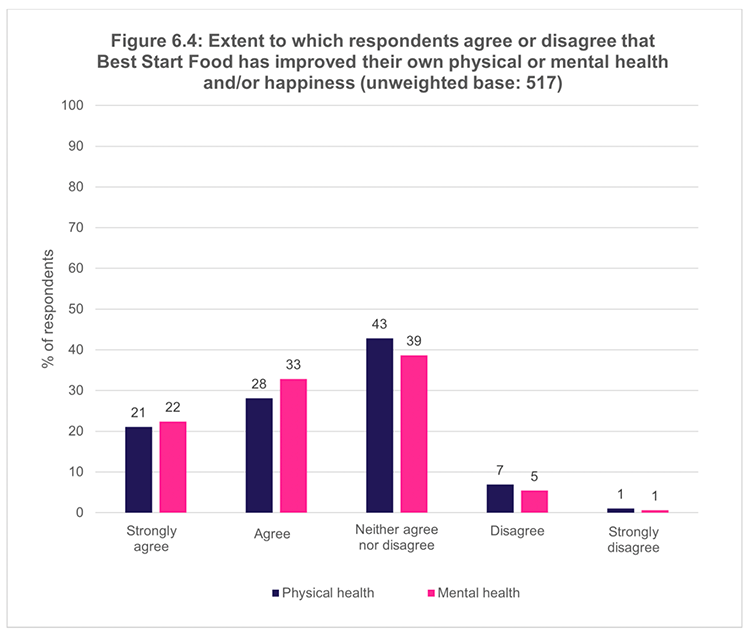
Around one half (55%) of respondents ‘agreed’ or ‘strongly agreed’ that BSF had improved their own mental health and/or happiness.
Respondents more likely to ‘agree’ or ‘strongly agree’ that BSF had improved their own mental health and/or happiness were those from families with three or more children (63%) compared with those with one or two children (51%), and those from families from minority ethnic backgrounds (67%) compared with those from white ethnic backgrounds (53%).
Around half (49%) of survey respondents also ‘agreed’ or ‘strongly agreed’ that BSF payments had improved their own physical health. As with mental health and/or happiness, respondents from families from minority ethnic backgrounds were more likely to ‘agree’ or ‘strongly agree’ that the payments had improved their physical health (65%) compared with those from white ethnic backgrounds (46%).
6.2.3. Physical and mental health and/or happiness of children
Survey respondents were also asked about the extent to which BSF payments had improved their child’s physical health and mental health and/or happiness.
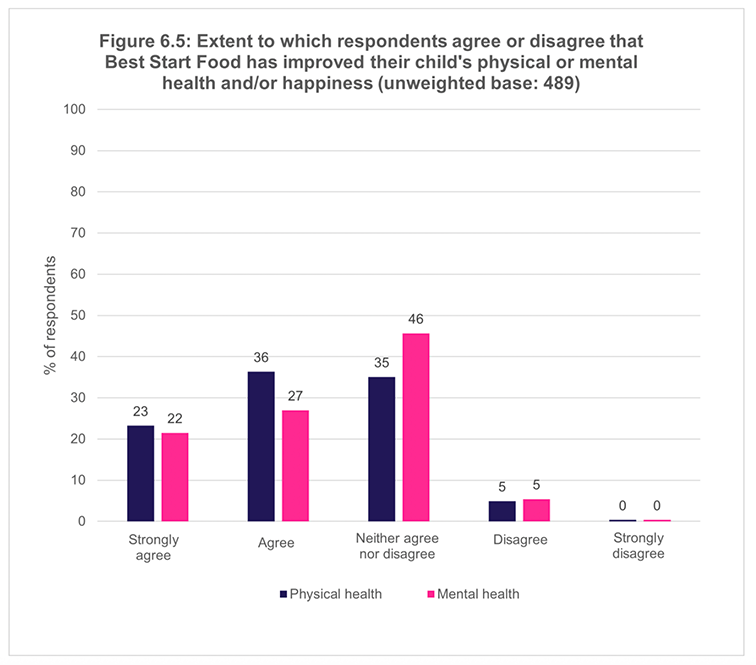
Around one half (49%) of respondents ‘agreed’ or ‘strongly agreed’ that their BSF payments had improved their child’s mental health and/or happiness. As with their own mental health and/or happiness, respondents more likely to ‘agree’ or ‘strongly agree’ that BSF payments had improved their child’s physical health were those from families with three or more children (56%) compared with those from families with one or two children (44%), and those from families from minority ethnic backgrounds (81%) compared with those from white ethnic backgrounds (55%).
A larger proportion of respondents reported improvements to their child’s physical health, with 60% ‘agreeing’ and ‘strongly agreeing’ that BSF payments had improved their child’s physical health. Again, respondents from families from minority ethnic backgrounds were more likely to ‘agree’ or ‘strongly agree’ that the payments had improved their child’s physical health (81%) compared with those from white ethnic backgrounds (55%).
6.2.4 How BSF improved health and wellbeing
In both the survey open-text responses and qualitative interviews, parents and carers shared the impacts BSF on had on their own and their children’s physical and mental health and wellbeing.
One way in which BSF helped parents’ physical health was by enabling them to buy food to support their health while pregnant. A parent shared that the BSF payments had encouraged her to eat more food while pregnant after years of food poverty had left them with little appetite.
Absolute amazing benefit that has helped me throughout my breastfeeding journey. I can buy plenty of fruits, nuts, oats all things that support breastfeeding that otherwise I may not afford. (Survey respondent)
[BSF] just means there’s a little extra money there and I’m quite a bad eater, well I was a very bad eater before I got pregnant. Sometimes I would go a day without eating, either I couldn’t afford it, or I didn’t have the…the mental fortitude to want to eat. When you get into a habit of fasting because you can’t…you maybe can’t afford it or you want your food to last a bit longer, you actually lose your appetite. (Parent and carer interview)
BSF also helped promote healthy eating amongst parents and carers who were not pregnant. Parents and carers shared that having plentiful fruit and vegetables in the house was helping them eat more healthily, making it easier to maintain a healthy weight.
Other parents and carers shared that BSF enables them to buy large amounts of fruit and vegetables to maximise their child’s intake. A parent described making vegetable-packed pasta and curry sauces using fresh and frozen vegetables bought using the BSF card. Being less anxious about wasting money and feeling able take a risk on buying new fruits and vegetables for their child to try was also frequently reported by parents and carers receiving BSF.
[BSF] was amazing because it helped us because, with kids, you have to try…sometimes they eat it, sometimes they don’t eat it. You have to try, try, try, try. Like one day if I bought potatoes if you don’t like it, I’m going to change to carrot, if you don’t like it, I’m going to change to another veg or fruit. (Parent and carer interview)
The BSF payments were also enabling parents and carers to bulk-buy healthy long-life foods or access deals when they were able to visit cheaper shops.
Parents and carers also spoke about the way in which the BSF payments were helping to improve their mental wellbeing by reducing their anxiety about being able to afford food.
I do have a bit of anxiety with money, and I think with a food shop you can kind of control how much you spend, whereas with your mortgage or rent that money is fixed, you can’t like budget a mortgage or whatever because that’s like a fixed outcome. Whereas obviously with your food shop you can scrimp and save and what not. But with that extra money sitting there I’m not having to be like…I’m nowhere near as anxious about spending the money. (Parent and carer interview)
6.3. Best Start Grant (BSG)
Survey respondents in receipt of BSG were asked about the extent to which Best Start Grant payments had improved their own physical health and mental health and/or happiness, and the physical health and mental health and/or happiness of their child or children.
6.3.1. Physical and mental health and/or happiness of respondents
As with SCP, the greatest impact of BSG on health and wellbeing was on the respondents’ mental health and/or happiness, with around two thirds (64%) of respondents who had received at least one BSG payment agreeing or strongly agreeing that BSG had improved their own mental health and/or happiness.
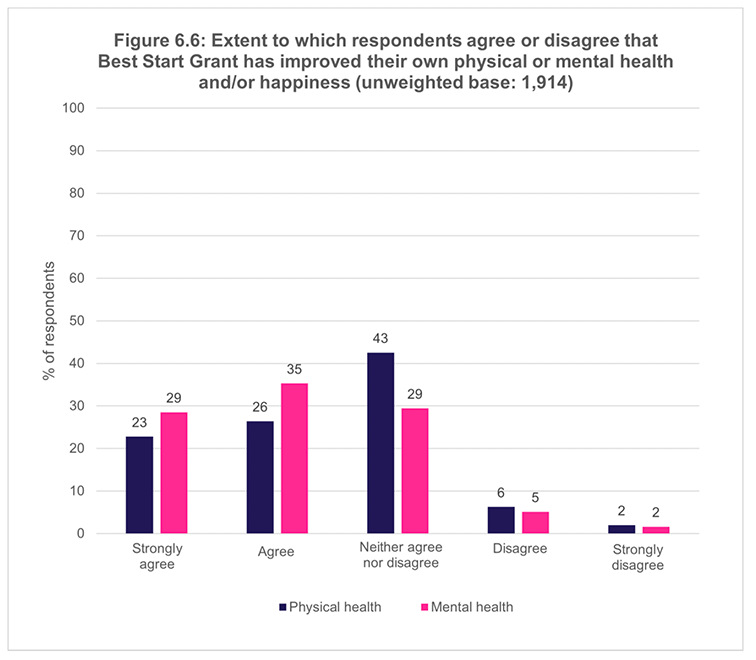
Respondents more likely to ‘agree’ or ‘strongly agree’ that BSG had improved their own mental health and/or happiness included:
- Families with three or more children (68%, compared with 62% of families with one to two children).
- Two or more parent or carer households (69%, compared with 61% of one parent or carer households).
- Respondents from minority ethnic backgrounds (73%, compared with 63% of respondents from white ethnic backgrounds).
There were no other notable differences by priority family groups or area deprivation.
Respondents also reported a positive impact of BSG on their physical health. Around half (49%) of respondents who had received at least one BSG payment ‘agreed’ or ‘strongly agreed’ that BSG had improved their own physical health. Respondents more likely to ‘agree’ or ‘strongly agree’ that BSG had improved their physical health included:
- Two or more parent or carer households (53%, compared with 47% of one parent or carer households).
- Respondents from minority ethnic backgrounds (68%, compared with 46% of respondents from white ethnic backgrounds).
- Households without disabled family members (52%, compared with 47% of households with disabled family members).
There were no other notable differences by priority family groups or area deprivation.
6.3.2. Physical and mental health and/or happiness of children
When survey respondents were asked about the extent of the impact of the BSG payments on the physical and mental health and/or happiness of their child or children, around half (49%) ‘agreed’ or ‘strongly agreed’ that BSG had improved their child’s mental health and/or happiness.
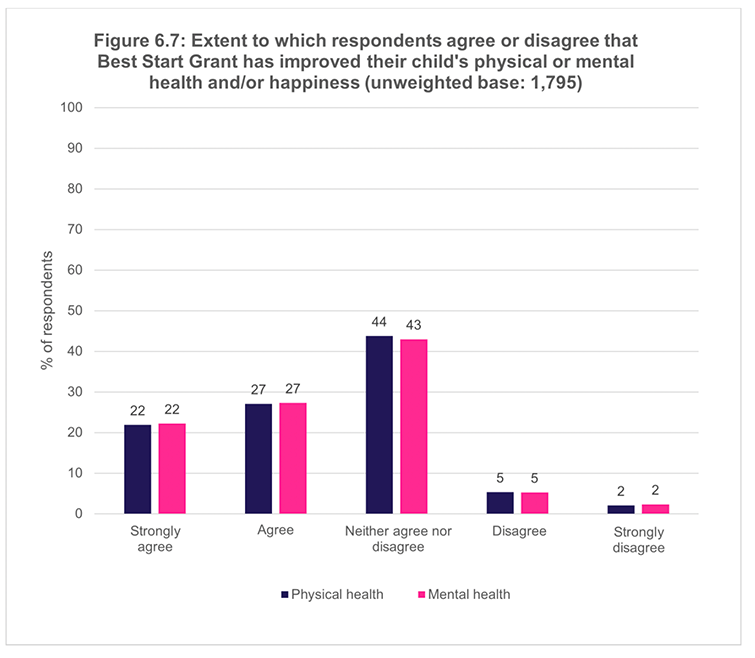
Respondents who were more likely to agree with this included:
- Families with three or more children (57%, compared with 47% of families with one to two children).
- Two or more parent or carer households (53%, compared with 48% of one parent or carer households).
- Respondents from minority ethnic backgrounds (71%, compared with 46% of respondents from white ethnic backgrounds).
There were no other notable differences by priority family groups or area deprivation.
Similarly, around half (49%) of respondents who had received at least one BSG payment ‘agreed’ or ‘strongly agreed’ that BSG had improved their child’s physical health. Respondents from families with three or more children were more likely to ‘agree’ or ‘strongly agree’ that BSG had improved their child’s physical health (55%), compared with respondents from families with one to two children (47%). Respondents from minority ethnic backgrounds were also more likely to ‘agree’ or ‘strongly agree’ with this statement (70%), compared with respondents from white ethnic backgrounds (46%). There were no other notable differences by priority family groups or area deprivation.
6.3.3 How BSG improved health and wellbeing
Similarly with SCP, parents and carers who received Best Start Grant payments reported that these payments had a positive impact on their mental health and wellbeing. Parents and carers who took part in interviews talked about feeling less socially isolated as the payments had enabled them to take their children out to meet friends. Parents and carers also described positive impacts on their child’s development through, for example, having new experiences and better toys.
I was able to get better toys for his learning, I suppose he has benefited from being able to develop maybe better than if I didn't have the payment and I wasn't able to get those, like certain toys or expose him to different days out. (Parent and carer interview)
Contact
Email: socialresearch@gov.scot