
Five Family Payments evaluation: annex A - mixed methods research
This report presents findings from research which informed an evaluation of the Five Family Payments.
4. Impact of Five Family Payments on child spend
A key aim of this research was to explore the extent to which Five Family Payments (FFP) is achieving its medium term outcome to reduce instances of material deprivation experienced by families, and the shorter term outcomes of increased child-related spend. The survey and qualitative interviews explored how families used the FFP and the extent to which they supported families at key transition points in their children’s lives.
4.1. Scottish Child Payment (SCP)
There is clear evidence from both the survey and qualitative interviews with FFP clients and stakeholders that SCP has helped with families’ child-related spend. The impact of SCP on different types of child-related spend is explored in more detail below.
4.1.1. Types of expenditure
Survey respondents currently in receipt of SCP were asked what they spent their SCP on. They were asked to select as many options as applied from a list. The most common source of expenditure was things for their children, such as toys and clothes, with 78% of respondents who received SCP reporting they spent their SCP on this. Day to day household costs (66%), and activities for the child or family (53%) were the other main sources of expenditure of SCP.
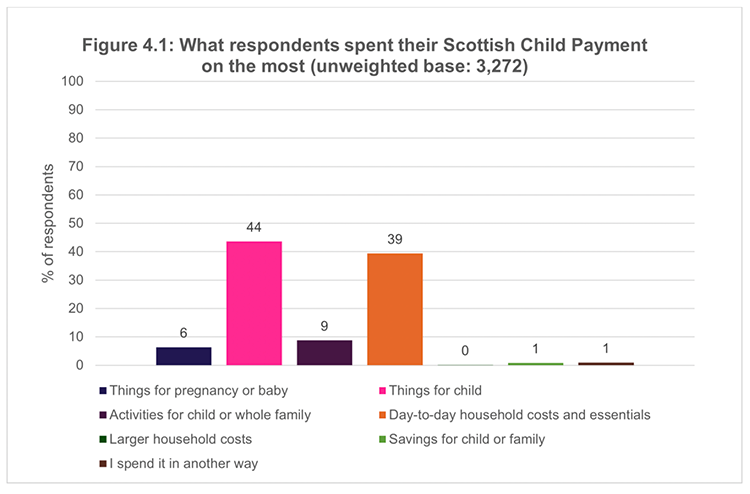
Survey respondents were also asked what they spent their SCP on the most, and could only select one type of expenditure. It was common for respondents to report that they mostly spent their SCP on their children. Half of respondents (50%) reported they spent their SCP mostly on things for the child (44%) or things for pregnancy or baby (6%). A further 9% reported they spent their SCP on activities for their child or the whole family such as day trips or sports and physical activities. However, around two-fifths (39%) of respondents mostly spent their SCP on day-to-day household costs and essentials such as food, bills, travel and housing.
Respondents more likely to say that they had mostly spent their SCP on ‘things for the child’ were:
- From households without disabled family members (46%, compared with 42% of households with disabled family members).
However, around two-fifths (39%) of respondents mostly spent their SCP on day-to-day household costs and essentials such as food, bills, travel and housing.
Respondents more likely to mostly spend their SCP on day-to-day household costs were:
- From white ethnic backgrounds (42%, compared with 24% of respondents from minority ethnic backgrounds).
- From families with no child under 1 year old (41%, compared with 21% of families with a child under 1 year old).
- From households with disabled family members (43%, compared with 33% of households without disabled family members).
Survey respondents could also select ‘other’ to describe what they spent their SCP on, and had the option to provide a written response. Some respondents provided details of the items they spent their SCP on or to indicate that they spent their payments on a variety of items, which for some, changed month to month depending on their child(ren)’s needs. Respondents also shared that while they aim to spend their SCP on their child, there are times that they need to use SCP for bills, food, housing costs or bigger household items or repairs that they could not afford to pay for without SCP.
It’s always used for my child’s benefit, but in what way is dependent on what’s happening on a given month (i.e. clothes, school trips, lunches at school, treats). (Survey respondent)
4.1.2. Impact of SCP on essential child spend
Survey respondents were asked on a scale of 0-5, how much the Scottish Child Payment helped them with different types of child spend, where 0 means the payment hasn’t helped at all and 5 means it has helped a lot.
Essential items
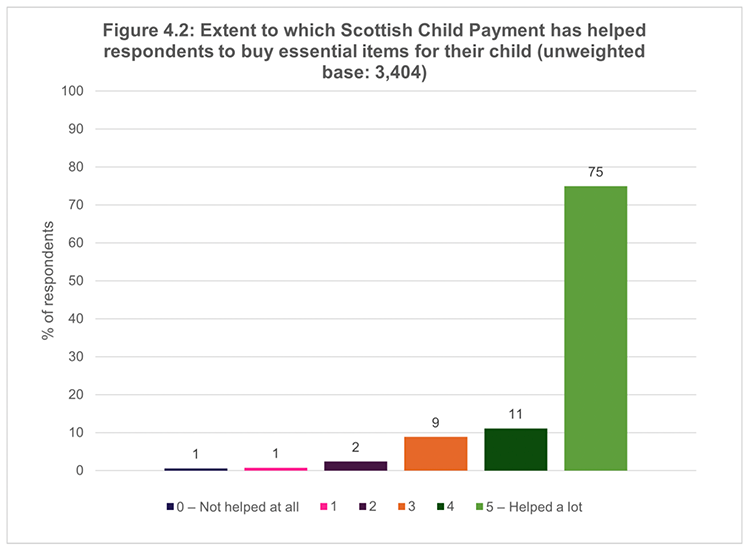
When asked the extent to which SCP helped them buy essential items for their child such as food, clothes, or medicine, three-quarters (75%) of respondents reported that SCP had ‘helped a lot’.
Respondents more likely to report that SCP had ‘helped a lot’ to buy essential items for their child were:
- Families with three or more children (79%, compared with 74% of families with one or two children).
- Households with disabled family member (77%, compared with 72% of families without disabled family member).
- Families from white ethnic backgrounds (76%, compared with 68% of families from minority ethnic background).
There were no notable differences by other priority family groups, area deprivation, or length of receipt of SCP.
In both qualitative interviews and open-text responses in the survey it is clear that SCP helped parents and carers buy essential items for their child(ren). Food and clothing were key areas of essential child spend for children of all ages. Parents and carers highlighted the increasing cost of both food and clothing to the extent that for some parents and carers these were the main, or only, items they spent their SCP on (see section 4.1.3.).
There were parents and carers who shared their gratitude for SCP being extended to children up to the age of 16, as they felt child-related costs only increased as their children got older. There were examples of parents and carers frequently replacing clothing because their child(ren) were growing so fast, and others moving into adult sizes for clothing which increased the cost (see section 5.1.6.).
I mean my grandson of 11 he got his school shoes in August and he got his feet measured and everything and they’re too tight for him now. So after school today I’ve got to go down the town and get him new shoes because he was complaining that they were tight this morning. […] And the oldest one who’s 15 he’s a size 10 ½ in a shoe so he’s men’s prices for his shoes and things like that. For a pair of shoes for…a cheap pair of trainers as [child] called them they’re £60 and that’s for a cheapish pair. (Parent and carer interview)
Most of it [SCP] was for clothes, I spent on clothes, because she's five-foot-seven as well, an 11-year-old. She's into 15-16 clothes. She's only 11. (Parent and carer interview)
Stakeholders also spoke about the ‘massive difference’ extending SCP to children up to age 16 had made to the families they worked with, particularly for families with secondary school aged children who were often growing fast and eating more.
There were other essential items that parents and carers bought for their child(ren) using the SCP, which varied by the age and personal circumstances of the child and their family. For example, parents and carers of newborns reported using their SCP for essential items such as formula milk, nappies, baby wipes and other toiletries they needed on an ongoing basis or in large quantities. Childcare was another example of essential child spend, enabling parents and carers to work or study (see Chapter 7).
I genuinely think this payment has helped so much with the start of my journey as a mother of two. Nappies/wipes/clothes were so expensive especially in Covid things seems to just go way up and having this payment meant I wasn’t worried being on maternity as I know I had this as a back-up. (Survey respondent)
I’ll maybe take some more of it and buy ingredients to make dinners. That’s probably what I’ll use it for the noo. As she gets older that’s when I’ll need to start thinking about things like infant paracetamol, plasters, we’re going to try and make it so that’s her money. It doesn’t go to bills, it doesn’t go to this, it’s her money. (Parent and carer interview)
As noted in the survey, families with a disabled family member(s) were more likely than those without a disabled family member to report that SCP ‘helped a lot’ to pay for essential items for the child(ren). In both the open-text responses in the survey and in the qualitative interviews, parents and carers shared that meeting the needs of their disabled child(ren) could be expensive and that the SCP helped with these costs. For example, enabling them to buy food to meet dietary requirements related to their disability or health condition. Respondents also shared that due to their caring responsibilities for another adult or child in the family, or their own health conditions, they could only work limited hours, or not at all, which restricted their household income. Therefore, SCP was vital in enabling them to buy essential items for their child.
My son had a lot of hospital visits as he grew until recently and it helped us get to them and buy him specific foods that fit his dietary needs. (Survey respondent)
My child has special needs so this payment also helps with costs of vitamins. (Survey respondent)
In both the open-text responses in the survey and qualitative interviews, parents and carers talked about SCP being for their children and where possible, they tried to keep SCP for things their child(ren) needed. Some clearly delineated that income such as wages or benefits such as Universal Credit or Child Benefit, were for household costs and SCP was for child spend. Others, said all their income came together and what they spent it on was based on the child(ren)’s or family’s needs at the time (see Chapter 5).
So I think now when the money comes through I like opened a children’s account for both of my kids because like to try and be organised with funds and make sure that I’m allocating it towards them now when those specific funds come through. I think I try and split it and then put into their savings accounts, not to like accrue that money but just to be able to dip into it for things that they specifically need. So if they need like more expensive shoes, like from Clarks or something like that, then I know that that money will definitely be there. (Parent and carer interview)
I very much concentrated on the money needs to go towards what we need, which is food for the house, nappies for the baby, her toiletries, things like that. It was very much decided through what is essential to spend this money on. […] It was very much decided through what is essential to spend this money on. […] Probably a little bit maybe went to get maternity clothes for me, or do you know like not maternity clothes, but breastfeeding clothes, like easy-open tops and stuff I think I spent a bit of money getting. Just in Asda and Morrisons you can get those brilliant kind of things, so that would have been another thing. I probably did spend a wee proportion on myself, to get myself some clothes, mainly some tops thinking back on it now, yes. (Parent and carer interview)
School spend
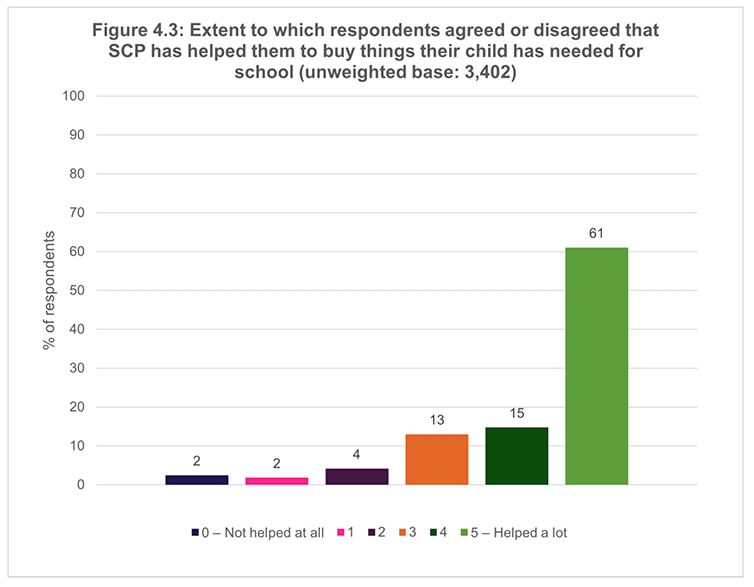
Around three-fifths (61%) of survey respondents reported that SCP had ‘helped a lot’ to buy things their child needed for school, such as pens and pencils, school uniform and school bag.
Respondents more likely to report that SCP had ‘helped a lot’ to buy items for school were:
- Respondents who had been receiving SCP for over 12 months (63%, compared with 58% of respondents who had been receiving SCP for up to 12 months).
Using SCP to pay for school related costs was a common response from parents and carers in both qualitative interviews and open-text responses in the survey. Respondents reported that they used SCP to pay for school uniforms, or clothes needed for school, including clothing for school clubs. Parents and carers shared that they needed to buy multiples of clothes and/or replace clothes regularly because they got mucky or torn while at school, or because their children grew out of clothes quickly.
It’s just things like every month it helps with bills, it helps with new clothes for the kids, as I said with [Oldest child] starting school and [youngest child] starting nursery it’s just things like…for socks, they grow so quickly so then you need to buy them new socks, new shoes every couple of months. It’s just mainly for things like that I would say. And obviously, food and snacks. (Parent and carer interview)
Other school-related costs that respondents used the SCP for included school dinners and packed lunches, school bags and supplies, school fees and school trips and events.
[SCP] Helps me to provide essential items my child needs for day to day, uniform, clothing, school trips to prevent exclusion from friends, would be a huge struggle to manage without it. (Survey respondent)
There’s always things that you’re needing to pay at the school, the school is always looking for money for something. It [SCP] helps to pay that. [Child] would get free dinners as well but he doesn’t…he wants to go out for lunch with his friends during the week, he wants to go to the shops and just be like his other pals. So then I need to like give him money every day for his lunch. I don’t even give myself that money each day for my lunch. (Parent and carer interview)
Again, SCP helped families with additional costs related to additional support needs (ASN). For example, a parent shared that with SCP they were able to purchase their child with dyslexia a tablet computer which helped with online learning.
My daughter who’s 9 has been diagnosed with dyslexia and so I was able to manage to get her a tablet to help with online learning. So things like that it’s made a difference. (Parent and carer interview)
Treats
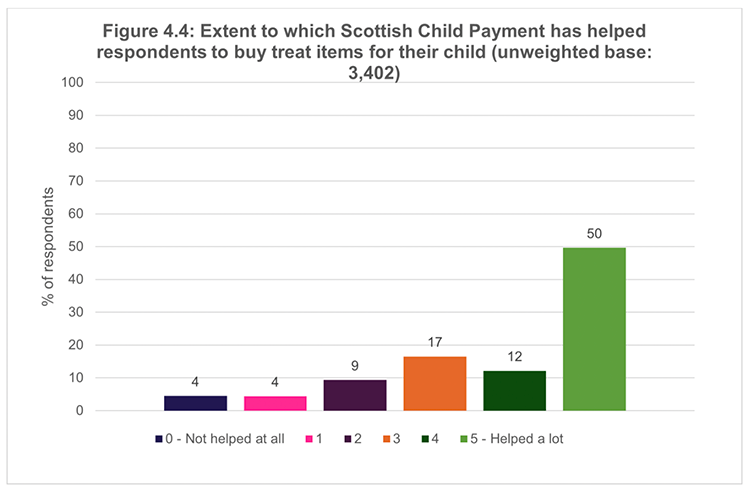
Half (50%) of survey respondents reported that SCP had ‘helped a lot’ to buy treat items for their child, with no notable differences by priority families most at risk of poverty.
Respondents more likey to report that SCP had ‘helped a lot’ to buy treat iteams for their child were:
- Families from the 20% most deprived areas (54%, compared with 45% of families from the 20% least deprived areas).
- Families who had been receiving SCP for over 12 months (53%, compared with 44% or families who had been receiving SCP for up to 12 months).
In both the qualitative interviews and open-text responses in the survey, there were respondents who shared that SCP helped them to buy treats for their children. How respondents defined treats varied and included being able to: buy toys; have a meal or snack out or order a takeaway; give money to their child(ren) to go out with their friends; afford birthday and Christmas presents; and buy new items rather than second-hand items. A treat could also be the ability to buy a child a more expensive or branded piece of clothing that they liked to fit in with their peers (see Chapter 6).
This money is helping a lots for me saving mostly for birthday and Christmas. (Survey respondent)
I’ve been using it [SCP] more just sort of things for the kids, so as I said the 15 year old she kind of wants her room to be a bit nicer and things like that and before we would buy probably second hand furniture and not very matching. So she’s been able to kind of get like her room done. We’re still slowly doing it but she’s been able to get new furniture in her room and she wants to get the room decorated and things like that. So now there is money there that that’s going to be possible to do. (Parent and carer interview)
The extent to which SCP helped families provide treats for the child(ren) varied. In both qualitative interviews, and open-text responses to the survey, parents and carers said they used their SCP to meet their basic needs so they were unable to provide their children with treats at all, or could only do so very rarely. Some families reported that they saved up their SCP to enable them to buy treats for their children, particularly for birthdays, Christmas and for holidays. Others were able to use SCP more regularly or ad hoc for treats and shared the positive impact this had on their and their children’s mental health and wellbeing (see Chapter 6). There were also parents and carers who used their SCP to provide pocket money to their children so they could decide what they would like to spend it on.
Scottish child payment has helped massively in being able to take child on outings to swimming or cinema things that I’d have struggled with he knows that’s his money and we use it for treat days or things that he needs. (Survey respondent)
It probably has gone more on like food and things like that and less on days out but days out are getting more expensive as well. But I always try and like put money towards something even if it’s just going out for like a meal or something just as a treat for the kids. (Parent and carer interview)
Social and educational activities
When asked the extent to which SCP had helped their child take part in social or educational activities, around half (48%) of survey respondents currently receiving SCP reported that SCP helped their children ‘a lot’ to take part in social or educational activities such as clubs, classes or trips out with other children and families. Seven percent of respondents reported SCP had ‘not helped at all’.
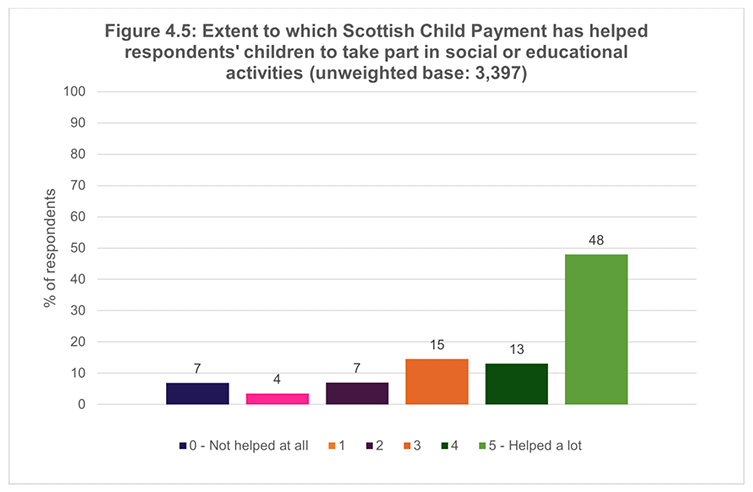
Respondents who had been receiving SCP for over 12 months were more likely to report SCP had ‘helped a lot’ with their child taking part in social or educational activities (50%) than those who had been receiving SCP for up to 12 months (43%). No other differences by priority family groups were reported.
Parents and carers shared, in both the qualitative interviews and open-text responses in the survey, the ways in which the SCP helped their child(ren) to take part in social and educational activities. SCP helped parents and carers pay for their child(ren) to take part in a wide range of educational and social clubs including sports (e.g. gymnastics, football, cheerleading), martial arts, music, drama and other clubs and groups such as Scouts or Brownies. Costs related to these clubs included uniforms, equipment, membership and competition fees.
The extra money has helped my kids to do things we normally struggle with. Hobbies - both boys enjoying boxing club memberships, youth clubs and we were able to buy the boys new bikes for their birthdays this year. We are not a high income household we have never been on holidays but days out and even extra money for Halloween costumes, good food, attending their friends birthday parties with a gift etc.…all the money gets spent on them their needs. It’s a massive blessing for our family. (Survey respondent)
SCP was also used to pay for individual activities for children which helped them develop skills such as swimming lessons, piano lessons or tutors. Parents and carers with children with additional support needs (ASN) spent their SCP on buying sensory educational items for their child. Parents and carers noted that these toys can be expensive so SCP made it easier for them to access what they needed.
She's got a lot of visual things. So she goes to speech and language therapy and Makaton lessons, which is sign language. So she uses visual communication. So she has a lot of vision boards and stuff in the house with photos on so we can show her her routine and stuff like that. […] I actually bought a laminator, it was half price in Argos, so I can go to the library and get my own printed out and laminate them myself because it's going to be a lot cheaper for me to do that than for me to carry on buying them. (Parent and carer interview)
My eldest daughter, the one with autism, there are other things that she needs as well, just things to do with her autism, so that [SCP] all goes mainly for that. Yes, I think, because I now pay, as I say, for my daughter's drama course and for her music lessons, it's just stuff that I just never thought I would have been able to afford, so those are ones that definitely - they make that happen, and it didn't happen without the Scottish Child Payment. (Parent and carer interview)
SCP was also used to enable whole families to take part in social or educational activities. This included trips to the theatre, cinema, museum and activity parks/centres, as well as trips to visit family or friends, or to go on holiday. Being able to afford to take part in these activities had wellbeing benefits for the whole family (see Chapter 6).
I think it’s [SCP] very useful, it definitely gives us a chance to go out for days that I don’t have to worry and think how am I going to pay for that. I mean we took advantage this year of being on…because we’d moved onto Universal Credit a couple of the places that we like to visit were doing tickets a little bit cheaper so that made it a great day out as well, without being too costly. So it allowed us to do something else another time. (Parent and carer interview)
As SCP is a regular payment, it has enabled some parents and carers to meet the cost of these activities on an ongoing basis. There were parents and carers who reported they would have been able to pay for these social and educational activities even without SCP, though they may have had to do without something else. However, other parents and carers reported that without SCP they would not have been able to afford to pay these costs so their children would have done without.
It's [SCP] absolutely essential in our household. I tend to compartmentalise, so I pay my rent and my housing costs and stuff off my wages and then when it comes to the Scottish Child Payment I can say that [child] is in two groups that cost more than the Scottish Child Payment. So, she's at martial arts and she does swimming. These are the two groups that she's maintained and she would not be able to go to that. I wouldn't be able to afford that at all if it wasn't for the Scottish Child Payment. Again, these are groups and clubs that her peers are going to. Her peers at school for the most part have a club or a group like music lessons or gymnastics or dance or whatever they go to and I assume that [child] would be hugely excluded if she didn't go to the likes of swimming. It's something that the peer groups talk about. (Parent and carer interview)
The payment has helped towards my daughter’s dance classes and uniforms something I may not have had the money spare for her to do. It also enables me to do day trips with the family each month without stress. (Survey respondent)
4.1.3. Changes in child spend
The qualitative interviews with parents and carers explored how, if at all, the use of SCP varied at different times of year.
Overall, parents and carers reported that their overall child spend did not vary much by season, but what they spent SCP on did vary. For example, in summer they may spend SCP on summer clothes, ice creams or activities outdoors, in winter they spent it on hats, gloves, warm clothes and indoor activities.
Different seasons. It's like, you're not putting the gas on all summer, but all summer, they're looking for ice creams, they’re looking for - they need new shorts, they need new flip-flops. It's ongoing. So it's seasonal. With children, you didnae really save anywhere. (Parent and carer interview)
There could however be some spikes in child spending, for example at the start of the school year, Christmas and birthdays. Parents shared that to meet these spikes in costs they would try and spread their spending over several months, therefore evening out the spend. Others used credit cards to help meet these expenses, for some in an ad hoc way, and for others in an intentional way, planning out how they will pay money back without incurring charges. Forward planning was a key strategy for families to be able to meet the needs of their child and their household, however, not all families were able to do this, instead living month to month on their income. For these families increased heating costs over winter, often combined with costs of Christmas, made winter months particularly challenging, having to spend more of their income on household costs. The long school summer holidays could also be challenging with children who received free school meals during term-time being at home for more meals. However, some families had income freed up from term-time activities that could be redistributed to pay for food or other needs over this time period.
For after school activities for my daughter to pay for her swimming lessons and she does ballet. […] if there’s leftover money because like in the summer she doesn’t do it so we use it for food bills. […] Basically priorities you know, the stuff you need to spend it on, the food is essential and it’s quite expensive at the moment. Quite a big chunk of the monthly budget goes on food. […] More goes on essentials, on food and like heating bill. (Parent and carer interview)
Obviously the winter, more money goes on electricity, because you can't dry your drying outside. I've got a small pump condenser tumble dryer, so that gets more use in the winter, which uses more electricity. My electricity prices, all those things like the government cap and everything, all of our prices are going up. During the winter months, it's much more of a struggle to make that money last than it would be during the summer months. Priorities absolutely change in the winter months, where that money goes. (Parent and carer interview)
4.2. Best Start Foods (BSF)
4.2.1. Helped with buying first infant formula milk
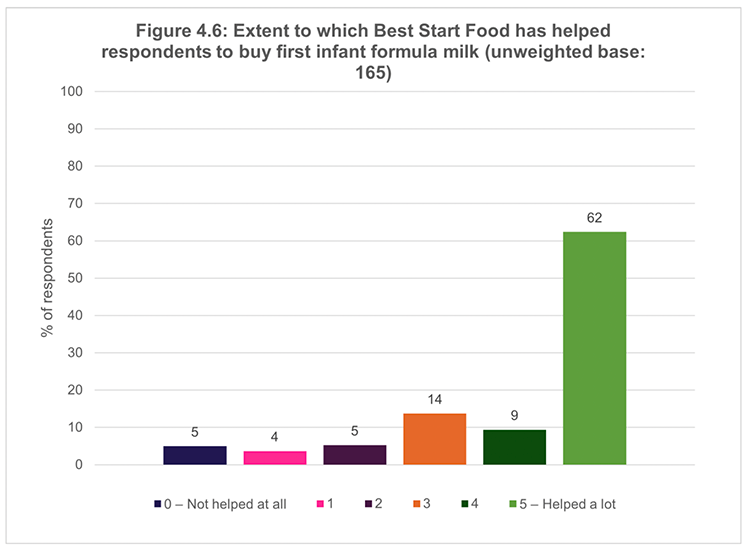
An aim of Best Start Foods is to help families with the cost of buying first infant formula milk. Around one third (34%) of survey respondents receiving BSF said they were buying first infant formula milk for a child or children aged under one. Respondents who were buying first infant formula milk were then asked, on a scale of 0-5, how much BSF had helped them pay for first infant formula milk, where 0 means the payment hasn’t helped at all and 5 means it has helped a lot. Nearly two-thirds (62%) said that their BSF payments ‘helped a lot’ with paying for first infant formula. There were no significant subgroup differences.
4.2.2. Helped with buying healthy foods for family
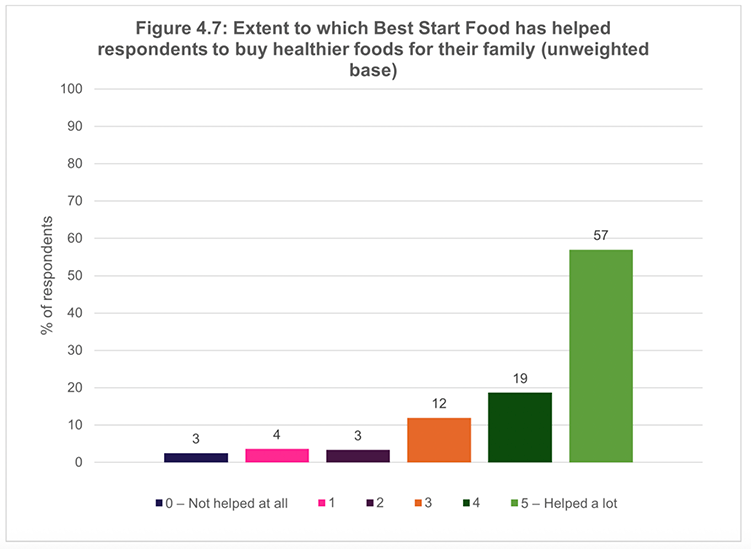
Survey respondents currently in receipt of BSF were also asked on a scale of 0-5, how much the BSF payments helped them with buying healthier foods for their family. Over half (57%) of respondents reported that BSF had ‘helped a lot’ with buying healthier foods for their family.
It is clear from data in both the survey and qualitative interviews that BSF helped families with young children buy and perpare healthy food for their children. This is discussed in more detail in Chapter 6 (section 6.2).
4.3. Best Start Grant (BSG)
There is also evidence from both the survey and qualitative interviews with parents, carers and stakeholders that BSG has helped with families’ child-related spend, particularly at key transition points. The impact of BSG on different types of child-related spend is explored in more detail below.
4.3.1. Types of expenditure
Survey respondents who had received at least one Best Start Grant (BSG) payment were asked what they spent their BSG payments on. They were asked to select as many options as applied from a list. As with SCP, the most common source of expenditure respondents used their BSG on was things for their children, such as toys and clothes, with 71% of respondents who had received at least one BSG payment reporting that they spent their BSG on this. The second most common source of expenditure was things for pregnancy or baby, such as breast pads, formula milk or nappies, with 59% of respondents who had received at least one BSG payment reporting that they spent their BSG on this.
The other main sources of expenditure of BSG were day to day household costs (29%) and activities for the child or family, such as day trips or visits to family or friends (23%).
4.3.2. Impact of BSG on essential child spend
Respondents were asked on a scale of 0-5, how much the Best Start Grant payments helped them with different types of child spend, where 0 means the payment hasn’t helped at all and 5 means it has helped a lot.
Essential items at key transition points
When asked the extent to which BSG had helped them buy things their child needed, such as when they were born, or started nursery or school, around two-thirds of respondents (65%) reported that BSG had ‘helped a lot’.
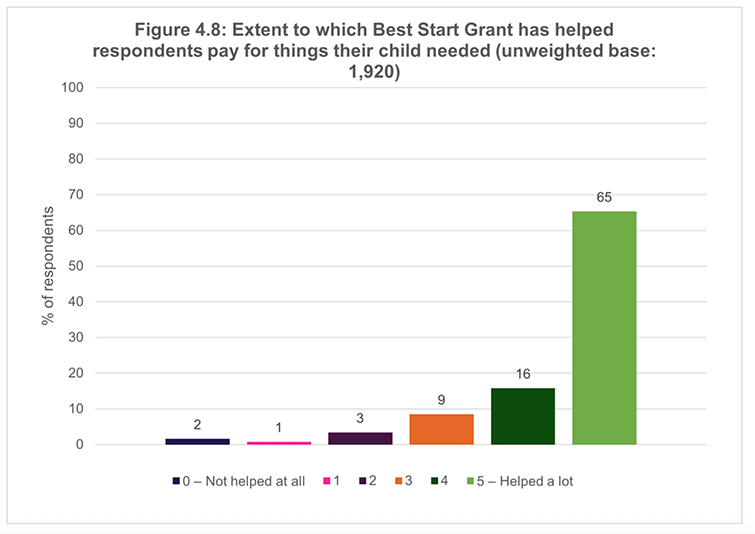
Respondents more likely to report that BSG had ‘helped a lot’ to buy things their child needed were:
- Respondents from two or more parent/carer households (69%, compared with 64% of one parent/carer households).
- Households with disabled family members (68%, compared with 62% of households without disabled family members).
- Respondents from white ethnic backgrounds (68%, compared with 50% of respondents from minority ethnic backgrounds).
There were no other notable differences by priority family groups or area deprivation.
Survey respondents were also asked the extent to which they agreed that they relied on BSG to buy things their child needed, for example when the child was born, or started nursery or school. Around three-quarters (77%) of respondents who had received at least one BSG payment reported that they ‘agreed’ or ‘strongly agreed’ that they relied on BSG to buy things their child needed. There were no notable differences by priority family groups or area deprivation.
It was clear from both open-text responses to the survey and qualitative interviews that all three BSG payments helped parents and carers buy things their child(ren) needed when they were born, going to nursery and going to school. Further details on each payment are provided below.
Pregnancy and baby payment
Stakeholders spoke about the positive impacts of the BSG Pregnancy and Baby Payment, which they felt came at a time when family finances could be particularly stretched. Parents and carers used the payment to buy a wide variety of items. There were parents and carers who reported that receiving the large one-off payment enabled them to buy expensive essential items such as a pram, cot, car seat or bedroom furniture.
It went quick because the cot was £200, the pram was near enough £300 […] and my breast pumps and the bottles, so I don’t think it actually covered all of that but it covered the majority of it. So it allowed me to get the things I needed so it was…it’s a good whack of money that really does help. (Parent and carer interview)
With my first, that [BSG Pregnancy and Baby Payment] helped me buy her cot, her wardrobe, her chest of drawers, because that cost us £600 for the whole set for the bedroom because I genuinely had nothing. I got a Moses basket and stuff as well with that. Then the second time round, I obviously needed a double pram. I'd kept a couple things from when I had her, so I managed to get the baby's car seat, the double pram, and a couple of other essentials with the maternity grant the second time round. If it wasn't for me being able to get them, I genuinely would have struggled to be able to afford to buy those larger items because I obviously don't have a lot of family support and I've only really worked part-time when I have, and baby things are expensive. So it definitely took a lot of pressure off. (Parent and carer interview)
The large payment helped some parents and carers to invest in better quality, safer or new items such as car seats or prams that gave them peace of mind and/or best met the child’s and parent’s needs. For example, a respondent shared they had received a second hand pram which only allowed the child to lie down. As the child got older they wanted to sit up and look around and cried when they could not. Receiving BSG enabled the parent to buy a foldable pram that enabled the child to sit up and see which made them happier, and it was also easier for the parent to get up and down stairs.
I'd been looking at the same car seat, the car seat that I got for him and her car seat, because I've just bought her a new one actually, with the Scottish Baby Payment, because she was getting out of her current car seat. She was managing to pull her arms out the straps. So I ended up buying her a new one. The ones that they've both got have been tested to the maximum capacity of what Sweden tests their car seats to because they've got the best car seat laws and restrictions. They're obviously a bit more expensive, but they are a lot safer than what the car seat I did have for her was. (Parent and carer interview)
Respondents who had pregnancy and baby items from a previous child, or gifted by family, friends and/or organisations, were able to use the pregnancy and baby payment more flexibly for their child or wider family. There were examples of respondents using the payment to pay to furnish their child’s room, move home or buy they child(ren) toys or other items they needed. Sometimes this was for the eligible child only, but some parents and carers with large families also used the payment to buy items for their other children.
We buy new carpet and some toys and stuff because the pram and all the furniture we had before. But yeah it was spent all on the kid. […] I think it was maybe £150 saved from this but I spent it for clothes to be honest she grows so fast. Yes so it was maybe 2 months later for new wardrobe for her. Yeah and winter stuff I think. I think I bought something for the pram to cover her in the winter. […] To be honest it was quite help because you have like peaceful mind and you can afford everything that the child needs. I know that someone maybe used it for bills, food etc. because everyone have like different situations at home but yeah I was quite happy that I can buy her everything that she needs. (Parent and carer interview)
Some parents and carers also used the pregnancy and baby payment for items they needed as a new mum, for example maternity clothing, breast pumps and breast pads.
While the pregnancy and baby payment did not always cover all the new child costs, overall it helped families to buy what they wanted, when they needed it. Without BSG there were parents and carers who said they would have had to save up for items, particularly more expensive items.
I mean I think we would have managed but we would have had to have put a lot of money by and just gradually took money out to buy certain things. I think it might have took a bit longer to get everything we needed. Whereas when the payment came in it was…you could buy the stuff you needed and then add…anything else you needed you could just get that just before my son was born. So it was really handy the time when it came. (Parent and carer interview)
Early Learning Payment
Open-text responses in the survey and qualitative interviews indicated that parents and carers used their Early Learning Payment in a wide variety of ways.
There were parents and carers who used the early learning payment to prepare their child for nursery. This included using the payment to buy clothes for nursery, whether that was a uniform or clothes suitable for activities at nursery. Parents and carers shared that their child’s nursery required certain items like wellies, waterproofs and hats and gloves to be bought and left at nursery. This required parents and carers to buy multiple items and the BSG payments helped them with this additional cost. The SCP was also used to buy items to help with potty training in preparation for the child going to nursery, or to pay for nursery fees.
Because they go through so many different sets of clothes, so I used it to just buy multipacks of clothes, whether it was from George at Asda…loads of different leggings or wee tracksuit bottoms and multipacks of tops. Bags, they needed to take a bag and then the nursery want you to provide like wellies and wetsuits and stuff to go into the nursery for them to keep there. So I feel like you’re constantly spending money because you’ve got to have like wellies and like stuff like that in your house but then the nursery want a set to keep as well and they’re not cheap. So it definitely helped to buy that kind of stuff and they want to keep hats and scarves and all that in the nursery as well. You’re kind of like doubly buying when you’re buying stuff for your kids you know. It definitely helped to buy all that and hand that into the nursery. […] with getting the kind of list from the nursery of all the things that they need you’re just like oh…I was like god like…I don’t have much extra money as it is so yeah it definitely…it did definitely help with that. (Parent and carer interview)
As was the case with SCP, respondents reported that the larger value of the BSG Early Learning Payment helped them to invest in better quality items such as shoes that would last longer. The payment also enabled parents and carers to buy clothing as and when their child(ren) needed. Children at this age quickly grow out of clothing or clothing gets well-worn from play and activity.
Yes, I got that one for my oldest and that was just before she started nursery. So I went out and bought her some Clarks trainers because they're obviously really good trainers. They don't get scuffed up as quick as what cheaper trainers do. And I went and bought her loads of spare clothes that she could just wear for nursery because obviously, you can imagine their clothes get ruined at nursery. A hat and gloves, a bag, lunchbox, stuff like that. So that really helped out too. (Parent and carer interview)
There were also respondents who used their Early Learning Payment on household essentials such as food, and unexpected expenses such as car repairs. This was not always how parents and carers planned to use the payment but it was what was needed at the time for the family.
Amazing! Amazing, it was brilliant because my car had just broken down. So yeah that money was a wee bit of a relief so yeah I was able to then get my car repaired. I know it’s not supposed to be used for that, needs must, I had to. […] The guidance was it was to be able to either buy clothes, buy toys, or take [child] out on days out. So that was the guidance on how it should be spent but to take [child] on days out I needed the car! (Parent and carer interview)
School Age Payment
In interviews, parents and carers predominantly described using the School Age Payment to pay for school uniforms and other clothing and stationary needed for school. As with the other BSG payments, while some parents and carers used the payment only on the eligible child, others used the payment to buy items for multiple children where there was a need. Parents and carers with large families highlighted the expense of clothing multiple children, particularly because they are constantly growing out of clothes.
Well by the time the 6 year old went to school I had three at school and one being a teenager, it was expensive but I like to have maybe four or five outfits for the week. I don’t like to have just one or two of things because I feel if you have an outfit for each day you can be more organised and get them ironed and things like that for them for the week and they last the year. […] we used it all towards the school clothes. (Parent and carer interview)
As was the case for nursery age children, there were also parents and carers of school age children that were required to buy multiples of items so that a set could be used at school. The School Age Payment of BSG helped towards meeting these additional costs.
They’ve got like a wee forest at the back of the school so they want waterproof suits and stuff and they want extra wellies and hats and scarves that they keep in the school. So it’s definitely helped with that and then kitting out their school bags with their pencils and everything, it definitely helped out with that. I get help with like a school clothing grant from the council but that’s…it’s not much by the time you’ve like bought their clothes and their shoes and everything, it’s like that’s pretty much done. […] And they grow so fast […] I buy him clothes and then I feel like a month or 2 months later they’re dead short on his legs and it’s like god I’m constantly buying stuff. (Parent and carer interview)
As with SCP, there were also examples given of the School Age Payment helping parents and carers meet the needs of a child with sensory needs linked Autism. A parent shared that due to sensory needs, they needed to be very careful with choosing clothing for their child which could be more expensive than standard school clothing. The School Age Payment helped meet this additional cost so their child could wear clothing that met their needs.
He just started school in August, yeah August, so yeah we received that [BSG school age payment] which was amazing and we obviously used that for things like his school uniform, for his first school haircut […] he has sensory difficulties, so we had to make sure that the uniform we bought was okay with his skin and kind of checked the labels and things like that. […] you’d have to maybe get the bus because I don’t drive and go to different supermarkets and try out different clothes and see how he reacted with the textures when he had them on. […] you weren’t just buying kind of one jumper, obviously they’re children and their knees are going to get scuffed and things so we did buy…we did spend quite a lot on the uniform, especially because we found the right texture and the softness of uniform for [child] so we thought we may as well just get a few in case maybe M&S changed their uniform and then we had to go on a crazy hunt again. So yeah I think the majority was spent on things like that. (Parent and carer interview)
A stakeholder spoke about families being able to use the School Age Payment to help their child fit in with peers at school (see Chapter 6).
with the School Age Payment, being able to get the bag that every other kid is getting rather than the one out of Asda, because there’s a lot of peer pressure. So normally they wouldn’t have the money to do that but that lump payment will maybe provide that. (Stakeholder interview)
Social and educational activities
When asked the extent to which BSG had helped their child take part in social or educational activities such as clubs, classes, or trips out with other children, around a third (35%) of survey respondents reported that BSG helped their children ‘a lot’. Ten percent of respondents reported that BSG had ‘not helped at all’.
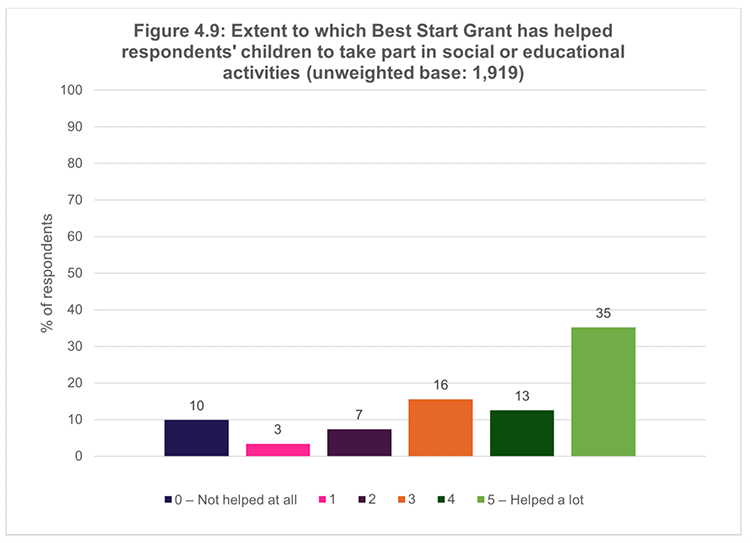
Survey respondents from families with three or more children were more likely to report that BSG had helped their child a lot with taking part in social or educational activities (40%), compared with families with one to two children (33%). There were no other differences by priority family groups or area deprivation.
As with SCP, BSG payments were used by parents and carers to pay for social and educational activities for the child(ren). The Early Learning Payment was the BSG payment qualitative respondents said they used primarily for social and educational activities, both for the individual child and the whole family. For example, there were parents and carers who used the payment towards purchasing annual passes for local activity centres or places like the zoo. Parents and carers also used the payment to take their child(ren) on days out or to buy them toys.
When I got it, it was actually like near [child]'s birthday when it came through, so I got him some more needed toys that he, ones that were more age-appropriate for his age that he was going to, and some summer toys and some summer days out, just so that he could enjoy that payment for him. Because again, I, any money that's meant for him, I'd feel so guilty if I had to use it on myself! So, I just make sure that when it comes in, I spend it on him, so he, even though he wouldn't know, but it's just, I don't know. (Parent and carer interview)
Contact
Email: socialresearch@gov.scot