
Five Family Payments evaluation: annex A - mixed methods research
This report presents findings from research which informed an evaluation of the Five Family Payments.
3. Five Family Payments application process
One of the objectives of this research was to explore and understand the extent to which Scottish Government efforts to engage marginalised groups have been effective and have led to greater awareness of the Five Family Payments (FFP) and encouraged take-up of FFP.
To explore this, parent and carer experiences of applying for FFP were explored in the qualitative interviews with parents and carers and with stakeholders who support low income families. Parents and carers discussed how they became aware of the payments, their reasons for applying and their experiences of applying for the payments, including what helped the application process and what made it more challenging. Stakeholders spoke about their experiences of supporting families to apply for FFP, including levels of awareness about the payments among eligible families and support staff, and barriers and facilitators to applying.
3.1. Take-up of Five Family Payments
Parent and carer experiences of applying for and receiving FFP varied. Some had only ever been in receipt of Scottish Child Payment (SCP) while others had received multiple payments. While some parents and carers had applied for more than one of the FFP simultaneously, others had applied for one or more payments at different time points.
3.1.1. Awareness of the Five Family Payments
In interviews, parents and carers reported becoming aware of FFP through a variety of ways, including:
- Through word of mouth, such as from friends, family and colleagues.
- From conducting their own research online.
- From their midwife, family nurse or health visitor.
- From other professionals they were in contact with.
- From social media platforms and national news.
- From their children’s schools.
- From their local council and through communication from Social Security Scotland.
Parent and carer awareness of FFP varied. There were those who were aware of some of the payments but not others. For example, there were participants who had received one of the Best Start Grant (BSG) payments but they were not aware of the introduction of SCP at that time.
There was also variation among parents and carers of when they applied for BSF and BSG. While some applied for BSG and BSF as soon as they became eligible during pregnancy[7], others only found out about the payment once their baby was born. Discussion about FFP sometimes only arose because a parent or carer disclosed to a professional that they were struggling financially. The variation in when participants became aware of FFP led to some participants missing the chance to receive certain payments earlier, such as receiving BSF during pregnancy.
She [family nurse] asked me if I was receiving [BSF] and I was like, 'No, I didn't even know about it.' Then she was like, 'Oh, you could've been getting it this whole time,' and I was like, 'Oh great.' At least I found out later than never. Better late than never. (Parent and carer interview)
Lack of awareness of FFP also resulted in some families missing the opportunity to receive certain payments, such as BSG Pregnancy and Baby Payment. By the time they became aware of the payment, their child was no longer in the eligible age range. Others reflected that they could have received a different FFP earlier if they had been made aware of them sooner.
I just found out about [SCP] about a year and a half ago. It’s not a payment everyone knows about and it’s helped me with day to day living so I’ve lost so many years as it’s not an advertised payment. (Survey respondent)
A lack of knowledge and awareness of FFP was commonly raised as a barrier to take-up of the payments by eligible families. Reflecting on their own experiences, parents and carers shared instances of informing friends and family members of the payments and encouraging them to apply. There was a perceived lack of advertising and promotion of FFP and their eligibility criteria within local communities. Additionally, parents and carers highlighted that families, who do not have access to welfare advisors or other individuals who can direct them to appropriate support, would have limited knowledge of their entitlements.
I genuinely think it's just not well known. It's not got enough advertising and pushing it out there, getting it into the community. I don't ask, it's not something you ask, but I don't know how many people I know would be on these kind of payments. They're so helpful, they could help so many people that qualify for them and aren't getting them. It's quite sad really. There could be people out there. (Parent and carer interview)
Stakeholders’ views
Stakeholders were asked about knowledge of FFP among the families they worked with. While acknowledging that levels of take-up of FFP was high among the wider population, levels of awareness among their clients were felt to be low. Their clients included a wide range of low-income families including those with English as a second language, survivors of abuse, lone parents and single parents. The variety and complexity of benefit payments meant that their clients were often unaware of which benefits they were receiving. Child Benefit and SCP were commonly confused, with families receiving Universal Credit and Child Benefit assuming they were already receiving all their benefit entitlements. Stakeholders perceived that the relative newness and lack of media coverage of the devolved benefits meant they were less well-known than the reserved benefits.
There is definitely a lot of confusion around the new devolved benefits. As such, a lot of clients do not realise that there are benefits that are devolved. I think that is probably another reason why these five payments sometimes get missed because they're not in the mainstream media. Like we see all the Universal Credit and Child Benefit, Housing Benefit, whatever. That's all in our mainstream media, but unless you are really looking for it, it's quite hard to find. (Stakeholder interview)
Families with the lowest levels of awareness of FFP identified by stakeholder interviewees included those with older children, women who were pregnant with their first child and single parent fathers. Stakeholders also described barriers to awareness of FFP among minority ethnic families. For clients whose first language was not English, low literacy levels could make it almost impossible to access information. Stakeholders reported supporting clients with very limited knowledge of their immigration status and government systems, including the benefits system.
Awareness of BSF and BSG Early Learning and School Age payments was felt by stakeholder interviewees to be particularly low. While many clients had been told about the BSG Pregnancy and Baby Payment by their midwife or health visitor, some had not and had missed out on the payment.
Stakeholders were also asked about levels of awareness of FFP among colleagues in their organisations. Staff providing specialist benefits advice were felt to have good awareness of the payments. However, awareness levels among non-specialist staff tended to be lower largely due to the complexity of benefit eligibility criteria. Colleagues could find it difficult to advise clients to make an application. Stakeholders indentified low literacy and digitial illiteracy or digital poverty among their clients as barriers to awareness of FFP (see see section 3.1.3).
I would say general-level awareness can vary between the people that you speak to. Again, because of the uniqueness of the clients we work with, it really does. It's not as simple as saying, 'Well, you are entitled,' or 'You're not entitled.' There's a lot of work has to go into working with a client to ensure that they are getting what they are entitled to. The awareness level, again because it changes so frequently, it can be difficult to keep up with that. (Stakeholder interview)
Finding the time to keep up to date with information about benefits was reported by stakeholders to be difficult and demanding.
3.1.2. Experiences of the application process
Experiences of applying for the Five Family Payments were generally positive and changes made to the application process have helped address some of the challenges identified by parents who applied when FFP were newly introduced. However, stakeholder, parents and carers identified factors that made applying for FFP challenging which could affect takeup of these payments. These factors are outlined below.
What helped the application process
Content and structure of the application form
In interviews and open-text responses in the survey, overall, parents and carers were positive about FFP application process. They reported finding the application form easy to complete, with minimal need for support. They appreciated that the language used was easy to understand and that it could be completed online.
It’s [application form] quite straightforward, they don’t use bulky language which can throw a lot of folk off. So it was quite straightforward. (Parent and carer interview)
Overall, parents and carers found the application process straightforward with minimal stress. They often made comparisons to their experiences of completing applications for other benefits such as Universal Credit. Participants reflected that they would usually seek out support to complete forms, but additional support wasn’t necessary for them to apply for FFP.
It all went very smoothly. There wasn't any point where I felt stressed or felt I was having to chase anything up. (Parent and carer interview)
Usually, I have to get people to help us fill out forms, especially if it's on paper because sometimes I don't understand the questions and stuff, but I never struggled. I think maybe it helps because it's on your phone. It's a lot easier to fill things out on your phone than it is to write them down on a bit of paper. I never had any problem. I found the process for all of the applications really easy. (Parent and carer interview)
Receiving support with the application process
Some parents and carers benefited from receiving support to apply for FFP. Parents and carers had positive experiences of receiving formal and informal support to complete the FFP application form. Experiences of support included receiving advice and guidance from Social Work, their midwife and family members. Parents and carers also described receiving helpful advice and guidance on applications from Social Security Scotland, describing staff as helpful and friendly.
It was very easy to apply for my application was dealt with easily and quickly. I have been treated with respect and kindness from staff. (Survey respondent)
It has been a great experience and the staff I’ve spoken to on the phone when setting up were all fantastic, especially when it came to adding my new baby to the claim. It has definitely helped us to be less stressed about money. (Survey respondent)
Parents and carers were largely positive about their experiences of communicating with Social Security Scotland and described being treated with respect by professional staff. Parents and carers shared that this was often different to their experience of applying for benefits offered by the Department of Work and Pensions (DWP).
I don't think it can be understated how much [BSG], particularly the way it was non-invasive in claiming it, gave a level of peace of mind and dignity to my position as a newly-single parent. Having a child and ex-partner who both have some complex mental health diagnoses, the uncomplicated way in which I was able to access this extra help was a huge boost to my own mental health and wellbeing. This is an important distinction in my opinion. A payment that in language terms respects a person's autonomy and individual dignity, rather than involving long interview processes and form filling that require a person to tell every detail of their lives to strangers. (Survey respondent)
Stakeholders were also positive about their communications with Social Security Scotland. One stakeholder also identified a difference in attitude towards benefits between the DWP and Social Security Scotland.
It feels very much like a lot of the Westminster benefits are designed to prevent fraud or people claiming unnecessarily. It’s quite hostile. It’s like, if you are claiming, should you be claiming? Not, you’re not claiming? Well should you be claiming? So it’s that kind of…I think there is a difference there. (Stakeholder interview)
Stakeholders welcomed the provision of a freephone contact number for Social Security Scotland, explaining that clients often had little or no phone credit available to make calls.
Online applications
The online mode of the application and the language used in the form were also considered helpful in completing the application.
I'm quite digitally literate, so I could get through it, but I could also quite clearly see where there was scope for people to step out and get help where they needed it as well, even though it was digital first. (Parent and carer interview)
Stakeholders also spoke about the benefits of online application forms, describing how the availability of online forms helped them offer telephone support, which was often preferred by parents and carers.
Most of the forms now are all online so there isn’t the same need [for in-person support] and I think parents find [telephone support] an awful lot better. So they can just get the help that they need there and then, follow up appointments whatever and they can just build that around their day. (Stakeholder interview)
Automation within the application process
As outlined in section 1.5, some automation has been introduced to FFP application process to make it easier for parents and carers to apply for multiple FFP at the same time. Overall, these changes have been positively received. There were parents and carers who participated in an interview who had benefitted from these changes and described being able to apply for more than one of the payments within the same application. For instance, when applying for a BSG payment, participants were able to select the option to apply for BSF simultaneously.
I was very surprised, very delighted, yeah I mean I couldn’t be more pleased I would say. Just I mean I didn’t have to know anything about it, I didn’t have to apply for it or anything like that, I mean it just kind of all happened automatically. (Parent and carer interview)
Furthermore, parents and carers with multiple children described the ease of adding younger children to their existing SCP account, rather than having to complete a new application for each child. Those who had been in receipt of one of the BSG payments for an older child were aware of the three payments available and would apply once their younger children were eligible.
Automation of the BSG payments was also identified by stakeholders as a positive development that had helped to simplify the claims process and ensure more families were receiving the payments
What made the application process more challenging
Content and structure of the application form
While the overall experience of applying for FFP was postive, there was some discussion of challenges parents and carers faced which could act as barriers to families receiving FFP. For example, some found the application form too long, they experienced challenges completing the form, or they experienced a long wait for a decision after submitting the application.
Parents and carers also reported some challenges with communication with Social Security Scotland, such as not having enough time to phone and wait to speak to staff and challenges with reaching staff through the live chat.
Parents and carers also shared experiences of having their FFP application initially rejected despite being eligible for the payments. Rejections of applications were often a result of participants not providing enough evidence, though this feedback was reportedly not provided until participants had contacted Social Security Scotland.
Like, yes, it's like all very backdated, so it took them forever for it to come through but finally, I did get told that I was getting it, but it was a lot of unnecessary anxiety that it caused, because twice they were like, 'We can't offer you it', instead of looking at it and being like, 'Oh, we could offer you it, if you give us this evidence.' But both times, it was a solid no and I'm sitting there thinking, 'But I meet all the criteria. How are you saying no to me?' (Parent and carer interview)
A stakeholder spoke about how having an application refused could prevent families from applying for benefits in future.
I know that that’s just going to make it even harder for them to apply for other benefits in the future because the more often you’re rejected for a benefit the more sort of jaded you become and disenfranchised by being part of the system [...] There are literally benefits where if you apply a day before you’re eligible, it will get rejected and then at that point you go’ ‘Oh well I’m not entitled to that’. And you live without it. It’s maddening, absolutely maddening. (Stakeholder interview)
FFP eligibility linked to Universal Credit
Stakeholders described other ways in which the processes of applying for FFP could act as a barrier to claiming for the families they worked with. The most frequently reported issues arose from the link between Universal Credit (UC) and eligibility for the FFP. Making a claim for UC could be very complicated, with complexity increased by the fact that UC is administered by the DWP while FFP are administered by Social Security Scotland. There was a perception among stakeholders that DWP do not explicitly advertise Social Security Scotland benefits to Scottish recipients, therefore there were parents and carers who were not aware of their eligibility for FFP.
See unless you’ve got somebody that deals with everything that’s the only way you ever get a full picture. So for example, the DWP will deal with Universal Credit that’s all they’ll ever be able to tell you aboot. Social Security Scotland they’ll only ever be able to tell you aboot their benefits. We are really the only people that have actually got a full picture, the full circle and we can say to people right do that, do that, do that, do that, so it’s got to be like in the independent advice sector. (Stakeholder interview)
Stakeholders also felt that the two administrative systems created additional confusion for families and for staff working to support them. As a result, a successful application for UC required support from staff with indepth knowledge of both systems, which stakeholders felt was limited in Scotland. Without this support, those who could be eligible for FFP were not receiving these payments because the complexity of UC as a qualifying benefit.
I think nowadays if you were to go into loads and loads of advice agencies and ask somebody to sit down with a pen and a bit of paper and do a benefit check with the rates, I don’t think they would be able to do it. I think people now are relying on benefit calculators and if you’re relying on a benefit calculator you don’t understand the system so you’ll maybe no’ necessarily understand what could make a difference in this person’s circumstances. So somebody fairly recently I spoke to was getting help for their childcare through one of the…the schemes have changed but basically you get it aff your taxable pay that’s the benefit of it you’re saving on the amount of income tax. But you cannae get that and Universal Credit, it’s an either/or but I worked oot that they would actually get a small amount of Universal Credit which would get them the Scottish Child Payment so they would actually be far better aff with Universal Credit. See unless you understand that system and you can factor all that in, I don’t think you can do it with an online checker and I think in Scotland there is a real lack of people that can do an in-depth benefit check in that respect. (Stakeholder interview)
Parents and carers also highlighted challenges with the eligibility criteria for Universal Credit and FFP. For example, households who did not have a fixed income found it difficult being accepted for UC due to their fluctuating income. As a result some had to apply multiple times to be accepted which delayed their receipt of FFP. Stakeholders perceived that there were families, due to the complexities of their lives, who would not reapply if they were rejected and as a result they may miss out on the payments altogether.
There’s a lot of problem solving involved and when these families have mental health issues, learning difficulties, disabilities, just kids demanding things, you know even issues with their neighbours, dogs that are out of control, it’s really hard to try and navigate those systems with a clear head and get what you need out of it and then you’ve got other problems as well when you’re doing the forms and the language isn’t necessarily clear. There’s even points when I’m going through some of these things and I’m like I’m not quite sure what they’re actually asking here. I have to go and do the research, making sure I’ve got the right understanding before I put in the wrong information because you put the wrong information in you get rejected. You then believe you’re not entitled to it; you then go without it, and you might never apply again. So it’s just making sure that…there’s a lot of hand holding as necessary unfortunately for a lot of these things. (Stakeholder interview)
Stakeholders spoke about how establishing eligibility for FFP often required careful consideration of a family’s individual circumstances, which required expert knowledge. The benefit calculators relied upon by non-specialist support staff and clients were felt by stakeholders to be unable to take full account of complex individual circumstances and interactions between different benefits. Parents and carers described instances of receiving incorrect information and advice regarding their eligibility to apply for FFP. Benefit advisors who were not well informed about FFP and their eligibility could act as a barrier to applying for other families. Stakeholders were clear that the complexities of the benefits systems meant that many of the families they worked with would be unable to claim without intensive skilled support.
[A third sector staff member] told me that I wasn't entitled to it and when I was entitled to it, and that's as well how people would maybe not be able to get these payments, because they maybe go to the wrong person for advice and get the wrong advice, and that's put a stop to it, whereas I did do that. (Parent and carer interview)
Automation of the application process
As described in Chapter 1, changes were made to SCP in November 2022 which enabled those in receipt of SCP to automatically get paid the BSG Early Learning Payment and School Age Payments for eligible children. While some parents and carers experienced this automation, others did not, despite being eligible for these payments after automation was introduced. It is not clear why this automation did not occur. They described having to remember to apply for each BSG payment when their child had reached the appropriate milestone. This could result in families missing out on payments, or receiving the payments late.
Literacy and language barriers
In interviews, parents and carers were asked about particular groups of families who may face challenges with taking-up FFP. They discussed that parents and carers with low digital literacy may struggle to apply and those with learning difficulties may find the application long and confusing to complete. Additionally, there was a view that parents or carers with physical disabilities who are housebound may find it difficult to seek out additional support or information to apply.
There were parents and carers who were not fluent English speakers who reported that the support they received from Social Security Scotland was clear and helpful when applying. However, language was described by some as a potential barrier to take-up of FFP, with participants sharing instances of families relying on their children or friends to translate letters and forms to support them.
Stakeholders who took part in interviews were also asked about barriers to applying for FFP among the range of families they worked with. Most frequently discussed were barriers faced by minority ethnic families including those with refugee or asylum seeker status. Having limited English language was described by a stakeholder as a ‘massive barrier’ to applying for benefits. In addition to being unable to read the application form, clients whose first language was not English could find contacting organisations for support with their claim challenging.
I think that there is an apprehension, a fear that I still have to phone and it's going to be in English, for a start, and if they don't have a support network of someone who can speak English, then that's a really scary prospect. Just not knowing, not understanding, that's a very daunting prospect. (Stakeholder interview)
A stakeholder identified a fear of authority as a further deterrent to applying for benefits for families seeking asylum.
They have often come through particular hardships to even get to Britain. They’ve gone through the process, which is not easy, being in Home Office accommodation and can be very fragile and don’t maybe want to particularly interact with official organisations, so will miss out. (Stakeholder interview)
Stakeholders welcomed Social Security Scotland’s provision of benefits information in a wide range of languages. However, some clients were illiterate in their own language and struggled to read even translated information. For a small number of clients, translation work was complicated by the fact that they spoke rare dialects of their native language.
Understanding how immigration status affected benefits eligibility could be very difficult both for families and for stakeholders. Families given the Right to Reside or Habitual Residency were often focused on trying to claim Universal Credit from the DWP and, due to a lack of joined up awareness raising, be unaware of the devolved benefits.
I would say they’re definitely the biggest percentage of parents that haven’t claimed benefits and have absolutely no idea and because usually once they get the Right to Reside and Habitual Residency and they’re claiming Universal Credit they’re so focused on claiming Universal Credit because that’s the benefit that is going to keep them going. They don’t realise there’s other things, and the problem is when it comes to advertising or information, the DWP won’t tell you about Social Security Scotland and Social Security Scotland won’t tell you about the DWP benefits. (Stakeholder interview)
Providing evidence to support a claim was a further barrier for some minority ethnic families. Stakeholders spoke about families who had no photo ID and, sometimes, no birth certificates for their children.
Digital poverty and digital illiteracy were also identified by stakeholders as barriers to applying for the families they worked with. Completing benefit applications could be a lengthy process and clients often had limited or no access to a computer and limited data on their phones. Trying to complete a benefits application on a mobile phone was also a challenge.
I think other barriers again is digital access in… For all benefits, there's a level of requiring that digital access now, and that's not always possible, especially for those on low incomes. If they're accessing the food bank, it's very likely they haven't got data on their mobile or they haven't got a computer at home, and library access is only like 45 minutes for free, so it's not a simple process. Especially when you are going through applications for benefits, that can take a long time. (Stakeholder interview)
Supporting clients with low literacy levels could also be challenging. Stakeholders shared examples of parents and carers who were unable to read their address, National Insurance Number, or passport information. Stakeholders shared that clients’ literacy problems made it difficult for them to navigate the Scottish Government and Social Security Scotland websites when trying to make an FFP application.
I know the words are there but a lot of the families that I work with, they’ve fallen out of the education system or they don’t spend a lot of time reading. When they are online they’re on like social media and stuff like that. The websites that they’re using are very different, they’re geared up to get you to interact, rather than for you to try and figure out how it works and get something out of it. (Stakeholder interview)
Poverty
Poverty itself was described by stakeholders as a significant barrier to applying for FFP for their clients. The mental burdens of living in poverty could leave families with little capacity to think about benefit applications. A stakeholder working with lone parent families reflected that their clients were “surviving, they’re not thriving”. Finding the time and energy to engage with a benefits application could be an insurmountable challenge.
You do a benefits check and it’s telling you all these things. It takes a lot of capacity to actually pursue that […] I mean a lot of these families, I’m often surprised myself where I go in and I’m like have you got this? No. I’m like it’s so fundamental, it’s so basic, and they’ve gone however many years without it. It’s just like how many…it’s like how wide are the gaps that they’re slipping through? It’s not just like one professional forgot to mention it, it’s like they might have given them all the information, but because it’s just so overwhelming, it’s just not going in. (Stakeholder interview)
For some families, taking out a loan was felt to be an easier option than attempting to navigate the benefits system.
A lot of these processes are just too complicated for the families that we work with because they’re in crisis mode all the time […] the systems aren’t set up to make it easy and, if they are easy, it’s because they’re there to exploit you, like a lot of the debt things. It’s very easy to take out a loan, very challenging for some of these families to take out like benefits. (Stakeholder interview)
Stakeholders noted that simplifying the process of applying for FFP was fundamental to breaking the cycles of intergenerational poverty they saw among the families they worked with.
Stigma
Parents and carers and stakeholders both idenfitied stigma around receiving benefits as a further barrier to applying. Stakeholders spoke about clients fearing the involvment of social services if they asked for support.
I think there's also still a slight stigma around people asking for help with benefits, and especially families. Especially if it's the first time you've ever needed help, just wanting to not make a big deal in case services get involved. There's still a lot of stigma around like social services and things and a misunderstanding, I suppose I could say, about their role. (Stakeholder interview)
Concern about the implications of making an application for FFP was identified as a particular barrier for survivors of abuse who might fear that sharing their personal details could put them at risk of harm.
We see many clients, mainly women, who have experienced domestic abuse in some way and have had to basically start again with their children in a new property, not really knowing where to turn to […] There's a lot of stigma around - not even stigma but a lot of fear around people finding out new addresses and giving that information to someone. I think maybe applying for benefits at that point could be quite daunting, and, also, just with everything else going on around them, not knowing what that will lead to in the future. (Stakeholder interview)
Parents and carers also highlighted how parents may feel too proud to apply for benefits to support their families financially, particularly regarding BSF.
Especially with the ones that are associated with food, I feel like, psychologically, there's a bit more of a stigma about that. Yes, I don't know. I think I would feel much less comfortable applying for something that was like food vouchers or something. It would feel a bit like, oh, you can't manage to feed your family stigma to it. Logically, objectively, I know that that's not how any of that works, but yes, it's hard to shake that off, I think. (Parent and carer interview)
3.2. Administration and experience of Five Family Payments
Survey respondents were asked which of the FFP they received and those in receipt of each type of payment were asked about their experience of receiving this payment. The experiences of receiving SCP, BSF and BSG are outlined below.
3.2.1. Scottish Child Payment (SCP)
The majority (96%) of all survey respondents with children aged under 16 in the household reported receiving Scottish Child Payment (SCP) at the time of the survey, with a further 3% of respondents reporting that they used to receive SCP but do not anymore. This proportion was consistent across the priority family groups, with the exception of families with a child under 1 year old, who were less likely (92%) to report receiving SCP than those with no child under 1 year old (97%).
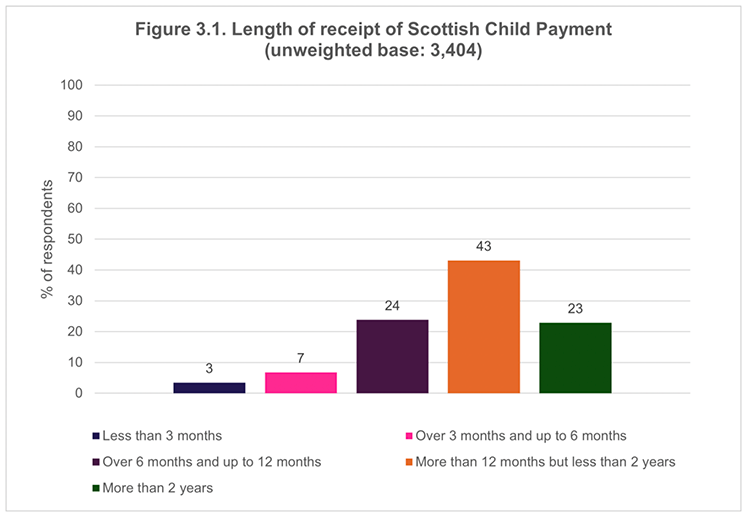
Of those currently receiving SCP, two thirds (66%) reported that they had been receiving SCP for over 12 months.
Administration of the payments
When asked whose bank account their SCP was paid into, the majority (93%) of survey respondents reported that it was paid into their own bank account. Almost all (98%) of those who said they alone had caring responsibilities had SCP paid into their bank account. The majority (84%) of those who shared caring responsibilities with someone else also had SCP paid into their bank account.
A small proportion (4%) of respondents reported that their SCP was paid into a joint account with them and their partner, or that it was paid into their partner’s account (2%). Less than 1% (0.5%) of survey respondents reported that SCP was paid into ‘another account’. A small number of respondents provided information about what these accounts were. Some had the SCP paid directly into their child’s bank account or the bank account of a family member. There were respondents who shared that SCP was paid into a family member’s bank account because that family member was their appointee, or had main caring responsibilities for their child.
Note that, due to a low base size (n=12), data from those who indicated that “Someone else in the household alone” had caring responsibilities have been suppressed and therefore not shown in Table 3.1.
| Bank account SCP is paid into | Total (%) | Respondent alone has caring responsibility (%) | Respondent and someone else share caring responsibility (%) |
|---|---|---|---|
| Respondent’s bank account | 93% | 98 | 84 |
| Respondent’s partner’s bank account | 2% | 1 | 4 |
| A joint account with respondent and partner | 4% | 1 | 13 |
| Another account | <1% | 1 | <1% |
In qualitative interviews with FFP recipients, the four weekly payments of SCP were overall viewed positively. Interview participants described being able to manage their outgoings according to the times they receive SCP and other benefits, like Universal Credit. However, there were participants who highlighted challenges to budgeting the payments. For example, there was discussion about difficulties with paying bills and managing other outgoings before SCP arrived in their bank account.
With SCP arriving every four weeks, there were survey respondents who commented on how they found it challenging for the payments to arrive on a different date each month. Changes in when respondents receive SCP also impacted the ability to budget and manage outgoings.
Changing the dates of the Scottish Child Payment had a massive impact in finances as the payment was being paid around the 13th of the month this then changed to the first few days of the month then changed again to the 23rd of the month. This all happened without warning, no emails, letters, national information of change of dates! How can you keep track of your money, organise payments, direct debits, standing orders, school trips, etc if you don’t know when you are being paid? Changing dates without warning can put people into financial hardship! (Survey respondent)
Stopped SCP payments
The majority (92%) of survey respondents in receipt of SCP reported that their payments had been uninterrupted. Around 1 in 12 respondents (8%) in receipt of SCP reported that their payments had stopped once (7%), or more than once (1%).
In both the qualitative interviews and survey open-text responses, parents and carers explained the context of why their SCP had stopped. For some, their SCP stopped when their child had reached the end of their eligibility at age 6. Once informed that SCP had been extended up to age 16, they had reapplied. For others, their SCP stopped due to issues with UC as a qualifying benefit. For example, parents and carers who had shift work, were students or had partners who worked irregular shift patterns experienced changes in household income which took them over the monthly threshold for UC. This resulted in their UC payments being stopped which led to SCP stopping[8]. This could lead to a gap in income for some households.
Frustrating process, my husband received a one-off bonus at work this meant we did not get Universal Credit one month and therefore did not get Scottish child payment. I had to call to inform SSS and then call again the following month when we received universal credit again. This caused a gap in payments and meant we were worse off that month because of the bonus. (Survey respondent)
Another example of SCP stopping was due to technical issues through Social Security Scotland. In these cases participants made contact to report the issue and though payments had resumed, there was a knock-on effect on their household finances.
Yeah it just messes things up and then you’ve got to…if you don’t have the money in your account for money coming out then you’re having to try and contact the companies and it’s just…it ends up being a nightmare because you end up spending the whole day trying to like fix things and sort things out so then you’re not getting` extra charges because of late fees and stuff you know? (Parent and carer interview)
3.2.2. Best Start Foods (BSF)
Around a fifth (18%) of all survey respondents were in receipt of BSF at the time of the survey, with an additional fifth (22%) who used to get Best Start Foods, but don’t anymore because they are no longer eligible for the payment.
The majority (95%) of respondents currently in receipt of BSF reported that they were receiving the payments for a child or children aged under 3 years old, with 3% reporting they were receiving BSF during their pregnancy.
Around half of respondents had been receiving BSF payments for up to 12 months (53%), with the other half receiving it for over 12 months (47%).
Stopped BSF payments
Respondents were asked whether their BSF payments had ever stopped, even for a short time. The majority (85%) of respondents in receipt of BSF reported that their payments had never stopped. Around 1 in 7 (14%) respondents reported that their payments had stopped once (12%), or stopped more than once (2%).
In the qualitative interviews, respondents were asked about their experiences of BSF payments stopping. Reasons for this included having an increase in their household income which affected their eligibility to receive the payments and administration and technical issues. Administration errors were also raised by some survey respondents as a reason for their BSF payments temporarily stopping. For example, there were respondents who reported their payments stopping after updating their account to include their recent baby.
How respondents used their BSF card
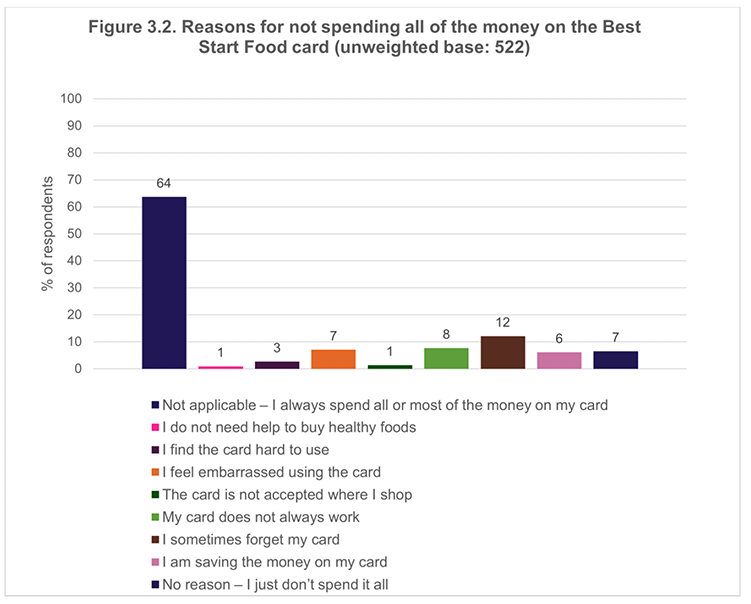
Survey respondents were asked about any reasons why they may not spend all the money on the BSF card and could choose as many as applied. Around two-thirds (64%) of respondents in receipt of BSF said they always spent all or most of the money on their payment card.
Around a third (36%) of receipients did not spend all or most of the money. The most common reasons for not spending all or most of the money were forgetting the card (12%), their card not working (8%) or feeling embarrassed to using the card (7%).
A small proportion (6%) of respondents said they did not spend all the money on their BSF card because they were saving it, or said it was for ‘another reason’. Those who selected ‘another reason’ were given space to provide more information if they wished to do so. The most frequently reported reason for not spending all the money on the BSF card included difficulties splitting payments between healthy foods and other shopping.
Experience of using the BSF card
Parents and carers were also asked about their experiences of using the BSF card in interviews. The way in which parents and carers used the card varied, with some letting the payments accumulate and others using the payments as soon as they arrived on the card. Participants described shopping at a variety of supermarkets and local shops and purchasing a range of foods and essential non-food items for their children. Although there were parents and carers who did not have issues using the BSF card whilst shopping, there were some challenges highlighted in both the qualitative interviews and open-text responses to the survey. This included experiences of administration and card errors, lack of clarity on where the card can be used and how it can be spent and challenges with separating their shopping.
Administration errors experienced by survey and interview respondents included receiving payments irregularly, their BSF card expiring or being blocked and delays with receiving the card. Card errors were also discussed, with participants raising issues with not being able to use the card in certain shops or online. Participants in interviews described experiencing embarrassment when having their card declined or rejected. They discussed how certain supermarkets and shops in the local area would not accept the BSF card or how the card would not work when paying. Survey respondents also reported issues with their BSF card not always working, being blocked or having to use their pin as the contactless payment would not work.
There was also discussion about shopping with a separate card. Whilst some participants found it helpful to have a separate card for food shopping to budget, others shared challenges and associated embarrassment with separating items in their shopping to use the BSF card and their own bank card. There were therefore suggestions to receive the payment into their own bank account.
Unable to use the card and my own bank card at the same time for one transaction so have to do it in two transactions which can be frustrating and time consuming (Survey respondent)
Like I don’t have time to be sitting like being what can I actually put on this card and what do I not put on this card. Having to say to the guy ‘oh stop this here, I’ll beep this card, stop this here and I’ll beep this card’, no one has got the time to be doing that. (Parent and carer interview)
I do sometimes think that me and other people, I think they find it embarrassing with the card, because everyone knows what that card is, because they all look the same. Even though it shouldn't be embarrassing, because it's just one of those things that it's there to help you, but I think it's an internal thing where you think, 'Oh, I should be able to get this without needing help.' But then I suppose if it was put in people's banks, they might not spend it on the right thing, so there is ups and downs to it. (Parent and carer interview)
Other issues raised by survey and interview respondents included damaging or losing their card, forgetting their pin, difficulties with checking their balance and views that what you can buy with the card were too restricted.
3.2.3. Best Start Grant (BSG)
Around half (57%) of all survey respondents reported they had ever received at least one Best Start Grant (BSG) payment. This proportion was higher for respondents from particular priority family groups, including:
- Families with three or more children (80%, compared with 54% of respondents from families with one to two children).
- Households with two or more parents/carers (62%, compared with 54% of those from households with one parent/carer).
- Respondents from minority ethnic backgrounds (64%, compared with 56% of those from white ethnic backgrounds).
Families from the 20% most deprived areas (61%) were more likely to have received at least one BSG compared with families from the 20% least deprived areas (40%).
There were no other notable differences by priority family groups.
Experience of receiving BSG
In qualitative interviews, parents and carers were asked about their views and experiences of the timings for each BSG payment.
Parents and carers who received one or more of the BSG payments generally found the timings appropriate. They described how at the time of receiving a BSG payment, they had needed to buy essential and expensive items for their children, such as prams, clothes for nursery and school uniforms. Those who were not eligible or were unaware of earlier BSG payments, such as the Pregnancy and Baby Payment, shared how they would have benefitted from the payment had they received it.
Yeah I think that the timings are definitely…the timings are great, especially when you’re pregnant and you’re…you’re pregnant and you’re trying to plan for all these extra things and having to buy all these extra things and then it just…I think the timings are really good for them yes, the whole pregnancy bit and then the nursery and then the school because that’s…its big major points in their life you know that you want it to go as smoothly as possible for them. (Parent and carer interview)
It was perfect, yes. Because it was before nursery, I knew what I needed to get her and I didn't have to ask my partner for money to put into it. We had that money already that we could just spend on her nursery stuff, spend on her new shoes, her school bag, all those bits. It was brilliant. The timing on the second one was really good, yes. (Parent and carer interview)
Those who experienced challenges with the BSG application and received the payment later described how they would have benefited from receiving the payment earlier to pay for essential items for their children. However, there were some benefits to receiving the payment later, as parents and carers shared being able to pay for items for their child that they had not anticipated. The impact of timings of BSG were viewed by participants as dependent on individual circumstances, with interview respondents highlighting seasonal variations to how they spend payments, such as higher costs of heating in winter and child spend on activities during the summer holidays. The timings of the payments are discussed further in Chapter 4 below.
Contact
Email: socialresearch@gov.scot