
Five Family Payments evaluation: annex A - mixed methods research
This report presents findings from research which informed an evaluation of the Five Family Payments.
5. Financial impact of Five Family Payments
A key aim of this research was to explore the extent to which Five Family Payments (FFP) are meeting the short and medium-term outcomes to reduce pressure on household finances, including debt and food insecurity, and reduce money-related stress. The survey and qualitative interviews asked questions to help understand the overall impact of FFP on families’ financial circumstances and experiences, including food insecurity.
5.1. Scottish Child Payment (SCP)
There was evidence in both the survey and qualitative interviews that SCP is helping to reduce pressure on the household finances and money-related stress for some families. The extent and variation of this impact is explored in more detail below.
5.1.1. Helped with household essential costs
SCP was reported to be an important source of income for covering household essentials such as rent, food, and bills. As outlined in section 4.1, two-thirds (66%) of survey respondents currently receiving SCP, spent their SCP on day-to-day household costs such as food, bills, travel and housing, with around two-fifths (39%) mostly spending their SCP on these household costs.
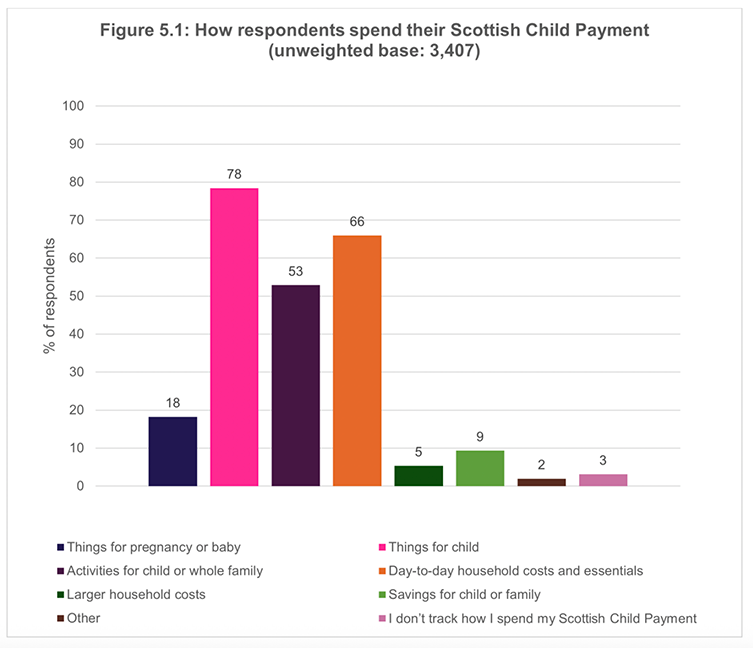
Respondents more likely to mostly spend their SCP on day-to-day household costs were:
- From white ethnic backgrounds (42%, compared with 24% of respondents from minority ethnic backgrounds).
- From families with no child under 1 year old (41%, compared with 21% of families with a child under 1 year old).
- From households with disabled family members (43%, compared with 33% of households without disabled family members).
Respondents were asked, on a scale of 0-5, how much SCP had helped them pay for household essentials, where 0 means the payment ‘hasn’t helped at all’ and 5 means it has ‘helped a lot’.
Around half (49%) of respondents receiving SCP reported that SCP ‘helped a lot’ with paying for household essentials. Respondents more likely to report that SCP ‘helped a lot’ with paying for household essentials were:
- Families with three or more children (54%, compared with 47% of families with one or two children).
- Households with disabled family members (51%, compared with 45% of families with no disabled family members).
- Families from white ethnic backgrounds (51%, compared with 38% of families from minority ethnic backgrounds).
- Families with no children under 1 year old (49%, compared with 41% of families with a child under 1 year old).
- Respondents who had been receiving SCP for over 12 months (51%, compared with 44% of respondents who had been receiving SCP for under 12 months).
Relied on SCP to pay for household essentials
Survey respondents who received SCP were asked the extent to which they agreed that they rely on SCP to pay for household essentials. Three-fifths of respondents receiving SCP either ‘agreed’ or ‘strongly agreed’ that they rely on SCP to pay for household essentials (60%).
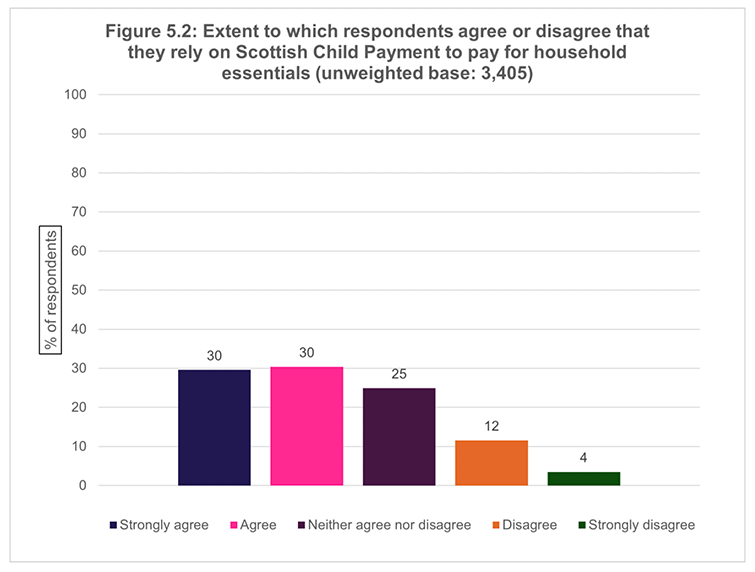
Respondents more likely to ‘agree’ or ‘strongly agree’ that they rely on SCP to pay for household essentials were:
- Families with three or more children under the age of 16 (66%, compared with 59% of families with one or two children).
- Households with disabled family members (63%, compared with 55% of families with no disabled family members).
- 1-parent/carer households (61%, compared with 57% of 2 or more parent/carer households).
- Families from white ethnic backgrounds (61%, compared with 52% of families from minority ethnic backgrounds).
- Families with no child under 1 year old (61%, compared with 52% of families with a child under 1 year old).
In the survey, respondents were asked if there was anything else about their experience with SCP that they would like to share. Hundreds of respondents shared that they used SCP to help with essential payments particularly food, housing and utility bills. Some shared that they relied on SCP to meet these costs, particularly in light of rising costs of food, gas, electricity and petrol.
I rely heavily on the payment to help with weekly household costs which are constantly increasing. (Survey respondent)
In winter it helped to pay for heating as we had to switch the heating off before I received the child payment, after I received it I could use the heating when it was very cold & I knew I could fall back on it when needed. (Survey respondent)
Reliance on SCP to pay for household essentials was also highlighted in the qualitative interviews, with parents and carers sharing that they relied on SCP to see them through to the end of the month. The SCP did not always cover all essentials costs, with some parents and carers sharing they sometimes needed to prioritise payments.
Food shopping and petrol money. The payment usually comes through just in time at that point in the month where the bank account's looking quite empty and that covers, usually, our final food shopping of the month and any top-up of petrol that I need to be able to get to and from work over the course of the last week of the month. (Parent and carer interview)
Scottish Child Payment mainly goes toward groceries and keeping our house running. It would be groceries and electricity, would be the main things that that would go on. Every month I rely on it. I'm usually waiting for it to come in. […] I wouldn't say the payments would always cover my electricity. They'd either cover my groceries and not my electricity, or just my electricity and maybe some of my groceries. (Parent and carer interview)
In both the open-text responses in the survey and qualitative interviews parents and carers shared that their personal circumstances, such as being a lone parent, having a large family or caring for a disabled family member, made their financial circumstances challenging. As a result, some said they relied on SCP to meet their daily living costs. Whether they were currently in work also impacted on how they used their SCP and the overall impact it had on their financial security.
I have 6 kids. The Scottish payment’s very helpful because without Scottish payments I can’t manage living crisis. I like to say many thanks. (Survey respondent)
I was still earning an income when I first got it [SCP] so what that did was that let me buy different things for [child] so be it toys, be it clothes, be it shoes. Aye things for her and that’s what it was used for and it was great. But when I stopped having an income and was reliant solely on benefits that contributed towards the household costs. Just so we could live. So yeah, yeah…I’ve seen it from both sides so…those families with an income it is used to buy different things for the child, but if they’re a struggling family it is used to top up the household income. (Parent and carer interview)
Stakeholders felt that SCP had an important impact on large families for whom the payments could make the difference between being in poverty or not.
I think for larger families definitely. Let's say you get Scottish Child Payment, and you have let's say four or five children or I had someone who had seven, it will make a difference between living in poverty […] and in being able to afford food and clothes and not. (Stakeholder interview)
A stakeholder described how the SCP helped, to an extent, to mitigate the impact of the two-child limit in place for Child Tax Credits and Universal Credit.
[SCP] definitely makes an impact financially, especially where you have families who have more than 2 children right because of the 2-child rule. So, if you’ve got 4 kids right and you’re not getting the child element payment for 2 of them say right, each week that’s making a difference of what is it…about £53 a week right. So that £53 a week can go towards food bills, can go towards ongoing clothes that they need or whatever. (Stakeholder interview)
5.1.2. Impact on borrowing and saving
Another way in which SCP has improved respondents’ financial circumstances is by reducing the need to borrow money to pay for essentials.
Respondents receiving SCP were asked the extent to which they agreed that SCP has meant they do not need to borrow money to pay for essentials (such as rent, food, bills). Over half of respondents receiving SCP (58%) either ‘agreed’ or ‘strongly agreed’ that SCP has meant they do not need to borrow money to pay for essentials.
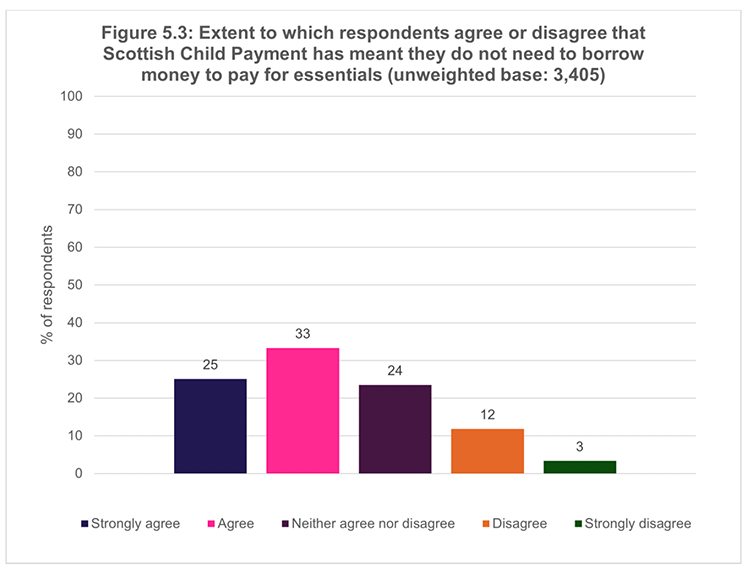
SCP had a particular impact on respondents from large families with three or more children under the age of 16, who were more likely to report agreeing or strongly agreeing with this statement (67%) than those from families with 1-2 children (57%). There were no other notable differences by priority family groups, area deprivation, or length of receipt of SCP.
Borrowing and saving
In both the open-text responses to the survey and qualitative interviews, parents and carers shared that receiving SCP had a positive impact on their overall financial wellbeing. There were parents and carers who reported that receiving SCP meant that they did not need to borrow money, either from family, or from using credit cards or loan companies, to meet the needs of their children and family as a whole. For some, SCP also meant that they could save some money, either for unexpected expenses such as a boiler or car breakdown, or towards something bigger, such as a new car or a deposit for a house. Not having to rely on borrowing to meet essentials costs had a positive impact on parents and carers wellbeing (see Chapter 6).
It stops me going into my overdraft every month. I also save some of it, for emergencies and to potentially go towards a newer car at some point. (Survey respondent)
The payment has helped immensely it could be rent or food or that’s unexpected new shoes or wow holiday let’s have a treat at the weekend without it we would be in more debt that what we are. (Survey respondent)
I pay full rent, don’t qualify for school meals, school uniforms and my son doesn’t get Education maintenance allowance as I earn more than £26k. Without SCP I wouldn’t be able to save for a deposit - I have £5k saved. (Survey respondent)
SCP has also provided parents and carers opportunities to teach their children how to budget. Some parents and carers shared that they also saved some of their SCP to give to their children for them to decide what to spend it on, or put it in a child’s own bank account for their future. A stakeholder also spoke about a parent they worked with who was using SCP to teach their child about budgeting.
I do mostly just spend it on [child] and if I have got any left over, she's got her own bank account so I put it in there and then when we go for a day out or something. (Parent and carer interview)
Receiving Scottish Child Payment has helped my children to understand budgeting and prioritising spends. I use a part of this money to provide my children pocket money and both are proving to be very money savvy. (Survey respondent)
With the Scottish Child Payment I had a parent who was getting the kids to put some of the payment onto you know these bank cards you get where they can budget themselves right. So she was doing that so that the kids could start to save wee bits of money and then decide what they wanted to do with it but it’s teaching them budgeting skills as well. (Stakeholder interview)
However, there were parents and carers who shared in qualitative interviews that even with SCP, they do still need to borrow money, either from family, or by using credit cards or loan companies to buy both the essentials for their children and the household. ‘Buy now, pay later’ providers such as Zilch, Clear Pay and Klarna were all mentioned by participants.
Sometimes what I actually do is I use an app called Zilch and if things are really bad Zilch is a thing that it lets you pay over 4 payments. So when my £100 goes in my Child Payment if I’ve got other things to pay or say I know that maybe my son has got something that he really needs that week I would use the Zilch […] It just helps ease it a wee bit because you’re able to pay it over your 6 weeks. (Parent and carer interview)
I would have tried to borrow money in some way…Klarna is it, so I kind of…I would use that previously. If I was going to borrow money I would try and kind of do it with something that was as low an interest rate as possible. But that’s not always easy if you haven’t got such a great credit history. But I would use something like Credit Union or something rather than anything else. (Parent and carer interview)
It is important to note that as a result of receiving SCP, borrowing was less frequent, or for a lower amount for some parents and carers, and others were able to borrow in a planned way so they did not incur high interest rates (for example, paying off a certain amount each month). SCP also helped some parents and carers to pay off existing debt, which again had a positive impact on their overall mental health. A stakeholder described SCP as providing a ‘buffer zone’ for families that helped them to either avoid going into debt to afford essentials or to make their debt repayments.
The money has help my wee family a lot it has took a strain of myself worrying how I can afford clothes and shoes for my son. And helped dig me out a hole with debts. (Survey respondent)
Scottish Child payment has had a hugely positive impact on my family. It’s reduced our need for credit. It has assisted us in spending money on food shopping to provide a varied and healthy diet without worry. (Survey respondent)
It really has helped me as often the extra money from [Scottish] Child Payment is my only disposable income, so I can save it for unexpected costs. (Survey respondent)
5.1.3. Impact on food security
Similarly, SCP reduced the need for some respondents to use food banks. Respondents were also asked the extent to which they agreed that SCP has meant they do not need a food bank or food parcels.
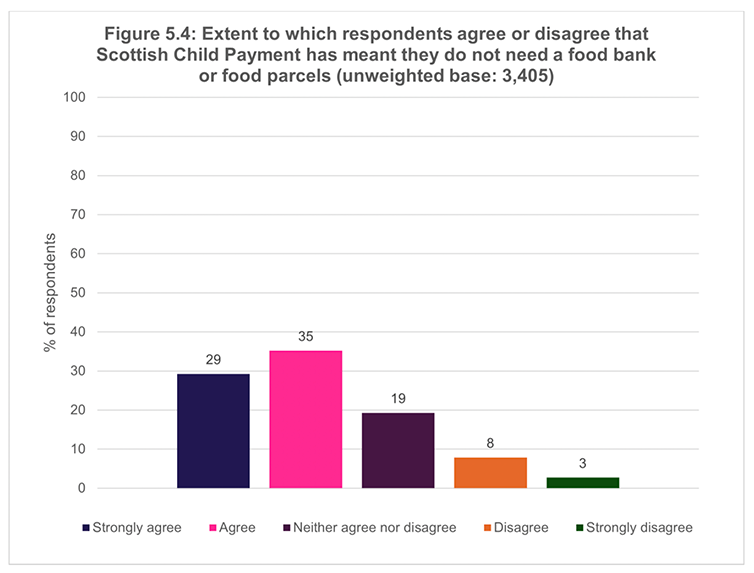
Almost two thirds (64%) of respondents receiving SCP either ‘agreed’ or ‘strongly agreed’ that SCP has meant they do not need to use a food bank or food parcels. Again, this was particularly the case for respondents from large families, who were more likely to ‘agree’ or ‘strongly agree’ with this (70%) than those from families with 1-2 children (63%). There were no other notable differences by priority family groups, area deprivation, or length of receipt of SCP.
While the survey found that around a fifth (21%) of survey respondents had used a food bank or similar services in the last 12 months, there was some evidence in the survey open-text responses and qualitative interviews with parents and carers that SCP was having a positive impact on food security for some families. For some parents and carers, SCP stopped them from needing to use a food bank, or having to cut back on food. A stakeholder also spoke about working with a large family who no longer visited the food bank after being supported to make a successful SCP claim.
It had helped to stop using food banks and being able to buy healthier food instead of all ultra processed or dried noodles...it's also stopped gas and electricity being cut off. (Survey respondent)
Receiving SCP also reduced some of the anxiety around being able to provide food for their children, and in some instances improved the quality and volume of food they could provide (see Chapter 6). Some parents and carers achieved this through vigilant budgeting and shopping around to make their budget stretch.
It [SCP] did make a massive difference because it was able to nudge things over so that food security was one hundred per cent improved […] So for me, it made a massive difference for the variety of food, so for my eldest daughter, it helped. It helped with basic food security, it helped with increasing the variety of food that we had. (Parent and carer interview)
It just goes into my bank account and the bank account is used to pay for food, nappies, wipes, cleaning stuff, yeah everything. Everything you need to kind of really live. […]I find myself shopping in the likes of Aldi and I would go in at certain times because I knew that’s when all the reduced…the reductions were for the food. […] So yeah you go in there and you can get…your budget stretches. (Parent and carer interview)
However, while SCP helped, it did not completely prevent food insecurity for some families with parents and carers reporting cutting back on meals to ensure their child(ren) can eat.
I think I would have had to rely on food banks if that payment [SCP] didn’t come. I’ve got to say I have been very very very very close to having to get a food bank parcel just recently. That’s why I had to get this job at [supermarket], I had to get it because I am really really struggling for food. I always made sure she was eating, I cut my meals down to one a day, I had to because again it was that…I had to make it stretch. So yeah…yeah I was hungry all the time too but I’m fine now. (Parent and carer interview)
5.1.4. Helped with money worries
There is also evidence that SCP has also improved respondents’ financial circumstances by helping reduce worries about money. Respondents receiving SCP were asked the extent to which they agreed that SCP helped them to feel less worried about money.
The majority (81%) of respondents receiving SCP either ‘agreed’ or ‘strongly agreed’ that SCP had helped them feel less worried about money. Respondents from large families were more likely than those from families with 1-2 children to ‘agree’ or ‘strongly agree’ that SCP helped them to feel less worried about money (87% and 80% respectively).
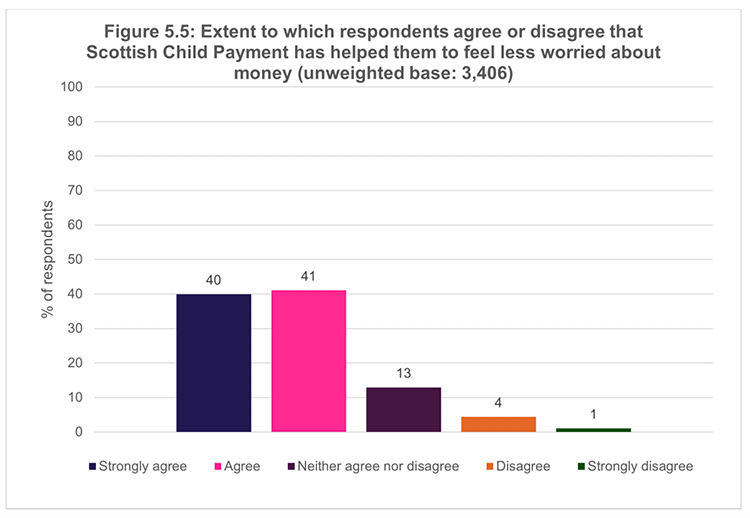
Overall, SCP is having a particular impact on respondents from large families, helping to reduce financial strain by covering household essentials and reducing the need for borrowing and food bank usage.
It was common for parents and carers to share that receiving SCP helped them feel less worried about money. As described in previous sections, SCP helped parents and carers meet essential costs such as food, heating and rent which helped to reduce financial pressure and stress. SCP was described as a ‘safety net’ by some as it was there to fall back on if an unexpected cost came up (see 5.1.2.).
Gives me peace of mind knowing I have money there that I can afford to keep gas and electricity bills at bay and that the payment can be used for food and I don’t need to choose.” (Survey respondent)
Before payments when new shoes, jackets or other more expensive clothing items would cause stress and need to cut back on other things for a few weeks to be able to afford items, I feel now I can buy those items when needed without the stress and worry. Activities have become much easier to access and again without having to cut back on food bill or heating bill. This payment makes a huge difference in the atmosphere of the household as it’s not always a no the kids here from me! (Survey respondent)
In both the open-text responses to the survey and qualitative interviews, parents and carers shared that receiving SCP has helped them to budget and ensure that both their household and child costs are met. This helped parents feel more in control of their finances, which helped them worry less overall.
Because it is paid every 4 weeks, it has helped money last longer. For example if it’s the week before I get paid, there is less stress about making money last longer, knowing this payment was incoming. (Survey respondent)
Parents and carers able to save money from SCP reported that it reduced anxiety about unexpected costs or expected social costs related to their children. This allowed them to both participate in, and enjoy, rather than dread such events (see Chapter 6).
As mentioned in section 5.1.1, parents and carers shared that their personal circumstances, such as being a lone parent, having a large family or caring for a disabled family member, made their financial circumstances challenging. Receiving SCP helped to relieve some of the financial pressure they faced.
It has helped take some of the financial pressure off. My circumstances had changed a few years before the Scottish Child Payment started. I was no longer able to work full time due to illness. Once the payment started, it helped me to afford all the basics that I'd been struggling with. (Survey respondent)
It has helped with the additional cost of raising a child with ASD as I have not managed to secure CDP. Without it life would be very difficult. (Survey respondent)
The Scottish Child Payment has helped contribute towards a reduction in financial pressures after moving to a one income, one parent household with three young children. It is the difference between being able to do my monthly food shop and pay for my high school child’s lunches in cash rather than having to pay for it on my credit card and be constantly chasing my tail. (Survey respondent)
5.1.5. Cost of living
The impact cost of living increases had on both families’ overall income and what they spent SCP on was mentioned in both the open-text responses in the survey and the qualitative interviews with parents and carers. Increasing costs for food, utilities such as gas and electricity, petrol and clothing were all mentioned as impacting on families income and spending, and the extent to which SCP helped with meeting these additional costs varied. For some families, the SCP helped mitigate the impact of these increasing costs. Parents and carers described the SCP as a ‘lifeline’ or a ‘life saver’, helping them to meet their essential costs.
An essential fund to help meet a lot of the rising costs of living. Helping me and my wife to cope better with the mental strains due to cost of living. (Survey respondent)
This payment has been a life saver, especially since the cost of living crisis. I used to be able to get a decent amount of shopping and essentials every week without worrying too much, but the cost of shopping is unbelievable. Without this payment we would be eating much worse, less fresh and nutritious foods and be relying on cheap frozen food instead. (Survey respondent)
For some parents and carers, SCP enabled them to still pay for their child(ren) and the whole family to take part in activities or pay for treats, despite the cost of living increases. It may have meant doing less than they did before, but it did not mean cutting things out altogether.
Very grateful for the additional money. With the recent impact of inflation, that has increased the cost of daily living and taking more of our family income, this extra money helps the kids still get the extras that they need and softens the impact of the price increases. (Survey respondent)
For other families however, while SCP helped, it did not fully meet the increased costs to their family and they were still struggling to get by, which it turn led to financial worry (see section 5.3 below).
With rising costs child payment is doing a little to help with the constant worry of money. (Survey respondent)
The payment is very much appreciated it with the rise in the cost of living I still struggle as a single parent. (Survey respondent)
5.1.6. Impact of changes to SCP
Increased value of SCP
In the qualitative interviews, those who received SCP were asked about their views on the payment being increased in value from £10 to £25 in 2022. Parents and carers were supportive of the increase, particularly in light of cost of living increases.
I wouldn’t have gotten the £10 payment but I think that the extra money now is kind of better for inflation because everything is more expensive. Like even things that were cheap before, you know how you would get a Pot Noodle, that was a cheap lunch, it’s actually expensive now. I can’t afford a Pot Noodle. The same goes with just cheap lunches, the things that you would buy before that cost pennies now costs pounds. I think it’s definitely in line with inflation. (Parent and carer interview)
For some families, the increase meant that they could not only cover the basics, but had enough to pay for days out for the family, and enable their child(ren) to take part in activities which had additional positive impacts (see Chapters 4 and 6).
I remember because it was roughly about £50 a month and well its more than doubled which is a massive help. […] Easing the overall…but also days out, they kind of things, when you’ve got more than one kid then you do go a day out…it’s extortionate. I think things like that it’s really helped with. (Parent and carer interview)
Increased eligibility of SCP
Parents and carers were also asked in the qualitative interviews for their views on the eligibility for SCP being increased from children under the age of 6 to children under the age of 16 in 2022. Again, parents and carers were very supportive of this change and shared the impact the increase had on them and their family. As outlined in previous sections, SCP helped families to pay for household essentials, and in some instances prevented or reduced their level of debt. Receiving SCP for children over the age of 6 helped towards this overall financial impact. Furthermore, receiving SCP for children over the age of 6 also meant there was income for these children to participate in activities, so they were not socially isolated (Chapter 6).
The big expenses that I've got round about the kids are actually round about the activities that they need to do. Even school trips, school lunches, all of those kinds of things that weren't actually expenses when they were much younger, but are sizeable expenses now that they are older. I haven't found that my children become inexpensive after the age of six. If anything, I think there's a lot of expenses for kids that actually go up. (Parent and carer interview)
There were parents and carers in the qualitative interviews who expressed that increasing SCP to up to the age of 16 was helping to reduce child poverty as well as steering children into positive pathways and personal outcomes, and away from negative ones such as anti-social behaviour and criminality which can result from poverty (see Chapter 6).
We would be living in definite poverty if that [SCP] had stopped. […] There's barely a day that doesn't reflect on my childhood and compare it to [child] and where she's headed and I grew up on a housing scheme in poverty and I was a cliché when I was growing up. It led me down a path where I wasted a number of years of my life that I really wished it hadn't going down the road of criminality to some extent or other, including the use of recreational drugs and what have you. At this moment in time, [child] is on a path that is far from that. It's far from becoming that cliché. I think if we had lost the payment that kept her in these groups, kept her in a positive circle and kept her in a positive frame of mind, then - not just the groups, but her not having to worry about being hungry or being cold or having a parent that's overly stressing out because they're having to choose between heating or eating. I know she's on a completely different path from my road. I'm just going to throw in there as well that I would say it's a small price to pay from the government to be steering people away from criminality because that costs far more than the child payment. (Parent and carer interview)
As a child I grew up in like a lot of poverty, we had no money and I could never afford to go to and do anything. Any sort of like after school clubs, like any sort of hobbies, nothing like that at all. So I think it being up to 16 is absolutely amazing because I feel like they’re the group that needs it the most, other than like the zero to five where their brain is still growing but there’s loads of stuff for zero to five but I think age 12-16 there’s nothing really for kids out there. […] It helps social exclusion from being from a low income background because it stops that barrier of not being able to go and access stuff. It opens up opportunities for other children, there’s so much that I think is so helpful (Parent and carer interview)
As the increase in eligibility of SCP had such a positive impact on families, there were parents and carers who were concerned about the impact when it stopped. Parents and carers in both the qualitative interviews and survey open-text responses said they would notice the difference to their overall finances when SCP stopped when a child turned 16 years old. For families with limited income, either as a lone parent or a one income household, or with high expenses for a large family, any change to their income could have a big impact, particularly if their child(ren) aged 16 or over were still living with them and in education as the cost to raise them was still there.
My oldest is 16 in a few weeks so I’ll lose one SCP monthly payment. I’m a lone parent and earn £29k so my 16 year old does meet criteria for EMA. I don’t get help with uniforms, schools meals. So I’m really going to miss the SCP payment once my kid turns 16. I’ll still get SCP for my 13. (Survey respondent)
5.2. Best Start Foods (BSF)
5.2.1. Helped with household essential costs
Best Start Food (BSF) payments were also reported to be an important source of income for covering household essentials such as rent, food, and bills.
Survey respondents were asked, on a scale of 0-5, how much BSF had helped them pay for household essentials, where 0 means the payment hasn’t helped at all and 5 means it has helped a lot. Around one third (32%) reported that BSF payments ’helped a lot’ with paying for household essentials such as food, rent and utilities. A fifth (21%) reported that BSF had ‘not helped at all’ with paying for essentials.
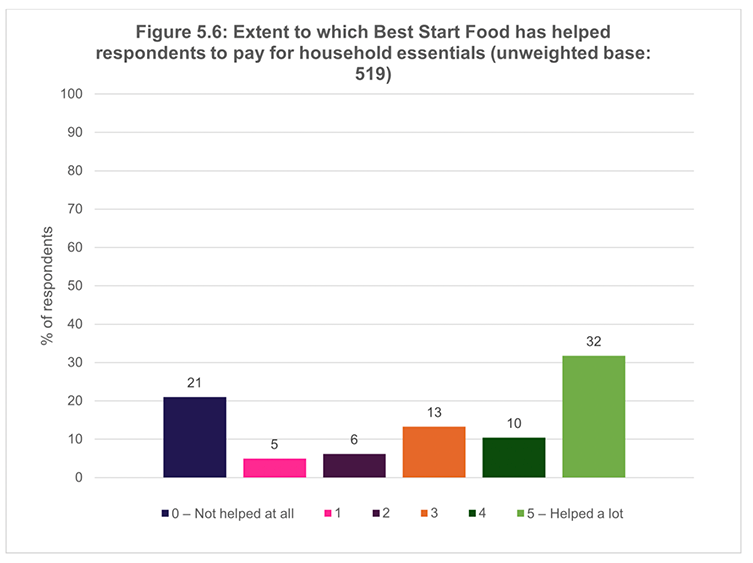
Respondents from families with three or more children were more likely to say that BSF payments were helping a lot with paying for household essentials (39%) compared with respondents from families with one or two children (29%). Those with a child aged under one were also more likely to say BSF was ‘helping a lot’ with paying for household essentials (39%) compared with those without a child under one (29%).
In qualitative interviews and survey open-text responses, parents and carers shared how receiving BSF helped them to pay for household essentials such as food, rent and utilities. The main way in which BSF helped was by providing dedicated income for food for their children which freed up other income for household costs.
5.2.2. Relied on BSF to pay for healthy food
Around two thirds (64%) of respondents ‘agreed’ or ‘strongly agreed’ that they relied on BSF to pay for healthy foods. Again, respondents more likely to ‘agree’ or ‘strongly agree’ that they relied on BSF to pay for healthy foods were those from families with three or more children (71%) compared with those from families with one or two children (60%) and families from minority ethnic backgrounds (82%) compared with those from white ethnic backgrounds (59%).
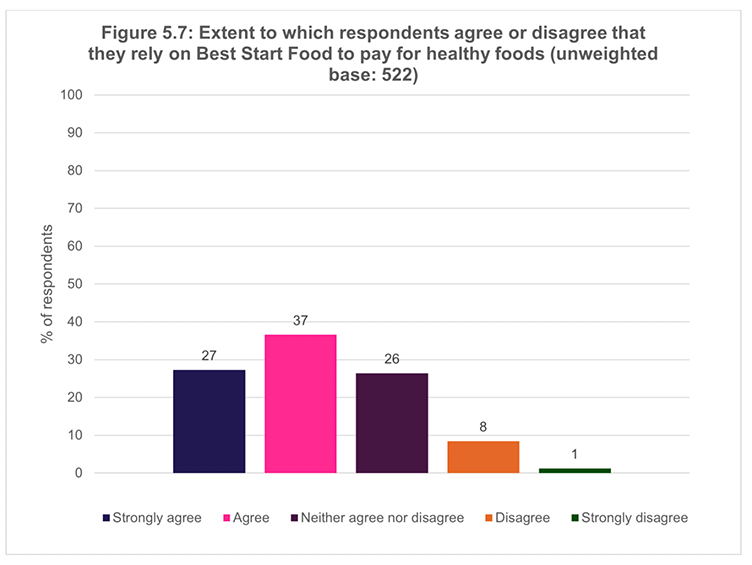
It is clear from both qualitative interviews and survey open-text responses that BSF helped parents pay for healthy foods for their children, and some relied on BSF for this. Parents and carers who used formula milk commented on how useful BSF was due to the high cost of formula milk.
I just feel like a lot of people should maybe know about it because there is a lot of families out there that might be struggling that aren’t aware about it because I found it…personally, my experience I found it really handy, especially the Best Start Foods, I think it’s essential for people that need to buy formula because it is really expensive. I feel like stuff like that, it is really essential that people are aware of it. (Parent and carer interview)
The baby's exclusively breastfed, so I don't actually have to use the card for infant formula. If I did, it would help out loads, but I don't actually have to use it for that. So that gives me more money to be able to spend on fruit and vegetables instead. Sometimes I have money leftover as well until the next month, which is great because then if I needed to buy more fruit and veg the next month, I've got more money left on there because the balance doesn't disappear. It just stays there. (Parent and carer interview)
If they had not received BSF, some parents and carers reported that they would have had to reduce the amount of healthy foods they bought or cut back on the quality of the food they bought their children.
It’s [BSF] taken the pressure off of paying certain bills because again I would skip a bill to buy her formula. […] it is handy for essentials and it probably makes a bigger impact to people who are more disadvantaged than me you know. It does help. (Parent and carer interview)
[If didn’t receive BSF] I'd probably need to put a limit on certain things, like I don't know, maybe make [child] not drink as much milk, so the milk could last a bit longer, or just shorten things that we're using, just so it can maybe last that bit longer, until I next get paid, or whatever. Just really cutting down on things, that maybe if we eat four of, we'll only eat two of or something like that. (Parent and carer interview)
Those who previously received BSF said that they noticed the difference it made when it stopped. While they could still buy food, they did need to cut back on certain items.
I was sad when it [BSF] stopped to be honest with you, I mean we never starved, the children never starved or anything like that, we never lacked, we just…we must have just…pulled our belts tighter. […] if you run out of milk you run out of milk that’s it for a few days until the next payment. So the…you just manage, you just manage, you just manage without it. But yeah…we’ve never lacked, we’ve never lacked. (Parent and carer interview)
5.2.3. Impact on borrowing, saving and food security
Half (50%) of survey respondents receiving BSF ‘agreed’ or ‘strongly agreed’ that BSF payments meant they did not need to borrow money to pay for household essentials. There were no significant differences between subgroups.
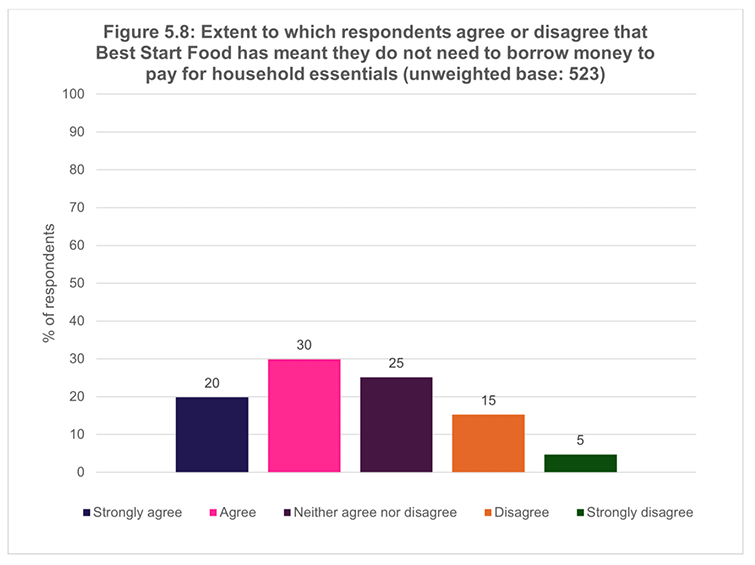
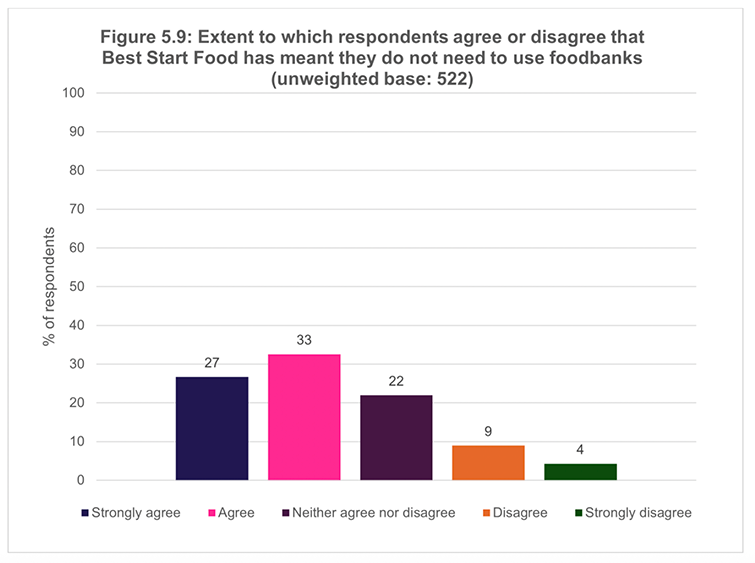
Around three-fifths (59%) of respondents ‘agreed’ or ‘strongly agreed’ that BSF payments meant they did not need to access a food bank or receive food parcels. Respondents more likely to ‘agree’ or ‘strongly agree’ with this statement were those from families with three or more children (67%) compared to those with one or two children (56%) and those who had been receiving the payments for over 12 (55%) months (65%) compared with those receiving the payments for 12 months or less.
As with SCP, those who received BSF said it helped improve their overall ability to meet their essential household costs which reduced their need to borrow money. BSF helped some families build a bit more financial security so they could still afford food if unexpected costs arose.
We can save to be honest, not a lot maybe but it’s a little bit of help, now our situation is better for sure than a few years ago. […] So yeah when we use that [BSF] card we have that little discipline to save. (Parent and carer interview)
It [BSF] has helped in a positive way because it obviously does relieve some stress about food. Say one month I got less Universal Credit, or I did have to spend more on something, like, with Christmas coming up, then I know, well, if I really needed to, I can go and get fruit, veg, eggs, milk, and bread with the card. […] because I know you can make a meal out of those types of things. So it's like a security blanket. I know that if something came out my bank unexpectedly, and I was meant to use that for food, I know that I can still go to the shop and get food without having to phone my mum. (Parent and carer interview)
There were parents and carers who also had family around that could help if they needed it, rather than get into debt with a credit card or lender.
[If didn’t receive BSFs] I would have borrowed off my parents. My dad can’t really afford it but he would give me the money for formula for her because she needs it and again he would sacrifice a meal so she could eat because he did that when I was a kid. He had to. His mum is the same, she gives us money when she can but she has her own bills so…but we figure out. We’ve got plenty of family to lean on if the worst comes to the worst I can ask my best friend’s mum. She would help us out if we needed…I know you can ask your Health Visitor or midwife for formula. I don’t know how often it’s done but I read about it that you can ask them. I would ask them if I really had to. […] It’s easier friends and family because they’re in the same situation as us, just going month to month. (Parent and carer interview)
5.2.4. Helped with money worries
Around two-thirds (70%) of respondents ‘agreed’ or ‘strongly agreed’ that BSF payments helped them to feel less worried about money.
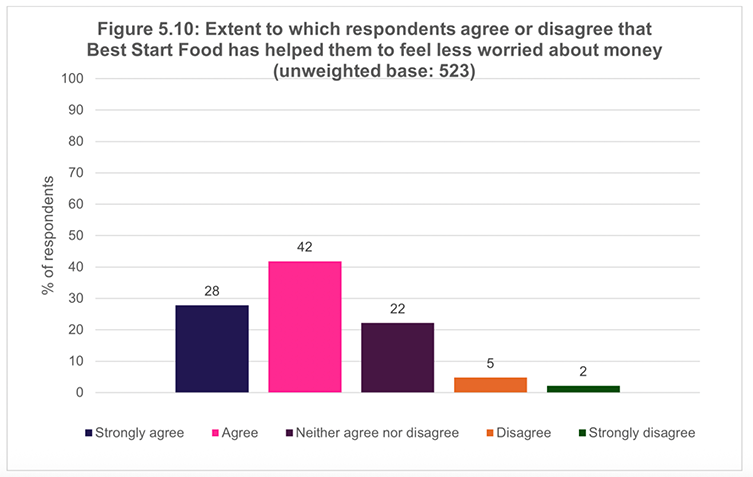
Respondents from minority ethnic backgrounds were more likely to ‘agree’ or ‘strongly agree’ that the payments meant they worried less about money (80%) compared with respondents from white ethnic backgrounds (67%). Respondents with a child aged under one were also more likely to ‘agree’ or ‘strongly agree’ that the payments meant they worried less about money (78%) compared with respondents without a child aged under one in their family (65%).
As with SCP, BSF helped parents and carers with children under the age of three feel less worried about money. For example, BSF helped them to afford food for their child(ren) which gave them more flexibility to use income for unexpected payments, easing strain on overall finances. Furthermore, BSF helped reduce worry among parents and carers of children with health conditions or disabilities which restrict the foods their child can eat. BSF enabled them to afford specific foods for their child.
It’s helped massively for us as I said, we would…I honestly don’t know where we would be if we didn’t have that extra little bit of help, especially with [child] and his kind of food hates and things. It just gives us that little bit extra to be able to…if he doesn’t like something right that’s okay we’ve got a little bit extra money so we can go and try something else for him. There are just so many things that he maybe doesn’t like because of the texture so that then enables us to go out and buy something else and he can try something else. It’s helped massively. (Parent and carer interview)
Parents and carers were grateful for BSF and the support it gave their family. However, there were parents and carers who were confused why the payment reduced after their child turned one or why it was only eligible for children up to the age of three. In both survey open-text responses and qualitative interviews parents and carers highlighted the cost of feeding their children at all ages and many thought the cost increased as their child got older. Parents and carers shared that there would be an increased benefit to their overall financial wellbeing if BSF was available for older children as many were not entitled to free school meals and were still struggling financially (see Chapter 8).
5.3. Best Start Grant (BSG)
5.3.1. Helped with household essential costs
In addition to helping respondents with child related costs (see section 4.3), Best Start Grant (BSG) payments were also reported to be an important source of income for covering household essentials such as food, rent, and bills. Around a third (29%) of respondents who had received at least one BSG payment reported spending this on day-to-day household costs and essentials such as food and bills.
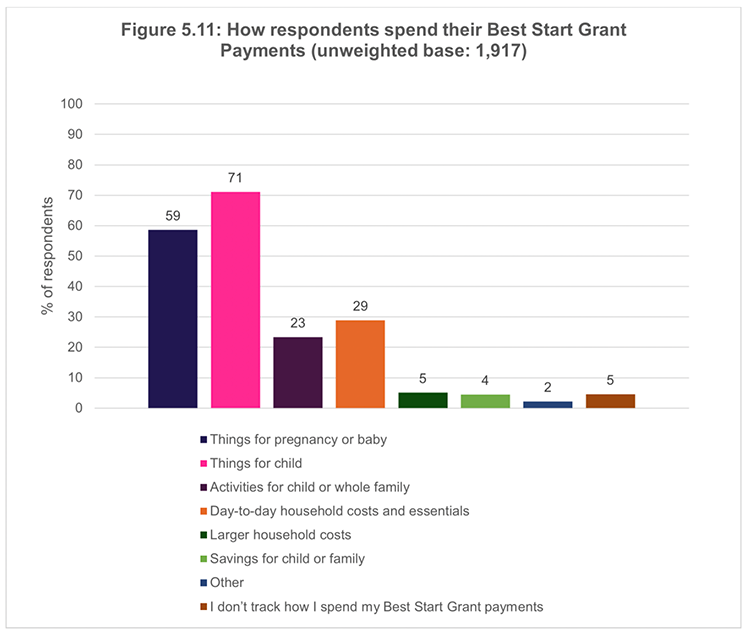
Respondents who were more likely to report spending their BSG payments on household essentials included:
- Respondents from white ethnic backgrounds (31%, compared with 21% of respondents from minority ethnic backgrounds).
- Families without a child under one year old (30%, compared with 22% of families with a child under one year old).
- Households with disabled family members (32%, compared with 25% of households without disabled family members).
There were no other notable differences by priority family groups or area deprivation.
Respondents were asked the extent to which the BSG payments had helped them pay for household essentials such as food, rent, and bills. This question was answered on a scale of 0-5, where 0 means the payment ‘hasn’t helped at all’ and 5 means it has ‘helped a lot’.
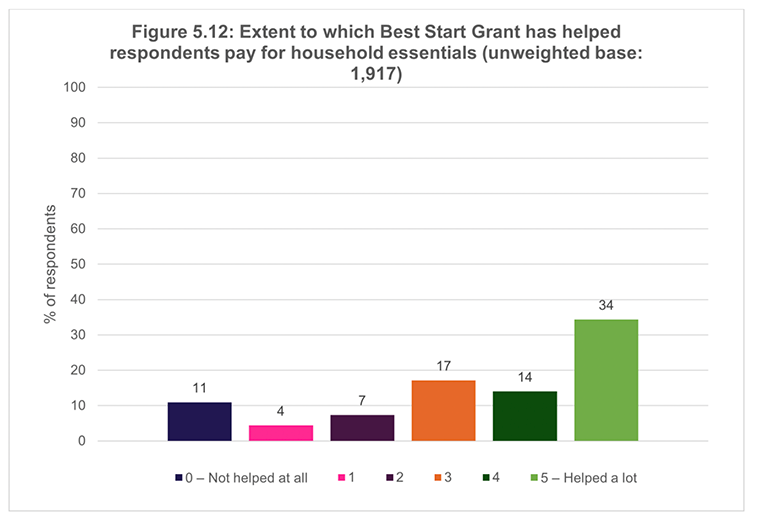
Around a third (34%) of respondents who had received at least one BSG payment reported that BSG had ‘helped a lot’ with paying for household essentials. This was a similar proportion of respondents who reported BSF had ‘helped a lot’ with paying for household essentials (32%), but a lower proportion of respondents that reported SCP helped in this way (49%). Respondents from white ethnic backgrounds were more likely to report that BSG had helped with paying for household essentials (36%), compared with respondents from minority ethnic backgrounds (28%).
As with BSF, BSG payments helped parents and carers with household costs primarily by providing them with money to spend on what their child(ren) needed at key points and therefore freeing up other income to pay for food, housing and bills.
As previously mentioned, BSG payments were sometimes used, either completely or in part, towards the cost of food, housing and utility bills. Parents and carers shared that this was not how they wanted to, or planned to use the payments, but it was how they needed to use the payment at the time, often leading to feelings of guilt.
That’s money for the children you know so I think I would have probably wanted to buy them things that they were needing or even things that they would have liked, even just a wee toy or something and maybe take them for a wee outing, or a wee cup of hot chocolate, or something. Just a treat for them even. But that’s just not even on the radar when every penny is needed you know. So I think I always felt guilty getting money for the children and then having to spend it on something that was like household. But then in the long run it’s for them if you know what I mean? Keeping a roof over their head and to keep them fed […] every time money would, the 2 payments, came in it was needed. There were things needing to be paid or things needing to be bought so we’re very thankful for them, very thankful for those payments. (Parent and carer interview)
5.3.2. Impact on borrowing, saving and food security
Best Start Grant (BSG) payments have also improved respondents’ financial circumstances by reducing the need to borrow money to buy things for their child, particularly at key times, for example when the child was born, started nursery or school.
Respondents who had received at least one BSG payment were asked the extent to which they agreed that BSG has meant they do not need to borrow money to buy things for their child (such as when they were born, or started nursery or school). The majority (70%) of respondents ‘agreed’ or ‘strongly agreed’ that BSG has meant they do not need to borrow money to buy things for their child. Respondents from families with three or more children were more likely to ‘agree’ or ‘strongly agree’ that BSG had meant they did not need to borrow to buy things for their child (76%), compared with those from families with one to two children (67%). There were no other notable differences by priority family groups or area deprivation.
Similarly to SCP, for some parents and carers, receiving BSG payments meant they could afford what they needed for their children without having to borrow money. There were parents and carers who took part in qualitative interviews who were clear that without BSG payments they would have had to borrow money to enable them to buy what they needed for their children. Some said that without the BSG payments they would have been able to borrow from family members, however, they would have had to pay back the money and some said they would have felt guilty asking for money from family who were struggling financially themselves. Others, either did not have family to borrow from, or their family was not in a position to lend money, therefore they would have had to borrow using a credit card or taken out a loan with a loan provider. Where BSG payments prevented families from borrowing in this way, they were grateful as it would have cost them more in the long term due to interest payments.
I would probably have had to borrow money for like the pram and that at the time or try to get it on credit or something. […] I would have eventually got it but it would have been paying it up over time. It was easier obviously being able to buy it outright. (Parent and carer interview)
[Without BSG – school age payment] We would have borrowed money, whether that’s credit cards, probably yeah that’s what we would do because it was very very costly for the uniform and especially having to buy a few. As I said kids do get dirty and have stains and they spill paint and things in school so yeah we would have put money on a credit card most likely. (Parent and carer interview)
[Without BSG] I would have had to try and borrow heavily from family members, and then I would have had to pay them back for it. I don't think anybody likes having to borrow money from people. (Parent and carer interview)
There were also parents and carers who reported that without BSG payments, they would have gone into debt with their utility companies so they could buy the items their child needed. There was recognition that this would have been a short term fix rather than a solution as all bills would need to paid eventually.
Probably not paid my rent for a couple of months. I can always phone them and say look I can’t pay my rent this month, can I pay it up, so it would have increased my long term costs because I would have said to them right, I can’t…I’m not going to pay my rent, I’m not going to pay my gas and electric this month. Robbing Peter to pay Paul. […] It would have been a higher monthly cost […] it would have meant there’s less money to spend on other bills. So I would have ended up not paying the internet to pay the…or not paying the Council Tax to pay this. Like so it would have eventually had a knock on effect leaving me not able to pay anyone. (Parent and carer interview)
It is important to note that there were parents and carers that used BSG payments to prevent them from going into credit card debt. An example of this was a parent whose car broke and was expensive to repair. While they intended to use the BSG on clothes and days out for their child, they did not have sufficient money to repair the car and buy these items. As the car was essential for driving their child to activities, as well as doing shopping they had to fix the car. While this was not how they intended to use the payment, in the long term it benefitted the whole family not going into debt and allowed for day trips in the future.
Finally, as was the case with SCP, there were examples in qualitative interviews with parents and carers being able to save some of their BSG payments to spend on their children later, when they needed it. A participant shared that to help them make sure the Early Learning Payment was spent on their child, they put it into a savings account until they were ready to use it.
5.3.3. Helped with money worries
BSG has also improved respondents’ financial circumstances by helping respondents to feel less worried about money. Respondents who had received at least one BSG payment were asked the extent to which they agreed that BSG had helped them to feel less worried about money.
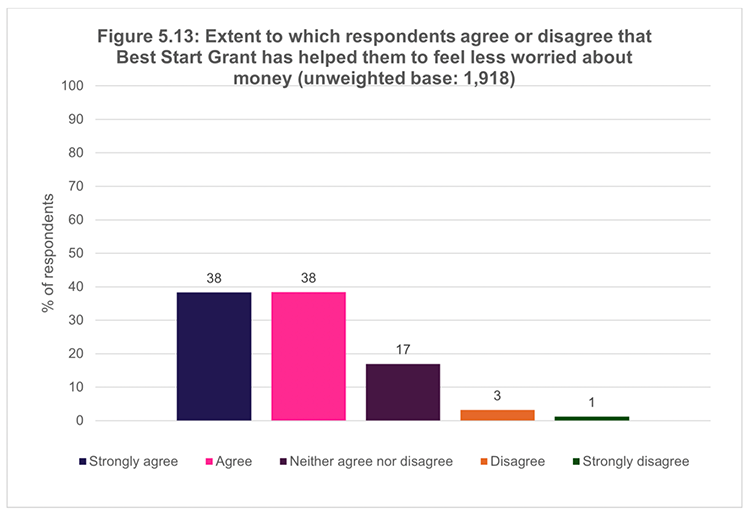
Around three-quarters (77%) of survey respondents who had received at least one BSG payment either ‘agreed’ or ‘strongly agreed’ that BSG had helped them to feel less worried about money. Respondents from two or more parent or carer households were more likely to ‘agree’ or ‘strongly agree’ that BSG had helped them feel less worried about money (81%), compared with those from one parent or carer households (74%). Respondents from the 20% least deprived areas were also more likely to ‘agree’ or ‘strongly agree’ that BSG had helped them feel less worried about money (81%), compared with those from the 20% most deprived areas (74%).
As with SCP and BSF, parents and carers, in both the open-text responses in the survey and qualitative interviews, said that receiving BSG helped them feel less worried about money. As BSG payments come at times when spending on children may be higher (at birth, going to nursery and going to school), having a lump sum available at these times helped ease the pressure of child spend.
It [BSG] has made a substantial difference to my financial situation. Obviously, before I got it, when I was pregnant before I got any grants or anything, I was struggling to be able to afford to buy stuff for her. I obviously didn't realise how expensive babies were or how expensive baby stuff was. Then when I got the maternity grant and I managed to buy her bedroom furniture that was a weight lifted off my shoulders for that. […] I have got anxiety. So I do worry about everything and anything quite a lot. (Parent and carer interview)
Honestly, it [BSG Pregnancy and Baby Payment] does help out; it really does help. I’ve always lived month to month and trying to work out how I’m going to pay for this without that money was stressing me out especially at 6 months pregnant with it being…not a high risk pregnancy but stress was the last thing I needed. So it really did help and I think it helps a lot of people. (Parent and carer interview)
Similar to SCP, by providing money to spend on what a child needs, it gave some families flexibility with their other income which meant they could still do things with children even if unexpected expenses arose. If they had not received BSG payments, there were parents who said they would have been stressed about how they would be able to meet the needs of their children. Some said they would have had to do without certain things altogether, or they would have to wait and save up before buying things their child needed.
I would have managed somehow but it would have caused a lot of stress or…we would probably have had to went without stuff or maybe not been able to do as much with my kids those months because I would have that extra money to put out to get for the kids. […] so getting that money helped us like not really have to do that. (Parent and carer interview)
Contact
Email: socialresearch@gov.scot