
Cash-First Programme: interim evaluation - updated
Interim findings from a process and impact evaluation of the Scottish Government's Cash-First Programme. The Programme supports new local partnership work to deliver Cash-First interventions across eight delivery partner areas.
4. What activities have taken place?
Highlights
- There is a wide variety of activities and approaches across the different areas, reflecting that Delivery Partners have tailored action to fit their local needs.
- There is strong evidence that new partnerships and working relationships have been established with and between stakeholders. In fact, the funding has been positively used to try new approaches that focus on long-term systemic change. This has taken the form of improved flexibility of service delivery, alignment with anti-poverty services, and developing the skills of service beneficiaries.
- Effectively engaging people with lived experience takes a long time and requires careful planning and consideration of activities such as data sharing. Engagement of this group has been a key component of Cash-First delivery during the first year and has been most successful in areas with pre-existing mechanisms to do so. In other areas it has not yet taken place and there may be an opportunity for peer learning from other Delivery Partners.
- Cash-First approaches have facilitated new ways of disseminating information and communicating between partners, stakeholders and people in the target groups. New training resources for partners and stakeholders have been produced. Examples to support their understanding of their Cash-First interventions and Cash-First approaches more generally can be found in Glasgow and Edinburgh.
This chapter discusses the initiatives and activities that have resulted from Cash-First in the first year. It gives an overview of new and improved activities, processes, and resources and considers the strengths and limitations of these.
Cash-First initiatives and activities
The first year of the Cash-First Programme has led to a variety of new initiatives and activities at Programme level and in the local areas. While projects are varied across areas, they can be grouped into the following categories:
- information and communication
- new partnerships, approaches, and activities
- new or innovative approaches to support target groups
- engaging people with lived experience and
- staff development and training.
In the following section, we look in more detail at the types of projects seen across each of these categories.
Information and communication
New ways of disseminating information and communicating with partners, stakeholders and people in the target groups have been developed and implemented as a result of Cash-First. Delivery Partners have reported that Cash-First approaches include a significant information and communication element, due to the volume of services, low levels of understanding of Cash-First, and the need to adapt communication and engagement methods depending on the needs of service beneficiaries.
For example, the Aberdeenshire Delivery Partner has increased their reach into target groups by proactively distributing “Worrying About Money?” leaflets and toolkits, as hard copies and online, to emergency food providers and other stakeholders including third sector organisations, religious groups, Police Scotland, and GP practices. This targeted approach has resulted in an openness and willingness in the Emergency Services to support the aims and activity of Cash-First. The Fire and Rescue Service distributes the leaflets as part of their home welfare checks and where appropriate and with permission, refers people to Cash-First services. This positive and proactive approach ensures Cash-First approaches are firmly associated with welfare and wellbeing. The Delivery Partner reports:
We are really trying to work as a partnership, [they know they] can’t do it all on their own. – Delivery Partner
The Delivery Partner states that this work has further cemented awareness amongst the Police of the relationship between poverty, mental health, and potential criminal or antisocial behaviour, and increased support of the Cash-First approach.
There is a sense of caution amongst all Delivery Partners. Some expressed concerns about their ability to manage demand for Cash-First services, meaning that they are balancing the scale of communication activity around the Programme in a careful and controlled manner. However, to date, there is no evidence that demonstrates demand is exceeding what can be provided in any area or across the Programme, which may be due to this managed approach to communications.
New partnerships, approaches, and activities
There is very strong evidence that new partnerships and working relationships have been established with and between stakeholders. In interviews, Delivery Partners and stakeholders have expressed confidence that these new relationships are likely to extend beyond the lifetime of Cash-First and so leave a legacy, for example, one stakeholder noted:
Partnerships and working together will be a legacy of this no matter what happens, having that solution-based approach to things on a local level… local groups have come together, and that will continue. That will be a wider benefit beyond Cash-First too with other support services – Local stakeholder
The role of CABx and money advice services
The evaluation has highlighted the important role of Citizens Advice Bureaux (CABx) and other partners who offer debt and anti-poverty support, and money advice.
For example, through the West Dunbartonshire Delivery Partner, individuals are referred to the CAB for financial resilience capability support. Through the relationship with the CAB, they are then referred on to other types of support that are tailored to their need.
Through the Aberdeen City Delivery Partner, led by ACVO, an agreement to engage with, or a referral being made to, services, is required to be in place for individuals to receive a recurring Cash-First payment, where this is the method of support. This may simply mean in practice that an individual has ongoing engagement with the initial referring organisation, for example, CAB or others, who may also be providing them with additional wraparound support.
In one area of the Fife test of change pilot, Cash-First funds are distributed by a local Credit Union. Recipients are encouraged to open a Credit Union account which is seen as a longer-term benefit and a positive outcome. The anti-poverty approach of the Credit Union is very well aligned to Cash-First and complements the wider services that beneficiaries can access.
In Edinburgh, the Delivery Partner is working in partnership with the Fuel Bank Foundation to offer food and fuel support to people in need through a daily drop-in service. Individuals are referred on to wrap-around services and offered a follow-up appointment at 7 days and 4 weeks. A new priority referral pathway has been established between the local Council’s Family and Household Support Team, and other key Council services.
The Orkney Delivery Partner is aligning activity with existing interventions to address fuel poverty and financial insecurity which means that an existing crisis pathway has been used to provide access to Cash-First. Tackling Household Affordable Warmth (THAW) Orkney works with CAB as part of Orkney Money Matters (a partnership coordinated by Voluntary Action Orkney that also includes Blide Trust, Orkney Housing Association, Orkney Charitable Trust, Orkney Food bank, NHS Orkney, Orkney Islands Council and Social Security Scotland). The Orkney Delivery Partner has now developed a shared referral system. This is in an early stage of use by Delivery Partners with the intention of rolling out a similar approach more widely across the area in the future.
This further highlights the complexity of the reasons why people face food insecurity. Ideally, there would be no need for a Cash-First approach. Addressing this may require structural changes to welfare policy and the benefits system. It will also require a shift and uplift in the support available to people to divert them permanently from food insecurity and, ideally, ensure there is early intervention for the causes of food insecurity so that it does not arise as an issue at all.
Further innovative approaches to partnership working are being explored as Delivery Partners build their detailed understanding of local need and support infrastructure. Thinking about sub-area responses, one Delivery Partner commented:
We’d like to look at some micro-local collaboration. There will be specific solutions for specific areas that can’t be replicated across [the area] – Delivery Partner
New or innovative approaches to support target groups
Cash-First has provided an opportunity for Delivery Partners to design and test innovative ways of working with a range of target groups. Collaboration with partners is essential to overcome barriers to engaging with some of the harder-to-reach target groups. This has involved, for example, structured communications to key organisations, working with the Emergency Services, and very focused engagement with wider services and stakeholders that support target groups in other aspects of their lives.
The approaches taken have delivered targeted support, sometimes over a sustained period of time, that focuses on creating long term impact, improving service user skills, and changing behaviours.
In Fife, service beneficiaries are identified and referred for Cash-First support by frontline workers, who act as trusted intermediaries and facilitate reach into target groups. Beneficiaries are supported for 6 months and receive regular payments as well as a Programme of holistic support, for example budgeting and cookery skills. Beneficiaries must sign an agreement to participate in this longer-term support which helps to keep them engaged and optimise the impacts.
The North Lanarkshire Delivery Partner is taking a welfare rights approach, and it is an integral part of a wider system of support aimed at delivering sustained change for people. It is designed to be responsive to need, for example there is an additional payment for infant formula and a discretionary top up payment for large families. This flexibility and discretion, coupled with access to wrap-around services aims to produce long term change.
The Aberdeen City Delivery Partner launched the Flexible Crisis Fund in November 2024 to target support at single men aged 18-45. At the point of referral, there is an assessment of what wrap-around supports are needed. This ensures a person-centred, needs-led package of support. This approach recognises that this demographic often has complex needs that are sometimes not met, due to individuals’ lack of awareness of the support available, a lack of willingness to engage with services, or as a result of challenging lifestyles.
In order to address the barriers to accessing support for target groups that are discussed in Chapter 3 above, some Delivery Partners are exploring different solutions to this. This includes developing a shared referral system and protocols. These will be discussed further in the final evaluation when they have been more fully implemented and tested.
Local stakeholders reported that there is a reluctance amongst some beneficiaries to engage with services that are perceived to be delivered by the Council. This can be because of previous negative experiences or fear of what engaging with authorities may lead to.
People are reluctant to get any engagement with officials – they say, “they want to know about my kids.”
There’s an element of us having to educate people that the Council are not the enemy and want to help.
- Local Stakeholders
In these instances, service beneficiary interviewees were keen to emphasise that local partners were very helpful in reassuring them and dispelling these misconceptions. As one commented in interview:
The support [from services, and to access these services] is there for those that need it. – Service Beneficiary
Engaging people with lived experience in service design
Engaging people with lived experience in service design has been a key component of Cash-First delivery during the first year. It ensures services are designed to be needs-led and provides staff and organisations with relevant and up-to-date information about service users’ experiences and any challenges they are facing.
All Delivery Partners recognise the importance and value of incorporating lived experience in service planning, development and delivery. There are several ways in which this has been facilitated, including the creation or repurposing of a lived experience panel; 1-2-1 and group engagement in a food bank/food pantry setting; through the Community Planning system (as noted in Chapter 3) and other regular community fora. The range of engagement approaches are noted in Table 4.1.
Table 4.1: Engagement methods by Delivery Partners
Delivery Partners
Aberdeen City (ACVO)
Engagement methods
Proactive engagement with around 70 people with varying degrees of lived experience.
Delivery Partners
Aberdeenshire Council
Engagement methods
An existing panel for engaging people with lived experience operates in Aberdeenshire. Cash-First is aligning with this.
Delivery Partners
Edinburgh
Engagement methods
Engages people with lived experience via the End Poverty Citizens Group and Capital City Partnership, supplemented by frontline engagement in food banks, and engagement with other relevant groups not specifically focused on food insecurity.
Delivery Partners
Fife
Engagement methods
Fife are working with the Poverty Alliance to develop a Cash-First charter which will be developed alongside those with lived experience.
Delivery Partners
Glasgow
Engagement methods
At a strategic and organisational level, there is good understanding of method and routes to engaging people with lived experience, though nothing specifically for Cash-First is in place.
Delivery Partners
North Lanarkshire
Engagement methods
Informal surveys in person at food banks, and engagement with schools and communities.
Delivery Partners
Orkney
Engagement methods
Individual feedback and lived experience workshops with service users. A dispersed population means it can be difficult to bring people together.
Delivery Partners
West Dunbartonshire
Engagement methods
The Community Empowerment team engages service users to design services. Newly formed Family Prosperity Network is looking at ways of tracking and reflecting lived experience.
However, the extent of successful engagement of with people with lived experience in service design and delivery is very mixed across Delivery Partners. It appears to depend partly on the expertise and experience of staff. Areas where engagement mechanisms were already in place, or were proactively planned into Cash-First, were more likely to consider people with lived experience from the start. For example, the lived experience panel in Aberdeenshire is well-established and the Delivery Partner has a good understanding of what needs to be considered when engaging people with lived experience, including appropriate ways to compensate people for their time and input.
In other areas, Delivery Partners are implementing new ways of working to engage this cohort and have identified key local partners to support this. For example, the Fife Delivery Partner is working with the Poverty Alliance to establish a lived experience group for Cash-First approaches.
The Edinburgh Delivery Partner engages regularly with the End Poverty Edinburgh citizen group, although this group has a broader focus than just food insecurity. To supplement this, the Delivery Partner carries out proactive frontline engagement with service users at food banks and food pantries to understand what services and interventions would be of value to them. It also engages with other groups in the city, such as a parent and baby group in an area of deprivation, where high levels of financial crisis are identified but people may not be accessing a food bank.
In West Dunbartonshire, approaches have historically been focused on 1-2-1 discussions, and less directly focused on service design, with service users invited to complete case studies. The local Community Empowerment team engages service users to design services. A newly formed Family Prosperity Network in the area, that includes public and third sector agencies, is also exploring ways to work with individuals and track and reflect lived experiences. The scope of this is greater than Cash-First but it will encompass Cash-First activity.
As the case study at Appendix 8(a) shows, engaging people with lived experience can help to identify barriers to accessing support. Whilst this has not happened consistently, engaging with people with lived experience has enabled Delivery Partners in the case study to address these barriers.
All Delivery Partners raised the importance of compensating people with lived experience for their time when they contribute to service design, planning and feedback. This acts as an incentive to individuals to become involved and sends the important message that their contribution, experience and time is valued.
Challenges in engaging people with lived experience
Meaningful engagement of people with lived experience is resource intensive and time consuming. This has meant that some Delivery Partners have made no, or very limited progress in this, as highlighted in the following comment:
[we] would love a [people with lived experience] panel set up but it’s such a short project and the remit of the project is enormous… I’ve asked people how long it takes to set up meaningfully and they said it takes years. - Delivery Partner
People with lived experience will often need a good deal of support to engage with Delivery Partners and can benefit from training and development to help them actively and confidently participate. They may also lack the digital skills and necessary equipment. These issues are also discussed in more detail in the case study at Appendix 8(a).
A further underlying barrier to engagement has been identified by one of the Delivery Partners areas, who noted how systems can often be focused on organisations rather than individuals:
The governance structures […] are always very organisational focused rather than person-focused… [people] feel so disempowered by the systems that support them. – Delivery Partner
It was stated that individuals’ data is often gathered according to the needs of the organisation (what they need to report on to satisfy funders, for instance), meaning a person’s experience of seeking support can be shaped by organisational need, rather than their own.
Cash-First approaches and processes seek to engage people with lived experience by design. This, in some cases, requires new ways of managing and sharing data, and of monitoring activity, that will ensure greater transparency, understanding and therefore agency for individuals in accessing the support they need.
Service provider development and training
There are several good examples of new Programme resources being developed to support staff training and development. Delivery Partners have invested time and resources in the development of training materials to improve understanding of Cash-First across Delivery Partners and partner and stakeholder organisations. These are openly available and have been shared with other Delivery Partners to support their own project development and delivery.
New resources have principally been developed by Glasgow and Edinburgh Delivery Partners. Systems change is the basis of their approach and so staff development is central. Their work with service providers has highlighted a need for these materials to ensure consistent and shared knowledge and understanding. Other Delivery Partners have also been given access to some of these materials, notably the ‘Cash-First Concept Explainer’ which is highlighted below, for their own use and to support their own learning. This is a very good example of how Cash-First has generated new resources that have been shared across the eight areas and so dispersed the benefits at Programme level.
Figure 4.1 shows the Cash-First Concept Explainer. It was developed by Glasgow Centre for Population Health to enhance stakeholders’ understanding of Cash-First and embed a common language and use of terminology. The Concept Explainer sets out what is meant by ‘Cash-First approaches’, why they are used, how they can help people experiencing food insecurity, and the wider effects on wellbeing. It clearly articulates the fact that Cash-First is about wrap-around support and a sustainable move away from food insecurity.
It has been made available on social media platforms and circulated to all Delivery Partners to use in their own areas. This is an example of how activities in one area have had a much wider benefit.

Source: Glasgow Centre for Population Health
The Glasgow Delivery Partner has also worked with partners to develop a suite of Cash-First webinars for organisations across the city. The first webinar was launched as part of the Partner’s Challenge Poverty Week activity in October 2024. Challenge Poverty Week is an annual event which is co-ordinated by the Poverty Alliance and brings together services and individuals engaged in anti-poverty works across Scotland to advocate for an end to poverty.
This first webinar was an introduction to the Glasgow Cash-First project: Cash-First approaches: Reducing the need for food banks in Glasgow. The other three (to date) are:
- Money Counts Training: A Cash-First approach to food insecurity;
- Working with refugees and asylum seekers experiencing food insecurity; and
- Unlocking local resources in Glasgow: A guide to ALISS (A Local Information System for Scotland).
The Edinburgh Delivery Partner has delivered bespoke training for staff and volunteers in response to a request from stakeholders around ensuring appropriate referrals to wrap-around support. This has formed the basis of a Community Guiders Training Programme developed in partnership with Trussell and Faith in Community Dundee. It is designed to upskill staff in signposting and referrals. At the time of writing, the intention is to deliver this training in February 2025 through one in-person and one on-line session.
Another example is the Cash-First toolkit. This is part of a suite of resources and information developed in Edinburgh to support staff and volunteers involved in community food services. It explains what Cash-First is, the rationale for the approach, guidance on how to implement a Cash-First approach and start difficult conversations about money worries, assessing impact and includes links to wider resources. Whilst it was developed before the Cash-First Programme, it has been used extensively by the Edinburgh Delivery Partner to engage and inform partners and stakeholders.
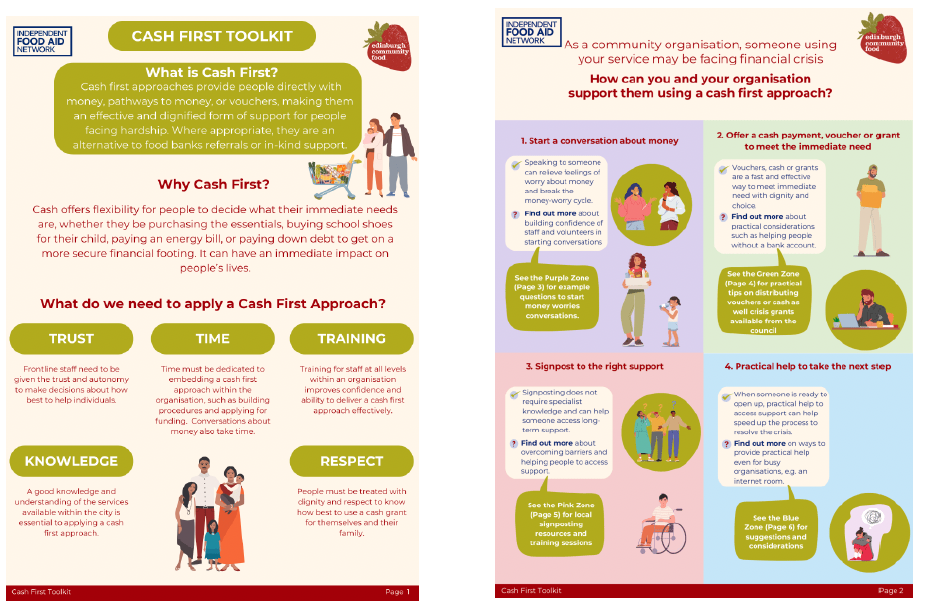
Source: Edinburgh Community Food
Strengths and limitations of Cash-First initiatives and activities
Whilst initiatives and activities continue to evolve and have not yet been fully tested, there is an emerging understanding of the strengths and limitations of Cash-First approaches. This will be further developed during the Year 2 evaluation. Still, during the first year, there are some strengths and limitations worth highlighting.
Strengths
A number of strengths have been identified in the approaches taken by Delivery Partners to date. These underpin the progress made by projects and create strong foundations on which to build and develop Programme delivery in Year 2.
- Strong partnerships have been developed and partnership working in local areas has been expanded as a result of Cash-First activities.
- New training materials have been produced, shared, and used by Delivery Partners, and will be available beyond the Programme period, supporting future skills development.
- These materials include clear concise and accessible information to enhance understanding of Cash-First approaches. This will help to secure buy-in and commitment to the Cash-First approach and build effective collaboration.
- Delivery Partner staff and wider stakeholder organisations have had the opportunity to develop their skills and knowledge. This is likely to impact positively on services and service users.
- Developing the skills of staff will have longer terms benefits for service provision beyond the Cash-First period.
- Taking a flexible user and needs-led, and discretionary approach to service design and delivery destigmatises support and removes additional barriers that can be faced by individuals. This minimises the risks of non-engagement and increases the likelihood of sustained impacts.
- Aligning Cash-First with anti-poverty services such as Credit Unions and CABx is likely to contribute to more sustainable and longer-term impacts.
- Embedding training support and key skills, such as budgeting and cookery, in wrap-around support, over a sustained period of time creates an opportunity for lasting behaviour change and improved life skills of service beneficiaries.
- Targeting funds at a very specific cohort can help address the needs identified in underserved demographic groups.
Limitations
A core element of the evaluation work in Year 2 will be to further test the approaches that have been implemented to date. This will include ongoing consideration of the limitations of the approaches that have been identified so far, noting that projects continue to evolve. These are:
- Further work is needed in some Delivery Partner areas to engage people with lived experience more closely in service design and delivery. This includes considerations of how to adequately compensate individuals for their contributions.
- Requiring Cash-First beneficiaries to sign up to an agreement to engage with services over a six-month period may be daunting and act as a barrier to participation.
- Delivery Partners are aware there is a need to overcome barriers to reaching some of the harder-to-reach target groups; as projects progress, this may present a further barrier.
- Cash-First approaches aim to engage with individuals that face significant and complex issues. Identifying wrap-around services to provide the necessary support can be challenging and whilst progress has been made, there is scope in Year 2 to continue to refine how these groups can be encouraged and enabled to participate in Cash-First services and then access the right support for them.
- Projects are working continuously to improve the referral system across/between organisations, but there is a widespread consensus that further work in this space will be beneficial for both organisations and service users.
- Staff resource and capacity in partner and stakeholder organisations can impact on their ability to deliver services and engage in development opportunities, for example training.
Contact
Email: socialresearch@gov.scot