
Whole school approach to racism and racist incidents: guidance
This guidance has been designed to assist school leaders, school staff, and local authorities to implement a consistent and robust whole school approach to responding to racism and racist incidents in schools.
Universal Actions: Creating a whole school anti-racist environment and ethos
The term ‘anti-racist environment’ is used to describe a setting in which all elements of a school community work together to proactively address and challenge racism that exists within the school community and within wider society. Schools will be mindful of how racism and racist incidents may be likely to manifest in their own local contexts, and can consider the development of their whole school approach in light of this.
The role of Local Authorities and school leaders
Under the Public Sector Equality Duty, Local Authorities and school leaders have a duty to promote positive relationships and proactively safeguard against racism and discrimination, understanding those as a source of serious harm for learners (UNCRC Articles 2 and 19), colleagues, families, and wider community members. School leaders have a responsibility to identify, implement, and model any change that is necessary for schools to adopt as part of a whole school approach to anti-racism.
The role of school staff
A vital step in responding appropriately to racism is in recognising the different ways that racism can manifest in school. This requires that all school staff are supported to engage in professional learning and collegiate discussion to develop understanding of the nuances of racism and anti-racism, with the language to name it and engage confidently and sensitively with the subject. This is referred to as ‘racial literacy’.
Equality is a key aspect of teachers’ Professional Standards Code of Professionalism and Conduct and teachers play a key role in modelling anti-racism. The Anti Racism in Education Commitment promotes a commitment to continual personal and professional learning to develop a high level of racial literacy for all school staff.
The role of children and young people
All children and young people have a right to have opinions and for these opinions to be heard and taken seriously (UNCRC Article 12). All children and young people therefore have a role to play in creating a whole school anti-racist environment, as part of their learning in becoming responsible and active citizens. Recent work by the Children’s Parliament showed that children and young people have a strong desire to learn about how to stand up to racism. Their Calls For Action outline what they believe adults should to do support them, including helping children and young people to identify racism and how it hurts people.
Consultation with children and young people should always involve two-way communication and provide opportunities for views to have an impact on the development of policies. Scottish Government has produced guidance to support the involvement of children and young people in decision making.
Pupils with lived experience of racism will be well-placed to identify the impact of racism and how school staff can best support them. However, they may feel unable, unsafe, or unwilling to share their experiences and should not feel compelled to do so. The approach taken should recognise the importance of balancing engagement with children and young people whilst being sensitive to the emotional load that this may place on them, particularly adversely racialised children and young people.
Anti-racist clubs
An Anti-Racist Club can be a useful tool for supporting people who experience racism, empowering pupils to support anti-racism, and building racial literacy within school communities. Other Equalities clubs and Pupil Councils can sometimes support the same functions, however this is dependent on whether adversely racialised children and young people participate in these clubs.
An anti-racist club should always be part of whole school measures to address racism, and should not be a standalone action. The valuable staff resource needed for clubs should be considered ahead of committing to plans to establish a club.
Education Scotland runs a monthly Anti-Racist Clubs Network meeting for educators interested in finding support to set up or run an anti-racist club for pupils, staff, or parents in their schools and learning establishments. Any educator interested in setting up an anti-racist club can sign up to the Anti-Racist Clubs Network.
The role of parents, carers and families
Parents, carers, and families play an important role in creating a whole school anti-racist environment.[1]
Collaboration with parents, families and carers helps children and young people to have continuity of values at home and school.
Schools should:
- work to amplify the voices of parents, carers, and families from adversely racialised communities
- engage with parent councils about racism and work to build racial literacy in partnership with parents from all backgrounds
- recognise that parent councils may not be representative of the parent body, and work to remove barriers to participation
- create meaningful opportunities to support and encourage all families to engage and share their views, for example one-to-one conversations, anonymous feedback opportunities, or group meetings, and accessible communications.
- ensure that families do not feel obligated to take part in anti-racism work, recognising the emotional load that this may place on some families
Schools can also consider how to support their parent councils to develop relationships and engage with all families in the school community. Please see Resources: engaging with parents, carers, and families.
Practical approaches to a whole school anti-racist environment
There are several key areas in which schools can focus actions to develop and amplify a whole school anti-racist environment which are set out below.
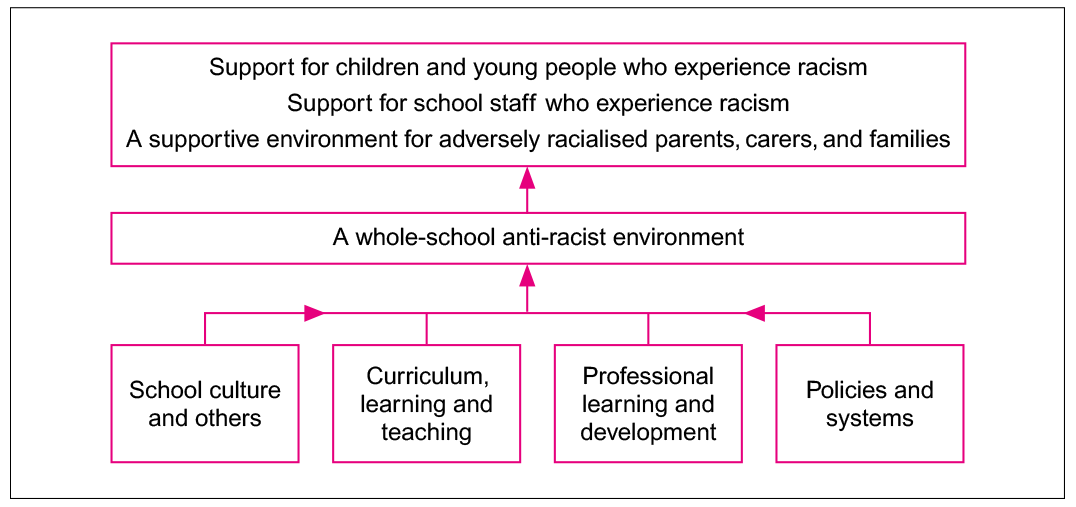
1. School culture and ethos
School culture and ethos play a critical role in setting expectations among all members of the school community of the standards of behaviour that are expected, and what happens when behaviour falls short of expectations.
Action which schools can take include:
A. Setting clear expectations with all members of the school community: This can include work on school vision, values and aims; pupil assemblies; regular sharing of messages through planned communications with parents, carers, and families; sharing of policies and practices; collegiate time and shared professional learning opportunities. Scottish Government guidance on fostering a positive, inclusive and safe environment in schools has information on how schools can work with the whole school community to develop its values, ethos and expectations. All school staff have a key role in demonstrating the attitudes and behaviours associated with anti-racism.
B. Listening to pupil views: see The role of children and young people. Ways in which schools and education authorities can support and engage pupils on approaches to respond to racism and racist incidents include:
- creating meaningful opportunities for pupils to engage in the development and delivery of anti-racist education in the curriculum, aligned to the Anti-Racist Curriculum Principles
- considering children and young people’s views in the development of school policies (for example school uniform)
- engaging with pupil equalities groups, anti-racist clubs, focus groups, and pupil voice processes, to hear pupil opinions and views
- gathering qualitative data about pupil experiences through pupil surveys
C. Prioritise racial literacy: Schools should provide support for all staff to develop racial literacy including time resource for professional learning and collegiate dialogue.
D. Discuss racism and the harm it can cause with openness and transparency: Environments where everyone can discuss racism openly, honestly, and with a willingness to learn and be accountable, helps foster an anti-racist culture.
E. Consider intersectionality: Any response to a racist incident should consider whether there are other forms of discrimination involved. This will help to identify ways in which adversely racialised children and young people may experience multiple forms of discrimination at once. An anti-racist whole school culture and ethos can support interconnected inclusive approaches, such as LGBT inclusion, support for children with additional support needs, and responding to gender based violence.
F. Promote inclusion and shared experiences: The confidence of all learners is enhanced when their heritage and culture are equally recognised, explored, respected and valued. Some actions to support this may include:
- measures to ensure everyone’s names are pronounced correctly, such as phonetically spelling out all names
- consider ways in which to include the religious, cultural and linguistic backgrounds of all pupils and staff in the everyday practice of the school and teaching (UNCRC Article 30)
- embed a ‘mirrors and windows’ approach to curriculum design that ensures that learners see themselves and the lives of others in what they learn, and recognise the importance of respecting their own and others’ identities. Further information is available from Education Scotland
G. Increase diversity within the teaching staff: A diverse workforce brings benefits for all learners and staff, regardless of their ethnicity. Adversely racialised learners’ attainment is positively impacted when their teacher is from an adversely racialised background. Education Scotland’s guidance on Promoting race equality and anti-racist education for schools sets out information on school leaders’ responsibilities to ensure recruitment practices adhere to equalities legislation. Scottish Government have developed an action guide for local authorities on Increasing and retaining minority ethnic teachers.
2. Curriculum, learning and teaching
Curriculum
Opportunities to embed and amplify anti-racism exist across the curriculum with particular connections through social studies, health and wellbeing, global citizenship, and the life and ethos of the school. All young people should learn about anti-racism as part of the Responsible Citizen education capacity that fosters respect for others and a commitment to participate responsibly in political, economic, social and cultural life.
The Anti-Racist Curriculum Principles, the associated Calls to Action and anti-racist resources for educators have been designed to support educators, leaders and learners understand what an anti-racist curriculum can mean in practice.
Schools should use the Principles to
- identify key aspects of learning around racism and anti racism for further development in the curriculum, such as the difference between individual and systemic racism, its impacts, and how it intersects with other types of injustice
- promote the co-design of an anti-racist curriculum with learners
- support professional learning and self-evaluation for staff
- assist school staff to prepare for occasions when discussion of diversity or race in the classroom may lead to incidents of racism between learners
Curriculum topics and materials can, at times, be biased or racist in the content, tone or assumptions of the materials. School staff should be alert to this possibility and critically review materials.
Learning and Teaching
GTCS Standard for Career-Long Professional Learning requires teachers to ‘recognise, see and acknowledge the value in everyone and have a deep awareness of the need for culturally responsive pedagogies.’
Learning and teaching approaches promote anti-racism when they:
- are led by practitioners who have developed their own racial literacy so that they can readily identify bias and take steps to address it
- engage meaningfully with all learners’ cultural and linguistic heritages and use these as assets to frame and support learning and teaching
- move beyond acknowledgement or ‘celebration’ of diversity, and instead incorporate opportunities for learners to use and sustain their home culture during lessons
- provide ‘mirrors and windows’: opportunities to see positive representation of one’s own identity throughout the curriculum, learning and teaching, as well as opportunities to explore diversity
- purposefully create opportunities for recognising and exploring perspectives, for example through skilful questioning and collaborative learning as well as through curricular planning
- support children to make links between their own cultural context and others, understanding how cultures interconnect and share commonalities
- create explicit opportunities for critical thinking about power and privilege as experienced by different communities
- challenge stereotypes and deficit thinking
- create opportunities for teachers to develop skills in pedagogies that support an antiracist classroom environment, such as global citizenship education and culturally responsive and sustaining practice
School leadership should support staff to consider how to incorporate anti-racism into their teaching and learning approaches
3. Professional learning and development
Professional learning about anti-racism can support teachers and school leaders to:
- grow and develop the skills and confidence to engage in anti-racism work, including racial literacy
- engage pupils in safe and constructive dialogue around racism
- identify and challenge negative attitudes and behaviours
- reflect on their own beliefs, attitudes, assumptions, and unconscious bias
All educators and leaders should:
- ensure staff at all levels are able to promote and engage in high quality professional learning about anti-racism, with opportunities for planned professional dialogue
- support the development of racial literacy
- foster a culture of collaboration on anti-racism work
- encourage accountability and sharing of learning throughout the school
Further detail about the role of educators and leaders is outlined at Breaking the mould
Building Racial Literacy Programme
Education Scotland and a range of co-design partners have developed the Building Racial Literacy (BRL) programme for school staff. The BRL programme runs throughout the year.
If your school is seeking further support with anti-racism education and the BRL programme is not currently accepting applications, you may wish to connect with local Antiracist Mentors. Mentors are BRL alumni who have undertaken additional training to support antiracist practice across Scotland. For more information or to make an enquiry, please contact: edsbrl@educationscotland.gov.scot.
4. Policies and Systems
Systems, structures, policies, or expectations, that have become established within a school community can have unequal and discriminatory impacts on adversely racialised learners, staff, and families, even if this is unintended.
Schools do not need to create a separate anti-racism policy unless they wish to do so. Senior leadership can take a holistic approach, in which all existing policies and procedures are reviewed from an antiracist perspective, in accordance with the relevant local authority policy framework, to ensure that they actively promote anti-racism.
Policies and systems which schools may wish to give particular attention to include:
- Equalities policy: Addressing racism and racist incidents should be a key part of a school’s equality policy. Equalities policies should recognise the experiences of adversely racialised children and young people, and acknowledge that experience of racism and racist incidents can be a barrier to participation and inclusion. Guidance can be found on Education Scotland’s equalities policy guide.
- Relationships and behaviour policy: Consideration should be given to how this will be applied to incidents of racism. This will help set clear expectations with all members of the school community, including what to expect if an incident occurs. Scottish Government guidance on fostering a positive, inclusive and safe school environment notes that a racist incident may require immediate escalation. Consideration should also be given to ensure that the behaviour policies do not disproportionately affect particular groups. The EHRC technical guidance for schools provides an example of how exclusion policies might disproportionately disadvantage black boys.
- Anti-bullying policy: Consideration should be given to how schools will respond to incidents of prejudice-based bullying, or incidents of both racism and bullying, to ensure that these are addressed and recorded appropriately.
- Special leave and religious observance: Policies that determine time off, and facility for religious observance during and beyond school, may indirectly or directly impact adversely racialised staff and learners
- School uniform policy: Scottish Government has published guidance for schools on clothing and uniform policy. Schools should take action to ensure that their clothing and uniform policy does not discriminate on the basis of race or ethnicity and enables cultural expression, for example in hair, hairstyles and headcoverings. Schools should ensure that their approach includes measures to prevent and tackle stigma, bullying, discrimination or prejudice.
- Opportunities provided in school for personal achievement, clubs and activities, and school trips can also be examined to ensure they are fully inclusive of pupils from all backgrounds; for example, ensuring that there will be appropriate food available for all pupils on the trip, and ensuring that regular extracurricular activities are planned at a time that does not exclude particular groups of pupils, for example due to prayer times or religious festivals.
- Key performance data, such as attainment, achievement or absences can be reviewed by school leadership to help understand their relationship to race and other protected characteristics in their individual local context.
- Information from SEEMiS and similar systems on recorded incidents of racism can be used to inform appropriate targeted action to address this.