
Schools - fostering a positive, inclusive and safe environment: guidance
Guidance on fostering a positive, inclusive and safe school environment, including the use of consequences in schools.
Section 4: Creating a culture of positive relationships and behaviour
The foundation of any school’s approach to supporting a child or young person is a school’s culture and ethos to positive relationships and behaviour.
Values, climate and belonging
Evidence shows that a focus on fostering an inclusive, relationally rich school ethos is likely to impact positively on behaviour.
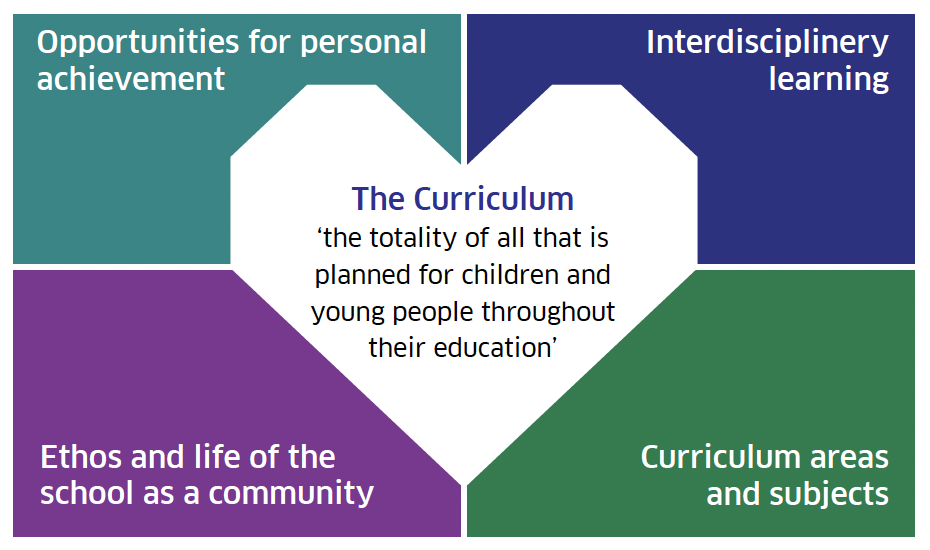
The Curriculum
‘the totality of all that is planned for children and young people throughout their education’
- Opportunities for personal achievement
- Interdisciplinery learning
- Curriculum areas and subjects
- Ethos and life of the school as a community
In Scotland the ethos and life of the school as a community is an integral part of the curriculum. It is the responsibility of all staff to proactively promote positive relationships and behaviour in the classroom/learning space, playground and the wider school community.
In order to develop skills such as positively participating in groups, acquiring and developing social skills and being able to manage their own emotional regulation, children and young people need strong, trusting relationships, to feel known by the adults and peers in their school, and opportunities to acquire and develop such skills through modelling, planned experiences and learning. This also involves clear expectations, consistent routines and boundaries, effective responses and opportunities to learn from their behaviour. This provides the structure that allows them to acquire and develop skills for learning, skills for life and skills for work. In doing so, it supports their growth as successful learners, confident individuals, responsible citizens and effective contributors – the four capacities of the curriculum.
Educational settings should be able to clearly articulate their core values and translate these values into expectations around behaviour. Priority should always be given to health, safety, wellbeing and systems that promote positive behaviour in line with agreed expectations. There should be a direct link between values and expectations.
Developing a whole school ethos
A strong ethos begins with a set of cohesive values that reflect the identity and aspirations of the learning community. To ensure that schools’ approaches to responding to behaviour support this ethos effectively, schools should adopt a structured approach based on clear values, expectations and consistent application.
Identifying values
To develop an effective approach to relationships and behaviour, schools should first determine their core values that underpin their approach. These values should be:
- meaningful and relevant to the particular context, ensuring they are understood and agreed across the school community
- developed collaboratively with children and young people, staff and parents to foster shared ownership and commitment
- clearly communicated so that everyone understands their significance and how they shape the culture and approach to behaviour
- embedded and reinforced in daily practice to ensure modelling, consistency and clear link to expectations and responses
Schools should regularly reflect on how well these values are shaping their culture and practice. This includes using self-evaluation processes such as:
- analysing behaviour data to identify patterns, trends or areas that require additional focus through self-evaluation mechanisms, such as HGIOS4
- conducting surveys or consultations with children and young people, staff and parents to gather diverse perspectives
- engaging the wider school community in ongoing dialogue about how values are lived and experienced within the school environment
Values should be regularly reviewed and adapted in response to what is working, what is changing, and the evolving needs of the school community.
Translating values into expectations
To ensure that values translate into daily practice, schools should develop clear, practical expectations that align with them, in collaboration with the whole school community. This involves:
- defining specific behaviours that reflect the identified values
- ensuring expectations are inclusive, simple, explicit and easy to meet
- communicating expectations consistently through daily interactions, assemblies, classroom/learning space discussions, school policies, and parental engagement sessions
- applying expectations to all members of the school community, including children and young people, staff, and parents
Approaches to expectations should be inclusive and reflective of the diversity of age and developmental stages across the school community and framed in such a way that ensures children and young people are able to meet them, particularly those who may be disadvantaged or face barriers linked to a protected characteristic. For example, an expectation that children and young people should ‘follow instructions first time’ may be unachievable for children and young people due to their age, developmental stage or neurodiversity. ‘To follow instruction’, may be an alternative, more inclusive and achievable expectation.
Applying expectations consistently
Underpinning a whole school approach to relationships and behaviour is the importance of consistency. This means that while expectations of behaviour apply equally to all members of a school community, the support and interventions provided will be tailored to individual needs, ensuring a child-centred equitable approach that is most likely to lead to change.
Key aspects of consistency include:
- all members of the school community – children and young people, staff and parents – should be expected to uphold school values and model expected behaviours to create a predictable, structured environment
- where a child or young person’s behaviour does not meet expectations, it should be addressed in line with the school’s relationship and behaviour policy, which outlines processes for responding
- expectations are regularly and positively reinforced across the setting, with clear and consistent messaging to and from all members of the learning community
- a clear escalation process should guide the progression of responses when expectations are not met
- high expectations should emphasise children’s rights, fostering a sense of fairness, equity, accountability and social and moral responsibility
- expectations should be applied equitably, with responses tailored to individual needs
- opportunities for professional learning for all staff to ensure a shared understanding of expectations and effective responses to types of behaviours, or situations, that present staff with more challenge, in line with the relationships and behaviour policy
Consistency is promoted through a structured, staged approach, in line with the GIRFEC approach and Additional Support for Learning Statutory Guidance.[7] Further information on a staged approach can found in section 5.
Reporting, recording and monitoring
An important element of consistency in approach is a standardised approach to reporting, recording and monitoring incidents. Schools should have clear processes for recording incidents in line with local authority procedures and national guidance, such as Respect for All.
There is a clear expectation that all incidents involving violence towards other children and young people or staff should always be recorded.
A common criticism of current approaches to promoting positive relationships and behaviour is that responses can be perceived as being ‘rewards’ for not meeting expectations or if they are not visible, it can be perceived that nothing has been done in response. Where there have been incidents between children and young people, mitigations may impact on either or both of the children or young people which can lead to concerns the person affected by behaviour is being further victimised.
Such perceptions can impact on the culture and ethos of the school, particularly if little is perceived to have been done in response to behaviour that is violent or perceived to be abusive.
It is therefore important that schools are clear about how they will communicate their response to all relevant parties (staff involved, children and young people affected, and their parent(s)). There will often be confidentiality issues relating to the other child or young person involved meaning information cannot be shared with the person affected. In such instances the need to respect confidentiality should be explained and reassurance given that action has been taken, and as far as is possible, the reasons for decisions.
Messaging about upholding expectations should also be regularly reinforced through whole-school approaches, in order to create a strong culture and ethos. Staff understand the need for individualisation for some children and will be able to support all children to understand this in terms of equity.
Examples
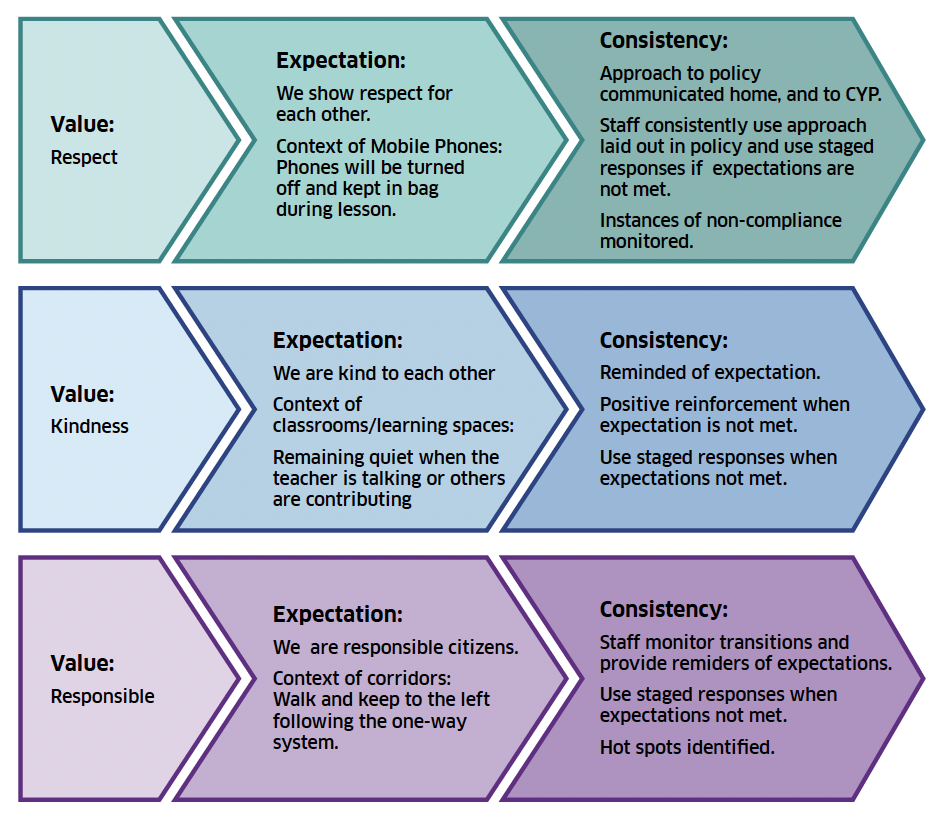
Value: Respect
Expectation:
We show respect for each other
Context of Mobile Phones: Phones will be turned off and kept in bag during lesson
Consistency:
Approach to policy communicated home, and to CYP.
Staff consistently use approach laid out in policy and use staged responses if expectations are not met.
Instances of non-compliance monitored.
Value: Kindness
Expectation:
We are kind to each other
Context of classrooms/learning spaces: Remain quiet when the teacher is talking or others are contributing
Consistency:
Reminded of expectation.
Positive reinforcement when expectation is not met.
Use staged responses when expectations not met.
Value: Responsible
Expectation:
We are responsible citizens
Context of corridors: Walk and keep to the left following the one-way system
Consistency:
Staff monitor transitions and provide remiders of expectations
Use staged responses when expectations not met.
Hot spots identified.
Monitoring and reviewing consistency
It is important for schools to continually reflect upon and evaluate their school’s culture and ethos, strengths to build on, and areas for improvement; the nature of child development is such that even schools with very strong cultures will still experience instances of behaviour that does not align with the school’s expectations. Schools will also have very different contexts or face different challenges. To ensure consistency and effectiveness in supporting positive behaviour, schools should have a robust reporting, recording and monitoring process in place. See section 6 for more information.