Shaping the Future: Strengthening Scotland's education system through empowered schools

Final report of the Independent Professional Advisor on future school reform in Scotland, with a focus on improvement, funding and governance.


5. Improvement

“Scotland can become the best at getting better.” - Pasi Sahlberg, International Council of Education Advisors (ICEA), October 2025

“It is crucial that … collaborative working is not a blind act of faith. Rather, activity must be underpinned by systematic enquiry to ensure that evidence informs developments rather than replicating uninformed or out-of-date practice.” - ICEA Third Formal Report, 2021 - 2023[19]

Structural support for improvement at school level is undergoing a substantial change.

The recommendations set out in Professor Muir’s independent review (2022)[20] gained traction and were met with broad approval from stakeholders. The report led to key legislation being taken forward through the Education (Scotland) 2025 Act[21], the creation of Qualifications Scotland and an independent HMIE.

Education Scotland is being refocussed with its primary purpose to lead curriculum design, delivery and improvement, including the provision of resources to support high-quality learning and teaching, while also playing an important role in supporting a thriving professional learning sector[22]. Qualifications Scotland seeks to be agile and responsive to the voice of the profession and to learners as it moves forward with qualifications better fit for purpose. The introduction of the Centre for Teaching Excellence (CfTE) indicates a commitment to enhancing the most critical part of the teacher’s role.

Some commentators have highlighted the need to move away from a so-called ‘self-congratulatory education system’[23] which allegedly 'marks its own homework’[24]. An independent inspectorate should lead to continuous robust and unbiased evaluation of both individual schools and the system in which those schools operate. At time of writing the inspectorate is engaging in a discussion with stakeholders about how the inspection system should work and what value it could add to children's and young people's experiences in our schools[25]. Furthermore, in the changing financial climate local authorities are adapting how their approaches support school improvement.

This changing context represents a real opportunity to affect change within and of the system. The potential to accelerate improvement and optimise resources is substantial.

Measuring improvement

What’s water?

The story goes that one day two young fish were swimming along, minding their own business. They meet an older fish coming in the opposite direction who remarks, “The water’s fine today, isn’t it?”

Moments later the two young fish look at each other and one says, “What’s water?”

Is there a need to improve? Analysis of the performance of our education system indicates that the answer to this is yes.

“There is wide variation in education performance across councils, with evidence of worsening performance on some indicators in some councils. At the national level, exam performance and other attainment measures have improved. But the rate of improvement up until 2018–19 has been inconsistent across different measures … Progress on closing the gap has been limited and falls short of the Scottish Government’s aims. Improvement needs to happen more quickly and there needs to be greater consistency across the country.” – Audit Scotland, Improving outcomes for young people through school education, March 2021[26]

Scotland measures its education outcomes through the National Performance Framework (NPF). Within this are nine education National Indicators and 15 sub measures. By 2025, progress that had been made during the preceding five years was mixed, at best. See Table 4.3 in Appendix A. In relation to attainment, we had improved in four but worsened in three sub-measures. It is of further interest that the sub-measures in which performance had worsened were all related to the attainment of learners at the point of leaving school. The lack of alignment between the Broad General Education phase and Senior Phase gives cause for concern.

There is a tendency to assume that the quantitative data on learner’s progress collected by our national system is valid and reliable. Yet school leaders and other key stakeholders do not have full confidence in the reliability and validity of judgements of A Curriculum for Excellence (ACEL) levels. During one engagement Professor Paterson described ACEL data as deeply flawed. Further, he describes the political claims of rising attainment as “statistical fictions”.[27] The lack of alignment nationally between ACEL data within the BGE and Senior Phase data, and inspection evidence of secondary schools supports these concerns.

Beyond attainment data, further questions around the commitment to support and report progress in developing the ‘whole child’ are prompted by the NPF. In four outcome fields pertaining to young people: confidence; resilience; engagement; and participation, no data was recorded.

While it could be argued that our direction of travel has been broadly positive, the pace of our journey has without doubt been too slow. Put simply, we are not meeting our own ambitions.

Scotland has committed to closing the poverty-related attainment gap. No-one in our system disputes the importance of this goal. Despite this, based on an analysis of data from the Insight tool there remains a significant gap in attainment (whether measured through the lens of all SCQF Qualifications or through National Qualifications) between FME and non-FME, or Quintile 1 and Quintile 5 learners.

Further detailed information is presented in Appendix B, Poverty Related Attainment Gap.

There is strong quantitative evidence of the need to accelerate our improvement and to raise our overall performance[28]. Despite the many strengths and achievements of Scottish education, the challenge to close the poverty-related attainment gap remains significant. Whilst there is recognition of the societal factors that affect learners such as child poverty and family support needs, we should at all times remember that the quality of school provision plays a crucial role in young people’s educational success[29].

The measures by which Scotland self-evaluates performance at the various levels of our system require de-cluttering. While metrics are used to report to different audiences, the core of overlapping outcome measures do not fully capture what we say we value.

Alongside the 15 NPF sub-measures mentioned above, the National Improvement Framework (NIF) is the primary tool for evaluating the performance of the school system. It focuses on five key priorities: placing human rights at the centre of education; improvement in attainment (specifically literacy and numeracy); closing the poverty-related attainment gap; improvement in children’s health and wellbeing; and improvement in employability skills and positive destinations for school leavers. There are 16 key measures for the NIF with 190 specific measures across the seven outcomes.[30]

Of the 16 measures there are 14 measures where multiple years of data are available; 5 measures show an improvement over time since 2019/20 and 9 show a decline or no consistent pattern of improvement. Of these 14 measures where multiple years of data are available, there has broadly been a narrowing of the gap in 6 of the measures, and a widening of the gap in 8 of the measures over time in the latest year of data. The most generous description of these trends is ‘mixed’.

Other key metrics used to gauge education in Scotland are:

  • How Good Is Our School? 4th Edition [31] (HGIOS4)
  • How Good Is Our Education Authority? (HGIOEA) There are two frameworks, the second of which is under development.
  • i. Developed by Association of Directors of Education (ADES)[32]
  • ii. Being developed by HMIE
  • The Local Government Benchmarking Framework[33] (LGBF)
  • International standardised assessments such as the Programme for International Student Assessment (PISA)

Of note is the fact that from this range of metrics only three measures are common across all. Attainment data in terms of Achievement of Curriculum for Excellence Levels (ACEL) for literacy and numeracy, qualifications at identified Scottish Certification and Qualifications Framework (SCQF) levels, and positive destinations data are the only metrics that appear on all measurement frameworks.

The LGBF is utilised to evaluate the effectiveness of local authority support for schools. It does not adequately assess the quality of inputs and processes as it is dominated by outcome measures. This is a key point when it comes to considering how Scotland could and should improve. If we want to be the best at getting better we have to know how well the main components of our system are affecting and improving provision at school and classroom level. It is only by doing so that we can be confident that what we are doing is making the difference that we seek.

Figure 3[34]: Around a third of the indicators from the LGBF are dedicated to Children’s Services. From these 33 performance indicators 22 are specifically related to school performance. Almost all of these indicators are outcome indicators i.e. there is no reference to inputs such as leadership or learning, teaching and assessment bar costs associated with education
Pie chart illustrating distribution of 108 indicators, divided into 33 indicators for Children's Services in dark green and 75 indicators for Other categories in dark red. The 33 indicators are divided further into a second pie chart illustrating 22 school related KPIs in dark green and 11 other KPIs in light green. There is an additional section in light green illustrating 3 KPIs common to all baskets.

Measuring inputs (resources, staff, funding) and processes (curriculum, learning, teaching and assessment, personalised support) is critical because they reveal how and why outcomes have been achieved. Inputs and processes provide essential insights for improvement, accountability and replication.

Figure 4[35]: Nine indicators from the National Performance Framework are aligned to education. From these national indicators, there are 12 performance indicators with 8 specifically related to school performance. All of these indicators are outcome indicators i.e. they do not make reference to inputs such as leadership or learning, teaching and assessment.
Pie chart illustrating distribution of 81 indicators, divided into 9 National indicators for Education in dark green and 72 National indicators for Other categories in dark red. The 9 indicators are divided further into a second pie chart illustrating 8 school related KPIs in dark green and 4 other KPIs in light green. There is an additional section in light green illustrating 5 KPIs common to all baskets.

For the purpose of external calibration, Scotland utilises Programme for International Student Assessment (PISA) measurements. We will shortly re-introduce Progress in International Reading Literacy Study (PIRLS) to assess reading at age 10 and Trends in International Mathematics and Science Study (TIMSS) at two points of learners’ journeys.

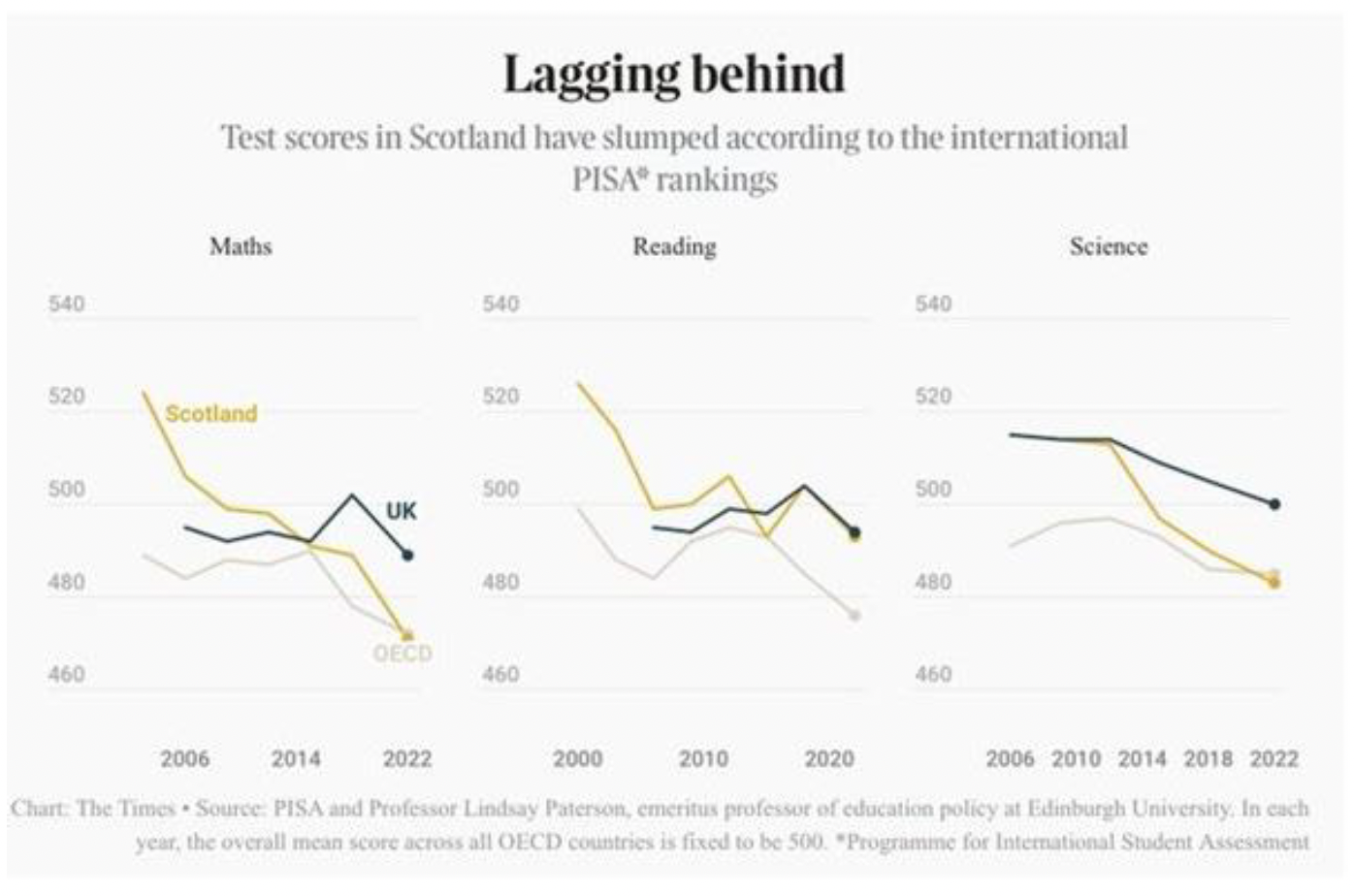
As outlined in my introduction PISA scores show that educational performance in Scotland has declined over time. In the 2000s, overall scores in Scotland were relatively high and above the average across OECD countries. Since around 2012, there has been a significant decline in PISA scores. This trend of declining performance in Scotland relative to England is seen in both the maths and science domains of PISA scores, although performance has remained much more stable for reading.[36]

In their 2024 report on “Why Educational Data Matters”[37], the Commission on School Reform commends “Scotland’s participation in the Programme for International Student Assessment – the PISA studies – which happen every three years in about half of the world’s countries”. The Commission, however, makes a strong case that we do not go far enough in tracking learners’ progress, and that a much fuller picture of progress and what contributes to that progress is within our grasp. The Commission further posits that “Because of all these serious gaps in evidence, there is no way of evaluating policies that are intended to improve schooling.” Based on the views expressed during the course of compiling this report, it is hard to argue against this assertion. The system would do well to refer to the Commission on School Reform when designing future metrics of success.

“The quality of statistical evidence on Scottish education is poor… The current statistical evidence on Scottish schools does not provide a basis for understanding what works and what does not, what can be improved and how, and what experiments are worth extending.” - Commission on School Reform, Why Educational Data Matters: Statistical Evidence for Improving Scotland’s Schools, November 2024

Each of these metrics and baskets of measures utilised by Scotland’s education system serves a different purpose. They cover individual and collective school standards and quality, local authority management, through to national performance and international comparisons. Utilising them concurrently could provide a multi-dimensional picture of what is happening at all levels. It is not apparent, however, how well these streams of data are currently integrated to provide that full multi-dimensional level of understanding that tells us how well the system is performing. Nor is it clear to what extent the data is then utilised to indicate potential improvement actions at each layer of provision.

It is fair to question whether our system currently follows the sequence of Learn-Do -Understand before cycling back to learning more, doing better and understanding more deeply in a continuous loop. Despite mountains of data, we are not letting ourselves reach the heights to which we aspire.

If the purpose of data is to understand and measure progress and indicate how to improve outcomes there is a risk that the current basket of metrics does not provide sufficient overlap at the centre. Elected members may emphasise one basket of measures, while local authority Directors of Education are focused on another, and Headteachers and practitioners yet another. There is a risk that what Scotland truly values is getting lost somewhere amongst the data and proxy measures that we use. One striking omission is that there is no data collected on the quality of learning, teaching and assessment across the country, despite this being one of the most important contributors to outcomes. When metrics do not capture causal links to the outcomes that are sought they obscure rather than illuminate, and they dissipate rather than focus energies.

Being immersed in data is not necessarily being informed by it. The more data there is, and the less core overlap exists the greater the likelihood that different parts of the system end up valuing different things. Some stakeholders may point to minor achievements which do not contribute to the overall end goal. At best that produces tensions; at worst it leads to distractions and misdirection of finite resources. Some data could be distracting the system instead of focusing its attention on the prize of providing what our children and young people really need from our schools.

A number of stakeholders who have participated in engagements for this report have argued strongly for a more relevant range of core metrics relating to education to be deployed, and for those measures to be used more intelligently than they are currently. Examples include ensuring that the wellbeing and confidence measures are given more prominence. Impassioned pleas have also been made to enable the tracking of progress made by individual learners over time, reflecting the importance of progress made by learners at all levels of academic capability. Further, they argue that Scotland should capture the proportion of learners who have progressed through ACEL levels in the course of one, three and five school years. This is not the same as recording the percentage who have achieved a certain level at any given time.

On the metrics that are used to gauge improvement, members of the Headteacher Panel observed that there is a lot of focus on attainment, rather than improvement, with very little account taken of each learner’s journey. They also highlighted that some of our children make remarkable progress from very low starting points despite challenges, yet their progress is not measured. They concluded that we need more relevant data that allows the system to celebrate and build on ACEL progress just as much as raw attainment.

Scotland should now reflect on what it values most highly as outcomes from our education provision. From this, a basket of core indicators and metrics should be constructed that enables key stakeholders to gauge progress and evaluate their own contribution to the progress made.

These key stakeholders include the national agencies which have recently undergone significant reform and therefore have yet to fully demonstrate their impact on the system.

The Commission on School Reform has indicated that the Inspectorate has ‘failed in all three aspects of its remit’. They argue that the Inspectorate has been more interested in ensuring compliance from schools in implementing Curriculum for Excellence (CfE) than in evaluating the quality of provision and the corollary outcomes.

“HMIE should stand above trends and shibboleths, to concentrate on evidence-based research and actual outcomes.” – Commission for School Reform, 2024

The predecessor to Qualifications Scotland, the Scottish Qualifications Authority (SQA) faced intense, sustained criticism over its management of Scottish education, particularly regarding transparency, fairness, and trust. The 2021 OECD report described the qualifications system as a "barrier" to the Curriculum for Excellence. Many have described it as remote, overly bureaucratic, and poor at engaging with teachers and stakeholders.[38]

Education Scotland too has received significant criticism which revolves around a loss of confidence from teachers, parents, and pupils. Opposition parties and teacher unions have repeatedly stated that the agency is not fit for purpose, specifically citing its failure to address ongoing issues with the Curriculum for Excellence.

It is therefore imperative given the on-going reform of national agencies, that they individually and collectively demonstrate their impact on improving outcomes and experiences for our children and young people. The governance of these national agencies and the role of advisory councils, that provide objective criticality, will be vital in overseeing their work and the impact of that work.

Recommendation I1

Review the core metrics of educational success to ensure that they capture what Scotland and Scottish education deem to be most important, based on our vision for our children and young people.

Align the metrics used to gauge education provision and outcomes at school, local authority and national levels to capture approaches that make the biggest impact on learner’s outcomes.

  • The subsequent Improvement Recommendation I3 pertaining to the scope of HMIE inspections would be a major contributor to capturing this data.
  • An annual independently verified evaluation of the national education bodies would further identify the value each adds and would inform next steps for the continuous improvement of our education system (See also Recommendation I9).

We are often reminded of Scotland’s historical place in being a source of best practice in turning education aspirations into outcomes. Calibrating our education outcomes against international data will indicate how best to restore Scotland’s place as a leader of education delivery, underpinned by our values and principles.

The re-introduction of TIMSS and PIRLS will provide Scotland with more rounded data that monitors learning at different stages of learners’ schooling. Over time, it will be possible to utilise data collected over a number of years to evaluate the effects of system modifications designed to enhance school provision.

Recommendation I2

The re-introduction of TIMSS and PIRLS is to be commended.

National education outcomes should be calibrated utilising data from these metrics in conjunction with PISA, with progress in each tracked longitudinally.

  • The outcomes should be utilised as a source of reliable evidence to evaluate the quality of provision at all levels of the Scottish education system.

Process Key Performance Indicators (KPIs)

It has been universally acknowledged that our education system is complex. In such a complex system those with influence need to be clear about what makes the biggest difference to outcomes, thus directing their focus on the processes and inputs that bring about those outcomes. Revision of the metrics described above would benefit from greater reference to these processes and inputs.

HM Inspectors evaluate school practice and provision using a quality improvement framework based on European Foundation for Quality Management. This framework is organised under inputs (why), processes (how) and outcomes (what). It connects what a school does (inputs) with what it achieves (outcomes). HM Inspectors evaluate these inputs or the ‘why’ such as aspects of leadership and strategy, and processes or the ‘how’ such as learning, teaching and assessment and curriculum, that result in outcomes the school achieves or the ‘what’ such as attainment, progress or wellbeing.

The inspection framework and model are built on the premise that outcomes are achieved through appropriate inputs and processes.

The Performance Indicators in the LGBF are almost exclusively outcome indicators. These outcome indicators are important. They record a combination of the ‘What’ of local authorities work, together with the influence of external variables. What they do not do is capture the ‘Why’ and the ‘How’ of local authorities’ work. Assumptions and correlations play a part, but the causal links cannot be clear unless both the Why and the How are integrated into the framework.

Recommendation I3

To integrate process Key Performance Indicators (KPIs) into the Local Government Benchmarking Framework, to facilitate meeting expectations around public accountability, mirroring the approach taken in HGIOS4 and reflecting the model adopted by the European Framework for Quality Management.

The main aims of this change would be to:

  • Highlight the effective leadership and management and improvement practice within local authorities.
  • Establish which elements of authority practice make the biggest difference to the quality of provision and contribute to positive outcomes across establishments under their governance.
  • Enable the sharing of effective practice across establishments and authorities.

Raising standards

The Education (Scotland) Act 1980[39], enhanced by subsequent Acts in particular The Standards in Scotland’s Schools etc. (2000 Act) [40], outline the responsibilities around the provision of school education.

Section 1 of the 1980 Act states that “it shall be the duty of every education authority to secure that there is made for their area adequate and efficient provision of school education and further education.”

Section 3 of the 2000 Act outlines the responsibility for education at national and at local levels in relation to continuous improvement.

(1) The Scottish Ministers shall endeavour to secure improvement in the quality of school education which is provided for Scotland; and they shall exercise their powers in relation to such provision with a view to raising standards of education.

(2) An education authority shall endeavour to secure improvement in the quality of school education which is provided in the schools managed by them; and they shall exercise their functions in relation to such provision with a view to raising standards of education.

Section 7 of the Standards in Scotland’s Schools etc. Act 2000 requires authorities to review the performance of their schools "from time to time." If a review concludes that a school is "not performing satisfactorily," the authority has a statutory duty “to intervene and remedy the situation.”

Most recently the Education (Scotland) Act 2025[41] brings a significant change to the role and responsibilities of the Chief Inspector, with the balance of legislative power to set the frequency and focus of inspections moving from Scottish Government Ministers to His Majesty’s Chief Inspector. This change is designed to increase confidence in the independence of inspection and its role in identifying strengths and areas for improvement. While there will be no ministerial influence on the body’s professional judgement, Scottish Ministers will retain oversight of the inspection of education provision and where necessary Ministers will still be able to request inspections to be carried out by the Chief Inspector.

It is anticipated that intelligence derived from the inspections will substantially assist schools and authorities with their continuous improvement aims and practices.

The 32 local government authorities were formed in the mid-1990s. They are expected to deliver a wide range of local services for residents and local businesses. With regard to school education provision, they have delegated responsibility for the oversight of all matters relating to the delivery of the 3-18 curriculum ranging from the provision of the teacher workforce to ensuring adequate physical space for learning activities to be delivered. Local authorities in partnership with Education Scotland have responsibility to facilitate self-evaluation and promote continuous improvement to enhance learning outcomes. In pursuance of this, local authorities are tasked with co-ordinating staff professional development and promoting collaborative learning among school leaders and practitioners, while engaging with HMIE and Qualifications Scotland to improve educational standards.

The full range of education functions is currently delivered by each of the 32 local authorities.

In many respects the rationale for this model has been strong. Scotland has a deep respect for the principles of local democracy, bolstered by a history of agreements between national and local government. One indicative example of this partnership came in the form of the 2007 Concordat.[42] Yet by 2015 such was the strength of opinion around potential change[43] that an in-depth review of the governance of schools was undertaken.

The recommendations that arose from this review were largely welcomed and led to the Education Reform Joint Agreement (2018)[44]. Work towards greater school empowerment gained traction albeit unevenly, only to be halted by the global pandemic.

The Joint Agreement between COSLA and Scottish Government outlines clearly the joint responsibilities to deliver an empowered school education system throughout Scotland. The view taken by the then Cabinet Secretary for Education and Skills was that legislation would not be necessary to bring about the reforms and improvements envisaged in the Agreement.

In the following year HMIE conducted a review of progress[45], within which the key questions were posed as:

  • Improvement: How well do local authorities empower Headteachers and schools to lead improvement in order to close the poverty-related attainment gap through school improvement planning in collaboration with their school community?
  • Staffing: How well do local authorities provide Headteachers with flexibility to make decisions about staffing and leadership structures in their schools?
  • Funding: How well do local authorities empower Headteachers to decide how funding allocated to their schools for the delivery of school education is spent?

Inspectors found almost all local authorities committed to developing an empowered education system. When looking at staffing flexibility HMIE concluded that Headteachers had varying degrees of flexibility to make decisions, and that further improvement was needed. Around funding the inspectorate recommended that greater consistency was needed in the empowerment of Headteachers and schools.

Although some progress had been made in relation to commitments and intentions, there was understandably still much to do. By 2025/26 the view from Headteachers is that there is still some distance to go before the aspirations and undertakings of the Joint Agreement reach fruition. In some parts of the country school leaders report that good progress has been made, indicating that the potential for full implementation of the Agreement remains.

Responsibilities and challenges

Consistent with their pivotal role in driving and facilitating continuous improvement in schools, local authorities themselves were subject to a thematic review, published in March 2025[46]. A range of strengths and development areas were found by HM Inspectors. It was clear that in a number of areas and schools within them, schools were benefiting considerably from local authority oversight. However, despite efforts made by all involved the effects on school provision fell short of expectations. Ultimately the overall picture was summarised thus:

“In a minority of local authorities, strategic approaches are demonstrably improving attainment and standards in learning, teaching, and assessment in primary schools, but much less so in secondary schools. In most authorities, there is a need to revisit the principles of self-evaluation for improvement, so that this is well understood by school leaders and staff at all levels, particularly in secondary schools.” – HMIE, Thematic Inspection: Local Authority Approaches to School Improvement, March 2025

In summary, local authorities were able to demonstrate that the actions they were undertaking were leading to improvements in school provision in only 14%-49% of primary schools in Scotland. The picture is less positive in secondary schools than in primary schools.

In 2024/25 HMIE inspected 38 secondary schools - 15 of them required a further inspection, representing 39% of the sample. This means that more than 1 in 3 secondary schools that were inspected were found to have at least one important weakness affecting their learners. Despite the intentions of local authorities their statutory responsibility to intervene is not carried out to the degree expected. Their capacity to do so is likely to be a major factor.

In the process of gathering evidence for this report, a wide range of stakeholders have been asked for their views regarding local authority approaches to school improvement. At no point did any contributor suggest a lack of effort or commitment on the part of local authority officers. On the contrary, practitioners commend their colleagues at ‘the centre’ and sympathise with the number of roles, responsibilities and competing priorities with which they have to contend.

However, the 2025 thematic HMIE review captured several key challenges within Scottish education. At its most fundamental level improvement at school level is delivered by the professionals within each school. There is an implicit expectation of high-quality leadership supporting the practitioners who teach our young people. In turn the strategies that underpin effective school leadership are expected to be provided by our local authorities. Yet in this wide-ranging and detailed inspectorate analysis of the realities around Scotland’s 32 local authorities, the adequate provision of that expert oversight and advice is found to exist only in pockets. Only in a minority of local authorities is there palpable evidence of strategies that drive up standards and outcomes. Where they were identified, those strategies were much less evident in our secondary schools.

“There is notable variability in the consistency and quality of support provided to schools, both within and across local authorities. The effectiveness of self-evaluation processes requires strengthening, to maximise the progress of children and young people. Strengthening leadership development at all levels is essential for building capacity for continuous improvement.” – HMIE, Thematic Inspection: Local Authority Approaches to School Improvement, March 2025

It is beyond the scope of this report to investigate all of the contributory reasons for this variability. However, as stated there is no lack of commitment to young people, and no shortage of hard work that should contribute to improving quality in classrooms throughout Scotland.

It is necessary to highlight the additional challenges posed by rurality and remoteness, which are factors that must not be overlooked in the design of a revised system.

“A key challenge in supporting and driving school improvement is the recruitment and retention of high‑quality school leaders, particularly Headteachers with the appropriate skills, experience, and capacity to lead improvement in increasingly complex contexts. Difficulties in attracting suitable applicants can result in inconsistency of leadership across schools, placing additional demands on central teams to provide intensive support and develop leadership capability over time. Geography presents a significant and ongoing challenge, particularly within large, rural authorities. There are no simple solutions, but greater system‑level awareness of how these contextual barriers impact individual schools and local authorities is essential.” – Aberdeenshire Council response, Call For Views, February 2026

Although in their responses to the Call for Views some authorities highlighted the challenge in attracting highly able leaders and managers, those in place are determined to do all in their power to drive improvement. And yet.

Accountability

Nationally co-ordinated scrutiny of quality in our schools is designed to provide assurance to stakeholders, stimulate improvement and inform national policy. Inspection reports evaluate multiple dimensions of provision in individual schools and are synthesised to describe the overall quality of school education across the nation. At times thematic reviews are conducted to provide a deeper dive into specific aspects of school provision and standards. An anomaly that currently exists is that when a school is inspected, there is little or no reference to the quality of external leadership and management that oversees that school. This is anomalous because as evidenced above various Education Acts including Standards in Scotland’s Schools etc 2000, specify that the delegated responsibility for driving high standards in our state schools falls not on a national body but on education departments in local authorities.

In their response to the Call for Views (February, 2026), the General Teaching Council for Scotland (GTC Scotland) made this strong recommendation:

“Governance needs clear lines of accountability: Improved clarity of organisational roles and responsibilities remains a critical priority. This is essential to better ensuring accountability, high-quality education, and safeguarding. There needs to be effective oversight to improve public confidence in our education system and establish clear lines of accountability. The focus of inspection should be on education service providers rather than individual schools. Inspection must include activities that evaluate how well standards are embedded and ensure that the statutory obligations of education service providers are fulfilled. This will contribute more effectively to whole system improvement and effective system regulation.”

Apart from the simple operational connection between improvement practices, funding and overall resourcing when considering impact on outcomes, clarifying lines of accountability directly linked to roles and responsibilities would enable Scotland to plan and deliver transformational change in the way described by Donaldson and Chapman.[47]

“Issues of practice and delivery are vital but should flow from clarity of purpose and be seen as the professional responsibility of those directly involved in delivery.

A commitment to subsidiarity means placing those with the most relevant and up-to-date insight and experience at the heart of decision making. The key is to be clear about what decisions are best taken where and by whom, without the need for permission seeking from tiers of local and national government.” – Christopher Chapman and Graham Donaldson, Where next for Scottish Education, March 2024

A reminder: local authorities are required to facilitate self-evaluation and support continuous improvement to enhance learning outcomes. They have delegated responsibility to coordinate professional development, promote collaborative learning among school leaders and staff, and engage with national education bodies to maintain and improve educational quality throughout the system. We therefore have a scrutiny system in which schools are routinely evaluated in detail, yet the quality of support and challenge provided to them by those with the statutory responsibility to do so is not. The closest to routine evaluation and reporting of the quality of local authority provision comes in the form of the synthesis of individual school inspections over a period of time: a proxy measure at best.

Section 9 of the Standards in Scotland's Schools etc. Act 2000 charges HM Inspectorate of Education on behalf of the Scottish Ministers, to provide an external evaluation of the effectiveness of the local authority in its quality assurance of educational provision within the Council and of its support to schools in improving the quality of Education. It is of note that ‘Inspections of Education Functions (INEA)’ which was the model for inspecting local authority education departments ceased over 10 years ago. Given these assumptions and the lack of implementation thereof, there is at present a major blind-spot in how well we evaluate a key component of our education system.

In relation to agreed aims around school empowerment our system fails to assess progress towards specific milestones. Despite the potentially transformational actions agreed within the Joint Agreement (2018) there is no regular evaluation of the degree to which empowerment and subsidiarity is embedded in the practice and culture of local authorities. Perhaps the inspectorate will consider this when designing the next model of school inspection. In any case it is my view that the crucial influence of local authorities must be included routinely during school inspections.

Again from Professors Donaldson and Chapman: “An independent, reformed inspectorate should not only make judgements about quality and performance at institutional and local authority levels, important though these are, but should also be an authoritative source of evidence and insight based on first-hand engagement that can provide an overview of the quality of education across the system.” – Where next for Scottish Education, March 2024

Recommendation I4

The scope of school inspections should be broadened to include a discrete statement that evaluates the quality of support and challenge to raise standards provided by the local authority.

  • This would capture the strong causal link between the quality of provision in schools and the influence of the local authority with statutory delegated responsibility for assuring quality in those schools.
  • This should encourage closer partnerships between schools and their local authorities, given the joint responsibility and accountability of both partners for optimising learners’ progress and outcomes.
  • The revised framework for quality improvement practice should be underpinned at all times by the principles of empowerment and subsidiarity, reflecting the recognised benefits for all stakeholders, particularly children and young people.

Capacity for improvement

When asked to comment on the HMIE Thematic Review 2025, and comment on potential improvements, experienced school leaders offered the following insights:

“Local authority officers whose expertise lies in school improvement seem to spend more of their time dealing with FOIs and complaints from the public. Could FOIs be picked up by other officials? Many complaints are about issues such as toilet provision and litter in the neighbourhood streets.” – Member of the Advisory Group.

Local authorities are obligated to respond to FOIs and complaints from citizens. Authorities should continue to review the deployment of their full resources to free up time for central authority officers with an expertise in education, to more fully support school improvement. This might result in central staff, outwith education, dealing more fully with operational tasks such as complaints and FOIs.

“Even when a Headteacher is experienced and has a track record of success, they can be hampered by a lack of trust shown to them by their employer. Subsidiarity is something that my LA is only now starting to consider seriously.” – Member of the Headteacher Panel

In its response to the Call for Views, COSLA posited that Devolved School Management has been implemented and is supporting school improvement.

“The DSM, as outlined above, devolves decision‑making powers and budgetary responsibilities to Headteachers, allowing decisions to be made at the closest point to delivery. This is intrinsically linked to the school improvement process and enables schools to plan effectively for improvement and raise educational attainment.” – COSLA response, Call for Views February 2026

Although empowerment over spending flexibility including staffing decisions has been demonstrated in some areas, implementation has not been universal. There is a significant gap between the perception of local authority leaders and the lived reality of school leaders on this point. At time of writing eight years have passed since the Governance Review and the Joint Agreement signed by Scottish Government and COSLA which promised that this would be actioned.

Several school leaders highlighted the difficulty faced by local authority officials who are expected to transfer expertise from one school sector to another. Despite working conscientiously, officials are often expected to manage school leaders without adequate training or experience. This can compromise the rigour and robustness of local authority quality assurance reviews. On this:

“I know that a school down the road from me is struggling. But they cannot really ask for advice from our LA managers. As committed as they are, they have sparse experience of leading a school in the same sector. I think the school leader benefits from collaboration with Heads in similar schools, but the opportunities for that are limited.” – Member of the Headteacher Panel

In another case, a very successful school leader has sought more challenge and an opportunity to contribute their skillset to their local authority central team, but were told they are “too expensive” to work at the centre. This is a particular conundrum for secondary Headteachers seeking to join central teams. In contrast there are examples of practice within some local authorities where Headteachers are part of quality assurance visits and contribute to designing approaches. This is particularly evident where Headteachers are also Associate Assessors with the Inspectorate. They temporarily join inspection teams and benefit from working with HM Inspectors in developing their skills of analysis, evaluation and reaching judgements based on national standards and expectations.

Gaps too exist in the capacity of local authority quality improvement teams to provide support and challenge on subject-specific and stage-specific issues, outwith generic approaches. This, despite fundamental expectations stated within the Education Governance[48] document: “it is important that there are sufficient numbers of staff with educational expertise and with a dedicated focus on improving educational outcomes within regional teams.” Further, regional improvement teams should include curriculum area specialist support and hands-on improvement support when required. Given the tight budgetary restrictions on local authorities as they are currently defined it could be argued that these gaps in provision are inevitable.

In my engagement with Les Walton, CBE[49], he highlighted the importance of quality advice being given to schools, and for that advice to come from appropriately trained and accredited advisors. Although too late to integrate fully into this report Les’ strongly evidenced view is that empowering school leaders to lead system-level improvement in fact empowers their local authority every bit as much as it empowers the schools and their leaders. This three-way empowerment is within our reach, if not yet within our grasp.

There are examples around Scotland that demonstrate vision and deep strategic thinking of local authority leadership. These, according to Headteachers, tend to rely on excellent leaders within their local authorities. Notably, in these examples the right person is in the right leadership position. Although appreciative when this is in place, Headteachers observe that the provision necessary for schools to improve should not depend on exceptional individuals. That provision should, instead, be embedded in the system structures and culture within each and every local authority. Whatever Scotland’s education system does next, it must bear in mind the need to embed leadership and management capacity at the ‘middle’ to drive improvement at school level. If we rely on exceptional individuals to make it happen, by definition that leads to the majority not improving.

Recommendation I5

Whole school quality improvement should be led by appropriately experienced and trained school leaders with a proven track record of success, including at Headteacher level, co-ordinated by local authority senior leaders. Associate Assessors (HMIE) should play a key role in these activities.

  • Quality Improvement Teams should consist of representative proportions of practitioners at the level of school leader from all sectors. The proportions of practitioners should reflect the number of learners in each sector.
  • Subject and stage advisors should form part of the quality improvement teams, enabling peer to peer sharing of effective practice.
  • Professional development for subject and stage advisors should be ongoing, particularly in leadership of change and pedagogy. The Centre for Teaching Excellence and Education Scotland would jointly lead this provision.
  • Learning derived from school improvement exercises should be utilised as an authoritative source of evidence for system-wide improvement practice.
  • Inter-school verified self-evaluation (VSE) activity on an ongoing basis would be a universal expectation. The model of HMIE Associate Assessor training and deployment currently in place offers a proven model of professional development which should be utilised to support local authority VSEs.

Collaborative networks

Headteachers have stated that they appreciate and now largely rely on professional networks with fellow school leaders. Evidence from the March 2025 HMIE Thematic Review indicates that professional collaboration is most effective when it is based on evidence - both quantitative and qualitative - and characterised by robust open dialogue. An accountability framework based on well-evidenced research and shaped by challenge questions would further enable the sharing of effective practice and testing of innovative approaches.

When asked from where they get their best ideas for improvement and where they find solutions to challenges, the response from school leaders is clear: each other.

Collaborative networks of school leaders beyond local authority boundaries exist, with the broad intention of sharing effective leadership, management and improvement approaches. One successful example of a self-generated network is Building On Collaborations, Supporting Headteachers (BOCSH), which invites school leaders with a successful track record to participate. It must be highlighted that only a small minority of school leaders participate in such inter-council partnerships. As a consequence, the delivery of improvement strategies arising from wider collaborative networks at school level is limited. We seem here to be missing an open goal.

With particular reference to the considered recommendation from the International Council of Education Advisors (ICEA) to build… “relationships across curricula, organisational, geographical and professional boundaries that move knowledge, expertise and ideas around the system.” It could be argued that at present the most effective leaders are helping each other to be even more effective[50]. But what of those who are aspiring to move from good to great? Do our 32 education authorities have the capacity to provide the operational and strategic support to help schools make significant strides? Is our current structure helping Scotland’s schools to be the best at getting better? At this point, neither the inspectorate nor our school leaders would be confident about saying yes.

There are examples of partnerships designed to share effective practice operating at the level of local authorities. Local authority Quads with similar socio-economic characteristics have been formed and are in the process of implementing an improvement framework to optimise the potential of their collaboration. In existence also are partnerships that have arisen from the Regional Improvement Collaboratives (RICS). The senior leaders in the former Tayside RIC, the Northern Alliance and the West Partnership are proud of the progress they have made. Despite losing the additional funding to support the RICS they recognise the benefits of continuing to work together.

During my engagement with the West Partnership its leaders and practitioners at all levels shared examples of the benefits of working across local authority boundaries. Through skilful co-ordination the Partnership has facilitated knowledge and practice sharing. Particularly pertinent is the way in which they have taken the opportunity to harness economies of scale in quality improvement and the provision of professional development at every level. Aspiring leaders speak of real growth in their understanding, of the tangible benefits that their improved practice has had on the teams who report to them, and ultimately on the learners within their establishment. Classroom practitioners have taken advantage of the ‘Improving our Classroom’ seminars and learning opportunities to re-invigorate their learning, teaching and assessment. This is one example of the way in which collaborative networks can take advantage of sharing both resources and areas of expertise to bring benefits to their children and young people.

Governance and improvement are inextricably linked. For the purposes of school improvement almost every voice in the system recognises that teachers learn best from other teachers, and school leaders learn best from other school leaders. The governance system in place should therefore facilitate purposeful collaboration amongst practitioners. This will be more fully developed within the governance section.

Dr Pauline Stephen of GTCS recently summarised the potential benefits with a typically pithy remark: “Networked autonomy is the way forward: schools should be empowered to make decisions, share ideas, and find solutions from each other.”

Recommendation I6

Formal collaborative networks of school leaders and practitioners should be co-created and adequately resourced directly by the local authority, with this being taken into account in the grant funding formula utilised by national government.

  • A balance should be struck between bringing together schools from similar contexts and schools from contrasting contexts.
  • Partnerships should be cross-council where possible in order to spread effective practice on a larger scale.
  • School leaders should seek to strengthen their school cluster partnerships, establishing a 3-18 approach in particular to learning, teaching and assessment, and curriculum design and delivery.
  • Schools leaders will choose to form networks where they identify potential benefits, promoting positive system-wide relationships. Collaborative networks created and adopted by school leaders themselves should be encouraged and supported.

Accountability for progress and outcomes will lie with the participants. Collaborative networks should utilise quality improvement frameworks that integrate open dialogue, challenge questions, and the testing of innovations.

Financial controls

Linked to the subsequent section on finance – but distinct from funding amounts or DSM schemes – is the crucial need for both budget certainty and effective and transparent financial controls to be in place. Stakeholders report wide variation in this regard. In some parts of Scotland school leaders are routinely allocated their whole-year budget only to be told after the annual school census in November that they must not spend any more of that annual budget despite there being five months left of the financial year. In effect this increases instability and reduces the actual budget disbursement to schools. In some examples, underspend compared with annual budget is reclaimed by the authority and re-purposed for other services. Elsewhere, a small but important minority of school leaders have been left in the dark about the budget allocated to their school until the tenth or eleventh month of the financial year, making it impossible for the Headteachers to respond to local needs. At its most basic level, the learners in those schools do not have the learning resources that they deserve.

Local communities rightly assume that children and young people benefit from funding allocations at levels declared by national and local government leaders. The upshot of poor financial controls means that some school leaders cannot spend that vital funding on children and young people.

In one particularly concerning example of poor financial controls, that was highlighted to me as I undertook this report, significant amounts of money are moved around school budgets by the local authority without notification to the Headteacher or Business Manager. Worryingly no-one can make the numbers add up at the end of the financial year. This is unacceptable practice.

Not all local authorities are able to provide the necessary tools for schools to monitor and optimise their budgets. Some need assistance to provide their schools with this. Local authorities who face these challenges should be supported to overcome them by those with successful systems in place.

Further to this, when school leaders are unclear about how much funding they have to support their learners, they will almost always spend less than the children need and deserve. Expecting schools to manage their budgets with poor financial controls is not acceptable: falling short in supporting children is even worse.

Recommendation I7

Improvements should be made to the transparency, stability and quantum of resourcing to schools, to enable improvement at pace.

  • The quality of the Devolved School Management (DSM) model in place should be evaluated in every school inspection, including both quantum of funding and the empowerment of school leaders to disburse in accordance with local needs within the national framework.
  • The quality of accounting tools and support provided for financial management of school budgets should be evaluated at every school inspection. The transparency of budgets and schools’ ability to track revenue and outturn should be prioritised.

Pedagogy

Continuous improvement of pedagogy is arguably the most influential component of our education system in improving outcomes. Learners depend on great teachers to both inform and inspire. Effective teachers possess a combination of many attributes, and fundamental amongst these is expertise in the craft of teaching itself.

All national education agencies have a part to play in providing well-evidenced resources and guidance. Education Scotland and the newly independent inspectorate could co-ordinate their approaches to promoting effective pedagogy, given their opportunities to gather intelligence from sources throughout the system. As well as offering in-person or synchronous online programmes providing real time interaction, each could build a bank of advice based on empirical evidence of what works. Such a resource, reinforcing the crucial place of learning, teaching and assessment, would be invaluable for Scotland’s teachers.

Local authorities can and do play a key role in promoting effective classroom practice. Programmes of learning visits, involving both central and visiting school-based staff, can be a very effective and efficient way to share effective practice.

Within schools, peer to peer classroom visits which focus on strengths and provide colleagues with a platform to learn from each other, can be the single most productive form of professional development. The value of observing colleagues effectively teaching the same learners as they themselves teach, followed up with professional discussion, cannot be overestimated.

The advent of the CfTE brings further hope. One draft recommendation from the ICEA (2025)[51] is that government ensures that the CfTE does what it sets out to do, rather than theorise and talk about what needs to be done. This is good pragmatic advice from an eminent group of academics who are very familiar with this risk! If the Centre develops a programme of professional learning complemented by a ‘boots on the ground’ approach to spreading effective practice it will be a boon to Scotland’s teachers. Further, if the expertise in the CfTE is utilised to develop a team of ‘lead practitioners’ who cover age, stage and subject areas, Scotland’s schools will benefit immensely. And when this happens the real winners will be our children and young people.

Recommendation I8

Optimise the interface between the CfTE, national agencies, individual schools and school groups, and local authority improvement teams. This would include but not be limited to:

  • The provision of evidence-based professional development programmes, both in-situ in schools and off-site, in person as well as online, from exploratory levels to mastery of skills.
  • The curation of evidence-based online resources relating to pedagogy, including stage-specific and subject-specific learning, teaching and assessment.
  • Provision of advice on effective learning, teaching and assessment for elected members on Education Executive Boards (EEB) to further strengthen their understanding. (See Governance Recommendation G2)

Coherence across the national bodies

All of Scotland’s national education public bodies are undergoing significant change. It could be argued that Scotland has too many main players at national level and there should only be one. However, it should be remembered that although another of our public service bodies, NHS Scotland, has only 14 geographical bodies it also has eight cross-cutting bodies that oversee key elements of health provision[52]. By comparison, having four national bodies overseeing school education policy and practice seems parsimonious.

Key roles for Scottish Government in relation to school education include providing the funding, setting the legislative framework and overseeing policy direction for school education in Scotland. Actual delivery of policy is the responsibility of local authorities, supported by national bodies. Further, the relationship between the government’s Learning and Education Reform Directorates and the national bodies is worthy of exploration to ensure that they collectively deliver improved outcomes for children and young people. Within the responses to the Call for Views and during engagements with senior local authority representatives there is general consensus that an overloaded policy landscape with frequent changes, overlapping expectations and inconsistencies in policy direction inhibits improvement. Many felt that the Learning Directorate should ensure a more coherent, evidence-led national policy environment with fewer, better sequenced priorities to reduce duplication and improve alignment. They have been critical of what they see as the bureaucratic nature of the Directorate, and of silo working within it.

The clarion call from school leaders and to an extent Directors of Education in relation to the national education bodies is this: define your roles, responsibilities and accountabilities and make sure these align. This would not only ensure efficient use of resource within each body, it would also prevent the reported overload of policies that can lead to confusion despite being intended to provide support. Even the best of policies will fail if they are not complementary to other policies intended to be delivered by the same people.

“It is essential that each part of the school improvement support system works together, avoiding overlaps or duplication by assigning clear roles and responsibilities and good co-ordination…. All partners in the system need to exercise their full responsibilities and authority for any system to be able to improve in a sustained way.” – ADES response, Call for Views, February 2026

Recommendations from the ICEA and representatives from within Scotland alike advocate that our national education bodies should be co-ordinated by one executive director (or similar). Their central aim would be to ensure that there is clarity in the role, reach and responsibility of each body, leading to coherence in their combined influence. In turn this should facilitate system-wide improvement that takes account of capacity. A Chair of Scottish national education, overseeing national guidance to schools and authorities, removing unnecessary confusion, co-ordinating the conditions for improvement at pace and at scale. This role being politically impartial (although politically aware) would go some way towards ensuring that education ceases to be the political football and the object of critical media reporting (not all of which is balanced) that many school practitioners observe.

Recommendation I9

In addition to the observations and corollary recommendation in the later section on Governance:

Create the role of Executive Director, overseeing and co-ordinating the umbrella group of national education bodies. This role would be focused solely on the educational offer to our children and young people and would protect the political neutrality of Scottish school education.

  • To ensure coherence in the messaging to and expectations of schools
  • To identify synergies, optimising resources in each body
  • To take careful account of a reference group reporting to the Executive Director which includes voices of learners, practitioners and school leaders, enhancing the range of perspectives informing key decisions.

Improvement recommendations

Continuous improvement at school level is the holy grail. At classroom, year group, subject and whole school levels teachers and school leaders pore over assessment outputs. In-depth analyses are conducted, followed up with lengthy professional discussions. At local authority level similar exercises are conducted, often in preparation for dialogue with elected members and external scrutiny. Yet, despite these steps there are blind spots in our system. When it comes to the question of who or what has responsibility for driving improvement almost all of the attention falls on individual schools and their leaders. This should change.

Recommendation I1

Review the core metrics of educational success to ensure that they capture what Scotland and Scottish education deem to be most important, based on our vision for our children and young people.

Align the metrics used to gauge education provision and outcomes at school, local authority and national levels to capture approaches that make the biggest impact on learner’s outcomes.

  • The subsequent Improvement Recommendation I3 pertaining to the scope of HMIE inspections would be a major contributor to capturing this data.
  • An annual independently verified evaluation of the national education bodies would further identify the value each adds and would inform next steps for the continuous improvement of our education system (See also Recommendation I9).

Recommendation I2

The re-introduction of TIMSS and PIRLS is to be commended.

National education outcomes should be calibrated utilising data from these metrics in conjunction with PISA, with progress in each tracked longitudinally.

  • The outcomes should be utilised as a source of reliable evidence to evaluate the quality of provision at all levels of the Scottish education system.

Recommendation I3

To integrate process Key Performance Indicators (KPIs) into the Local Government Benchmarking Framework, to facilitate meeting expectations around public accountability, mirroring the approach taken in HGIOS4 and reflecting the model adopted by the European Framework for Quality Management.

The main aims of this change would be to:

  • Highlight the effective leadership and management and improvement practice within local authorities.
  • Establish which elements of authority practice make the biggest difference to the quality of provision and contribute to positive outcomes across establishments under their governance.
  • Enable the sharing of effective practice across establishments and authorities.

Recommendation I4

The scope of school inspections should be broadened to include a discrete statement that evaluates the quality of support and challenge to raise standards provided by the local authority.

  • This would capture the strong causal link between the quality of provision in schools and the influence of the local authority with statutory delegated responsibility for assuring quality in those schools.
  • This should encourage closer partnerships between schools and their local authorities, given the joint responsibility and accountability of both partners for optimising learners’ progress and outcomes.
  • The revised framework for quality improvement practice should be underpinned at all times by the principles of empowerment and subsidiarity, reflecting the recognised benefits for all stakeholders, particularly children and young people.

Recommendation I5

Whole school quality improvement should be led by appropriately experienced and trained school leaders with a proven track record of success, including at Headteacher level, co-ordinated by local authority senior leaders. Associate Assessors (HMIE) should play a key role in these activities.

  • Quality Improvement Teams should consist of representative proportions of practitioners at the level of school leader from all sectors. The proportions of practitioners should reflect the number of learners in each sector.
  • Subject and stage advisors should form part of the quality improvement teams, enabling peer to peer sharing of effective practice.
  • Professional development for subject and stage advisors should be ongoing, particularly in leadership of change and pedagogy. The Centre for Teaching Excellence and Education Scotland would jointly lead this provision.
  • Learning derived from school improvement exercises should be utilised as an authoritative source of evidence for system-wide improvement practice.
  • Inter-school verified self-evaluation (VSE) activity on an ongoing basis would be a universal expectation. The model of HMIE Associate Assessor training and deployment currently in place offers a proven model of professional development which should be utilised to support local authority VSEs.

Recommendation I6

Formal collaborative networks of school leaders and practitioners should be co-created and adequately resourced directly by the local authority, with this being taken into account in the grant funding formula utilised by national government.

  • A balance should be struck between bringing together schools from similar contexts and schools from contrasting contexts.
  • Partnerships should be cross-council where possible in order to spread effective practice on a larger scale.
  • School leaders should seek to strengthen their school cluster partnerships, establishing a 3-18 approach in particular to learning, teaching and assessment, and curriculum design and delivery.
  • Schools leaders will choose to form networks where they identify potential benefits, promoting positive system-wide relationships. Collaborative networks created and adopted by school leaders themselves should be encouraged and supported.

Recommendation I7

Improvements should be made to the transparency, stability and quantum of resourcing to schools, to enable improvement at pace.

  • The quality of the Devolved School Management (DSM) model in place should be evaluated in every school inspection, including both quantum of funding and the empowerment of school leaders to disburse in accordance with local needs within the national framework.
  • The quality of accounting tools and support provided for financial management of school budgets should be evaluated at every school inspection. The transparency of budgets and schools’ ability to track revenue and outturn should be prioritised.

Recommendation I8

Optimise the interface between the CfTE, national agencies, individual schools and school groups, and local authority improvement teams. This would include but not be limited to:

  • The provision of evidence-based professional development programmes, both in-situ in schools and off-site, in person as well as online, from exploratory levels to mastery of skills.
  • The curation of evidence-based online resources relating to pedagogy, including stage-specific and subject-specific learning, teaching and assessment
  • Provision of advice on effective learning, teaching and assessment for elected members on Education Executive Boards (EEB) to further strengthen their understanding. (See Governance Recommendation G2)

Recommendation I9

In addition to the observations and corollary recommendation in the later section on Governance:

Create the role of Executive Director, overseeing and co-ordinating the umbrella group of national education bodies. This role would be focused solely on the educational offer to our children and young people and would protect the political neutrality of Scottish school education.

  • To ensure coherence in the messaging to and expectations of schools
  • To identify synergies, optimising resources in each body
  • To take careful account of a reference group reporting to the Executive Director which includes voices of learners, practitioners and school leaders, enhancing the range of perspectives informing key decisions.

Contact

Email: EducationStrategicEngagement@gov.scot

Back to top