
Scottish Housing Market Review Q3 2025
Quarterly bulletin collating a range of previously published statistics on the latest trends in the Scottish housing market.
Part of
5. Mortgage Approvals and LTVs
5.1. New Mortgage Advances
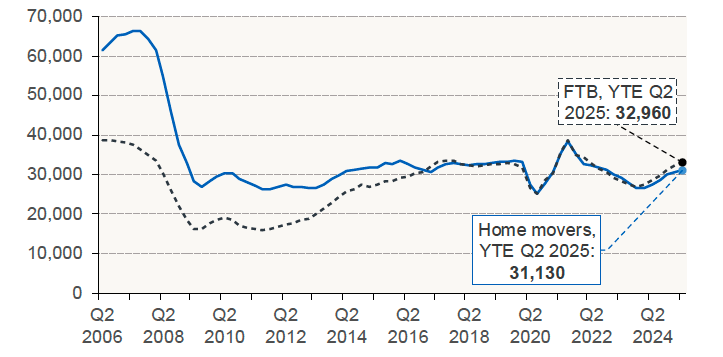
There were 8,940 new mortgages advanced to first-time buyers for house purchase in Scotland in Q2 2025, an annual increase of 8.8%. Meanwhile, there were 8,270 new mortgages advanced to home movers, an annual increase of 6.0%. Chart 5.1 shows the trend in new mortgages advanced using a 4-quarter moving total. In the year to end Q2 2025, the 32,960 new mortgages advanced to first-time buyers was the highest since the year to end Q2 2022. Over the same period, the 31,130 new mortgages advanced to home movers was the highest since the year to end Q4 2022. [Source: UK Finance]
Source: UK Finance
5.2. Mortgage Approvals
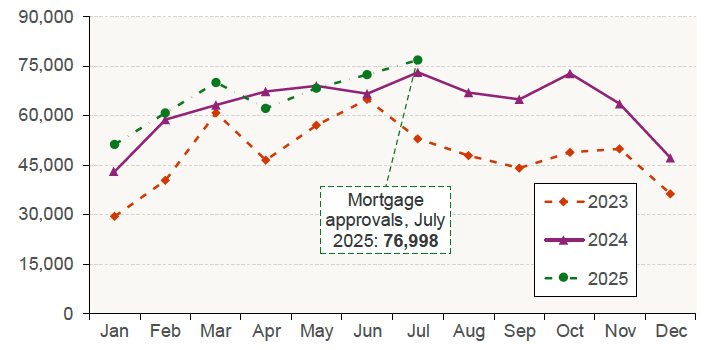
Chart 5.2 plots the monthly number of mortgage approvals across the UK for house purchase by individuals. Mortgage approvals for house purchase, which are the firm offers of lenders to advance credit fully secured on dwellings by a first-charge mortgage, are a leading indicator of mortgage sales as they reflect activity early in the buying process.
The number of mortgage approvals in July 2025 was 76,998 compared to 73,174 in July 2024, an annual increase of 5.2%. Looking at year-to-date performance, the number of mortgage approvals in the UK between January and July 2025 was 4.8% higher than the same period a year earlier, and 31.4% higher than the same period in 2023. [Source: Bank of England].
Source: Bank of England
5.3. Loan-to-Value (LTV) Ratios
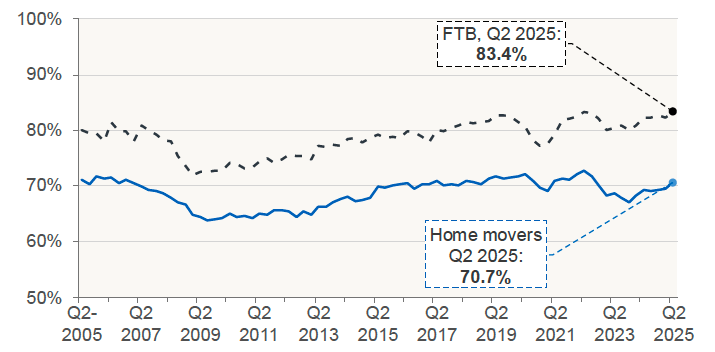
Chart 5.3 shows that after initially falling following the Covid pandemic, mean LTV ratios on new mortgages advanced to both first-time buyers and home movers in Scotland recovered to their pre-pandemic levels, before declining again as the upward trend in interest rates beginning at the end of 2021 fed through to mortgage lending.
Subsequently, there has been an upward trend in mean LTV ratios for first-time buyers and home movers, which has continued into Q2 2025. The mean LTV ratio for first-time buyers increased over the quarter from 82.4% to 83.4%; this was the highest recorded in this time series, which began in Q2 2005. The mean ratio for home movers also increased over the quarter from 69.6% to 70.7%. This was below its post-pandemic peak of 72.7% in Q2 2022. [Source: UK Finance]
Source: UK Finance
The share of all regulated residential lending across the UK with an LTV greater than 90% increased over the quarter from 7.3% to 7.8% in Q2 2025, which is the highest share since Q2 2008, prior to the impact of the 2008 financial crisis. The share of all lending with both an LTV greater than 90% and a high income multiple also increased from 5.3% in Q1 2025 to 5.5% in Q2 2025, which is also the highest share since before the start of the 2008 financial crisis.
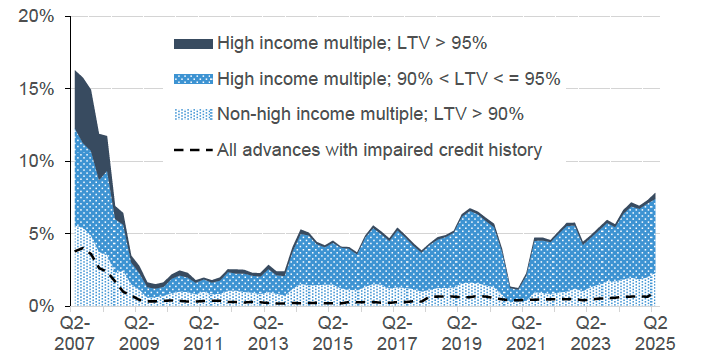
Source: FCA. Higher-risk lending is classified by the FCA as an LTV over 90% or an income multiple greater than or equal to 3.5 for single-income purchasers or 2.75 for joint-income purchasers.
The total number of residential mortgage products increased by 220 over the month to stand at 7,062 in early September 2025, which is the highest recorded in the time series, which began in 2008. The number of products with a maximum LTV of 95% rose over the month (by 22 products) to stand at 464 in early September. [Source: Moneyfacts UK Mortgage Trends Treasury Report]
Mortgage shelf life is the length of time between the launch of a product and its repricing or withdrawal from the market, and average shelf life can be an indicator of volatility in the mortgage market. The average mortgage product shelf life in September 2025 of 17 days was unchanged over the month and was below the average in September 2024 (21 days). [Source: Moneyfacts UK Mortgage Trends Treasury Reports]
There has been a significant increase in the number of buy-to-let (BTL) products, which have risen from 3,231 in December 2024 to 4,597 in September 2025, the highest level since Moneyfacts records for this series began in 2011. [Source: Moneyfacts UK Mortgage Trends Treasury Reports]
Contact
Email: Jake.Forsyth@gov.scot