
Scottish Housing Market Review Q3 2025
Quarterly bulletin collating a range of previously published statistics on the latest trends in the Scottish housing market.
Part of
1. Sales
1.1. Scottish Sales Performance: National
Source: Registers of Scotland
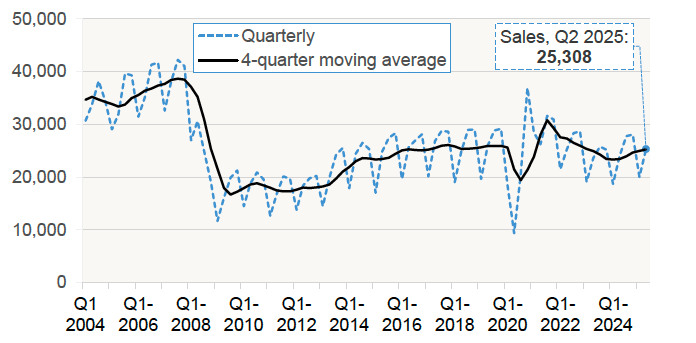
Chart 1.1 shows the volume of sales for each quarter and the 4-quarter moving average which gives a better indication of the longer-term trend.[1]
There was strong sales growth in Scotland in the second half of 2024, with sales up by an annual 9.5%, likely reflecting the softening of mortgage interest rates during 2024. While growth has since moderated, it remains positive, with the 25,308 residential property sales registered across Scotland in Q2 2025 representing an annual increase of 5.2%, which meant that the annual growth rate in sales in the first half of 2025 was 6.0%. This brings sales approximately in line with their pre-covid level (the number of sales between January and June 2025 was 0.7% below the level in the corresponding period in 2019).
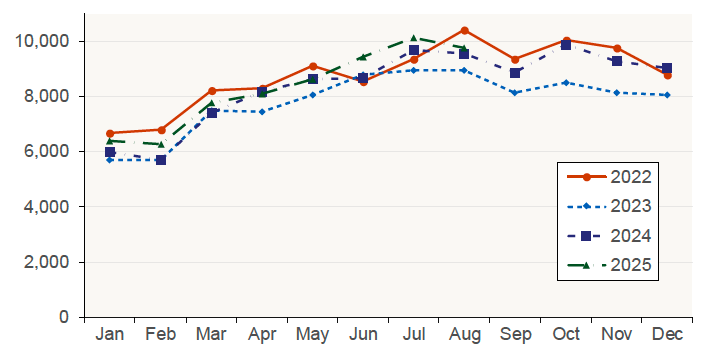
Chart 1.2 tracks monthly residential LBTT returns between January 2022 and August 2025. The number of LBTT returns received between January and August 2025 was 66,530, which is 4.3% higher than during the same period in 2024 and 8.9% higher than in 2023. Within the latest period, the annual growth rate for the period January to April 2025 was 4.6%, while for the period May to August 2025 it was 4.1%, suggesting that there is still momentum in the upward trend in sales.
Source: Revenue Scotland
1.2. Scottish Sales Performance: Local Authorities
Table 1.1 sets out the level and annual change in quarterly transactions by local authority. The volume of transactions at local authority level can fluctuate significantly, particularly in smaller local authorities such as the island local authorities. To remove some of this volatility, the change in transactions in the last 4 quarters compared to the preceding 4 quarters is also presented.
Table 1.1 shows that the number of residential property sales has increased in most local authorities in Scotland: in the four quarters to Q2 2025 compared to the preceding four quarters, Clackmannanshire (-8.2%) and East Renfrewshire (-5.7%) were the only local authorities that experienced a fall in sales. The local authority with the highest growth rate was Shetland Islands (18.6%), although, as noted above, given the small number of transactions in this local authority changes tend to be volatile. The next highest growth rates were in Aberdeenshire (14.9%) and Argyll and Bute (14.8%).
|
Local Authority |
Sales - Q2 2025 |
Q2 2025 on Q2 2024 |
4 quarters to Q2 2025 on previous 4 quarters |
|---|---|---|---|
|
Aberdeen City |
1,241 |
6.4% |
12.5% |
|
Aberdeenshire |
1,108 |
14.6% |
14.9% |
|
Angus |
541 |
13.7% |
14.3% |
|
Argyll and Bute |
431 |
16.2% |
14.8% |
|
City of Edinburgh |
2,841 |
2.3% |
11.6% |
|
Clackmannanshire |
183 |
-17.2% |
-8.2% |
|
Dumfries and Galloway |
628 |
6.6% |
4.5% |
|
Dundee City |
669 |
-1.3% |
6.5% |
|
East Ayrshire |
556 |
4.7% |
1.5% |
|
East Dunbartonshire |
406 |
-5.8% |
5.3% |
|
East Lothian |
646 |
18.8% |
13.2% |
|
East Renfrewshire |
363 |
-10.6% |
-5.7% |
|
Falkirk |
717 |
9.0% |
8.6% |
|
Fife |
1,693 |
-0.4% |
5.2% |
|
Glasgow City |
2,632 |
0.7% |
3.7% |
|
Highland |
1,013 |
8.2% |
9.5% |
|
Inverclyde |
321 |
11.1% |
8.8% |
|
Midlothian |
543 |
22.3% |
13.1% |
|
Moray |
477 |
11.2% |
2.8% |
|
Na h-Eileanan Siar |
76 |
-8.4% |
11.6% |
|
North Ayrshire |
691 |
18.7% |
10.0% |
|
North Lanarkshire |
1,418 |
11.5% |
6.7% |
|
Orkney Islands |
81 |
6.6% |
2.6% |
|
Perth and Kinross |
737 |
-1.6% |
10.1% |
|
Renfrewshire |
911 |
4.7% |
4.2% |
|
Scottish Borders |
497 |
11.4% |
7.0% |
|
Shetland Islands |
68 |
17.2% |
18.6% |
|
South Ayrshire |
528 |
-0.9% |
3.7% |
|
South Lanarkshire |
1,665 |
2.7% |
8.5% |
|
Stirling |
382 |
5.8% |
8.6% |
|
West Dunbartonshire |
340 |
2.4% |
3.1% |
|
West Lothian |
905 |
7.1% |
13.0% |
|
Scotland |
25,308 |
5.2% |
7.9% |
Source:RoS
Contact
Email: Jake.Forsyth@gov.scot