
Ending conversion practices in Scotland - consultation analysis: SG response
Scottish Government response to the consultation analysis on ending conversion practices Scotland. This responds to some of the issues raised in responses to the consultation and what we are doing now.
Understanding consultation proposals
23. The consultation document outlined our proposal to create a package of measures that work together to address conversion practices in Scotland.
24. The consultation included proposals for the introduction of new criminal offences for engaging in conversion practices and removing a person from Scotland for the purposes of conversion practices, as well as a statutory aggravation and a civil protection order. These three elements as set out in the consultation are set out in Figure 1, below:
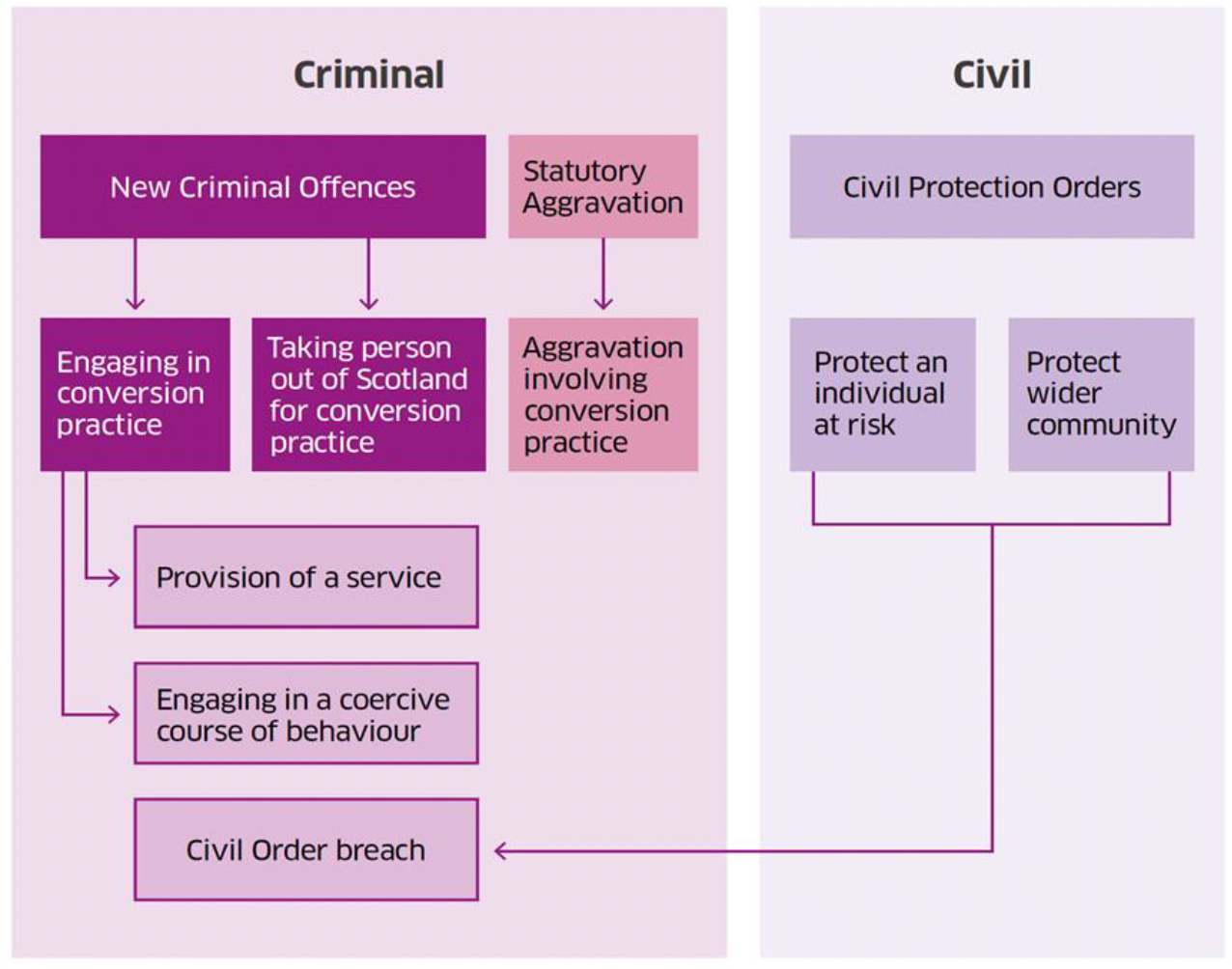
Criminal
- New Criminal Offences
- Engaging in conversion practice
- Provision of a service
- Engaging in a coercive course of behaviour
- Taking a person our of Scotland for conversion practice
- Engaging in conversion practice
- Statutory Aggravation
- Aggravation involving conversion practice
Civil
- Civil Protection Orders
- Protect and individual at risk
- Protect wider community
- Civil order breach
25. Many of the questions in the consultation focussed on the proposed criminal offence of engaging in conversion practices, so most of the feedback we received was about this part of proposals. Figure 2, below, sets out the criminal offence of engaging in conversion practices as set out in the consultation, in further detail.
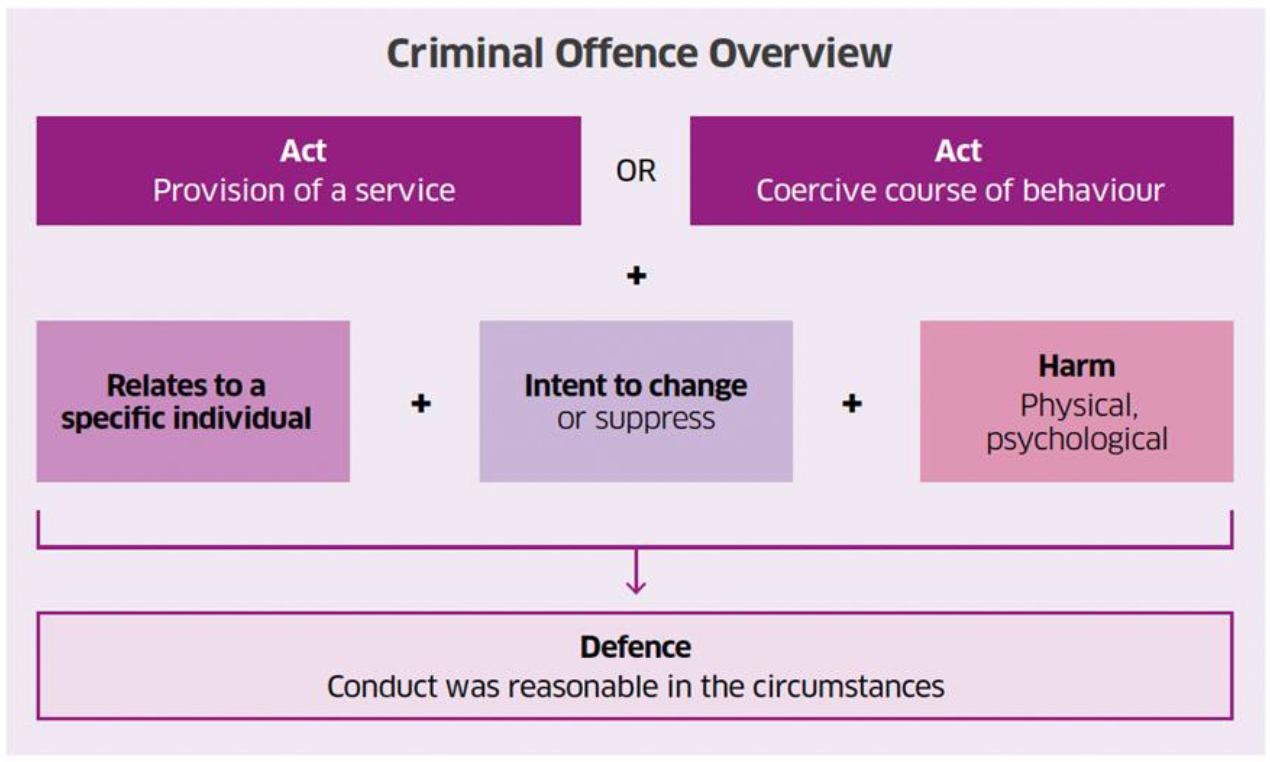
Criminal Offence Overview
- Act – Provision of a service
OR
- Act – Coercive course of behaviour
PLUS
- Relates to a specific individual
- Intent to change or suppress
- Harm. Physical, psychological
- Defence – Conduct was reasonable in the circumstances
26. The proposed offence, as set out in the consultation, would require either the provision of a service, or a coercive course of behaviour. In addition, three other requirements would also all need to be proven:
i. Intent: that the individual accused of carrying out conversion practices did so with the intent that the service/course of behaviour would change and/or suppress the sexual orientation or gender identity of the victim
ii. Victim: that the act or course of behaviour was directed at a specific, identified individual
iii. Harm: that the act or course of behaviour caused the victim physical or psychological harm
27. As a result of the way the consultation questions were structured to ask respondents about each aspect of the proposals in isolation, many respondents judged these requirements individually instead of considering them as a package where all requirements must be met in order for an act or course of behaviour to be captured by the criminal offence. Analysis of consultation responses suggests that the cumulative nature of these requirements could have been more clearly reiterated throughout the document, in addition to the requirement for two sources of reliable and credible evidence to corroborate that an offence has been committed and the requirement to prove that the offence was committed by the accused beyond reasonable doubt. Detailed feedback from the consultation is being taken into account as we continue to develop proposals for legislation.
28. Analysis of responses and conversations with stakeholders highlighted the need for further clarification around how some of the aspects may work in practice.
29. For example, Question 11, which asked respondents for their views on the proposed harms test, received a high percentage of respondents who did not agree with this test (65% of all responses, 70% of organisations). This included respondents who were otherwise supportive of proposals, as well as those who were otherwise against. The concerns raised in many responses suggested that respondents were unaware that harm, an essential part of the offence, would have to be proven and corroborated to a legal standard.
30. Many responses also referenced concerns about parental control of their children, with some raising concerns that proposals could criminalise everyday parental decisions and conversations. However, the consultation set out that proposals would only apply to actions which are done with the intention that they would change or suppress an individual’s sexual orientation or gender identity and only where they meet the other criminal offence criteria including harm. The consultation document also set out that exploratory conversations and parental controls which have no intention of changing or suppressing a child’s sexual orientation or gender identity would not be criminalised under consultation proposals.
31. We are reflecting on the feedback we have received and continue to develop our proposals with a view to providing the public with greater clarity and reassurance about how legislation would work in practice.