
Publication - Research and analysis
Scottish economic bulletin: June 2025
Provides a summary of latest key economic statistics, forecasts and analysis on the Scottish economy.
Consumer Activity
The Scottish Consumer Sentiment Indicator fell in April to its lowest level in two years.
Consumer Sentiment
- The Scottish Consumer Sentiment Indicator reflects how people feel the economy is performing, how secure they feel about their household finances and how relaxed they feel about spending money.
- Consumer sentiment further weakened in April, following a period of declining sentiment in the first quarter of the year and the latter part of 2024. In April, the Scottish Consumer Sentiment Indicator fell by 6.4 points to ‑14.3, its lowest net balance since April 2023.[14]
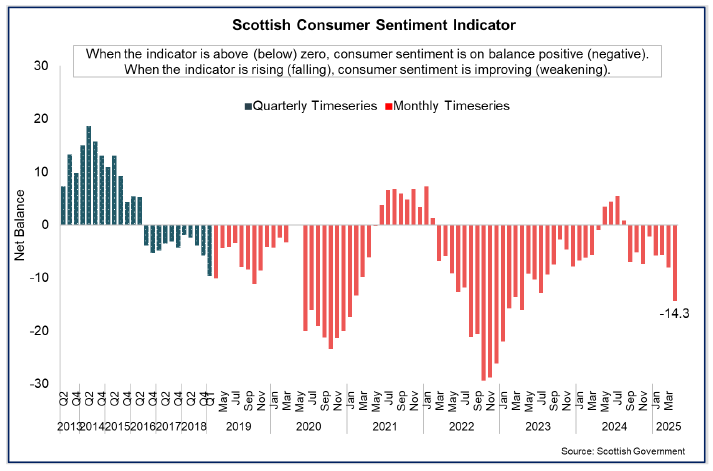
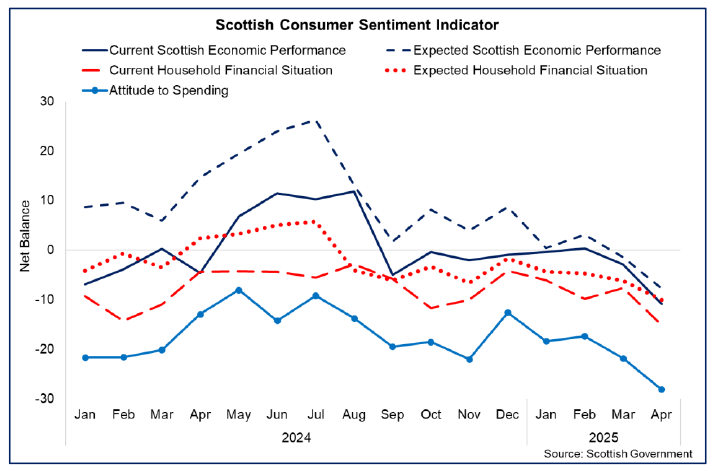
- This fall in consumer sentiment was driven by a fall in all five sub-indicators of sentiment regarding current and future economic performance and household financial security, and attitudes to spending. Sentiment regarding the performance of the economy has weakened to a greater extent than sentiment on personal household finances and spending, narrowing the gap in sentiment between these sub-indicators seen in recent years.
- The current economic performance and household finances indicators saw the largest falls, month on month, dropping by 8 points to ‑10.8 and 7.4 points to ‑15 respectively. The attitudes to spending indicator remains the most negative, falling 6.3 points to ‑28.1. Expectations indicators also fell and remain negative, although the decrease in sentiment was smaller than for the other indicators.
- The negative net balances indicate that, compared to a year ago, households increasingly feel the economy is performing worse and their household finances are less secure, with expectations that this will continue in the next 12 months.
- This fall is in line with consumer sentiment at a UK level, with the GfK indicator falling by 4 points to -23, driven by falling sentiment on economy-related measures, and attributed by GfK to tariff concerns and household cost increases (including utilities, council tax and stamp duty).[15]
Spending and Cost of Living
- At a GB level, retail sales rose in both volume (1.8%) and value terms (1.6%) over the 3-months to April and have risen 2.6% and 2.8% respectively on an annual basis.[16]
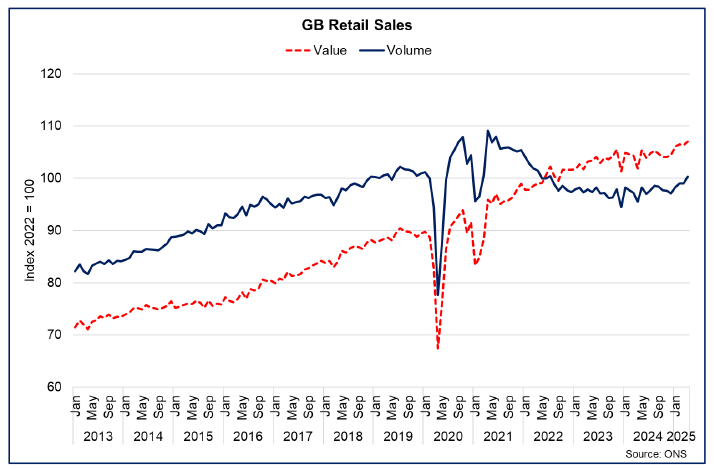
- More stable inflation expectations and reductions in interest rates are providing improving conditions for consumption, though the full benefits continue to feed through gradually, and cost of living challenges and weaker sentiment are continuing to impact households.
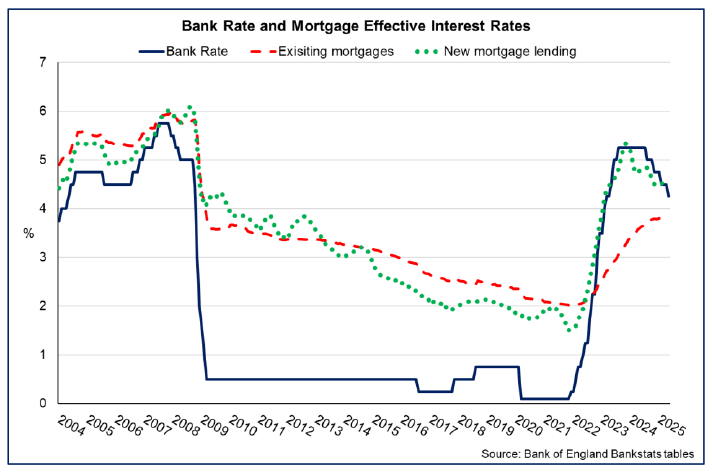
- As the gradual easing of monetary policy feeds through into economic activity, latest Bank of England data for April shows that the effective interest rate on the total stock of mortgages (new and existing) has risen marginally, from 3.84% in March to 3.86% in April, with the effective interest rate on new mortgages remaining largely stable at 4.49%, from 4.5%. In May, an average 2-year 75% loan-to-value mortgage offered a rate of 4.19%, down from 4.42% in April, suggesting the gradual pass-through of lower interest rates on the economy is resulting in lower mortgage costs for some households.
Contact
Email: economic.statistics@gov.scot