
Publication - Research and analysis
Scottish economic bulletin: June 2025
Provides a summary of latest key economic statistics, forecasts and analysis on the Scottish economy.
Labour Market
Unemployment rose to 4.2% in the three months to April, while earnings continued a trend of positive real terms growth.
Employment, Unemployment, and Inactivity
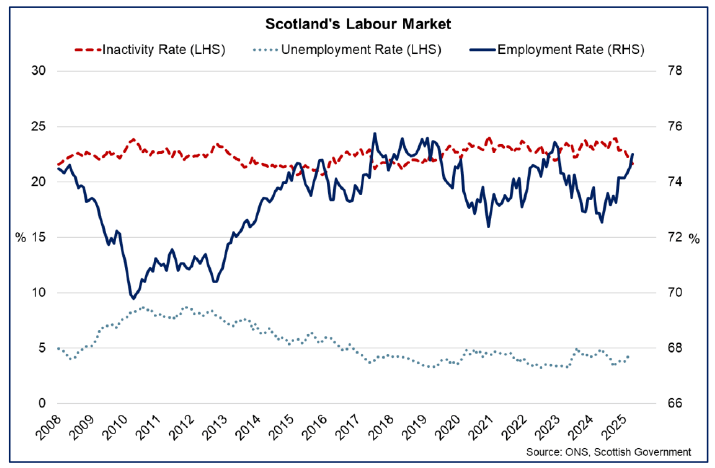
- There remains underlying resilience in the labour market in the first half of the year with some indications of loosening and stabilisation in recent months.
- The latest data (3-months to April) from the Labour Force Survey (LFS) shows that the unemployment rate in Scotland rose 0.4 percentage points (p.p) over the quarter to 4.2%, although is down 0.6 p.p when compared to the same time in 2024. Scotland’s employment rate rose over the quarter by 0.9 p.p. and by 2.1 p.p over the year, to 75.0%. The inactivity rate fell by 1.3 p.p over the quarter and by 1.8 p.p over the year to 21.6%.[7],[8]
- Wider labour market indicators suggest some loosening over the past year. Latest RTI data shows that there were 2.44 million payrolled employees in Scotland in May, down by 0.3% (c. 7,800 employees) from April, and by 0.9% (c. 22,800 employees) annually.[9]
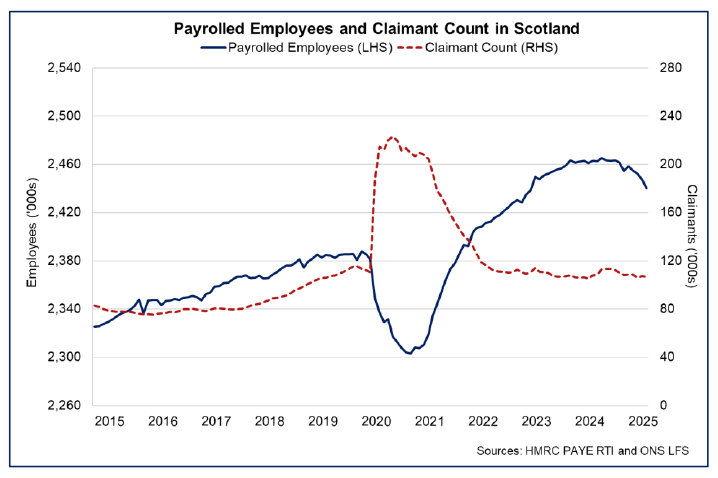
- However, Scotland’s claimant count unemployment rate has remained relatively stable at 3.5% in May, unchanged from April and down by 0.1 p.p (c. 1,500 claimants) over the year to 106,947 claimants.[10]
Recruitment Activity
- Business survey evidence suggests further stabilisation in recruitment activity, with fewer businesses reporting changes in employment levels compared to recent months.
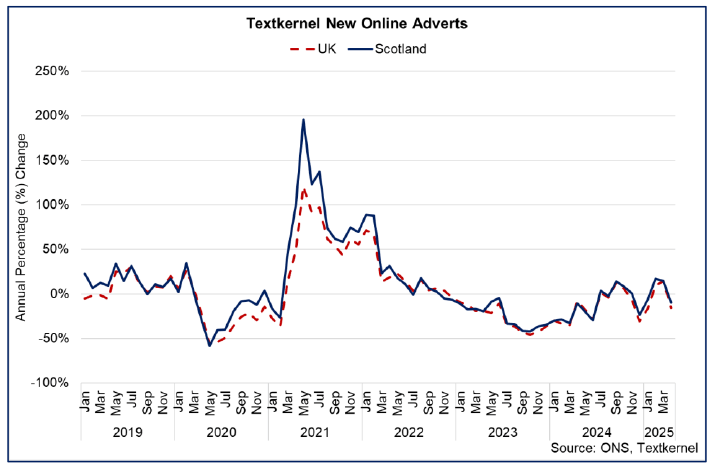
- Online vacancies data for April shows that there were c. 42,325 newly advertised jobs online in Scotland, down 10.9% from March and down 9.5% over the year from April 2024. In the UK as a whole, online job adverts fell 15.7% over the year.[11]
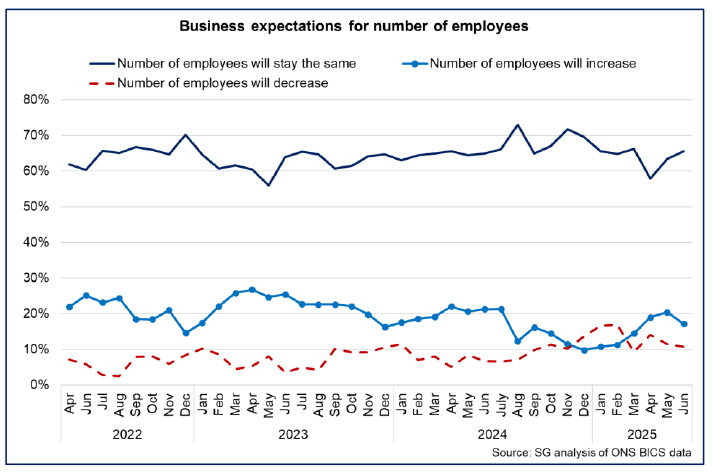
- Most recently, BICS data show the share of businesses expecting employee numbers to remain unchanged rose to 65.6% in June, up from 63.4% in May. The share of businesses expecting employee numbers to increase fell from 20.4% to 17.2%, similarly businesses reporting that they expect a decrease in the number of employees also fell moderately from 11.5% to 10.8%.
- These trends suggest some loosening with hiring intentions having softened slightly. Additionally fewer businesses are planning to reduce headcount, indicating a more stable employment outlook.
- Wider business survey data further indicates stabilisation with the Growth Tracker business survey showing that, on balance, Scottish businesses reported marginal job creation in May, following four months of reducing headcount.
Earnings
- Labour earnings have continued a trend of positive real terms growth, albeit at a slower pace than in 2024 with the recent easing of real earnings growth partly reflecting the pick-up in inflation.
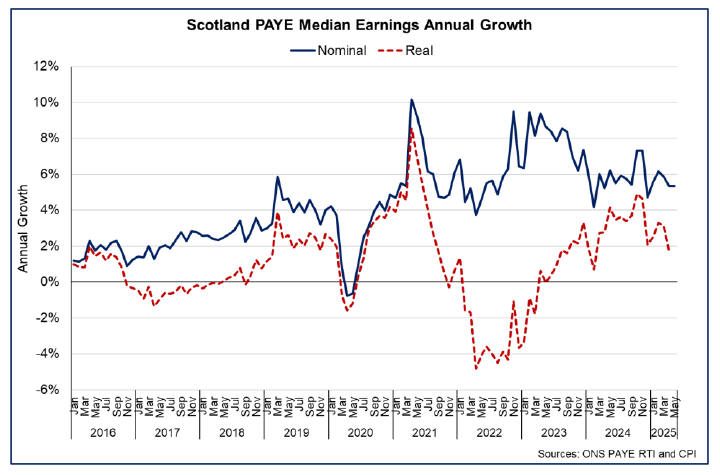
- Nominal median monthly PAYE pay in Scotland was £2,542 in May, and grew by 5.3% on an annual basis, with the pace of growth unchanged from April. The pace of nominal growth is slightly lower than the average annual rate in 2024, however has been more stable over the past year following the volatility in recent years. Real terms comparisons are only possible up to April, where lower nominal earnings growth and rising inflation resulted in annual real-terms median earnings growth falling to 1.8%, down from 3.2% in March.[12]
- Looking ahead, earnings growth is expected to further moderate. The Bank of England Decision Maker’s Panel (DMP) reported annual UK wage growth of 4.7% in the 3-months to May and anticipated year-ahead wage growth of 3.7%.[13]
Contact
Email: economic.statistics@gov.scot