
Publication - Research and analysis
Scottish economic bulletin: June 2025
Provides a summary of latest key economic statistics, forecasts and analysis on the Scottish economy.
Business Conditions
Business activity returned to growth in May as business optimism strengthens.
Business Activity
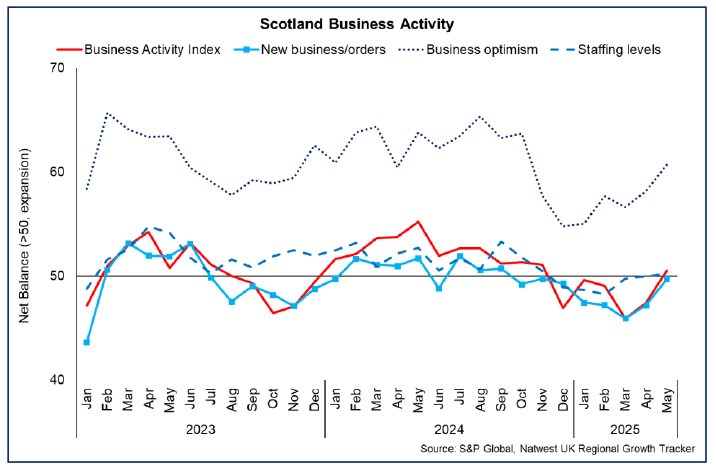
- The RBS Growth Tracker for May indicated that private sector business activity grew for the first time in six months, albeit marginally. The Business Activity Index rose to 50.5, its highest rate since November last year (a reading above 50 indicates growing activity).[5]
- The improvement in activity was underpinned by a slower decline in new business orders (49.7) than has been indicated so far his year while staffing levels rose marginally (50.2), suggesting further stabilisation following a period of modest reductions.
- Business sentiment also strengthened in May, with the Business Optimism Index rising to 60.7, its highest level since October 2024, indicating growing confidence among firms about future conditions.
Business Concerns
- The latest Business Insights and Conditions Survey (BICS) for June indicates a slight shift in business concerns in recent months. Falling demand for goods and services returns to being the most commonly cited main concern by businesses (17.3%, up from 14.7% in May), while taxation as a main concern has fallen to 10.4%, down from its recent peak of 18% in April as the increase in employer NICs was implemented.[6]
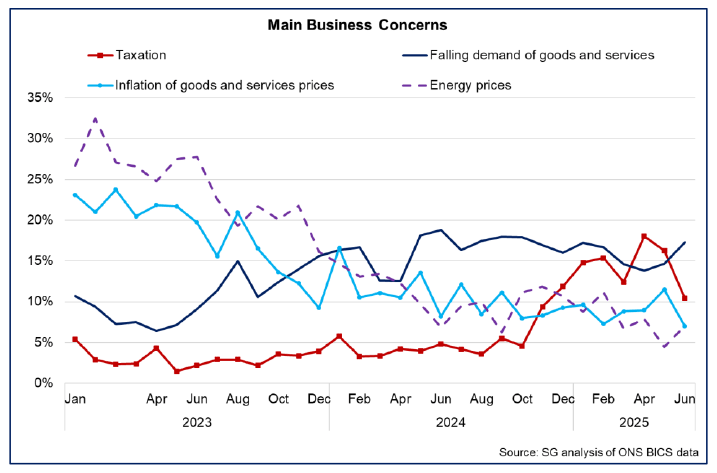
- Overall, the share of businesses reporting inflation, energy prices and falling demand for goods and services has remained relatively stable over the past year. The share of businesses reporting no major concerns rose to 18.4% in June, up from 15.4% in May, indicating a recovery in overall business sentiment following a dip in recent months and is consistent with the recent improvement in business sentiment in the Growth Tracker.
Business Costs
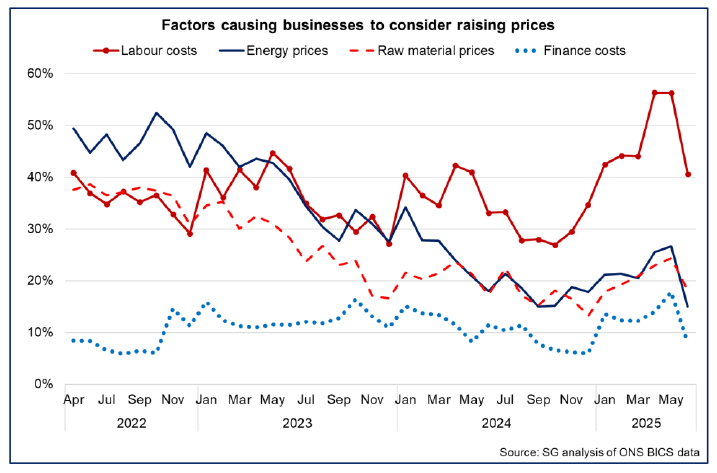
- The easing of some business concerns is partly reflected in cost expectations. BICS data indicates the proportion of businesses considering price increases fell sharply from 40.3% in May to 20.7% in June with a corresponding rise in the share of businesses reporting prices will stay the same (59.7%).
- Labour costs remained the most frequently mentioned driver of businesses considering raising prices (40.6%) followed by raw material prices (18.2%). However the overall increase in the share of businesses not considering raising prices indicates a greater degree of price stability.
- The recent indications of increased stability in cost pressures are also reflected in the RBS Growth Tracker data, showing that while input prices continued to rise in May, the pace at which they rose slowed to 61.5, its lowest rate since December 2024.
Business Optimism
- The RBS Growth Tracker reports that business expectations for the year ahead remain positive, with optimism improving in June to 60.7, up from 58.2 in April, and marking its highest level since October 2024.
- While this represents a continued upward trend, optimism remains below the levels observed through much of 2024, suggesting that businesses are cautiously optimistic amid ongoing economic uncertainty.
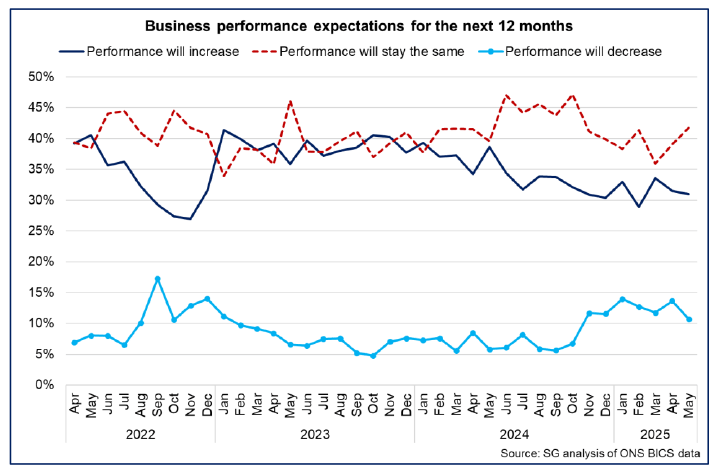
- Latest BICS data for May presents a more mixed picture. The share of businesses expecting performance to improve over the next 12 months fell marginally to 31.0% (from 31.5% in April). Similarly, the share of businesses expecting performance to decrease fell from 13.6% in April to 10.7%. Instead, the share of businesses reporting that they expect performance to stay the same rose to 41.7%, from 39.1%. This suggests a greater degree of stability in the overall business outlook, with fewer firms anticipating deteriorating conditions.
Contact
Email: economic.statistics@gov.scot