
Publication - Research and analysis
Scottish economic bulletin: June 2025
Provides a summary of latest key economic statistics, forecasts and analysis on the Scottish economy.
Inflation
Increased energy and regulated prices pushed inflation up in April.
- The annual consumer price inflation rate rose from 2.6% in March to 3.5% in April.[2] The increase was mainly driven by rising housing and household services prices (rising by 7.8%, up from 1.8% in March), transport prices (3.3%, up from 1.2%) and recreation and culture (3.1%, up from 2.4%).[3]
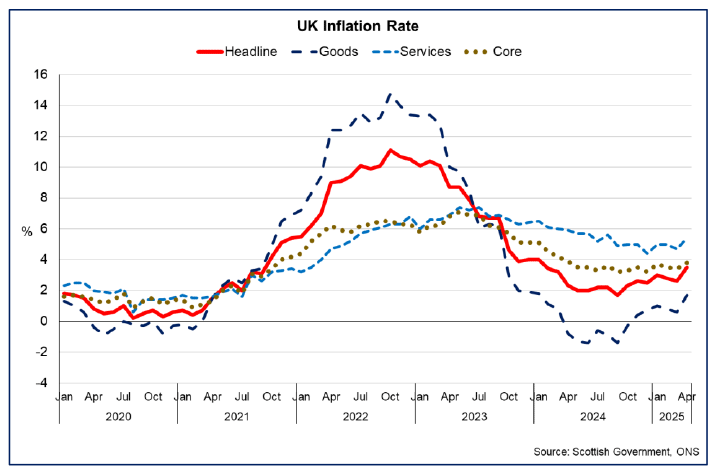
- There continues to be a difference in goods and services price inflation, with services prices remaining more elevated and rising 5.4% over the year, its highest rate since August 2024, while goods price inflation remains at a lower rate of 1.7% (its highest rate since January 2024), albeit rising from 0.6% in March. Core inflation (excludes energy, food, alcohol and tobacco) rose to 3.8% (from 3.4%).
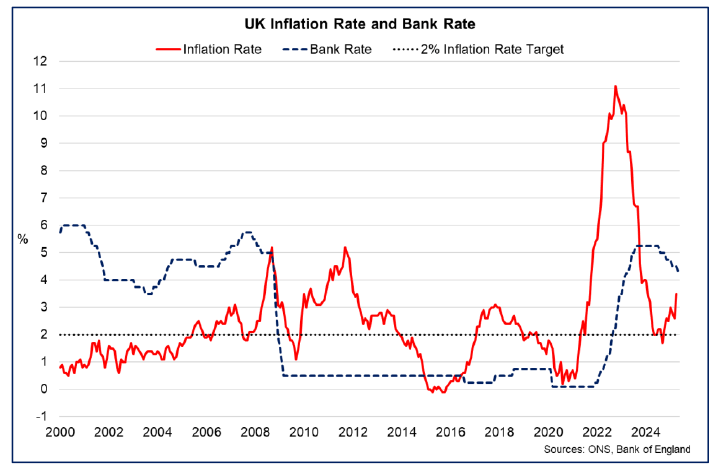
- The Bank of England (BoE) forecast inflation to rise to 3.7% in September (3.5% on average over the third quarter), reflecting the increase in energy and water bills, indexation of bills such as broadband and phone charges and the impact of higher employer NICs. Thereafter, their baseline projection is for inflation to gradually fall back to around 2% by the start of 2027.
- The Bank’s Monetary Policy Committee reduced the Bank Rate from 4.5% to 4.25% in May, reflecting the underlying progress in disinflation and the range of risks to inflation in both directions.[4]
Contact
Email: economic.statistics@gov.scot