
Scottish Budget 2026-27, Spending Review and Infrastructure Delivery Pipeline: strategic integrated impact assessment
Strategic integrated impact assessment considering the impacts that decisions made in the Scottish Budget, Scottish Spending Review and Infrastructure Delivery Pipeline are likely to have on different groups of people in Scotland.
Annex B Budget Tagging Pilot Studies
Pilot 1: Developing an Impact Database
Context
As part of our wider improvement programme, work has commenced to develop an impact budget tagging database. Budget tagging is a tool used to assess an individual budget measure (or budget line) and give it a ‘tag’ according to whether it is helpful or not to specific objectives.[76]
Portfolios were asked to use evidence to score the impact of a sample of 84 Level 4 budget lines on impacts for each relevant protected characteristic; socio-economic disadvantage; consumer duty and islands on a four-point scale, for example:
- Portfolios gave a positive score to budget lines which lead to “an identifiable disproportionate positive impact on those who share that characteristic.”
- Budget lines were rated as exceptional “if the area of spend has a significant and very large disproportionate positive impact on those who share that characteristic. This should be an exceptional impact, potentially at a national scale, and supported by clear direct evidence, for example with a well evidenced theory of change.”
The budget lines were selected by portfolios to include some of those with the most substantive impacts but prior to final allocations being known. Their value is equivalent to around £45 billion (or 66 per cent) of the 2026-27 Budget.
The impact database has the potential to develop a streamlined and transparent analytical approach to assessing combined impacts across portfolios or across relevant protected characteristics. The value and feasibility of the database are being assessed, and a process evaluation will be published later in 2026.
Limitations and caveats
The analysis is subject to some significant caveats. Firstly, it is based on a sample of budget lines and can therefore not be used to assess the totality of all budget decisions. Secondly, the assessments are self-reported by portfolios, with some central moderation. Further work will be required to ensure results are consistent and reproducible year on year. Thirdly, the tagged lines are of significantly different scales meaning that the relative weight of their impacts differs considerably. Finally, as budget lines can fund a range of distinct activities, the scoring for each Level 4 budget line has been assessed in relation to those (sub) activities making the most significant contribution. It may not be the case that all the spending in the budget line has the impact as scored.
At this point the ‘scores’ are published to aid transparency, to show workings, and to help explain how this analysis could be used in the future. They should be considered experimental and subject to change. As such, the scores do not represent the final view of the Scottish Government of the impacts of these budget lines. Neither should the analysis be taken as a list of all the potential budget lines that will have an impact.
Preliminary Findings
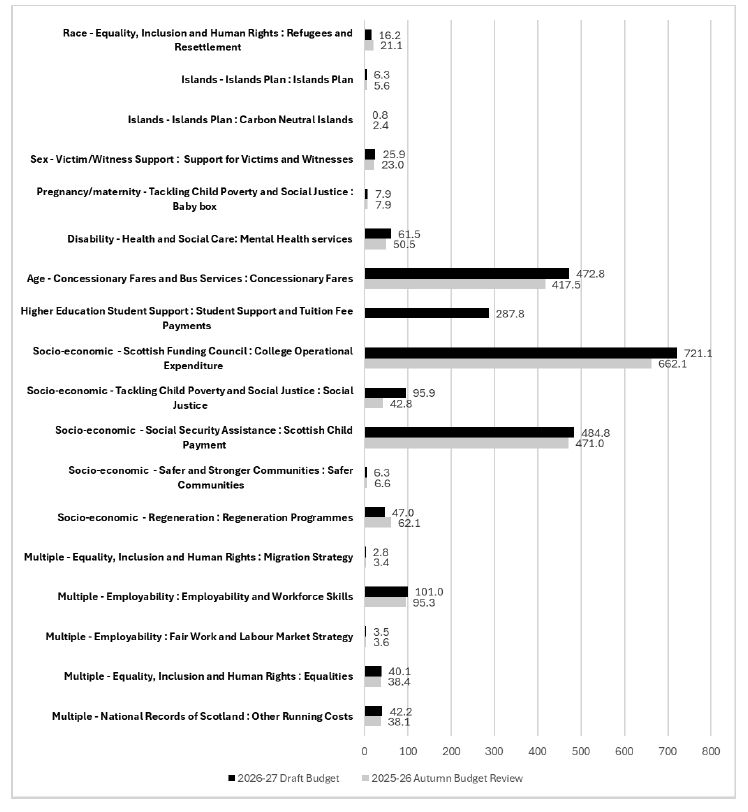
From the sample of 84 budget lines, 18 have been assessed as having an ‘exceptional’ impact in relation to at least one characteristic or other statutory duty.
Figure B.01 sets out these 18 budget lines. The value of the budget as set at the 2025-26 Autumn Budget Revision (ABR) is shown (bottom bar), alongside the budget set in the 2026-27 Budget.[77]
This approach allows us to look beyond individual lines and instead assess the bigger picture and overall trends. For example, when taken together, spending on all lines rated as ‘exceptional’ (excluding Higher Education support due to comparability issues) is increasing by £184 million, compared to the ABR.
The underlying database has been published alongside this document and sets out the rationale for the ‘exceptional’ scorings.
Pilot 2: Child Poverty Tagging
Context
Building upon our work with the Organisation for Economic Co-operation and Development (OECD) on gender budgeting, published alongside last year’s Budget, the Scottish Government initiated a pilot programme to explore how intersectional gender budget analysis could be more systematically embedded within the Scottish Budget process.[79]
At the time of the pilot study, the absence of agreed national gender goals and an associated outcome framework limited the feasibility of applying gender tagging across the Budget. Child poverty was therefore selected as a test case through which to explore the practical application of this approach.
Child poverty is also closely linked to women’s poverty and wider gender inequality. Women are more likely to be primary caregivers, to experience interrupted labour market participation, to undertake unpaid caring roles, and to be over-represented in lower-paid and insecure work. As a result, policies aimed at reducing child poverty can have significant effects on women’s economic security, while poverty experienced by women often manifests through household and child-related outcomes.[80]
However, it is important to note that the pilot analysis does not seek to treat child poverty analysis as a proxy for intersectional gender analysis. Further work to strengthen the gender focus of child poverty policy, including through the development of the delivery plan, is underway.
The selection of child poverty also allowed the pilot study to focus on a cross-cutting outcome spanning multiple portfolios, responding directly to the OECD recommendation to move beyond siloed, portfolio-level analysis.
Methodology
The child poverty tagging pilot study was applied to internal budget data currently available within the Scottish Budget process. This is more granular than the published Level 4 lines and includes 1,026 individual programme lines.
In contrast to the impact database pilot, this pilot study adopted a more centrally co-ordinated approach. Exchequer Analysis led the design of the tagging exercise, including the development and application of tagging parameters and the collation and management of data. The portfolio budget line data did include self-assessed impact on child poverty; however, the parameters applied in the pilot tagging process were significantly more rigorous and detailed. Once initial tagging had been completed the tagging underwent quality assurance and final judgements were made in collaboration with child poverty colleagues. This approach was adopted to test whether a consistent, analytically led application of tagging parameters could be achieved across the whole budget.
A structured tagging framework was developed in collaboration with the child poverty analytical team to support consistent assessment across all budget lines. The parameters were designed to go beyond headline judgements of impact and to capture the pathways through which spending might influence child poverty outcomes. For each budget line, the framework assessed whether impacts were direct or indirect; which primary and secondary child poverty drivers were engaged (income from employment, cost of living, social security and benefits, or other defined drivers); which population groups were targeted; and the expected timeframe over which impacts were likely to materialise, distinguishing between short-term, medium-term and longer-term impacts. Analysts assessed the strength of the available evidence underpinning claimed impacts, categorising this as robust, moderate, limited or absent, and recorded evidence sources and links where available. Evidence was drawn from evaluations, statistical analysis, modelling and published research, though in many cases the quality and specificity of evidence was constrained by the limited detail available within budget documentation.
Based on these parameters, each budget line was assigned to an overall impact category: high, medium, low, no evidence of impact, or not taggable. These categories were defined using explicit criteria relating to scale, targeting, coverage, strength of evidence and the likelihood of achieving meaningful reductions in child poverty. A narrative rationale was recorded for each tag to document key assumptions, limitations and analytical judgement, particularly where budget lines were composite in nature or where impacts were indirect or enabling.
Analytical judgements were subject to review through an expert group, providing an additional layer of challenge and quality assurance. This process supported consistency, helped identify areas where tagging was particularly sensitive to interpretation, and informed refinement of the parameters as the pilot study progressed.
The pilot study was explicitly designed as a first step to test proof of concept rather than as a definitive assessment of the child poverty impact of the Scottish Budget. Its primary purpose was to assess whether tagging could be applied at scale across the full budget, and whether it could help identify a subset of spending lines with potentially high and direct impact on reducing child poverty.
To explore the practical usefulness of the tagging outputs, the results were combined with emerging budget allocation information for 2026-27. This enabled an indicative assessment of the extent to which identified high impact areas appeared to be funded, under pressure, or potentially at risk as part of the decision-making process. This analysis was used to support early strategic discussion rather than to provide detailed recommendations, and to test whether budget tagging could offer Ministers a clearer, structured view of where some of the strongest child poverty levers sit within the overall Budget.
Emerging findings
In this report, we focus on a subset of budget lines assessed as having a high and direct impact on reducing child poverty. Rather than being concentrated within a single portfolio or policy area, these high-impact lines span multiple portfolios and cluster around a small number of primary child poverty drivers.
- Social security and household income support: The largest share of high-impact spend relates to demand-led social security assistance, including total benefits expenditure and the Scottish Welfare Fund. These lines primarily target low-income households with children and have a direct and immediate impact on household income. Funding levels are largely driven by forecast demand, with allocations initially set in line with Scottish Fiscal Commission forecasts.
- Income from employment and parental employability : A second cluster of high-impact spend relates to employability and parental labour market participation, including programmes such as No One Left Behind and the Child Poverty and Parental Employability Support Fund. These lines generally target households with children either universally or through eligibility criteria, and aim to support sustained movement into fair and sustainable work. Impacts are typically expected to materialise over the medium term and are sensitive to wider labour market conditions.
- Early learning, childcare and early intervention: Several high-impact lines relate to early learning and childcare (ELC), school-age childcare and early intervention services, including ELC expansion, Real Living Wage (RLW) commitments in commissioned ELC services, school-age childcare provision, and the Children, Young People and Families Early Intervention Fund. These lines primarily operate through reducing household costs and supporting parental employment, with impacts ranging from short- to longer-term depending on the intervention.
- Reducing school-related costs and supporting attainment pathways: High-impact spend also includes interventions that both reduce the immediate costs associated with raising children and support longer-term poverty reduction. Measures such as free school meals (FSM) (including holiday provision) and school clothing grants directly reduce the cost of the school day for families with children. These interventions are generally well targeted at low-income households and can have relatively immediate impacts on financial pressure and material hardship. In addition, a number of high-impact budget lines relate to educational attainment and local authority resource grants, including funding specifically aimed at closing the poverty-related attainment gap. While the impacts of these measures on child poverty are often more indirect, they were assessed as high impact where there was strong evidence of sustained investment focused on children in low-income households and a clear link to longer-term pathways out of poverty.
| Programme | Description | Primary child poverty driver |
|---|---|---|
| Total benefits expenditure | Demand-led devolved social security benefits | Social Security and Benefits |
| Scottish Welfare Fund | Crisis and community care grants via local authorities | Cost of Living |
| Tackling Child Poverty | Core child poverty programmes and delivery | Social Security and Benefits |
| Pathfinders (Fairer Future Partnerships) | Place-based system change to tackle child poverty | Multiple drivers |
| Advice Services providing welfare advice | Welfare and debt advice services | Multiple drivers |
| No One Left Behind | National employability programme | Income from Employment |
| Child Poverty / Parental Employability Support Fund | Targeted employability support for parents | Income from Employment |
| Children, Young People and Families Early Intervention Fund | Early intervention and prevention | Multiple drivers |
| ELC expansion – programme budget | Funded ELC expansion | Cost of Living |
| RLW commitment for ELC staff | Real Living Wage for commissioned ELC services | Cost of Living |
| School Age Childcare – programme budget | School age childcare provision | Cost of Living |
| School Age Childcare – holiday provision | Holiday childcare provision | Cost of Living |
| FSM – holiday provision | Holiday food provision | Cost of Living |
| FSM – Scottish Child Payment eligible P6–P7 | Targeted FSM provision | Cost of Living |
| School Clothing Grant | Support with school clothing costs | Cost of Living |
| Raising Attainment | Poverty-related attainment funding | Multiple drivers |
| Raising Attainment (local authority resource grant) | Local authority resource funding | Multiple drivers |
| Education Maintenance Allowance | Financial support for young people | Social Security and Benefits |
| Affordable Housing Supply Programme (capital) | Enabling delivery of affordable housing | Cost of Living |
Limitations and caveats
This pilot study was intentionally designed as a proof of concept exercise, and its findings should be interpreted in light of a number of important methodological and contextual considerations:
- Granularity: The analysis was constrained by the level of granularity available within the dataset. Many budget lines encompass multiple activities, including delivery, administration and enabling functions. In these cases, it was often not possible to disentangle the proportion of spend directly contributing to child poverty outcomes from spend that supports the system functioning more broadly.
- Quality of information: The quality and completeness of information available to support tagging varied substantially across budget lines. In many cases, only a brief description of the purpose of the spend was available, with limited detail on delivery mechanisms, beneficiary groups or expected outcomes. This constrained the ability to assess pathways to impact, particularly for indirect or enabling spend, and required analysts to exercise judgement in the absence of comprehensive evidence. Where evidence was weak, outdated or unavailable, this was reflected in lower evidence strength ratings and, in some cases, in conservative impact tags or classification as not taggable.
- Subjectivity: Although the tagging parameters were designed to promote consistency, a degree of subjectivity is unavoidable when assessing complex and multi-purpose public spending. This was particularly evident in relation to indirect impacts, administrative and staffing costs, and system-level investments such as analytical functions, commissions or infrastructure.
- Scale vs. intensity: Some budget lines were found to have potentially strong impacts on very small or specific populations, such as refugees or families facing acute crisis, while others had weaker individual impacts but reached large segments of the population. The tagging framework was not designed to produce a single composite measure that resolves this tension, and judgements about overall impact necessarily involved weighing these dimensions in a qualitative way.
In advance of any future iteration or wider application, the pilot study outputs will be shared with portfolios for review. This will support sense-checking of tagging judgements and associated rationales, enable portfolios to provide additional evidence and contextual detail, and inform refinement of the tagging framework.
Contact
Email: ScottishBudget@gov.scot