
Scottish Budget 2026-27, Spending Review and Infrastructure Delivery Pipeline: strategic integrated impact assessment
Strategic integrated impact assessment considering the impacts that decisions made in the Scottish Budget, Scottish Spending Review and Infrastructure Delivery Pipeline are likely to have on different groups of people in Scotland.
4. Impacts of Key Decisions by Government Priority
4.1 Eradicating Child Poverty
The Government is clear that eradicating child poverty remains its top priority. This prioritisation is key to improving national outcomes on poverty, health, education, and the economy across generations, while ensuring compliance with UNCRC commitments to uphold children’s rights.
What does the evidence tell us?
- The latest statistics published in March 2025 confirmed that Scotland has missed all four of its interim child poverty reduction targets for the target year of 2023-24.[20]
- In 2021-24, around one-in-four children (23 per cent, or 240,000 children) were living in relative poverty after housing costs. Most of the children (75 per cent) experiencing poverty were living in working households.[21]
- In 2023-24, rates of both relative and absolute child poverty in Scotland were nine percentage points lower than the UK average.
- Economic factors play a significant role in families’ experiences of poverty. Lower-income households faced slightly higher inflation than higher-income households in 2025, and households with children experienced marginally higher inflation than those without children.[22]
- Some types of households have a higher risk of poverty and make up the majority of those in poverty. These are households with a disabled person, three or more children, a baby aged under one, minority ethnic households, mothers aged under 25, and lone parent families. Since the Child Poverty (Scotland) Act 2017 came into force, reductions in poverty rates amongst priority groups have been mixed. There have been some marked decreases, for example for lone parents (-4 percentage points). At the same time, families with three or more children recorded an increase of nine percentage points in relative poverty over the same period.[23]
How are we addressing this?
The Budget and SSR continue to prioritise interventions designed to reduce child poverty with focus on the three key drivers of poverty reduction: increasing incomes from employment, or from social security and benefits in kind, and reducing the cost of living.
This includes maintaining investment in programmes and policies identified through the child poverty tagging pilot study as having the greatest potential impact on tackling child poverty including: employability and support programmes such as Fairer Futures Partnerships and No One Left Behind; early learning and childcare; and substantial investment in social security. These decisions were informed by discussions in the cross-ministerial workshop and the Cabinet Sub-committee on Child Poverty.
Key decisions in the Budget include:
- Supporting families with managing the cost of living through a universal breakfast offer in all primary schools and expanding wraparound activities provision building on the success of the Extra Time programme.
- Transformational investment in sport and physical activity with £40 million of new funding that will help deliver a Summer of Sport for Scotland’s children tied to the FIFA World Cup and Commonwealth Games alongside a universal learn to swim offer.
- £61.5 million for the Tackling Child Poverty Fund, an increase of £49 million compared to 2025-26, with detail of investments to be set out in the next Tackling Child Poverty Delivery Plan by the end of March 2026.
- Investing in a £50 million Whole Family support package to support parents into sustainable employment. This includes £20 million for third sector organisations and a projected £8 million to help adult learners get the skills and qualifications they need.
- Increasing the SCP with inflation to £28.20 per week per child.
- Maintaining £90 million investment in employability services, including £40 million for the Parental Employability Fund.
- Safeguarding 1,140 hours of funded childcare for all three and four year olds and targeted support for eligible two year olds.
- Continuing to offer Free School Meals for children in Primary 1-5, and for Primary 6-7 children of families in receipt of the SCP.
- Scotland’s colleges will see a combined increase of £70 million in resource and capital funding, equivalent to a 10 per cent uplift on last year’s budget.
- Maintaining free bus travel for under-22 year olds (as well as for older and disabled people).
Key decisions in the SSR and the IDP include:
- A SCP premium for families with children under the age of one to go live during 2027-28, resulting in a total payment of £40 per week.
- Significantly increasing the Tackling Child Poverty Fund with over £185 million invested during the SSR period.
- Creating more affordable homes by investing £4.1 billion.
How do these decisions impact on different people and places?
The Scottish Ministers have a statutory duty, under the Child Poverty (Scotland) Act 2017, to meet the 2030 statutory child poverty targets by reducing relative child poverty to below 10 per cent; and by reducing absolute poverty, combined low income and material deprivation, and persistent poverty to below five per cent. As part of the Act, Scottish Ministers have a duty to publish Delivery Plans every four years and annual reports assessing progress.
Scottish Government analysis indicates that the overall policy approach has a measurable impact. In 2025-26, relative child poverty is estimated to be around seven percentage points lower than it would have been in the absence of current policies, keeping an estimated 70,000 children out of relative poverty.[24] In 2025-26, households with children in the poorest decile were estimated to be £2,600 a year better off, on average, as a result of the Scottish Government’s policies, representing over 20 per cent of their income.[25]
Further impacts are outlined below:
- Increasing incomes and reducing child poverty through Social Security: The Five Family Payments, including the SCP, could be worth over £10,000 by the time an eligible child turns six and around £25,000 by the time an eligible child turns 16. This value will increase once the SCP premium for children under the age of one is delivered, which is estimated to support families of 12,000 children in low-income households. Distributional analysis shows that the SCP is already the largest single contributor to the improved financial resources of low-income households relative to the rest of the UK. SCP is forecast to benefit the families of around 330,000 children in 2025-26, as well as keep 40,000 children out of relative poverty. [26] The premium being delivered in 2027-28 will have a further positive impact on new parents and is relevant to the protected characteristic of pregnancy and maternity. Analysis drawing on the Growing Up in Scotland study suggests around a quarter of families fall into relative poverty in the year after the birth of their first child.[27] A positive poverty reduction is expected for households with children under the age of one, though it cannot be quantified at this stage due to modelling limitations.
- Increasing incomes through paid work: Scotland has relatively high employment rates, especially amongst parents. However, in international comparisons, Scotland has a greater prevalence of in-work poverty and lower levels of work intensity. This requires a combination of labour market policies that support working families as well as employability support to tackle economic inactivity and support people, including parents, into fair, sustainable jobs. No One Left Behind provided a range of employability support to 8,532 parents, including single parents who are predominantly women, in 2024-25.[28]
- Reducing household costs: The IDP sets out plans to support the delivery of 36,000 affordable homes to provide a warm, safe home for up to 24,000 children. Housing costs are an important factor related to income inequality and poverty. Research suggests that poverty is one of the core drivers of homelessness in the UK, and Scotland specifically. Evidence indicates that Scotland’s higher share of renters in affordable social housing helps to keep poverty rates lower. Modelling suggests that lower social rents benefit approximately 140,000 children in poverty each year.[29]
- Early Learning and Childcare: Evidence shows particularly positive impacts for younger parents, families with a disabled child of school age, or for families with a disabled adult and school age children, as well as for women. Increased access to affordable Early Learning and Childcare reduces childcare costs and enables parents and carers to enter employment, increase working hours, and take up education or training, helping to increase household income and reduce cost-of-living pressures. Investment in early learning and childcare also benefits children’s development, including improved cognitive outcomes and a narrowing of the poverty-related attainment gap.[30]
- Free school meals play an important role in reducing the cost of living for families with children by directly offsetting household food costs and supporting children’s nutrition. Free school meals for Primary 1-5 are being retained as it delivers broad cost-of-living support and higher uptake with lower stigma, while the targeted entitlement for Primary 6-7 children in receipt of SCP strengthens support for families at greatest risk of poverty.[31] The budget provides additional support to expand free school meals provision to include children from families in receipt of Pension Credit, and those impacted by the increase in the Administrative Earnings Threshold. These measures will enable a further 5,500 pupils to access nutritious and healthy food, backed by investment of up to £3 million. Free school meals play an important role as they are mostly targeted at low-income households and therefore primarily benefit families at risk of child poverty, including lone parent families, families with disabled children and some minority ethnic groups.[32]
- Building a system of school age childcare through universal breakfast clubs and additional investment in providing wraparound activities clubs. The School Age Childcare (SACC) programme vision is to build an accessible and affordable system of school age childcare before and after school and during the holidays, where those on the lowest incomes will pay nothing and children will be able to access healthy and nutritious food as part of the offer. The SACC programme is targeted at the six priority family types, including children from lone parent families, minority ethnic families, families with a disabled adult or child, families with a young mother (under 25), families with a child under the age of one and larger families (three or more children). The programme is intended to reduce the risk of families living in poverty by reducing barriers to employment and increasing parental income through work, while also reducing costs for families who currently pay for childcare. The SACC programme also emphasises children’s wellbeing impacts from access to provision, including rest, play, socialisation, and participation in activities alongside integrated food provision.
- Free bus travel addresses a number of inequalities, including supporting people on lower incomes who have less access to private modes of transport, and those who are more likely to be reliant on bus travel – people aged under 22, older people, disabled adults, and particular minority ethnic groups. As part of our budget tagging pilot study (see Annex B), this Level 4 line has been scored as having an ‘exceptional’ impact on the relevant protected characteristic of age. There is also a positive impact on consumers of public transport services. Modelling indicates a progressive impact, with lower income quintiles receiving greater benefit from bus pass spending, both in cash terms and as a share of income, driven by higher levels of bus usage.[33] An evaluation of the Young Person’s Concessionary Travel scheme calculated that survey respondents made over one million new bus journeys, that would not have otherwise been made, since the scheme began.[34]
- Further education colleges: As part of our pilot study, this Level 4 line has been scored as having an ‘exceptional’ impact on addressing socio-economic disadvantage since colleges support a wide range of Scots to boost their access to opportunities, including high proportions of students from deprived areas and increasing numbers of students who are disabled or who come from care experienced backgrounds. Distributional analysis has found that lower income households receive more in cash terms (and as a share of income) from spending on further education than higher income households.[35] In addition, women make up the majority of the college workforce, particularly support staff, so sustaining college funding supports women’s employment and earnings.[36]
- Summer of S port: The Summer of Sport will provide a number of programmes focused on improving lives through sport and physical activity. An activity programme for children and young people will be open to all, but specifically targeted at those at higher risk of poverty. This funding will also include a universal offer providing swimming tuition for every child in Scotland, based on the School Swimming Framework which addresses poverty-related barriers to access. A package of funding for football organisations who work with under-served communities will focus resources on organisations operating in deprived areas and those delivering life-changing programmes. A targeted campaign will also deliver “Health in the Community” programme to communities that are least likely to be active, including those living in areas of high deprivation and those with a long-term health condition.
The substantial investment in anti-poverty measures as well as spend benefitting children, and their parents, is likely to strengthen access to a range of children’s rights under the UNCRC requirements, as set out in Annex A.
A full suite of impact assessments is being undertaken for the new Tackling Child Poverty Delivery Plan.
4.2 Growing the Economy
Building a fair, green, and growing wellbeing economy is essential to delivering the Scottish Government’s priorities. It improves living standards, which in turn helps increase the tax revenues that enable the delivery of high‑quality public services. Moving more people into well-paid jobs is also a primary channel to reduce poverty.
What does the evidence tell us?
- Some disadvantaged groups still face significant barriers to accessing the labour market and fair work, including women, mothers, disabled people, unpaid carers, people with convictions, lone parents, people from socio-economically disadvantaged backgrounds and individuals from ethnic minorities.[37]
- People facing disadvantage due to multiple relevant protected characteristics can experience heightened barriers to employment, for example disabled women, minority ethnic women and women aged over 50.
- Women experience a range of barriers in the labour market that lead them to be paid less on average than men. The gender pay gap widened from 2.0 per cent in 2024 to 3.5 per cent in 2025 but remains well below the UK’s (6.9 per cent).[38]
- People aged 16-24 are more likely to be unemployed than older age groups and are vulnerable to long-term labour market ‘scarring’.[39]
- Workers over 50 years increasingly have caring responsibilities, with women continuing to carry the greatest share of unpaid care.[40]
- In 2021-24, 61 per cent of working-age adults in relative poverty after housing costs were living in a household where someone was in paid work.[41]
- Some disadvantaged groups, including disabled employees, religious minorities, and LGBTI employees, still face discrimination, bullying and harassment in the workplace.[42]
- Economic inactivity remains a concern, with a large proportion of inactive people being people reporting as long-term sick or disabled, accounting for around one-third of all economically inactive working-age people.[43]
How are we addressing this?
In addition to policies discussed in the previous section, key decisions in the Budget supporting disadvantaged groups include:
- Providing additional funding to ensure staff in commissioned services across social care and early learning and childcare are paid the Real Living Wage.
- Providing additional funding in culture that expands access to cultural opportunities, for example: £20 million uplift to Creative Scotland and £11.65 million in The Art Works in Granton delivering significant socio-economic benefits as part of Granton Regeneration.
- A new £2.5 million Young Entrepreneurs Pathways Package.
- Increasing resource and capital funding for Scotland’s Universities by £55 million, in addition to increasing college funding (see Section 4.1 on Eradicating Child Poverty).
- £215 million in City and Regional Growth deals, Regional Economic Partnerships and Community Wealth Building to support regional economic development.
Key decisions and investment in the SSR and IDP include:
- Confirming funding for dualling the A9 from Perth to Inverness.
- Investing £228 million in digital connectivity, supporting rural communities.
- Investing over £7 billion on capital maintenance spending over the SSR period.
How do these decisions impact on different people and places?
- Our Fair Work policy supports payment of at least the Real Living Wage across the public sector, its contractors and supply chains. Additional funding to ensure early learning and childcare and social care staff are paid the Real Living Wage recognises their critical work in supporting children’s development, health and wellbeing and providing support for adults who need help because of age, illness or disability. It will improve pay and working conditions for people working in these sectors, the majority of whom are women.
- Maintaining funding for the Employability programme will continue to support people who face structural barriers to participate in the labour market, including support to meet the needs of parents or carers, and specialist support for disabled people. Local Employability Partnerships have been given the responsibility for designing and commissioning services locally, moving decisions which affect service users closer to them. Over 92,000 people started receiving No One Left Behind support from April 2019 to June 2025.
- Affordable childcare is a key component of a successful economy and is required to enable parents, and frequently mothers, to return to work.
- Funding in Innovation, Enterprise and Entrepreneurship will create opportunities to enter entrepreneurship for women and other under-represented or under-supported groups, such as ethnic minorities and disabled people.
- University funding and free tuition fees: Free tuition provides access to higher education based on the ability to learn and not the ability to pay. Student Support is provided for over 163,000 students including those with a care experienced background and those receiving support through the Disabled Students’ Allowance (DSA).
- Investment in Public Transport and Active Travel Networks can reduce inequalities by improving affordability, accessibility, and connectivity to jobs, education, healthcare and social networks. Improvements particularly benefit people who are less likely to have a car, including disabled people, young people, older people and lower-income households.
- Dualling of the A9: Once complete, dualling is expected to improve road safety and journey reliability, with benefits for groups more vulnerable to road traffic accidents, including older people, children and disabled people. In rural areas, where car travel is often essential, improved road infrastructure can also benefit women, who are more likely to make complex and multi-stop journeys.[44]
- Infrastructure and maintenance spend: Evidence shows that maintenance spending benefits consumers of public services and delivers long-term savings by reducing emergency repairs and service disruption.[45] Maintenance spend also supports equality objectives, as well-maintained local infrastructure particularly benefits those who rely most on public services and have fewer alternatives if services deteriorate or close.
- Investment in digital connectivity ensures remote and island communities have access to high-speed broadband, reducing isolation and enabling equal access to digital public services and economic opportunities. Consumers will also benefit from improved service reliability and accessibility.
- Improving access to culture: Socio-economic disadvantage can create significant barriers to cultural access, with people from low-income backgrounds less likely to engage in cultural activities due to costs, lack of transport, and fewer local venues. Evidence suggests that engagement with arts and cultures supports many positive outcomes, such as stronger critical thinking skills, better mental health and wellbeing and increased cohesion between social groups.[46]
The policy decisions summarised above contribute to removing barriers to parental employment, higher wages, job stability, and improved living standards, positively impacting on children’s rights under the UNCRC requirements (as incorporated), as set out in Annex A.
While these decisions deliver positive impacts overall, some risks of negative impact have been identified from a reduction to the regeneration budget in the Deputy First Minister, Economy and Gaelic (DFMEG) portfolio. These programmes improve access to services in disadvantaged communities. This spending has been scored as having an ‘exceptional’ impact with regard to socioeconomic disadvantage in our budget tagging pilot study. However, the reduction could be more than offset by £120 million of child poverty spending – including on employability, transport, or whole family support. In addition, support for free school meals has been maintained and a universal breakfast offer is being made. There are also complementary budget lines outwith the DFMEG portfolio – for example on housing, transport, and skills that also advance the Growing the Economy objective and support inclusive economic growth.
4.3 Tackling the Climate Emergency
The Scottish Government remains committed to reducing carbon emissions in line with the Programme for Government and Scotland’s draft Climate Change Plan to 2040, published in November 2025. Action to tackle the climate emergency can also offer economy-wide opportunities and enable sustainable economic growth.
What does the evidence tell us?
- Disabled people or people with a chronic health condition are more likely to be in fuel poverty (41 per cent) than households without a member with a long-term health condition (27 per cent). Single mothers have been estimated to have a higher fuel poverty rate (67 per cent) than single working age adults without children (45 per cent). Rural communities, especially those on the islands, are much more likely than those in other areas to face fuel poverty.[47]
- Men may be more likely to work in energy-intensive industries, such as oil and gas, and may be more affected by the transition to renewable energy sources; however, where there are overlapping skill requirements with the oil and gas sector, they may also benefit more than women from the transition towards green jobs. This has the potential to exacerbate the gender pay gap and raise concerns about occupational segregation.[48]
- Climate change mitigation measures may require changes in household energy systems, transport choices, or consumption habits, and the associated costs could have a proportionately higher impact on protected or socio-economically disadvantaged groups.[49]
- Health inequalities persist across the population, particularly within socio-economically disadvantaged and protected groups. Many climate change mitigation measures can help reduce these disparities, for example, improving home energy efficiency and insulation ensures adequate heating, while cutting car use reduces air pollution and supports better respiratory and cardiovascular health.[50]
How are we addressing this?
This Budget sets out actions across areas such as transport, heat in buildings and agriculture as part of our efforts to achieve our statutory target of net zero emissions of all greenhouse gases by 2045. Key decisions directly supporting disadvantaged groups in the Budget include:
- Investing in public and low carbon transport, including concessionary fares and the removal of the peak rail fares and peak fares for Islanders on Northern Isles Ferry Services.
- To support the attainment of our net zero targets, we will introduce 100 per cent relief for eligible electric vehicle charging points for 10 years from 1 April 2026.
- Improving energy efficiency through £335 million investment in heat-in-buildings programmes.
- Providing £3 million in 2026-27 to support a just transition for the communities impacted by the closure of the Fife Ethylene Plant at Mossmorran.
Key decisions in the SSR and IDP include:
- Investing nearly £1.4 billion in low carbon and sustainable travel, including active travel, bus infrastructure and support for zero emission vehicles.
- Investing £110 million in peatland restoration over the next four years, and £93 million in wider nature restoration.
- Investing £15.9 million capital funding per year in the Just Transition Fund, supporting communities in the North-East and Moray in diversifying regional economies away from carbon intense industries and towards net zero.
- Investing £80 million over the next four years to progress Scotland’s transition to a circular economy by reducing waste and promoting sustainable consumption.
- Investing more than £1.9 billion over the SSR period in support for Scottish farmers, crofters, land managers, and rural communities.
How do these decisions impact on different people and places?
- Section 4.1 on Eradicating Child Poverty sets out the beneficial impact of concessionary fare travel schemes on equality groups, children and those experiencing socio-economic disadvantage.
- While certain investments contribute positively to reducing emissions, their primary benefits may be more accessible to middle- or higher-income households and consumers. For example, evaluation evidence suggests that the pilot study on peak fares encouraged rail use amongst low- to middle-income households but primarily benefitted existing users who tended to be above-average income.[51] Evidence also indicates that early electric vehicle adoption remains concentrated among higher‑income households with access to off‑street parking.[52]
- Heat in b uildings: Funding is targeted at households in or at risk of fuel poverty, with Area Based Schemes focused on the lowest 15 per cent of the Scottish Index of Multiple Deprivation (SIMD) areas and uplifts of 22 per cent for islands and remote rural locations. Warmer Homes Scotland uses benefit receipt as an eligibility criterion, helping lower-income households save an average of £400 per year on energy bills. Rural and island communities receive additional support through grant uplifts of up to £3,000 per application.
- The Just Transition Fund ensures economic transformation is fair, particularly in regions like the North-East, where industrial change is most acute. The support for communities affected by the closure of the Fife Ethylene Plant at Mossmorran aims to mitigate the impacts on displaced workers and help transition into new employment and support local businesses.
- The Circular Economy supports Scotland’s transition to reducing waste, with benefits for consumers through clearer, more consistent recycling services. While the transition may affect some groups or consumers differently, including potential cost pass‑throughs and variations in access to services, these issues are addressed through the Circular Economy and Waste Route Map, including support for low‑income households and the co‑design of inclusive recycling services.
- Nature Restoration activity improves equality and wellbeing by increasing access to high-quality green and blue spaces, benefitting disadvantaged communities and children. It also stimulates local economies, supports the resilience of supply chains and infrastructure, and contributes to Just Transition by creating good green jobs, with particular benefits for rural and island communities.
- Investment in agriculture is expected to primarily benefit this sector initially, which is currently characterised by a workforce that is predominantly male and older.
- Low-income households in rural and island areas face pressures from the cost-of-living crisis, with reduced real-term incomes and rising costs, meaning maintaining support could positively affect these communities.
While there is no right to a healthy environment under the UNCRC requirements, feedback received from representatives of children and young people (Members of the Children’s Parliament) has identified education on the climate crisis as an area of concern for children and young people. There is a potentially positive impact related to spending on climate change action and nature restoration in strengthening access to the right to rest and leisure, to play and recreation, and to participate in culture and the arts.
From a consumer perspective, most budget measures are either positive or neutral, with spending on renewable energy and environmental quality delivering positive impacts through reducing costs and improving health and wellbeing.
4.4 High Quality and Sustainable Public Services
The Scottish Government remains committed to delivering high quality public services while ensuring they can respond effectively to current and future challenges, including through the PSR programme.
What does the evidence tell us?
- All households benefit from public services, however, the extent to which they do depends on individual circumstances. For example, low-income households and women are more likely to use public services; the primary driver of NHS and education spend is age; and higher income households benefit relatively more from expenditure on road and trains.[53]
- The size of the devolved public sector, and the costs of paying public sector workers, is a significant driver of spend, accounting for over half of the entire Scottish resource budget. There are around 598,400 people employed in the public sector in Scotland, accounting for 22.2 per cent of total employment.[54]
- Health inequalities in Scotland are significant. In the most affluent areas of Scotland, people live around 26 years longer in good health, compared to those living in deprived areas.[55]
- Health inequalities are not limited to socio-economic status. Other disadvantaged groups also face poorer health outcomes. Women live longer than men but face higher rates of mental ill health and are more vulnerable to gender-based violence. Ethnic minority populations have increased risks of diabetes and cardiovascular disease.[56]
- In 2024, people in the most deprived areas of Scotland were 12 times as likely to have a drug misuse death compared to people in the least deprived areas, while men were more than twice as likely to have a drug misuse death as women. The age profile of drug misuse deaths has become older over time.[57]
- People who have experienced socio-economic disadvantage are over-represented in the prison population.[58] The likelihood of experiencing crime in 2023-24 was highest for those aged 16-24 and lowest for those aged 60 and over; was higher in urban areas compared to rural locations; and was higher for disabled adults than those who are not disabled.[59]
- In education, the poverty-related attainment gap, the difference in educational achievements between pupils from deprived backgrounds compared to their wealthier peers, remains a challenge.[60] Young people (16-19) identified as disabled are less likely to be participating in education, employment or training.[61]
- Rural, and especially island, communities are faced with additional costs in delivering the same level of public services as elsewhere in the country. This is due to the increased cost of transporting goods and the difficulties of getting specialist workers to serve those communities.[62]
How are we addressing this?
Key decisions in the Budget include:
- Intensifying preventative spend across justice, health and families – embedding bail and release reforms and delivering the Violence Prevention Framework.
- Providing a real-terms uplift to the Health and Social Care portfolio to fund improved access to primary care, additional investment in core general practice (GP), new high street GP walk-in centres, and achieve further reductions in waiting times.
- Increasing funding for the implementation of improvements in neurodevelopmental assessments and care for children and young people.
- Providing additional funding to deliver the Changing Places Toilet programme. This is essential for people with profound learning and multiple disabilities, and others, who require additional support due to illness when using the toilet.
- Protecting funding to support the delivery of the new Alcohol and Drugs Strategic Plan.
- Providing a real-terms uplift in the Local Government settlement in 2026-27.
- Investing up to £200 million to support the further improved attainment and outcomes of children and young people impacted by poverty through the Scottish Attainment Challenge, and providing over £57 million for additional support for learning.
- Supporting capacity in our frontline justice public services alongside an additional £10 million investment in community justice services which evidence shows can reduce reoffending.
Key decisions and investment in the SSR and IDP include:
- Delivering a workforce reduction target of an average 0.5 per cent per annum over the next five years, while protecting frontline workers.
- Restating the Public Sector Pay Policy 2025-26 to 2027-28, including the multi-year pay metrics with a commitment to review the Pay Policy as part of the 2027-28 Budget process. As part of this, consideration will be given to the development of an Equality and Fairer Scotland Duty assessment.
- Targeted investment across the NHS estate, which will improve resilience and enable modernisation of both property and services.
- Supporting justice and prisoner welfare through investing over £700 million in His Majesty’s Prison (HMP) Glasgow and the completion of HMP Highland.
How do these decisions impact on different people and places?
Distributional analysis shows that large families and lone parent households benefit most from many public spending decisions in the 2026-27 Budget, primarily due to higher spending on schools.
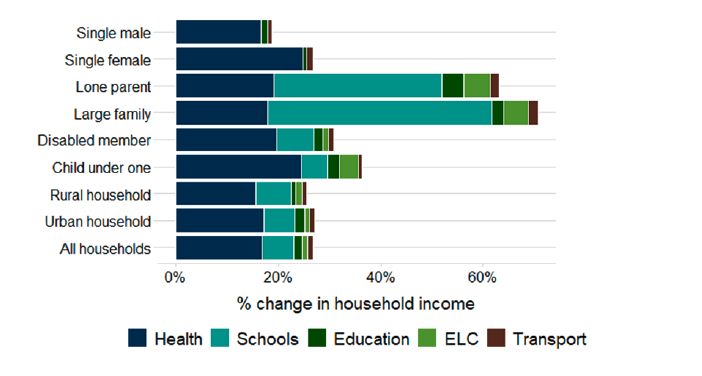
Source: Scottish Budget 2026-27 – Distributional Analysis
It also shows that overall, across all household types, families with children under one and single female households benefit most from the SSR decisions by 2028-29 through above-inflation spending on Health, when the benefit is shown as a share of income. In cash terms, families with children under one and large families benefit most.[63]
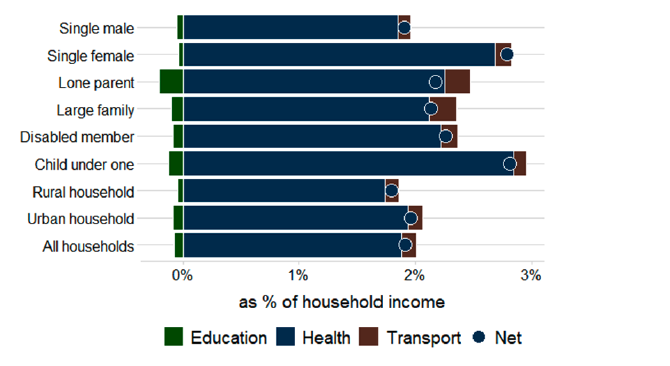
Source: Scottish Budget 2026-27 – Distributional Analysis
Further impacts are set out below:
- Health : A continued focus on reducing waiting times is expected to improve patient outcomes and help to reduce variation of services to ensure equity and parity of care for patients. Hospital admissions are much higher for older people, those with mental health issues, disabled people and those from lower socio-economic backgrounds. The budget also includes support to tackle health inequalities, increasing use of data and digital opportunities and supporting improvements in provision of primary care as well as GP walk-in services. Patients in Scotland had 34.28 million direct encounters with staff in General Practice between November 2024 and October 2025 – an increase of 2.3 million on the same 12-month period in 2023-24.[64] The GP investment deal, alongside plans for walk-ins, will build on this and further add to the GP workforce.
- Mental Health: People whose poor mental health has a substantial and long-term adverse effect on their ability to carry out normal day-to-day activities fall within the relevant protected characteristic of disability under the Equality Act 2010. People with mental health conditions face systemic disadvantage, discrimination, and significant barriers to care more broadly too. Mental health funding directly removes these barriers through improved access, workforce capacity, and service standards, delivering a high and well‑evidenced positive impact for people who are reliant on those services.[65] The Mental Health and Wellbeing Equality Impact Assessment[66] and Human Rights Impact Assessment[67] show that access disparities persist across protected groups and island communities. Mental Health support is also a key issue concerning young people and formed part of their calls to action (see Annex A).[68] It has also been scored as having an ‘exceptional’ impact under both the protected characteristic of disability and age in our pilot study.
- The Alcohol and Drugs budget supports activity to implement the forthcoming Alcohol and Drugs Strategic Plan which will set a long-term vision for how the Scottish Government will build on the National Mission in order to prevent harm, promote recovery and save lives. Delivery of the plan will be underpinned by a human rights-based approach, ensuring that the voices of people with lived and living experience shape the design and delivery of services, and that people receive person-led care and support. The budget maintains funding for initiatives that have delivered success as part of the National Mission, including on Medication Assisted Treatment standards, harm reduction initiatives, treatment and recovery. The budget also enables us to continue supporting a network of essential third sector organisations at the national, regional and local level that provide vital services to individuals, loved ones and communities impacted by drug and alcohol use.[69]
- The Local Government settlement provides grant funding to deliver a wide range of services that are used by most people in Scotland at different points in their lives. Area-based measures such as the SIMD are commonly used to demonstrate that people living in more deprived areas have higher levels of contact with a range of local government services, particularly in relation to health, social care, housing, transport and community safety. Available evidence consistently shows that lower-income households make greater relative use of core local government services, with a number of intersections with equality characteristics. While decisions on service design and spending priorities are for individual local authorities, understanding who uses services provides important context for assessing potential impacts at a national level.
- Education and skills: In addition to the impacts set out in Section 4.1 on Eradicating Child Poverty, investment in the Scottish Attainment Challenge will benefit children and young people living in the most deprived areas of Scotland, and tackle the intergenerational transmission of poverty. It should have positive attainment, health and wellbeing outcomes for groups of pupils at schools in receipt of Pupil Equity Funding (97 per cent of schools). There is also a strong link between additional support needs and poverty – across Scotland the proportion of pupils with an additional need in Scotland’s most deprived areas is almost double that in the least deprived areas.[70]
- Justice: By funding a range of system-wide measures to prevent and reduce crime and reoffending and ensure an effective system of civil law the budget supports people from disadvantaged socio-economic backgrounds and with relevant protected characteristics who may disproportionately experience issues such as domestic fires, crime, and discrimination and harassment. Violence prevention programmes target our least advantaged and most vulnerable communities, while a range of community justice services aim to create safer communities, through reducing and preventing reoffending. Improvements in the prison estate are also likely to have a positive impact on people from the most deprived areas, who are over-represented in prison arrivals by a factor of three.[71]
- Workforce reform will affect public sector staff, with proportionally greater impacts on women, older workers (particularly in local government), and ethnic minority staff (notably in NHS Scotland). Those at risk will have access to redeployment opportunities, advice, and voluntary severance schemes where appropriate. Frontline roles, such as primary teachers, midwives, nurses, and police officers, will be protected, safeguarding some workforces with higher proportions of female or male staff.
- There is a risk that reduced staffing, if not accompanied by effective service redesign, could impact the effective functioning of the public sector as a whole. However, the commitment to protect frontline roles, and the potential for a reduction in wider workforce to free up resources for frontline services could have a positive impact for equality, for fairness, and for consumers of public services.
- A detailed Equality Impact Assessment will be undertaken for the Workforce workstream of the PSR as outlined in the conclusion of the PSR Strategy Impact Assessments, published July 2025. The Equality Impact Assessment will further examine the implications covered above.[72]
- In 2024, the Equality Impact Assessment and Fairer Scotland Duty assessment found that the Public Sector Pay Policy promotes fairness by supporting the Real Living Wage, applying progressive pay increases, and flexibility to address inequalities. It benefits lower earners while restraining higher salaries to help reduce the gender pay gap, and analysis showed no evidence of discrimination. Additionally, measures such as the 35-hour week and No Compulsory Redundancy policy further enhance equality and job security.
Above-inflation increases in Health spending, alongside investment in education and an effective justice system, are expected to support the realisation of a number of children’s rights, as set out in detail in Annex A. The CRWIA in Annex A also contains further analysis of the impact of planned reductions in the public sector workforce.
Contact
Email: ScottishBudget@gov.scot