
Our Scotland, Our Future: Public Engagement Strategy for Climate and Nature
Sets out our overarching framework for engaging the people of Scotland in meeting the challenges of a changing climate and biodiversity loss.
2. Theoretical Framework
The theoretical framework for this strategy comprises of a vision, three objectives and nine outcomes, shown in the diagram below.
We intend for this to be a universal guiding framework to coordinate and streamline delivery of all public engagement on climate and nature across Scotland. This is a whole nation effort, that requires action and collaboration across the many individuals, communities and organisations that are working to engage the public, including and enabling different groups to engage meaningfully and take action. This framework is intended to help support that collaboration, providing a shared structure for our collective approach.
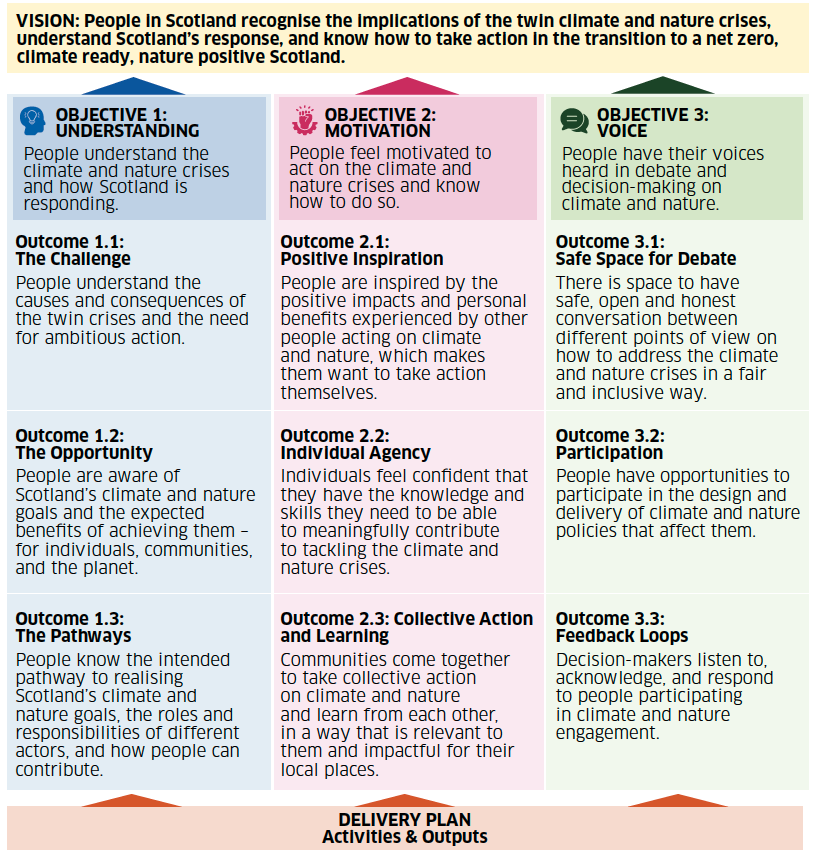
VISION: People in Scotland recognise the implications of the twin climate and nature crises, understand Scotland’s response, and know how to take action in the transition to a net zero, climate ready, nature positive Scotland.
OBJECTIVE 1: UNDERSTANDING
People understand the climate and nature crises and how Scotland is responding.
Outcome 1.1: The Challenge
People understand the causes and consequences of the twin crises and the need for ambitious action.
Outcome 1.2: The Opportunity
People are aware of Scotland’s climate and nature goals and the expected benefits of achieving them – for individuals, communities, and the planet.
Outcome 1.3: The Pathways
People know the intended pathway to realising Scotland’s climate and nature goals, the roles and responsibilities of different actors, and how people can contribute.
OBJECTIVE 2: MOTIVATION
People feel motivated to act on the climate and nature crises and know how to do so.
Outcome 2.1: Positive Inspiration
People are inspired by the positive impacts and personal benefits experienced by other people acting on climate and nature, which makes them want to take action themselves.
Outcome 2.2: Individual Agency
Individuals feel confident that they have the knowledge and skills they need to be able to meaningfully contribute to tackling the climate and nature crises.
Outcome 2.3: Collective Action and Learning
Communities come together to take collective action on climate and nature and learn from each other, in a way that is relevant to them and impactful for their local places.
OBJECTIVE 3: VOICE
People have their voices heard in debate and decision-making on climate and nature.
Outcome 3.1: Safe Space for Debate
There is space to have safe, open and honest conversation between different points of view on how to address the climate and nature crises in a fair and inclusive way.
Outcome 3.2: Participation
People have opportunities to participate in the design and delivery of climate and nature policies that affect them.
Outcome 3.3: Feedback Loops
Decision-makers listen to, acknowledge, and respond to people participating in climate and nature engagement.
DELIVERY PLAN
Activities & Outputs
Vision: People in Scotland recognise the implications of the twin climate and nature crises, understand Scotland’s response, and know how to take action in the transition to a net zero, climate ready, nature positive Scotland.
We have revised our vision for the PES to reflect the importance of engaging on climate mitigation, adaptation and nature loss together.
Sustained action to reduce emissions is required across how we heat and power our homes, travel, use and experience land, and consume goods and services. Engagement can support people to better understand the advice and support available to take action, and to understand their risks and vulnerabilities around flooding, extreme heat, wildfires and storms, as relevant to their local area. To do this, engagement should include practical examples to support transport, energy and consumption choices, protecting homes from flooding, creating greener neighbourhoods, or work to keep vital services functioning in a climate that will experience more extreme weather events. Protection of our environment has also been demonstrated to be a key driver of public climate action. People’s relationship with nature is an important element of addressing biodiversity loss. Evidence[10] suggests that people’s disconnect from nature, and the resulting lack of value placed on nature, is an indirect driver of biodiversity loss. Strengthening people’s connection with, and understanding of, nature is therefore an important component of efforts to halt and reverse biodiversity decline.
People engage most strongly when climate risks and solutions are connected to places, services and aspects of everyday life that matter to them. Place‑based engagement, rooted in local knowledge and partnerships, will be particularly important in helping communities shape responses that reflect their specific circumstances.
To realise this vision, we have set three strategic objectives, each comprising three key outcomes. These outcomes and objectives are intrinsically connected and mutually supportive.
Objective 1 – Understanding: People understand the climate and nature crises and how Scotland is responding.
Misinformation and disinformation about climate change, nature restoration and the transition to net zero present a growing challenge to public understanding and action. Inaccurate or misleading narratives can undermine trust, amplify concerns about cost and fairness, and create confusion about the role of individuals, communities and government. Effective public engagement to develop understanding must therefore prioritise transparency, clarity and credibility. This includes: providing accessible, evidence‑based information to counter misconceptions and support informed discussion; communicating openly and honestly about the benefits, costs and trade-offs associated with climate and nature action; and working with trusted messengers who can engage audiences in ways that reflect their values, lived experience and local context. Supporting people to confidently navigate complex information, including through trusted channels, existing community networks and educational resources, can play an important role in strengthening resilience to false and misleading information.
Outcome 1.1 – The Challenge:
People understand the causes and consequences of the twin crises and the need for ambitious action.
We know that providing facts and data alone is usually insufficient to inspire changes in attitudes or behaviour. Evidence shows that when people are equipped with an understanding of the causes and consequences of climate change and nature loss, they are more likely to understand the need for ambitious action.
Few people in Scotland remain unconvinced that climate change is happening. The vast majority recognise climate change as an immediate and urgent problem and are worried about the natural environment.[11] [12] Awareness of the crisis of biodiversity loss is much lower. It is important that we highlight the link between the impacts that people are experiencing locally and the underlying causes of the twin crises, such as greenhouse gas emissions, deforestation, pollution, habitat destruction and unsustainable consumption. A better understanding of the drivers of climate change and biodiversity loss can engender support for mitigation policies, encourage more sustainable behaviours, support action to adapt to and prepare for climate impacts, and help to protect nature.
Scottish Government will take steps to deliver on this outcome, including:
We will support engagement using credible sources of information on the causes and consequences of climate change and nature loss, and effective means of building understanding of these issues among the public.
We will continue to remain a credible source of information regarding the scale of climate change and nature loss in Scotland and our progress towards achieving our goals to tackle them.
We will continue to support education and skills focused engagement to build understanding of the challenges we are facing and the actions needed to address them.
Outcome 1.2 – The Opportunity:
People are aware of Scotland’s climate and nature goals and the expected benefits of achieving them – for individuals, communities, and the planet.
We have set out our ambitions to reach net zero emissions and restore biodiversity by 2045, support a nature positive environment by 2030, and deliver adaptation across society that builds resilience to climate impacts. Public engagement must work to build understanding of how reaching these goals will reduce the damages from climate change and nature loss, improve our daily lives and have a positive impact on our communities.
Engagement must paint a picture of the positive future we are trying to create and the wealth of benefits that action to meet our climate and nature goals can deliver.[13] This includes opportunities for improvements to health and wellbeing, reduced household costs, more investment in local economies and creation of good, green jobs as well as direct environmental benefits. Communicating how individuals and communities can prosper from the transition, as relevant to their area, is essential to building support.
Scottish Government will take steps to deliver on this outcome, including:
We will engage the public to build understanding of our climate and nature goals and policies.
We will engage people on how we are delivering against our strategies, particularly engaging those people who will be most affected by the policy changes or who are vulnerable to the impacts of the crises.
We will support engagement that highlights the potential for positive impacts from climate action on our health, wellbeing, economic and societal prosperity.
Outcome 1.3 – The Pathways:
People know the intended pathway to realising Scotland’s climate and nature goals, the roles and responsibilities of different actors, and how people can contribute.
We have a duty to ensure that the information within our climate and nature policies and strategies is made engaging and accessible to people across Scotland, so that they understand and can advocate for the action that is being taken – or needs to be taken – by government, public bodies and businesses. Public engagement should also help people understand the actions that individuals and communities can take to contribute to our climate and nature targets, signpost available advice, and make it as easy as possible for people to access opportunities to take action when they are available.
Engagement around individual action must be grounded in an understanding of people’s everyday realities. Concerns about affordability and fairness can limit people’s capacity to engage or take action, particularly for those already facing financial insecurity. It is essential that we are clear about costs and benefits, highlighting available financial support and money saving actions, and ensuring that policies and programmes are designed and communicated in ways that are fair and accessible.
Engagement also needs to recognise that the public – individuals, communities and households – are one part of a much larger picture of climate action being delivered through government, public and the private sector. The burden of responsibility for action lies in a whole-of-society approach, where the public support, action and input are integral but not sufficient alone to make the changes Scotland needs.
Scottish Government will take steps to deliver on this outcome, including:
We will set out and engage the public on the key actions needed across society to deliver on our policies, ensuring that people are aware of the actions they can take as individuals, households and communities, and the actions that are required of the public and private sectors, so that they are sufficiently informed to hold us to account for our policy promises.
We will work with trusted messengers and communities to support engagement that ensures people and communities have relevant, accurate and evidence-based information in accessible formats that enables understanding of what climate change and nature loss means for them and their local area, instils hope, and enables local and peer-led engagement.
Case Study: Climate Engagement Fund (CEF)
The CEF has supported 24 projects since 2023, directly reaching over 50,000 people with knowledge and skills to explore how climate change relates to their lives and how they can take action.
In 2024, Scottish Alliance for Geoscience, Environment and Society (SAGES), were provided CEF support to deliver an 11-part podcast series aimed at making climate science more accessible to a wider audience. The podcast covered a wide range of topics within climate science; our climate history and future, water and flooding, soil and peat, innovation and AI, coasts, the marine environment, communities, geothermal and groundwater, and climate resilient cities.
By the end of the project, the podcasts had been listened to or viewed over 20,000 times, and reached 285,000 on social media. It demonstrated the potential for a popular media format to reach a broad audience (35% over 45 years old), making science more relevant and relatable to people’s lives, using science communication to drive positive environmental and educational change.
“The podcast was an accessible and hopeful resource, providing an optimistic outlook on climate solutions, which is especially important in today’s often overwhelming climate discourse.” (Participant researcher, SAGES)
Objective 2 – Motivation: People feel motivated to act on the climate and nature crises and know how to do so
Public engagement alone cannot remove all the barriers to action on climate and nature. A person’s ability to act can be constrained by material factors, such as, costs, infrastructure and service provision, and care, work or study schedules. Where there is the opportunity for people to act, public engagement plays an essential role in supporting creativity to develop solutions and motivating people to take action, both as individuals and collectively in communities.
Outcome 2.1 – Positive Inspiration:
People are inspired by the positive impacts and personal benefits experienced by other people acting on climate and nature, which makes them want to take action themselves.
Evidence suggests that people are often inspired to act when they see that others’ efforts are making a tangible difference. People’s behaviours are shaped not only by their individual values and circumstances, but also by the behaviour of those around them and by broader social expectations. Seeing or hearing ideas and stories of the positive impacts of individual and collective action on climate and nature can inspire further action and foster hope, among individuals and communities. It can also widen the adoption of successful methods. By making positive change visible, such stories reinforce social norms and demonstrate that action is effective. This can increase engagement in climate and nature action and encourage people to see themselves as part of the solutions.[14]
Scottish Government will take steps to deliver on this outcome, including:
We will provide platforms and support communications to showcase climate and nature action and successes taking place at national and local levels to demonstrate models for action for others to follow and inspire new ideas and collaborations.
We will support engagement delivery that incorporates creative, imaginative and positive approaches, recognising that people learn when they feel and connect with issues as relevant to their own lives and addressing issues meaningful to them.
We will enable trusted messengers to share stories from climate engagement for peer learning and inspiration to develop and improve approaches.
Outcome 2.2 – Individual Agency:
Individuals feel confident that they have the knowledge and skills they need to be able to meaningfully contribute to tackling the climate and nature crises.
For many people, awareness of climate change and nature loss is accompanied by feelings of anxiety, worry or grief. While concern can be a powerful motivator for action, unmanaged eco‑distress or climate anxiety can also lead to disengagement, helplessness or fatigue. Public engagement has a vital role to play in responding to this challenge. Motivational approaches that emphasise agency and achievable steps can help people move from concern to participation. Effective public engagement, that sets out the ways in which people can play a part in taking action or advocating for the solutions, helps individuals see that climate change and biodiversity loss are not overwhelming problems beyond their influence, but issues that can be addressed through actions at different scales. Engagement processes can help to build and strengthen the relationships, networks, skills and confidence that enable participation in action and debate. This is most effective where behavioural insights have led to establishment of policies and services that enable people to take action.
Scottish Government will take steps to deliver on this outcome, including:
We will build public understanding of the services, supports and guidance available to enable people to take their own climate and nature action.
We will support trusted messengers and communities to lead engagement that enables specific audiences to understand the actions they can take and to develop approaches that resonate with them.
Outcome 2.3 – Collective action and learning:
Communities come together to take collective action on climate and nature and learn from each other, in a way that is relevant to them and impactful for their local places.
We know that community-led, place-based action is essential for delivering our climate and nature ambitions. Locally-led initiatives can deliver environmental benefits while also strengthening social connections and resilience. Through participation in local projects, people can see tangible results from their efforts, develop skills and confidence, and strengthen relationships with others in their community.
Peer-to-peer learning can play a particularly valuable role in supporting climate and nature action within communities because people often trust and relate to the experiences of their peers more readily than information delivered by institutions or experts alone. Through the sharing of knowledge, skills, experiences, and practical examples, community members can learn from others who face similar challenges and opportunities in their daily lives. Seeing neighbours, friends, or local organisations benefit from engaging in climate and nature action can make change feel more achievable and worthwhile.
Scottish Government will take steps to deliver on this outcome, including:
We will encourage communities to work together to develop and deliver locally-led initiatives, ensuring communities have the right guidance, capacity and opportunity to focus on the solutions that matter to them – engaging with local economic, wellbeing and social challenges in a way that is also reducing emissions, building climate resilience and supporting the natural environment and wildlife.
We will support communities to come together, share ideas, and motivate them to take collective climate action to help accelerate the transition to a low-carbon, resilient and nature positive future, which is fair, inclusive, and responsive to local needs.
We will support shared resources to enable trusted messengers to support connections between discussions on local and household issues with solutions that are delivering climate and nature action.
Case Study: Community Climate Action Hubs
A national network with hubs in every region in Scotland supporting locally led approaches that reflect community priorities and needs.
Inverclyde Climate Hub: Supporting a pilot volunteer-led driver network to redistribute excess food, February-April 2026
Inverclyde Community Food Network (ICFN) received seed funds from Inverclyde Climate Hub to pilot a volunteer-led driver network to redistribute excess supermarket food to local early learning centres.
Volunteer drivers redistributed over 2 tonnes of surplus food from supermarkets to local nurseries. They also delivered 4 ‘Ready, Steady, Cook’ sessions to 32 participants.
In addition to diverting two tonnes of food from landfill (the equivalent of driving a petrol car for 10,000 miles, or the equivalent of one to two people’s food emissions for an entire year). The food went to a wide range of people, including families, those experiencing financial pressure, and vulnerable groups. Access to fresh food helped ease household costs and supported healthier diets across the community. The cooking sessions also supported people to build confidence in preparing low-cost meals, while creating a welcoming social space that helped reduce isolation and strengthen community connections.
The pilot demonstrated both demand for and the benefits of the services, and informed the case for a dedicated paid driver and vehicle to continue the food redistribution and expand the network over the long term.
Feedback from the nurseries involved was positive with one commenting:
“Our families have given positive feedback on the days we have food to give away. The children enjoy choosing things to take home to try and parents are pleased to hear that they are saving it from going to landfill.”
Objective 3 – Voice: People have their voices heard in debate and decision making on climate and nature.
Public input and advocacy is essential to ensuring that climate and nature policies are fair, just and inclusive. Enabling people to contribute their views and opinions, and be heard and responded to, can ensure that the systems, actions and services put in place reflect the needs of those most impacted. This allows for lived experience and local knowledge to feed into the development of solutions.
It is also important that we talk about the climate and nature crises with each other. Discussions between family and friends have been shown to improve understanding of the crises, increase support for environment policies, and motivate individual action. Conversations can also help address eco-anxiety by creating opportunities for people to process emotions, find meaning, and feel less isolated in their concerns.[15]Surveys indicate that, despite most people expressing concern about climate change, few talk about it in any depth as part of everyday conversations. This matters because, the less people hear others speak about climate change, the less they feel it is a socially acceptable topic for discussion, creating a ‘spiral of silence’. This is compounded by the fact that, whilst being concerned themselves, people tend to underestimate how much others are concerned and willing to act on the crises, and may assume others are not interested in talking about it.[16]Facilitating more conversation about the twin crises is an important way of making the collective concern visible and demonstrating that the majority of people want to take action.
Outcome 3.1 – Safe Space for Debate:
There is space to have safe, open and honest conversation between different points of view on how to address the climate and nature crises in a fair and inclusive way.
In a time of heightening politicisation and polarisation around climate change, it is more important than ever that we have safe spaces for open and honest discussion about the challenges we face. The science of climate change and biodiversity loss isn’t up for debate; we are in a climate and nature emergency. There are many valid perspectives on how we should address these crises. Finding fair and effective solutions requires inclusive and accessible conversations between those with different points of view, and spaces where debate can support creative conversations for innovative solutions.
We recognise that conversations on these issues are confronting. Without a direct route to solutions and supports, engagement can lead to a negative effect and leave people feeling further disengaged and overwhelmed. Conversation and debate therefore should be balanced with routes to action and signposts to support.
Scottish Government will take steps to deliver on this outcome, including:
We will encourage constructive, safe conversations to bring in different perspectives on climate and nature action to bridge divides, encourage creative, solutions focused discussion, and enable communities to come together to agree a way forward, – supporting engagement around such local initiatives as Place plans.
We will work with trusted messengers to build confidence and capacity within communities to help them support conversations, use their voice, and build awareness of opportunities for people to contribute to conversations and decision-making processes.
Outcome 3.2 – Participation:
People have opportunities to participate in the design and delivery of climate and nature policies that affect them.
The Scottish Government is committed to being an Open Government where citizens are supported to understand and influence the decisions and policies which affect their lives both now and in the future. This isn’t just a matter of principle – it is an essential part of making climate action truly deliverable. For example, we understand that a just transition will only be possible if people are empowered to participate in and shape Scotland’s approach to climate and nature policy. It is a simple matter of fairness that individuals and communities should be given a say in changes that will affect them. Participation is also essential in ensuring that we take the right approach, working with local networks to bring people with us, and build social consensus for the changes required. Policy is better made when it is deeply informed by those who have direct lived experience. Personal testimonies, case studies, and input from groups who are more vulnerable to the impacts of the transition to net zero significantly improves our ability to design policy in a way that can respond to their needs. As we look to demonstrate the effectiveness of this approach, it helps encourage others to consider how engagement with those most impacted can be embedded in the way government works, making it something that automatically happens as part of everyday operations of government and not limited to the development of specific strategies or consultations.
Scottish Government will take steps to deliver on this outcome, including:
We will actively engage on the design and implementation of our climate and nature action to ensure that public input informs our approach and our policies, and that services and guidance are fit for purpose and fair, serving communities to realise the opportunities and benefits of action.
We will work with partners, public bodies, and other decision-making organisations to encourage them to support local communities to contribute to and influence decisions, policies and services in their design and implementation.
Outcome 3.3 – Feedback Loops:
Decision makers listen to, acknowledge, and respond to people participating in climate and nature engagement.
Public and community participation takes time, resources and capacity and we recognise the importance of acknowledging the contributions from the public in taking part in these processes. We know that, for participation to feel meaningful, those taking the time to engage must be able to see how their input was taken into account. It is important that decision makers have processes for tracking and responding to public input to policymaking, design and delivery. This is an essential element of enabling meaningful participation and ensuring that policy, services and guidance are fit for purpose. Demonstrating that members of the public, communities and peers have had their views and ideas listened to and reflected in decision-making, will encourage others to engage – in turn, ensuring the development of policy that relates to the needs and circumstances of people across Scotland.
Scottish Government will take steps to deliver on this outcome, including:
We will improve our process for tracking and responding to public input to our policymaking, recognising that acknowledging views and setting out what can and cannot be taken forward is part of our role as an Open Government.
We will encourage partners, public bodies and other decision makers to improve their processes for setting out how public input has influenced their approaches, providing adequate feedback and acknowledgement of communities’ contributions.
Case Study: Just Transition Commission (JTC) (2018-2021 & 2022-2026)
Expert advice and scrutiny drawing on direct insights shared by over 1,000 people and organisations across Scotland.
The independent Just Transition Commission is made up of senior leaders from across business and industry, trade unions, environmental groups, the third sector and academia. It has heard from communities, consumers, workers and businesses in key ‘hotspot’ localities including Shetland, the Isle of Lewis, Aberdeen, Peterhead, Grangemouth, Dundee, South Lanarkshire, Caithness, and Dumfries and Galloway. Engagement activities include town-halls, multi-stakeholder, roundtables, site visits and a national summit, convening genuine dialogue on the transition’s challenges and opportunities, and local experiences. Based on these inputs, the Commission’s advice to Scottish Ministers has supported policy development across core economic sectors, including energy and transport, and in adaptation policy. Most recently, the Commission’s advice informed the creation of just transition indicators embedded within the new Climate Change Plan to ensure that delivery of mitigation policy takes into account the impact on people most affected by the transition.
The Commission produced a showcase reflecting engagement with innovative people around the country, featuring examples of meaningful projects working on just transition challenges across Scotland. Case Studies Map – Just Transition Commission
The JTC has been renewed to deliver from 2026 to 2031.