
Humanitarian funding review: our future response to global humanitarian crises
This publication is an independent, external review of the Scottish Government’s humanitarian funding, assessing the Humanitarian Emergency Fund and wider mechanisms. It examines challenges, global trends, and ways to strengthen impact, localisation, feminist approaches, and future funding models.
5. Operational Review
This section provides evidence against the framing questions:
(B) What is the best mechanism to deliver Scottish Government humanitarian funding? (taking Value for Money, potential impact and alignment with Scottish Government International Development principles into consideration)
(D) To what extent are current mechanisms meeting or contributing to Scottish Government Humanitarian Funding Objectives and International Development Principles?
Throughout the review process several themes have emerged that illustrate good practices for donors of comparable size and orientation to the Scottish Government (See Annex F). These themes can be synthesized into 6 categories of practice (see Annex F Best practices review for further details). This section will use these categories to analyse the HEF’s operational approach in general, with respect to the activation and peer review processes, communication objectives, cost, impact, and value for money.
5.1: The HEF and comparable best practices
Six best practice themes
Smaller disbursements are associated with lean administrative structures and rapid decision-making: With lean administrative structures and streamlined decision-making processes, donors can roll out rapid-response funding mechanisms in emergencies where larger donors might be slowed down by bureaucracy.
Strong emphasis on localisation and community-led initiatives: When limited resources are channelled through locally guided efforts, they can generate outsized returns in terms of relevance and responsiveness.
Inclusive and participatory design: Bringing diverse voices -from women and marginalized communities to civil society experts- into the process of project design, decision, and disbursement involves not only funding feminist-oriented projects, but incorporating the principle into policy decisions and mechanisms.
Dedicated and predictable funding mechanisms: Longer-term funding enables projects to be planned and executed with an understanding that the impacts will be sustained over time.
Agile funding and implementation: The ability to make rapid decisions and quickly adapt to evolving conditions is highly appreciated, whether it’s pivoting to a cash programming model in a crisis or adjusting priorities based on real-time feedback.
Shared services and pooled resources: By investing in shared service platforms, small donors can facilitate improved coordination and reduce duplication.
Structure and disbursement mechanism
The HEF is designed to ensure that Scottish Government funds are disbursed responsibly, balanced against the need to activate funding quickly in response to crises.[39] Interviews with members of the panel revealed an understanding of these two imperatives, while also suggesting some of the ways in which the current model can lead to more onerous administrative needs, in some cases delaying its disbursement.
This is most relevant to Stream 2 activations, in which the Scottish Government approves funding for projects outside the context of DEC-initiated humanitarian appeals (see Annex G HEF Funding Streams for summary of HEF funding mechanisms). These grants, which range in size generally from GBP100,000 to GBP 250,000, are awarded following a competitive application process and peer review conducted by the HEF panel’s members. The process requires member organizations to generate a proposal and modify it following questions and feedback from peer reviewers and the Scottish Government: several panel members noted that in addition to the time dedicated by personnel based in Scotland, this process involves time from colleagues at headquarters, regional, and country-offices, and in some cases additional information from potential implementing partners.
Providing information to substantiate a grant application is not unusual, but several HEF panel members have noted that the type of budgetary information that has been requested by the Scottish Government is often difficult to provide in a humanitarian emergency ex ante, especially since Scottish grants are often of limited size – meaning that they are often pooled with other funds into an existing programme or project, from which it is often difficult to derive and forecast specific, itemized costs and expenditures. Given the institutional commitments to meeting sector-wide standards that are conditions-of-entry for HEF members, these requirements have been described by several members of the panel as excessive.[40]
‘…this is a voluntary, and non-recompensed position. The governance and decision-making are time consuming and hard to fit into individual’s remits. The decision-making is very subjective…… most applications are very similar in nature which makes them hard to judge’ – HEF Panel Member, interview.
It is important to note that Stream 2’s relatively heavy administrative structure is not a necessity for Scottish humanitarian disbursements. Two other modalities are already used, in parallel, with each following a different and slightly leaner process. Stream 1 disbursements are triggered by the launch of a UK DEC emergency appeal, with administrative due diligence largely transferred to the DEC itself. Stream 1 funding can also be accessed by members of the HEF who do not sit on the DEC.[41]
Beyond the two streams, additional funds can and have been transferred to entities beyond the HEF panel members and/or DEC in response to crises or humanitarian emergencies that Scottish public, political, and governmental decision makers consider salient.[42]
Based on the administrative costs of delivering the HEF, and a review of the operational requirements for membership, a baseline estimate of around 50,000 GBP is spent on administration, activation, peer review, and reporting, in addition to the cost of Scottish Government personnel (Table 1) . As a function of the distributed nature of HEF funding, most of those costs are born by organizations that are not awarded grants.
External Administration of HEF Cost Estimate[43]
HEF Secretariat DEC 36,952
Panel member wages (40,000 GBP annual salary, or 20 GBP/hour)[44] Biannual meetings (8 hours twice per year for each member) 2880
Panel member wages (40,000 GBP annual salary, or 20 GBP/hour) Activation meetings (3 meetings with 5 members each, 8 hours) 2400
Panel member wages (40,000 GBP annual salary, or 20 GBP/hour) Peer review (4 hours for each peer reviewer, for each activation 720
Panel member wages (40,000 GBP annual salary, or 20 GBP/hour) Proposal Development (8 hours per country office per organization per year) 1280
Panel member wages (40,000 GBP annual salary, or 20 GBP/hour) Proposal implementation, M&E (2 days per country office per project for 3 activations 7680
Total - 51 912 GBP
This represents approximately 5 percent of the 1 million GBP annual HEF allocation – and while actual disbursements exceed this amount, administrative costs also increase with additional disbursements/activations.
It is difficult to compare this across other donors, but some rough analysis is possible. To use a peer donor that has been referenced elsewhere in this report, Jersey Overseas Aid: internal administrative costs for JOA in 2024 were calculated at GBP 45 876, against a total humanitarian spend of GBP 4.4 million.[45] Jersey does not have a HEF equivalent, but relies on a board to approve disbursements.[46] As discussed elsewhere, most money is channelled through pooled funding mechanisms and multi-year partnerships, reducing the likely annual cost born by recipients in terms of proposal development, review, monitoring and reporting.[47]
Key Findings
The transaction time incurred to disburse relatively small amounts of funding is high and over complicated with potentially significant costs of engagement which are difficult to account for.
There are opportunities to increase transparency around allocations and streamline the requirements for accessing HEF across all the current mechanisms. Not all humanitarian funding goes through the HEF and at times it can be unclear what processes have been applied to other funding allocations. Increasing transparency around funding decisions, including criteria and rationale, could foster greater accountability and trust.
There is a risk of perception of bias/vested interests when a small number of panel members review each other’s work.
Enhanced flexibility ex ante- building in greater flexibility into the grant proposal stage could enable the HEF to adapt to evolving humanitarian contexts and support more flexible interventions. E.g. estimating reach figures in proposals and reporting actual reach figures once interventions are delivered.
Localisation and inclusive and participatory design
Interviews indicate that the HEF funding is ultimately channelled towards and through locally led and locally guided efforts. Given the time available to HEF panel members to respond through proposals following the activation of Stream 2 and the relatively small size of the funding available, HEF panel members are not designing interventions from scratch. Moreover, the small size of funding available from HEF, the timeframe for spending and the objective of delivering immediate and effective lifesaving assistance means that HEF funding is unlikely to be directed to an area where there are no partners on the ground.[48]
HEF-funded interventions are also often designed as part of a larger response or programme. Interviews with local partners confirms the focus on localisation and community participation – in fact, there are often localisation benefits and activities that are not formally captured in project documents.
In one case study (anonymized), in which a HEF panel member was awarded a Stream 2 grant, localisation played out in both formal and informal ways. Formally, the intervention was delivered by local partners. Informally, the shape and scope of the intervention itself was informed by consultations with a network of local humanitarian organizations. See also Section 4.3.
Views from HEF Local Delivery Partners
Six local delivery partners were consulted during this review – they unanimously welcomed the funds from the Scottish Government, highlighting their appreciation for swift delivery. All welcomed the opportunity to share their experiences in this review and asked how they might be able to engage in more regular conversations with the Scottish Government and the wider HEF panel.[1]
One interviewee noted, ‘the Scottish Government gives us the flexibility to determine where the needs are greatest – other donors tell us where to work and what to deliver…using cash transfers gives power to the communities to decide for themselves what they need – they have needs which we might not understand. The Scottish Government trusts us to know how best to deliver their funds.’
All interviewees noted a strong and positive relations and collaboration they held with the HEF panel members. One interviewee noted that they had benefitted from both HEF and Loss and Damage funding for the same community and recommended the Scottish Government think about how they can replicate this in future.
This latter activity, wherein priorities for action and the identification of appropriate partners are themselves driven by engagement with local actors, is less easily captured in project documentation, and does not necessarily correspond to a budget line; yet it is in many ways a more significant manifestation of the localisation agenda, contributing as well to inclusive and participatory design and delivery. A humanitarian portfolio evaluation, using participatory techniques, every 3-4 years could evidence changing patterns of action on localisation.
Advancing localisation in the context of the HEF and any future versions of the HEF would entail:
- Meaningful participation and representation of local humanitarian actors.
- Ongoing engagement with local communities throughout project implementation.
- Respectful collaboration between humanitarian actors and the communities they work with.
- Proportionate due diligence processes which do not place excessive burdens on organisations.
- Capacity building – a proportion of the funding awarded should be supporting ongoing training to support long term sustainability.
- Feedback – should be sought from all stakeholders involved in the funded project, including clear complaints processes.
Key Findings
Localisation is most effectively championed in the process, given the scale of Scottish funding. Relatively small amounts of funding are not going to radically change the approach to localisation in a country but Scottish Government funds can demonstrate how processes of consultation and working through small local delivery partners can be critical and are not necessarily captured in current reporting.
The review team were not able to comprehensively map the quality of engagement of local delivery partners by HEF panel members e.g. in order to answer queries on the extent to which local actors influenced project design. From the selected (6) interviews with local delivery partners – their role was critical and they felt they had led design work.
Dedicated predictable, and agile funding mechanisms
Across comparable funding, and in principles of good donorship more broadly, this theme refers to the timeliness and predictability of funding as key to improving humanitarian response: that funding should be communicated and provided early, clearly explained and documented in agreements with partners, and allocated along timescales that are both responsive and flexible.[49]
The current set-up of Scottish Government humanitarian response does meet some of these criteria: it is generally disbursed quickly, and the cadence for Stream 2 allocations is predictable. Yet its overall predictability and timeliness is compromised by the different disbursement mechanisms, as well as by the unpredictability of the overall annual envelope and an inability to provide multi-year funding. Stream 1 disbursements are by definition not predictable, as they are dedicated based on the initiation of a discrete appeal; yet nor are Stream 2 disbursement, which are largely one-off allocations without a mechanism for continuity. Finally, while additional funds made available at the end of the fiscal year are certainly welcome, they do not permit reliable or predictable use given their ad hoc nature.
The agility of HEF funding is also compromised by its project-based nature, and in the case of Streams 1b and 2, the ex-ante proposal requirements. This structure, at least in theory, limits the extent to which partners can shift or transform the use of their funds.
In practice, significant shifts in programme delivery have taken place. Yet these are contingent on an unstructured process of permissions sought and received by the Scottish Government. While this allows flexibility, it does not allow predictable flexibility. It also risks undermining the peer review process itself.
Shared services and pooled resources
At the level of the HEF’s structure and membership, there are elements of shared and pooled resources. The panel itself represents a shared pool of expertise and advice, while the Scottish Government’s relationship with the DEC –both administrative and financial through the Stream 1 mechanism - also represents an effort to pool resources and share services.
Yet at the disbursement level, this pooling of resources stops post allocation of funding. While HEF Panel Members and their local partners strive to coordinate with other humanitarian actors, coordination can be improved to deliver sustained change and value beyond the life of HEF funding by enabling pooling of resources at the country level.
Once again, there is a level of informal pooling that takes place in a manner that is not quite captured by the formal HEF structures, and in some cases may be undermined by them. Since the scale of individual disbursements are relatively small, and the projects supported by most of its members quite large, HEF allocations often fund components of broader interventions. In this sense, they are part of a pool of resources that a given recipient draws on to meet needs and deliver programmes. Yet the manner of reporting to HEF goes some way to mask this fact, or even to prevent it, as funds are specifically earmarked for projects.
Key Findings
Both HEF panel members and local partners emphasise the importance of allowing overheads for local partners; enabling them to maintain skills and resources.
Reducing the scope of the HEF (focusing on providing immediate and effective assistance to reduce the threat to life and wellbeing for a large number of a population faced with a humanitarian emergency) and being proportionate (in terms of proposals, monitoring and communications) and being more flexible were recurring themes from a diverse range of stakeholders.
Sharpening guidance on scoring criteria to enhance objectivity, and clarifying if country teams of HEF panel members are considered amongst local actors (i.e. if they locally registered in the country of operation of the proposal they would be defined as local actors) in the context of HEF.
5.2 HEF panel members commitments to wider standards
All HEF panel members must be signatories to the Code of Conduct for the International Red Cross and Red Crescent Movement and NGOs in Disaster Relief and also be members of the Core Humanitarian Standard (CHS) Alliance (HEF Operational Manual). Table 2 sets out HEF panel members’ wider public commitments and memberships, this illustrates the diverse spectrum of standards and bodies which current panel members engage with. The table also gives food for thought around eligibility criteria for any future funding – e.g. the START fund has recently reduced their expectations on eligibility criteria in order to maximise access to local partners (see Annex E for further details).
|
Standards/ Commitments |
SCIAF |
Oxfam |
Mercy Corps |
Christian Aid |
Islamic Relief |
British Red Cross |
Tearfund |
Save the Children |
|---|---|---|---|---|---|---|---|---|
|
Core Humanitarian Standard |
✓ |
✓ |
✓ |
✓ |
✓ |
✓ |
✓ |
✓ |
|
DEC |
X |
✓ |
X |
✓ |
✓ |
✓ |
✓ |
✓ |
|
Charter for Change[50] |
✓ |
✓ |
X |
✓ |
✓ |
X |
✓ |
X |
|
Climate and Environment Charter for Humanitarian Organisations[51] |
X |
✓ |
✓ |
✓ |
✓ |
✓ |
✓ |
✓ |
|
SPHERE[52] |
✓ |
✓ |
✓ |
X |
X |
X[53] |
X |
✓ |
|
Grand Bargain |
X |
✓ |
✓ |
✓ |
✓ |
✓ |
X |
✓ |
|
START Network |
X |
✓ |
X |
✓ |
✓ |
X |
✓ |
✓ |
5.3: Activations and Peer Review
Relevant for the HEF’s Stream 2 (non-DEC) allocations, the activation and peer review processes are core components of the Scottish Government’s approach to humanitarian donorship. The two processes provide a rubric for deciding on how to spend funds, as well as generating a body of evidence to record why interventions were chosen and how they were delivered.
Dedication of Stream 2 of the HEF to non-DEC humanitarian crises reflects the original founding objectives of the establishment of the HEF in 2017, the design of which was steered by INGOs, to ensure hidden funded crises receive support, an ethos which was supported by the Scottish Government.
In practice, this process results in a relatively loose set of criteria. Decisions on which crisis to activate for are made based on collective discussions that, while rooted in the evidence and data that each discussant brings, does not explicitly cite a certain metric.
Once a specific context is decided, the HEF moves to a peer review process for submitted applications. This process is based on a scoring system that involves weighting of scores. The process involves two levels of review once proposals are submitted.
Case studies on the identification of crises for HEF response and HEF Activation
The activation of the South Sudan displacement crisis in 2024 was discussed at a joint meeting with the Scottish Government. The HEF Panel together with the Scottish Government gave due consideration to the activation criteria of HEF Stream 2 along with the budget and spend criteria facing HEF at that time: (i) the humanitarian need presented by this crisis that was the world’s fourth most neglected crisis at that time, with extremely limited funding from the international community, (ii) £250K remaining in HEF Stream 2 from the annual budget, (iii) need to spend funds by the end of March 2024, and (iv) ability of HEF members present in the meeting to absorb and deliver against the budget.
When the HEF Panel activated for the Burkina Faso crisis in 2022, the panel members considered several crises that HEF could support. The crises in Myanmar had the support of 4 panel members while the crises in Burkina Faso together with two other crises had the support of 3 members each. The activation document noted that panel members agreed that HEF support should be channelled towards the Burkina Faso crisis given the geographic context of the crisis, which was the cross-border area between Burkina Faso, Mali, and Niger. The documentation records that panel members also gave due consideration to the level of media attention on this crisis and noted that a DEC appeal was unlikely due to the low UK media coverage; possibly because Burkina Faso is a French speaking nation. This also made the crisis a hidden crisis. Interviews suggest that there were two other considerations behind the activation of this crisis. First, the HEF had never activated funding for Burkina Faso despite the crisis there being discussed in 2-3 prior activations. Second, the Panel noted that many are unaware of Burkina Faso as a country or its location. Providing funding for the crisis would raise awareness.
During the activation of the Afghanistan earthquake in October 2023, the HEF Panel discussed three crises: the Afghanistan earthquake, escalations in Gaza/Israel, as well as the crisis in Sudan. The panel recorded its decision to not activate for Gaza/Israel due to the severely restricted access to the area and the resulting challenges for HEF members to mobilise a response. The Panel agreed to continue to discuss this crisis as developments evolve. Comparing the options for Afghanistan and Sudan, the Panel expressed the need to prioritise the latter but agreed that as a result of immediate and acute needs in Afghanistan following the devastating earthquakes, it was preferable to activate for Afghanistan, with the understanding that the Panel would revisit the conversation to activate for Sudan when timing was appropriate.
The first is by the peer review committee, who meet once the peer review process is completed and before recommending the proposals to be funded to the HEF Panel. Finally, once proposals are finalised and have been submitted to the Scottish Government, a final review is conducted by the Scottish Government who may suggest modifications, ask for clarifications, (e.g. on target beneficiaries, locations and budgets), or approve the proposals. To note that there appears to be limited review of budget sections by the panel, which are subsequently queried by Scottish Government.
The peer review process balances some elements of good practice – around consultative and inclusive design and pooled resources – with less-optimal features. Panel members have noted that the initial scoring system for proposals is “one size fits all,” allowing little differentiation between interventions that might be very difficult to weigh – for example WASH interventions against cash assistance. This is to some extent remedied during the intermediate stages, where the peer reviewers and broader panel are able to apply their collective intelligence – a robust, albeit subjective process of decision making.
The larger criticism is around the scale of this process, which includes significant demands on the time of panel members –those applying for the grant, those who serve as peer reviewers, those who assess proposals through the panel, and eventually those who are granted the award – that appears to be an outlier among funding mechanisms of similar scales.
As an example, we could consider the Canadian Humanitarian Assistance Fund, the French Humanitarian Innovation Call, DG ECHO’s small-scale implementation tool, and Jersey Overseas Aid’s process for disbursement. Each of these mechanisms provide grants of similar scale to the Scottish Government’s disbursements under HEF stream 2. With the exception of the Canadian mechanism, for which evaluation is delegated entirely to the Humanitarian Coalition (Canadian equivalent of the DEC), allocations are awarded based on in-house decision-making, either by technical staff or a standing board, and involve a single application-review process (See Annex F).
Key Findings
Disbursing funds via the HEF are transaction heavy proportionate to the size of funding available. The peer review process is resource-intensive for HEF panel members, with hidden costs and significant time requirements, and also resource intensive for Scottish Government officials first reviewing and then seeking authorisation from Ministers of the proposals, indicating that it needs to be streamlined.
Activation decisions under HEF Stream 2 are guided by HEF's operational manual criteria but also influenced by informal objectives, such as equitable fund distribution (in terms of the crisis supported), faster disbursement, and alignment with the Scottish Government’s preferences. To that extent, the process has generally worked well in identifying crises for response.
The extent to which activations relied on supporting data during discussions, complete activation requests by panel members, and reference to field information remains unclear.
The peer review process appears effective, but it has flaws, notably in its scoring system, which makes it difficult to fairly compare interventions of different types and leads to subjective decision making.
5.4 Communications
In a focus group discussion with HEF panel members, respondents provided their thoughts on the extent to which the HEF builds awareness in Scotland around humanitarian crises, as had been intended in its Aims, and on whether this awareness had an impact on resource mobilisation and fundraising. Views on these questions were mixed, yet there was strong consensus that the HEF, and the Scottish Governments’ status as a humanitarian donor more broadly, positively demonstrates the Scottish Government as a responsible global citizen. There was also significant agreement that current expectations around communication products and outputs is disproportionate to the scale of Scottish humanitarian funding.
Survey responses show:
- Mixed views on whether HEF funding builds public awareness of humanitarian crises in Scotland.
- Mixed views on whether awareness leads to increased funding.
- Strong agreement that HEF funding demonstrates Scottish Government’s role as a responsible global citizen.
- Strong disagreement that communications expectations are proportionate to funding.
Figure 3 HEF Communications opinion poll
Communication offers another area in which better use of pooled resources and shared services appears relevant. Stakeholders noted that their stories were more impactful when pitched to the media together (supporting earlier remarks on a call for a HEF ‘brand’.) They also noted that winning media attention was challenging when timings for announcements were unpredictable (which is natural in this sector) – country teams invest heavily in providing content. The group felt that communications around the HEF could be better packaged as part of a broader public communications offering around Scottish Government International Development, with inputs from the HEF panel and other partners to illustrate the core offering that the Scottish Government makes by contributing to humanitarian responses. HEF panel members were very open to more collaborative working alongside Scottish Government Communications teams.
Key Findings
It is difficult to separate the impact of the HEF communications strategy from the wider activities of HEF panel members to establish the extent to which HEF has generated additional funding or public awareness as originally intended.
Very little funding goes towards communications requirements (See Annex C) and there is evidence of panel members engaging their communications colleagues ‘for free’.
5.5 Cost, Impact, Innovation, and Value for Money
As humanitarian assistance has risen in recent decades (before the decline we’re currently experiencing), and since the push in the early 2000s to professionalize the sector, there have been many efforts to improve how humanitarian impact is understood and measured. In 2006, ALNAP’s guide to humanitarian evaluation provided something close to a consensus model of how to interpret and use the OECD DAC’s five criteria – efficiency, effectiveness, impact, sustainability, and relevance – in the context of complex emergencies.[54] These criteria have been updated by the DAC, and reinterpreted by ALNAP, to six – effectiveness, relevance/appropriateness, efficiency, impact, coverage, coherence and connectedness.[55]
As with any scaled system of measurement, this rubric has come under critique. Major issues raised with the criteria include its limited ability to evaluate change over time, or transformational shifts in aid delivery,[56] little attention to human rights and equity and positionality, difficulty in applying standardisation[57] and the general utility, appropriateness, and ease of use of the standards.
These critiques are important to bear in mind in assessing the impact of activities supported by the Scottish Government, for several reasons. First, they suggest that the criteria and their various interpretive lenses were intended for the evaluation of projects and programmes, rather than longer term policies or institutional arrangements.[58] In the case of the Scottish Governments’ approach, and the HEF structure specifically, funded projects often constitute components of broader interventions or programmes; assessing the intervention meaningfully would require coordinated approaches across many donors, and would likely stress the capacity and mandate of the Government of Scotland.
Second, the Scottish Government has already laid out a series of principles, guidelines, and objectives for its humanitarian programmes, while organizations that receive Scottish assistance have all likewise taken on a series of overlapping-but-different-commitments to standards and quality (including the Sphere guidelines, the 1996 Code of Conduct,[59] and the Core Humanitarian Standard). Adding additional sets of assessment criteria may not bring significant value, while the transaction and process costs of assessment risk becoming unsustainable.
With this said, there are ways to incorporate certain components of these criteria into a broad assessment of the impact of specific programmes receiving Scottish support with respect to the funds it has spent. This section uses case studies and a review of the body of assessment, reporting, and decision-making documents from the HEF from 2020 to 2025 –focusing on the most recent available documents, between 2023 and 2025 – to examine whether, broadly speaking, projects supported by the Scottish Government are in line with sector-wide expectations regarding efficiency and effectiveness.
Efficiency and Effectiveness
Efficiency refers to the outputs a programme or intervention achieved as a result of inputs, including financial, human, technical, and material. Best practices in terms of assessing efficiency focus on ensuring that resources have been used appropriately, and whether more efficient uses of resources were possible.
HEF project documents generally show a high level of detail around how inputs are used. Supplies and outputs are itemized and costed, and price variations between proposal and implementation stages are explained.
Snapshot: Cost and value of Scottish humanitarian funds
The review team analysed 21 activations and expenditures across the Scottish Government’s four major modalities of disbursement: Stream 1, Stream 1b, Stream 2, and additional funding – to look at overall cost, value for money, and efficiency of Scottish humanitarian funds.
Based on reporting by partners, Scottish Government funds return industry-standard (or better) returns. Of the 2,925,000 GBP of disbursements reviewed, across 21 individual activations, average direct costs sat at 94 percent of reported budgets, and indirect costs at six percent. This is in line with general standards across the IASC and for numerous pooled funds, including the Start Fund and OCHA.[1]
The extent to which individual purchases are in line with industry standards was also assessed, using an anonymized basket of expenses from randomized HEF activations:
|
Expense |
Costs under HEF |
Comparable cost / source |
|---|---|---|
|
Latrine construction |
GBP 1507 for 100 (GBP 15.07/latrine) |
USD 20 /household (IFRC Wash) |
|
Water purification inputs |
GBP 90.4/input |
CHF 75.60 (GBP 67.32) at 2018 prices (IFRC standard product catalogue) |
|
Sanitation items |
GBP 0.75/item |
CHF 1.3/item (GBP1.16/item (IFRC standard product catalogue) |
|
Non-Food Item (NFI) kits |
GBP 19.44/kit |
Typical kit price varies between USD 10 and USD 44 (GBP7.37-32.44) depending on contents. For this intervention, the HEF basket is smaller than average (Wash Cluster guidance note) |
|
Cash transfer |
GBP 26/person (adjusted for inflation) |
GBP 24.4/person (adjusted for inflation) (local Minimum Expenditure Basket, Cash Working Group) |
While this analysis represents only a sample of expenses, it reinforces the broader analysis that with respect to project expenditures, costs are broadly in line with sector-wide levels.
This is to be expected, given the scale and institutional commitments made by the members of the HEF, and the portfolio of projects that they implement additional to Scottish funding. In most cases, activities supported by the HEF constitute only a small part of a much larger set of interventions, where economies of scale dictate prices. The specific mix of expenditures under HEF reflect choices made at the programme level, around which the Scottish Government has limited visibility and control.
In fact, there is reason to suggest that reporting on use of Scottish Government funding does not present the full picture of costs borne by its partners. Between 2023 and 2025, the “unit cost” of reaching a person in need, according to the UN, has ranged between 224 and 265 USD (between 165 and 195 GBP).[60] In the same period, across the 21 Scottish activations analysed, per-unit cost ranged from less than 1GBP to over 100 GBP per person reached, with an overall rate of 12.7 GBP per person reached, and an average of 43.43 GBP per person reached. This is due to the wide disparity in unit costs both across organizations, grants and types of intervention, ranging from 1 GBP to 150. It strongly suggests that the current reporting framework incentivizes organizations to report costs according to the requirements of the HEF, while distributing other costs across their - generally much larger - total sources of funding.
This trend holds when we only look at cash distribution programs, as well. For cash programs considered, the average unit cost was 26.5 GBP, with an average of 44.00 GBP, within a range of 8GBP to 78 GBP per person.
Effectiveness refers to the extent to which an activity achieves its purpose, the extent to which it can be expected to achieve its purpose on the basis of its outputs, and on its timeliness[61]. It is the most applied of all the OECD DAC evaluation criteria. Its utility as a lens of analysis depends significantly on the manner in which objectives are articulated.
For the Scottish Government, objectives are understood on two planes. On the one hand are the specific project objectives of a given proposal, and at a higher order, the overall objectives of Scottish humanitarian assistance. For the purposes of this section, we will focus on the extent to which specific interventions are effective in their articulated objectives, and examine how – or if – they contribute to broader strategic objectives, noting that humanitarian assessment models are best fit and designed for specific projects and not for institutional and policy orientations. Yet in general, our analysis– again, far short of a comprehensive audit – suggests that programmes supported by the HEF meet general sector-wide expectations of effectiveness.
This is not necessarily always the case: examples exist of proposals that have recorded higher costs associated with materials, logistics, and overhead than industry standard in order to maintain the formal ceiling on indirect cost recovery. There are also examples in which assistance modalities are not clearly aligned with humanitarian best practices – for example, providing direct food assistance long after the initial crisis has hit.[62]
These outliers suggest that existing HEF structures are adequate at identifying reporting anomalies, but are not necessarily proof of poor value for money in the initial design of these projects. The fundamental nature of Scottish Government disbursements – relatively small, one-time grants in contexts where there is generally a significant humanitarian presence – means that figures provided in proposals are likely to reflect accounting and reporting that is to some extent tailored to the donor, rather than reflective of the response writ large: it is challenging for a small donor to adequately judge impact when responses are generally delivered over longer time periods, at larger scales.
Value proposition
Scottish Government humanitarian funding has added significant value to the broader humanitarian response by providing timely and targeted support and, in some cases, filling critical gaps (see Box 2) and reaching overlooked populations. By supporting both large-scale DEC appeals and smaller, less-publicised crises that often struggle to secure resources, the HEF has ensured that humanitarian assistance is more evenly distributed, not just focused on the most visible disasters. In all crises, the HEF has enabled immediate response and assistance.
Comparing the HEF to other mechanisms provides high-level insight into its relative value proposition.
|
Category |
HEF 2023-25 |
Global Humanitarian Appeal 2024 |
OCHA CBPFs 2024 |
OCHA CERF 2024 |
IFRC DREF 2024 |
Global START Fund 2023 |
|---|---|---|---|---|---|---|
|
Funds disbursed / targeted |
2.9 million GBP (disbursed) |
46.4 billion (target) |
936 million USD (disbursed |
575 million USD (disbursed) |
74.2 million CHF (disbursed) |
17.8 million GBP (disbursed) |
|
People reached / targeted |
230,000 (reached) |
180 million (target) |
14.8 million (reached) |
35 million (reached) |
14.6 million (reached) |
1.8 million (reached) |
|
Unit cost |
43.43 GBP |
257.77 USD |
63.24 USD |
16.42 USD |
5.1 CHF |
9.7 GBP |
Figure 4 Comparing the HEF to other humanitarian mechanisms
In general, the HEF is cheaper, on a per-unit basis, than the UN’s global cost estimates and than the UN’s Country-based pooled funds, and more expensive, on a per unit basis, than the CERF – which directs money only through UN agencies – the IFRC’s DREF, and the Global Start fund.[63]
This does not necessarily mean that the actual value-for-money of Scottish government funding is lower than these comparators. The fundamental nature of Scottish Government disbursements – relatively small, one-time grants in contexts where there is generally a significant humanitarian presence – means that figures provided in proposals are likely to reflect accounting and reporting that is to some extent tailored to the donor, rather than reflective of the response writ large. As seen in the formal division of direct and indirect spending, and in the variance of per-unit costs, these numbers suggest that the current reporting framework incentivizes organizations to report costs according to the requirements of the HEF, while distributing costs – and impact reporting – across their larger funding base.
Box 2: Key features of Scottish Government’s humanitarian response portfolio
The Scottish Government has provided over £16 million by way of humanitarian funding for 90 projects and appeals since 2017 following the creation of HEF (See Figure A). When broken down by year, the annual funding shows significant variation. HEF Stream 2 was the dominant channel for allocation of funding with 40% of the total humanitarian funding allocated through this model. £4.47 million allocated to 10 DEC appeals through the HEF and the IDF budgets. Funding has also been allocated through budget lines other than the HEF, IDF and CJF (see Figure B).
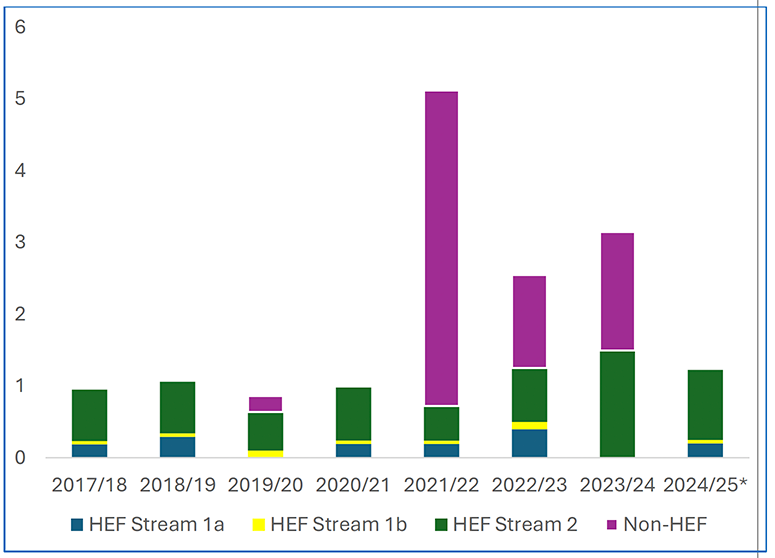
* As of December 2024 (including funding to Strathclyde University for Cyclone Idai response and funding to UNRWA)
Source: Authors’ analysis based on data provided by Scottish Government
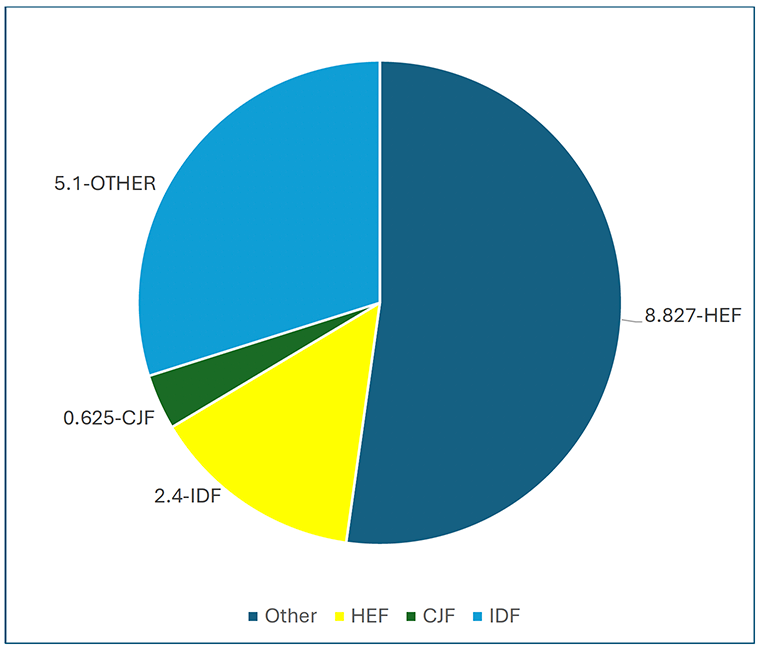
Source: Authors’ analysis based on data provided by Scottish Government
Funding was consistently channelled to several large crises and a wider range of other smaller crises (see Figure C). A review of allocations, excluding regional allocations that covered multiple countries and include some of the countries already listed, indicates that while Ukraine remains the largest recipient by funding allocation, Ethiopia received support with the highest number of projects.
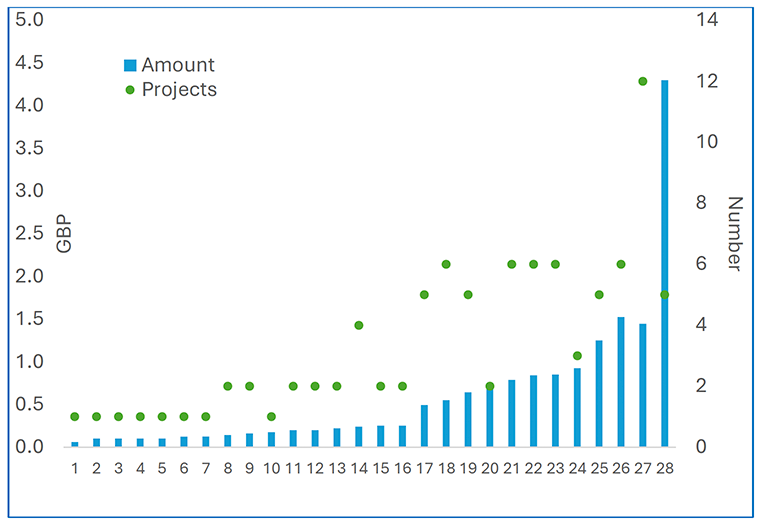
Note: Projects where funding was provided to more than one country have been covered under multiple countries
- Burma
- India
- Nepal
- Niger
- Yemen
- Burkino Faso
- Chad
- Somalia
- Bangladesh
- Zimbabwe
- Mali
- Syria
- Columbia
- Indonesia
- Libya
- Sudan
- DRC
- Lebanon
- Kenya
- Gaza
- South Sudan
- Multiple countries
- Afghanistan
- Zambia
- Pakistan
- Malawi
- Ethiopia
- Ukraine
Source: Authors’ analysis based on data provided by Scottish Government
However, the value proposition for the funding provided through DEC following a DEC appeal remains unclear.[64] DEC launches appeals to raise emergency based on three criteria; one of which is existing or potential public awareness and support which improves the chances of raising a significant amount of funding. Since existing and potential public awareness is a pre-requisite for DEC appeals and guarantees successful fund raising that can support emergency funding in a humanitarian crisis, Scottish funding has relatively low additionality.
Innovation and transformational impact
The conditions explored above also shape the extent to which Scottish funding can or should demonstrate innovation and transformational impact. In discrete cases, HEF mechanisms can and do demonstrate innovative approaches. The example of the Loss and Damage pilot demonstrates this clearly.
Pioneering climate-responsive humanitarian action - HEF’s Loss and Damage investments
The Loss and Damage pilot under HEF was part of the Scottish Government’s commitment to climate justice. The test-and-learn approach in this pilot provided valuable lessons on the need for rapid, holistic, and medium-term interventions to address the full scale of climate-related losses. Additionally, the approach allowed local actors to build the understanding of L&D and its relevance on the ground.
The learnings drawn from HEF L&D projects have provided valuable insights for L&D responses and for the design and implementation of the Global Fund for Responding to Loss and Damage (FRLD). HEF panel members who implemented L&D projects under this activation produced a learning brief and contributed individually to discussions leading to and at COP29 on the design of the Global Fund. SCIAF shared learning from the project at a Caritas Internationalis side-event at COP29, co-hosted with Catholic Relief Services, CAFOD and Caritas Australia. OXFAM also produced an individual policy brief based on the experience in Kenya towards this end. The brief contained recommendations for the FRLD Boad, recipient countries of loss and damage funding, loss and damage finance provider countries and even international NGOs.
Some local partners who were involved in the delivery of HEF L&D funding and were interviewed as part of this review noted that HEF funding enabled them to build their understanding of L&D. Prior to participation in the project funded by HEF, L&D was a theoretical construct for them.
This model offers an example of how relatively small amounts of funding can be used to improve systems, generate evidence, leverage additional funds and pilot innovative approaches. In previous sections of the report, additional climate-related options have been identified, including potential support for humanitarian efforts to integrate climate risks into their programming wherever relevant.
Yet at the level of specific grants and their support for more traditional humanitarian activities – the bulk of HEF funding since 2017 – it is difficult to credit Scottish funds with driving innovation. To return to two case studies from this section: the response to the needs of South Sudanese refugees in Gambela was underfunded by over 40 percent at the time of the Scottish Governments’ initial HEF Stream 2 activation – approximately 1 million GBP. In Burkina Faso, the humanitarian needs plan in 2022 was estimated at USD 608 million, and was only 43% funded. In neither case are funds available from the Scottish Government likely to lead to innovation in the response itself: in both cases, innovation is far more likely to be found in support for systems strengthening, piloting approaches, and supporting specific actors to scale up capacity.
Contact
Email: ceu@gov.scot