
Humanitarian funding review: our future response to global humanitarian crises
This publication is an independent, external review of the Scottish Government’s humanitarian funding, assessing the Humanitarian Emergency Fund and wider mechanisms. It examines challenges, global trends, and ways to strengthen impact, localisation, feminist approaches, and future funding models.
4. Findings from the Review – HEF Objectives
This section of the review responds to the following framing questions:
(A) How can the objectives and scope of Scottish Government humanitarian funding be refined to better reflect the budget available and the operating context?
(D) To what extent are current mechanisms meeting or contributing to Scottish Government Humanitarian Funding Objectives and International Development Principles?
The online survey for HEF panel members, a FGD and a series of KII’s were the main sources for this section.
The primary objective of the HEF[20] (as the main delivery mechanism of Scottish Government humanitarian funding) remains relevant and was well supported by those consulted, including organizations with a direct stake in the HEF - panel members and local delivery partners - as well as those based elsewhere and without direct experience of how it works. There is an opportunity to integrate messaging from some of the Scottish Government priorities – i.e. the primary objective of the HEF is ‘to provide immediate and effective assistance to reduce the threat to life and wellbeing for a large number of a population faced with a humanitarian emergency - maximising opportunities for Shifting Power South’.
Stakeholders were less confident on HEF secondary aims - that the HEF leads to greater public awareness in Scotland, demonstrates Scottish Government’s role as a responsible global citizens or helps raise additional fundraising – it is clear that HEF panel members use HEF activations to communicate with their members and the public and many panel members cited community level engagement with members[21]. However, it is difficult to measure the impact of this engagement and any links to fundraising. There was broad agreement that the HEF brings transparency and predictability to emergency funding - with some caveats around how much Scottish Government intends to channel through the HEF versus taking decisions and awarding funding out with the HEF.
On wider considerations (not explicit objectives of the HEF) stakeholders were not confident that the HEF is a vehicle to recognise Scottish expertise.[22] Most HEF panel members cited examples of using HEF funding to promote the value of humanitarian work in Scotland - these were not normally specific to raising awareness of hidden crises per se.
Wider review queries relating to the Scottish Government’s Feminist Approach to International Relations (FAIR) and International Development Principles, and the commitments to shifting power south and localisation that derive from them, are explored in more detail below. The review team was also asked to consider options around broadening the focus from immediate response to anticipatory action and/or longer-term resilience and recovery and supporting locally led humanitarian action. These are also explored below.
Key findings
The review team advise that the primary objective of the HEF should remain and be amended to include the opportunity using funds to Shift Power South, i.e. ‘to provide immediate and effective assistance to reduce the threat to life and wellbeing for a large number of a population faced with a humanitarian emergency - maximising opportunities for Shifting Power South’.
Secondary aims are not well evidenced and should not be given equal prioritisation communications about the objectives of the HEF. Selected secondary aims are better considered as ‘co-benefits’ – contributing to increased public awareness and fundraising.
Language around using the HEF to recognise Scottish expertise should be dropped. The HEF should not be broadened to anticipatory action and/or longer-term resilience and recovery.
There is strong alignment between Scottish Government commitments and HEF panel members on Shifting Power South and the Scottish Government International Development principles.
4.1. HEF panel members alignment with Scottish Government International Development Principles
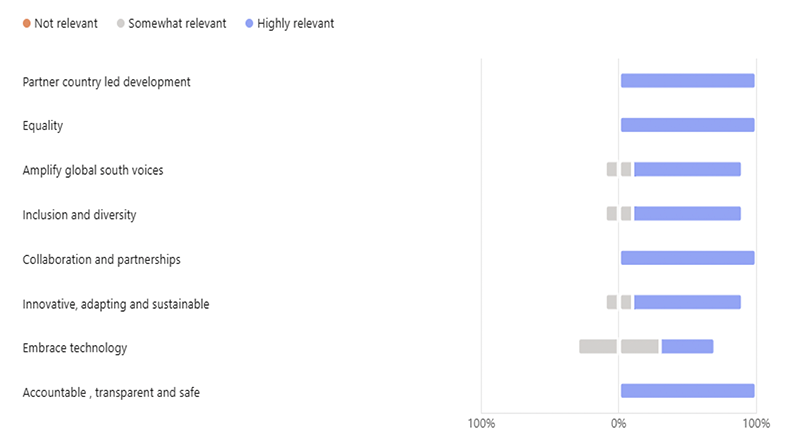
Five of the eight organisations submitted online survey responses (Figure 1) which show strong alignment to the Scottish Government International Development Principles with the exception of ‘embrace technology’.[23] Respondents shared rich examples of their alignment to climate justice.
Key findings
There is strong alignment between Scottish Government commitments and HEF panel members on Shifting Power South and the Scottish Government International Development principles.
4.2 Building public awareness
HEF panel members were clear in their views that it was very important to influence the Scottish public but that was difficult for them to achieve through the HEF (see Section 5.4 for more details on the communications aspects of the HEF).
Scottish public engagement on global poverty and development[24]
Scottish Public Attitudes & Opinion – January 2025
- 78% think the world is getting worse, all things considered.
- 42% think what happens in developing countries affects them too.
- 54% are concerned or very concerned about levels of poverty in poor countries.
- 46% think that we should give some aid, or give it generously.
- 21% think development aid is effective or very effective.
- 31% say they have some or a great deal of trust in NGOs and charities.
Question listed in each box. Data weighted to be nationally representative. Fieldwork by YouGov, 19–30 January 2025. Comparison to October 2023.
National polls led by the Development Engagement Lab show that support for aid in Scotland, in parallel with the rest of the UK, has been on a downward trend. In June 2022 support was measured at 63% (think we should keep or increase the current aid budget in the UK) – in January 2025 this fell to 47%.[25] Researchers note that domestic issues (economic downturns) and international issues (war, conflict) are front and centre of the public’s minds. The public also note a low degree of trust in the effectiveness of aid. The Scottish public appear to be positively influenced by concern for global poverty and a desire to meet basic needs in developing countries – the values of fairness, justice and equality resonate well – which align strongly to the Scottish Government International Development Principles.
“Scottish public support for ODA is on a downward trend, and engagement with global poverty & development is low… the Scottish public needs convincing that aid works and delivers” (Soomin Oh)25
HEF panel survey respondents and FGD participants recognised the importance of building public awareness in Scotland. Many noted the challenges involved in influencing the public and getting media attention, ‘due to lack of funding, time and support and it would be good to explore how the Scottish Government can support efforts in this area financially, through their communication channels and using their power to convene’ (survey respondent). Whilst welcoming the Scottish Government support for hidden crisis, informants noted that getting media attention for these was even more challenging.
One survey respondent noted that ‘the amounts of funding are low versus the level of effort expected both in terms of reporting, and communications outputs which also makes this a challenge…..I would suggest that a separate chunk of the funding would be better placed focussing on a combined campaign that organisations could put their weight behind as opposed to the communications expectations for each individual grant which are really challenging to deliver on, and as a result are rarely impactful.’ Another respondent suggested the creation of a HEF ‘brand’ which they could all support.
One stakeholder suggested that the Scottish Government move away from considering ‘humanitarian spending’ communications with the public – noting that the public doesn’t always know the difference between humanitarian and longer-term development work. Instead, they felt that stronger messages could be formulated around Scottish Government as a ‘nifty’ actor, responding to those in need across the world.
4.3 Shifting Power South- Localisation
Scottish Government has committed to shifting power south. It has ambitions to become a signatory to the Grand Bargain[26] which means it would sign up to a target of 25% humanitarian funding to local and national actors.[27],[28] The Grand Bargain speaks of "as local as possible, and as international as necessary” - this is an overarching principle. Multilateral institutions have and will always position themselves as key to localisation, and this is in some ways true: substantial funds will continue to flow through international and multilateral institutions. Their commitments to direct a greater proportion of those funds to local actors is an important part of the equation. But providing funds that flow in this way is not contributing to localisation per se, or in a systemic way. It is merely using existing channels that may become, over time, more localised.
The Red Cross Movement is an interesting example of these dynamics. The movement has at times argued that it is a model of localisation through its national red cross and red crescent societies, located in each country. Critical voices inside and outside the Movement push back on this, saying that providing funds through the Movement is difficult to describe as contributing to the localisation agenda because it maintains existing structures of power and directionality.
Despite widespread enthusiasm for more locally led ways of working, progress has been slow and significant barriers remain (ODI, 2024)
The humanitarian sector has been evolving in the last decade to a range of drivers around localisation and the decolonisation of aid (among many other drivers).[29] Many of the HEF panel members have made significant changes to their governance and funding structures to align with and further these ambitions. Localisation in particular is of significant interest, and debate about how best it can be meaningfully improved – alongside the role of the legitimacy and mandate of ‘global north’ based INGOs, many of whom are transitioning to ‘intermediaries’. The role of intermediary can go beyond being a funding conduit and include a much wider set of functions.[30] See Annex A Discourses on Localisation for further details and literature review. Briefly, the term localisation is used interchangeably with ‘locally led action’ and these are not the same.
Localisation focuses on reforming the international aid system by shifting power dynamics and making partnerships more equitable. While it can push for deeper structural change, it remains shaped by the priorities and political will of international and Minority World actors. Locally led action (Box 1) centres on directly resourcing and scaling initiatives driven by local actors, often outside of international aid structures. These approaches aren't mutually exclusive, but they require different strategies and carry distinct transformative potential. The current evidence on localisation is growing but remains fragmented and insufficient to guide systemic change.
Box 1: What donor collaboration on locally led action could look like?
The Scottish Government ambition on localisation is to be focused on pushing boundaries for the sector (and system) as a whole, identifying and understanding challenges and seeking to find innovative ways to overcome them. That way, Scottish Government has the potential for wider indirect impacts across the sector, beyond direct funding and taking a leadership role in spaces where it is gaining traction.
Focus on country level - The value of country-level pilots is that they focus attention and effort closer to where the impacts of new ways of working can be better observed, thus allowing for stronger feedback loops on good practices and their effects.
Streamline risk management approaches - opt for more collaborative models, for example exploring alignment across their requirements, or harmonising their requirements around a pooled fund or national network’s existing due diligence systems
Collectively incentivise better practices among international partners
Collaborate on joint risk assessments or preventative risk mitigation activities and learning about barriers and good practices
Source: Desk research and discussions with ALNAP
One HEF panel member shared this interpretation of partner country-led development:
‘[Our organisation] has local country offices, staffed by local staff in the countries where it works. Our Country strategies are developed by local staff and partners and are in alignment with the country’s development priorities…We work with local partners to effectively ensure local ownership and meaningful participation for communities to recover from emergencies, build resilience and see and work towards an end to poverty. We work with our partners to develop, adapt, strengthen, and pilot innovative evidence-based intervention models to tackle root causes of poverty, inequality, injustice; and to sustainably address harmful practices and behaviours which perpetuate inequalities and poverty at all levels of our societies’ (anonymised).
Key findings
There is significant support among HEF panel members, the broader sector, and other donors, that localisation is an important and potentially transformational workstream.
At the scale of Scottish Government support, contributions towards the agenda are more likely to be meaningful when they are targeted at developing the evidence for localisation’s benefits or supporting specific structures and/or capacities that can be used by local actors to increase their capacity in a given context. Providing funds in a manner that privileges localisation is not a bad thing – but the scale of funding is unlikely to shift or influence the extent of localisation in a given response.
4.4 Anticipatory Action and Resilience Building
The review team were asked to consider whether Scottish Government should broaden the focus of humanitarian support to include anticipatory action and resilience building. Whilst most HEF panel members are also delivering anticipatory action and resilience programming, there is widely held view that the HEF is not designed to deliver on these objectives and the amount of funding available would not merit expansion of the HEF – ‘Anticipatory action and longer-term resilience and recovery are vital and are areas our organisation actively works on as part of the humanitarian development-peacebuilding nexus. The HEF has a strong foundation in providing immediate assistance during acute crises but current HEF funding systems, processes and finance are not designed to cover both immediate and effective assistance as well as longer-term resilience and recovery so it would require a systematic review of the operational manual and processes to be effective’ (HEF panel survey respondent).
There may be opportunities to link humanitarian action with wider Scottish Government International Development funds, through partnerships with local organizations that do both. In Malawi, the Evangelical Association’s long relationship with Christian Aid, where it focuses mostly on resilience work and longer-term interventions, was the door through which it was able to receive HEF money for a one-off emergency assistance programme during 2024’s particularly acute lean year, tied to El Nino (KII). Work supported through Scottish Government contributions to the Fund for Responding to Loss and Damage shared early learning that the Fund can help build resilience, strengthen social cohesion, and support long-term recovery – to note this was not humanitarian funding.[31]
This does not mean that humanitarian support provided by the Scottish Government cannot meaningfully engage with efforts to address systemic risks – by building resilience – and responding to residual risks – through anticipatory action.
Since 2021 there has been significant work across the humanitarian sector to better factor climate risks into programming and to improve responses by contributing to adaptive capacity, filling gaps, and providing the foundation for longer term responses. Indeed, the climate mainstreaming objectives of current HEF panel members were noted as strong (Sect 5.1). Initiatives such as the Climate and Environment Charter for Humanitarian Organizations, launched by the IFRC and ICRC and signed by nearly 500 organizations and over 12 donors, is an example of one community of practice oriented towards improving humanitarian response in the context of climate change and longer-term risks. This doesn’t mean addressing climate change over emergency response, but rather on incorporating risks into programme design and implementation.
Key findings
The HEF is effective in providing assistance during acute crises, but it is not designed to support anticipatory action or longer-term resilience and recovery programming without substantial increased budget and a systematic review of its operational manual and processes.
4.5 Feminist Approaches
The review team was asked to consider how humanitarian funding could better align with wider aims and commitments including a Feminist Approach to International Relations (FAIR). The Scottish Government has adopted a range of principles towards FAIR[32] (Figure 3). These have not explicitly been adopted by the HEF at this stage, although many of the principles correlate with the various humanitarian standards the members adhere to (Table 2). Of the five HEF panel members who replied to the online survey[33], there was a mixed response to alignment with the FAIR principles:
- Two organisations interpreted the question at a superficial level - as a targeting issue. One cited that the humanitarian principles lead their organisation support those most affected by disasters – often women and children.
- Two described action at a more strategic level. They described their organisations gender policies and approach to intersectionality and challenging power imbalances – addressing the root causes of gender inequality.
- None shared examples of how this was being achieved in practice.
Defining a feminist approach for Scotland: our guiding principles
In line with international best practice, our stakeholder engagement and evidence review sought to define the parameters of a feminist approach to international relations in Scotland. This has informed the following set of core principles, which will guide the Scottish Government’s approach to international relations:
Transformative: We prioritise addressing the shared systemic barriers which drive inequality and insecurity. We collaborate and speak out in pursuit of innovative, progressive solutions.
Intersectional: We view inequality through an intersectional lens and understand the compounding impact of marginalisation and oppression.
Equitable: We commit to an equalising power agenda which seeks to be actively anti-racist and anti-colonial and we ensure reducing inequalities is central to how we work.
Participatory: We engage in participatory consultations at home and abroad and adopt accessible, collaborative approaches with civil society and women, girls and marginalised groups around the world.
Consistent: We ensure coherence between international, domestic, and local policies, integrating feminist principles across all aspects of our international policymaking.
Accountable: We promote transparency and accountability in Scotland and abroad in measuring both policy process and impact.
The Scottish Government International Development team takes a human-rights and a feminist approach to all their work[34] as well as supporting the Women and Girls Fund. The Women and Girls Fund was established under the Scottish Government International Development Funds Equalities Programme. It aims to promote gender empowerment through an intersectional approach in Malawi, Zambia, and Rwanda through a highly participative approach. The Women and Girls Fund has three objectives:
- Advancing gender equality and championing the rights of women and girls, particularly by empowering women’s rights organisations and movements.
- Establishing a highly participatory approach to design, monitor and evaluate the fund.
- Capturing insights and lessons from the participatory process.
The Fund is being implemented by a consortium between Ecorys UK and the Forum for Women Educationalists (FAWE) Chapters in Rwanda, Zambia and Malawi. The fund is in the early stages of delivery after a 9-month design phase which designed the fund with the participation of 65 women’s rights organisations. Early lessons include – co-design with women’s organisations has led to a strong sense of ownership over the fund with high levels of commitment to quality delivery. The team created criteria for the selection of organisations to support the design phase – ensuring that an appropriate cross-section of organisations was included. They also considered options for including unregistered organisations and options for partnerships so that all types of organisations would be included. As this funds moves into implementation and grant disbursement, there is strong potential for lesson learning across Scottish Government.
The review team hosted a FGD and a KII with four leading researchers and practitioners in this field (Annex B). The conversations were informed by a range of core references[35] including Megan Daigle’s published work and the Scottish Council on Global Affairs paper ‘Scotland the Brave? An Authentic, ambitious and accountable Feminist Foreign Policy note.
The former notes a discord between ‘neutral’ humanitarian mandates and the need to tackle the underlying system. All experts agreed that many donors and humanitarian actors conflate feminist approaches with gender sensitive or transformative approaches – without acknowledging that ‘a feminist approach should bring changes to the systems through which humanitarian assistance is delivered and should challenge its patriarchal nature’. The latter observes ‘If the Scottish Government is to develop an authentic feminist foreign policy, it needs to ensure that both domestic and international policies are pointing in the same direction, in a coherent way: towards peace, justice, equality, security and sustainability.’
"Feminism’s transformative ambition seemingly brings it into conflict with a narrowly interpreted humanitarian mandate that sees itself as neutral and needs-based – and this perceived tension will require open engagement to resolve." (Megan Daigle, Humanitarian Policy Group, ODI Global 2024)
One expert cautioned, ‘Just because an organisation is women-led, it doesn’t mean it’s taking a feminist approach’.
With the decline of ODA, there is a re-emergence of focussed attention on ‘needs’ but this doesn’t need to be instead of attention towards ‘rights’. The FGD experts felt that the Scottish Government could play a role in influencing other donors e.g. if they join the Grand Bargain, there is a community of practice on Gender, with the Scottish Government progressive stance in its FAIR and ID Principles, they could bring this work to a wider audience. The experts commended the Scottish Government approach to solidarity – not charity and suggested that funding opportunities be widened to actors based in the global South. They cited the Irish Government as a positive example of a country which is accounting for their history and using it as a platform for future engagement (with respect to decolonising aid).[36]
Should the Scottish Government wish to take a feminist approach to humanitarian funding, it would need to significantly alter the humanitarian systems and actors it supports. This would involve listening to and designing funding instruments based on the needs of movements, networks and organisations led by women, girls and gender-diverse people, indigenous groups, persons with disabilities, and refugee-led organisations . The review team recommends starting with a smaller, targeted fund to test and innovate options around feminist humanitarian action and funding practices[37]. This could position the Scottish Government as a thought shaper. [38]
Key findings
(Related to FAIR)
Whilst most HEF panel members deliver strong action on gender transformative approaches, none have adopted a feminist approach.
Experts recommend the Scottish Government innovate its humanitarian funding by creating targeted funds to support movements and organizations led by women, girls, gender-diverse people, Indigenous groups, persons with disabilities, and refugee-led organizations, with an aim to decolonize aid and further its approach to solidarity.
Contact
Email: ceu@gov.scot